
Cattle pellet making machinery in the Czech Republic was selected by an established feed producer in the Moravian region to replace an aging pelletizing unit that had become increasingly difficult to maintain. The customer already operated a complete raw material preparation and feed production system, including grinding, batching, mixing, conveying and cooling equipment, so the project did not require a new turnkey cattle feed line.
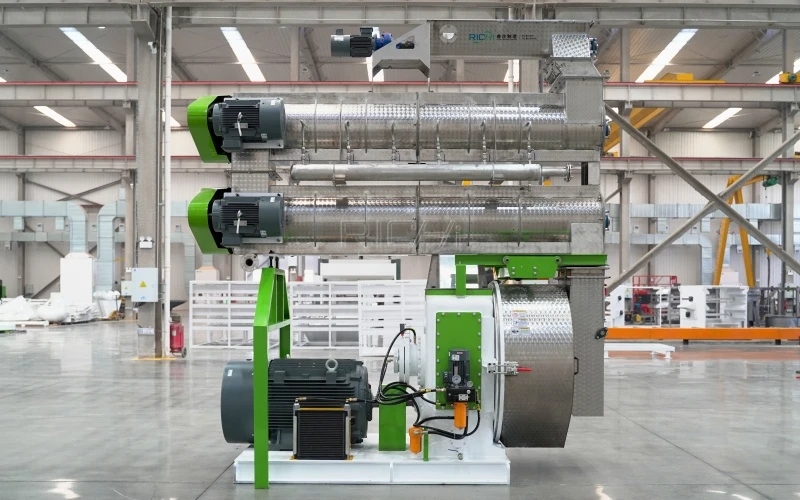
Cattle pellet making machinery in the Czech Republic was selected by an established feed producer in the Moravian region to replace an aging pelletizing unit that had become increasingly difficult to maintain. The customer already operated a complete raw material preparation and feed production system, including grinding, batching, mixing, conveying and cooling equipment, so the project did not require a new turnkey cattle feed production line.
The customer purchased one SZLH350 ring die feed pellet machine with a rated capacity of approximately 5–6 T/H under suitable formulation and operating conditions. The new machine became the core pelletizing unit for producing dairy and beef cattle feed pellets while allowing the mill to retain the upstream and downstream equipment that was still working effectively.
Name:
Cattle feed pellet press
Country:
Czech Republic
Date:
2025
Capacity:
5–6 T/H
Model:
SZLH350
Main Motor Power:
55 kW
Application:
Dairy and beef cattle feed pellets
Pellet diameter:
6-8 mm
The customer supplies compound cattle feed to dairy and beef farms in the Moravian region. Its plant had been operating for years, and most sections of the production process still matched current production requirements.
The main problem was the old pellet mill.
Maintenance frequency had increased, ring die and roller adjustment had become less predictable, and production interruptions were beginning to affect delivery schedules. More importantly, the customer was producing a wider range of cattle feed formulations than when the original machine had first been installed.
Some batches contained a relatively high proportion of cereal ingredients, while others incorporated more bran, oilseed meal and dry forage materials. These formulas did not behave identically during conditioning and pelletizing.
The old machine increasingly required operators to compensate for changing formulations through slower feeding or repeated adjustment. Instead of continuing to spend on repairs, the company decided to replace the bottleneck.
This is the main reason the customer invested in cattle pellet making machinery in the Czech Republic as a standalone upgrade rather than purchasing another complete feed production line.
RICHI first reviewed what equipment the customer already had.
The existing animal feed hammer mill could still prepare cereal grains and suitable dry forage ingredients at the required particle size. The batching and mixing system remained adequate for the planned output, and the cooler downstream of the pelletizer was still in good working condition.
Replacing those sections would have added capital expenditure without improving the customer's actual bottleneck.
The new SZLH350 feed pellet machine therefore needed to fit between the existing mixing and cooling stages.
For a retrofit project like this, machine selection involves more than matching T/H. Feed inlet height, discharge position, conditioner layout, motor power, steam connection, foundation, maintenance access and downstream cooler capacity all have to be considered before installation.
RICHI used these existing conditions to determine whether the new cattle feed pellet machine could be integrated without requiring unnecessary reconstruction of the workshop.
The plant produces several cattle feed products rather than one fixed formula.
Typical energy ingredients include wheat, barley and corn, selected according to availability, nutrient requirements and market price. Bran and other cereal processing by-products may also be included in appropriate formulations.
Protein sources can include suitable oilseed meals, while dry alfalfa meal or other prepared forage ingredients may be incorporated when the formulation requires more fibrous material.
Vitamin and mineral premixes are added at controlled inclusion rates according to the feed specification.
The earlier version of this project used a fixed formula of 65% cereals, 25% forage, 5% bran or oilseed meal and 5% premix. That type of ratio should not be treated as a standard Czech cattle feed formula.
Dairy cattle, growing cattle and beef finishing animals can have very different nutrient requirements. Ingredient analysis, energy density, protein target, fiber level and the rest of the feeding program all influence formulation.
For equipment selection, RICHI therefore focused on the physical properties of the feed mash rather than one artificial recipe.
The customer required a commercial pelletizer that could handle approximately 5–6 T/H without creating a large capacity mismatch with the existing mixer and cooler.
| Project Item | Specification |
|---|---|
| Equipment | Cattle feed pellet making machine |
| Model | SZLH350 |
| Quantity | 1 unit |
| Main Motor Power | 55 kW |
| Feeder Motor Power | 1.5 kW |
| Conditioner Motor Power | 4 kW |
| Ring Die Inner Diameter | 350 mm |
| Available Pellet Diameter | 2–12 mm |
| Project Pellet Diameter | Approximately 6–8 mm |
| Rated Capacity | Approximately 5–6 T/H under suitable conditions |
| Main Application | Dairy and beef cattle feed pellets |
The SZLH350 feed pellet mill provided enough capacity for the customer's current production plan without moving unnecessarily into a larger machine class.
Actual output still changes with formulation, fiber content, moisture, die specification, conditioning and required pellet quality. A grain-rich cattle feed and a higher-fiber formula should not automatically be expected to produce exactly the same T/H.
The conditioner is an important part of the SZLH350 configuration.
After grinding and mixing, feed mash enters the conditioner before reaching the ring die. Steam can be introduced according to the formulation and process requirements, helping adjust temperature and moisture before compression.
This improves the physical condition of the mash for pellet formation.
The settings are not fixed for every cattle feed.
A formulation containing more cereals may respond differently from one containing a larger amount of fibrous material. The operator therefore needs to coordinate steam addition, feed rate and pellet mill load according to actual production conditions.
This is one reason an industrial cattle pelletizer cannot be judged only by motor power.
The customer selected approximately 6–8 mm as the principal specification for its adult cattle feed products.
This provides a practical pellet size for the plant's main dairy and beef customers, but diameter itself is not a guarantee of better feed performance.
Pellet durability, fines, formulation, conditioning and how the feed is incorporated into the complete ration remain important.
The SZLH350 animal feed pellet machine can use another ring die specification if a customer order requires a different diameter within its applicable range.
However, this feed mill prefers to standardize its main cattle products instead of changing ring dies frequently for small orders.
This is another important consideration for customers evaluating cattle pellet making machinery in the Czech Republic.
Whole grains and long forage materials should not enter the SZLH350 directly.
The existing hammer mill reduces suitable raw materials to the required particle size first. Ingredients are then dosed and mixed according to the formula.
The pelletizer receives prepared feed mash.
If the grinding section produces an excessively coarse or inconsistent material, pellet formation can become less stable. If mixing is poor, the pellet mill cannot correct uneven nutrient distribution later in the process.
This is why RICHI evaluated the new machine as part of the customer's existing production system rather than treating it as an isolated piece of equipment.
A rated pellet mill capacity does not define the capacity of the complete feed plant.
If the existing hammer mill can prepare only 4 T/H, installing a 6 T/H pelletizer will not create a 6 T/H line.
The same problem can occur after pelletizing.
If the cooler or conveying system cannot accept the pellet output continuously, the new machine will simply transfer the bottleneck to another stage.
Before confirming the SZLH350, RICHI therefore reviewed the capacity of the customer's grinding, mixing and cooling sections.
This type of capacity balance is especially important in replacement projects because new equipment has to work around machines with fixed dimensions and existing performance limits.
The main objective was not to claim a dramatic percentage reduction in energy consumption.
The customer wanted a more predictable pelletizing stage.
With the old machine, production planning was increasingly affected by unscheduled maintenance and inconsistent operating conditions. The replacement SZLH350 gave the plant a new platform for controlling feeding, conditioning and pellet formation more systematically.
The customer could also establish a clearer maintenance program.
Ring dies and rollers are still wear parts. Replacing the machine does not eliminate maintenance. What changes is that inspection and replacement can be planned according to normal machine operation instead of continuously responding to problems caused by an aging pelletizer.
Cattle feed can contain more fibrous material than many poultry feed formulations.
This affects both feeding and compression inside the ring die pellet mill.
Higher levels of dry forage ingredients can change bulk density and increase resistance through the die. This can affect machine load, pellet durability and throughput.
For that reason, the customer does not assume one die compression condition will be perfect for every formula.
When a feed mill contacts RICHI about cattle pellet making machinery in the Czech Republic, the approximate percentage and type of fibrous ingredients are useful selection information.
Prepared feed mash from the existing mixer enters the new feeding and conditioning section.
After conditioning, the material passes into the pelletizing chamber, where rollers compress it through the ring die openings.
The newly formed pellets leave the machine warm and continue into the customer's existing cooler.
Cooling allows pellet temperature and moisture to stabilize before screening, storage or packaging.
This arrangement means the SZLH350 cattle feed pellet making machine replaced only one process stage while the rest of the original line continued to operate.
For the customer, this reduced both project complexity and unnecessary equipment expenditure.
The SZLH350 was shipped by sea from Qingdao Port in China to a suitable European seaport for a Czech Republic-bound industrial shipment.
Because the Czech Republic is landlocked, the most appropriate arrival port depends on ocean freight schedules, inland transport cost and the final plant location rather than one fixed port being correct for every project.
Before shipment, RICHI provided machine dimensions, foundation information, electrical requirements and interface drawings.
These details allowed the customer to prepare the existing pelletizing area before the machine arrived.
The initial commissioning period focused on adapting the new pelletizer to the customer's existing formulas rather than simply operating at maximum feed rate from the first day.
Operators compared machine load, conditioning response and pellet appearance across different cattle feed batches.
Higher-fiber formulations needed different operating attention from grain-dominant products.
Once suitable production settings had been established, switching between standard formulas became easier to organize.
The plant also incorporated feeder, conditioner, ring die and roller inspection into its normal preventive maintenance schedule.
The value of this project did not come from selling the customer the largest possible equipment package.
RICHI worked around an existing feed mill.
The technical discussion included formulation characteristics, required T/H, pellet diameter, existing mixer capacity, cooler capacity, installation dimensions and utility conditions.
This allowed the customer to replace only the equipment that was actually limiting production.
For an established feed company, that approach can be more valuable than being offered another complete line when most of the original investment still has useful operating life.
This cattle pellet making machinery in the Czech Republic project is particularly relevant to feed manufacturers that already have functional grinding, batching, mixing and cooling equipment but need to replace or upgrade the pelletizing stage.
A standalone SZLH350 may be appropriate when the existing process can continuously support approximately 5–6 T/H and the formulas are suitable for this machine class.
A smaller mill may be more economical for a plant producing much less feed.
A larger feed manufacturer may require a higher-capacity pelletizer or multiple units.
The correct model depends on the surrounding factory rather than only the desired pellet machine nameplate output.
The SZLH350 was selected for this Moravian customer because it matched the capacity and layout of an established cattle feed plant whose existing pelletizer had become the main production bottleneck.
For another customer, RICHI Machinery first needs to understand the actual production conditions.
Useful information includes the main cattle feed ingredients, approximate percentage of fibrous materials, required pellet diameter, target T/H, daily operating hours and existing hammer mill, mixer machine and cooler capacities.
For a replacement project, information about the old pellet machine is especially valuable. Customers can provide its model, dimensions, motor power, conditioner arrangement, feed inlet and discharge heights, as well as photos or drawings of the installation area.
RICHI Machinery can then determine whether the SZLH350 used in this cattle pellet making machinery in the Czech Republic project is suitable, whether another model would integrate more easily, or whether capacity limitations elsewhere in the line should be addressed first.
The purpose of the upgrade is not simply to install a newer pellet mill. It is to remove the actual bottleneck, preserve the useful equipment already in the plant and give the customer a pelletizing section that matches the feed formulas and production volume the business is really handling.
Having the right mix of reliable, high-quality pellet machine and pelletizing systems and expert support is essential to your success. Watch how our end-to-end feed pellet plant solutions have helped our customers optimize their performance.
Our customized and future-proofed turnkey pellet plant solutions is designed with you at the core. From vision to reality and beyond, our team stays connected with yours. Giving you peace-of-mind with an expert at your side.
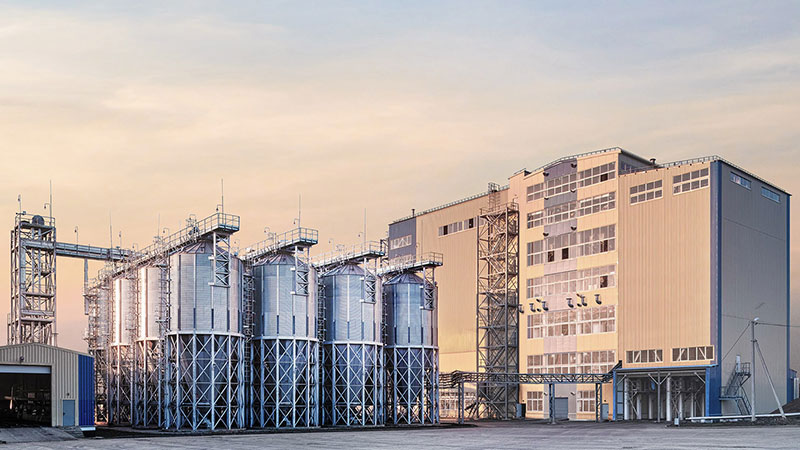
At RICHI, we go beyond project completion. With RICHI Servicee, we’re your dedicated partners in success. Count on us for expert guidance, minimal downtime, and optimized productivity. Choose RICHI for unmatched service and support.
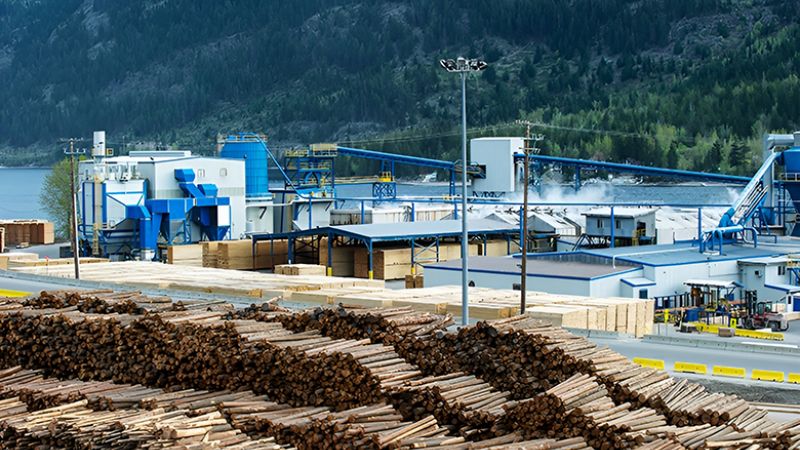


Meet global product demands and quality standards with industry-leading pellet plant design, engineering, equipment, and construction services for pellet processors.

Your Partner Beyond Project Completion
2000+ cases
RICHI is the leading designer, manufacturer and builder of pellet plants in the world, completing over 2000 projects in 140 countries across 6 continents.
Read More
Increase plant productivity, profitability, and safety by integrating high quality equipment into your pellet production line. Over the years, RICHI has become China's top pellet equipment manufacturer. At the same time, RICHI has established valuable partnerships with the world's leading component and raw material manufacturers to bring you the best there is in technology, automation, and efficiency in pelleting plant machinery.

For nearly 30 years, RICHI has been providing best-in-class pellet plant equipment and services to clients across a variety of industries, sizes, and needs. We pride ourselves on the knowledge and skill that each team member possesses – from our technical sales team to our process design engineers. You can count on RICHI Machinery to take your operation to the next level of innovation, quality, and success.
Need help with your pellet manufacturing plant project? Contact us today.
ANIMAL FEED
BIOMASS
WOOD
ORGANIC FERTILIZER
AQUA FEED
CAT LITTER
MUNICIPAL WASTE RECYCLING
SPECIAL PELLET PRODUCTION
RICHI Machinery continues to deliver world class pellet mill equipment, pellet plant engineering and project solutions that add value to our customers in the animal feed, wood waste, agriculture waste, organic fertilizer, cat litter and special pellet products industries. Throughout the years, we RICHI Machinery have built strong brand, becoming industry-leading pellet machine manufacturer. We value integrity, promise quality, and prioritize your success.
Learn MoreWith our expert team, we precisely implement your process engineering requirements in pellet mill and pelletizing plant systems. No matter which industry you’re in – we understand your needs and deliver solutions that meet the highest standards.
At RICHI, quality comes first. Our pellet making machine and related pellet line equipment undergo rigorous quality controls to ensure they meet the highest standards. Rely on products that are durable, safe, and efficient.
With decades of experience in pellet machine and pellet production line production, we have earned a reputation as a trusted partner in various industries. Our expertise allows us to cover a wide range of applications.
Not only do we offer premium pelleting equipment, but we are also experts at designing, building, installing, and maintaining facilities from the ground up. Our expertise is within pellt plant process design, discovering the most efficient, productive, and profitable way to handle your materials in an end-to-end cycle.
○ RICHI MACHINERY
Keeping in touch with us is an effective way to solve all your problems. If you have any needs or questions, please leave your contact information, then RICHI technical consultants will send design, quotation, videos to your mailbox. You can also contact us directly via WhatsApp: +86 13838389622
Copyright©2015-2026 by HENAN RICHI MACHINERY CO., LTD. All rights reserved.