
A commercial biomass fuel producer in the United States added one RICHI SKLF20×20 wood pellet cooler to an existing wood pellet production line operating at approximately 10 T/H. The plant already had wood receiving, size reduction, drying, fine grinding, pelletizing, screening and packaging equipment, but its existing cooling section had become a constraint as pellet production increased.
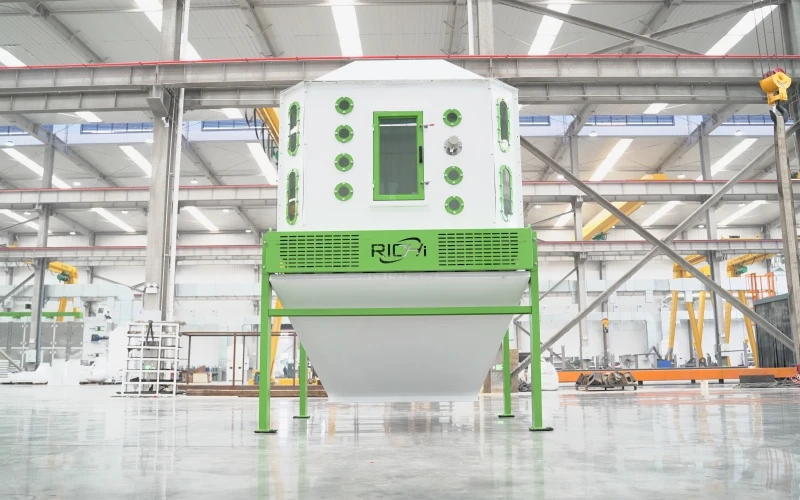
A commercial biomass fuel producer in the United States added one RICHI SKLF20×20 wood pellet cooler to an existing wood pellet production line operating at approximately 10 T/H. The plant already had wood receiving, size reduction, drying, fine grinding, pelletizing, screening and packaging equipment, but its existing cooling section had become a constraint as pellet production increased.
The customer did not need another complete wood pellet plant. The requirement was much more specific: receive hot pellets continuously from the wood pellet mills, remove sensible heat and part of the moisture added or redistributed during pelletizing, and deliver a more stable product to the downstream screening and storage system. With a reference capacity of approximately 8–13 T/H, the SKLF20×20 matched the operating range of this production section.
Name:
Counterflow wood pellet cooler
Country:
United States
Date:
2026
Capacity:
10 T/H
Model:
SKLF20×20
Discharge Motor:
1.5 kW
Main Material:
Wood fuel pellets
Typical Pellet Diameter :
6–8 mm
Wood pellets leave the ring die hot.
During pelletizing, prepared wood fibre is compressed through the die under substantial mechanical pressure. Friction and compression generate heat, while the material condition entering the pellet mill also influences the temperature and moisture of the discharged pellets.
Fresh pellets are therefore not normally ready for immediate storage or packaging.
They are relatively hot and have not yet reached the stable physical condition expected from finished fuel pellets. Sending them directly into enclosed storage or sealed bags can create product-handling and moisture-management problems.
The US customer had already increased the effective output of its pelletizing section to around 10 T/H. The main pellet mills could support the production target, but cooling had to keep pace with the higher mass flow.
That made the cooler a line-balance issue.
A wood pellet line is only as productive as its limiting section. Installing enough pellet-mill capacity for 10 T/H has little value if the cooler can reliably process only 6 T/H.
For this project, RICHI therefore reviewed the pellet flow after pelletizing rather than proposing another pellet mill or a complete line replacement.
| Project Parameter | Configuration |
|---|---|
| Equipment | Counterflow pellet cooler |
| Model | SKLF20×20 |
| Reference Capacity | Approximately 8–13 T/H |
| Discharge Motor | 1.5 kW |
| Production Section | Approximately 10 T/H |
| Main Material | Wood fuel pellets |
| Typical Pellet Diameter | Approximately 6–8 mm according to customer product specification |
| Installation Position | After pelletizing and before final screening/storage or packaging |
| Project Type | Existing wood pellet line cooling-section upgrade |
The 8–13 T/H reference range gives the SKLF20×20 an appropriate capacity relationship with a wood pellet section operating around 10 T/H.
However, cooler selection should not be based on tonnes per hour alone.
Pellet diameter, bulk density, pellet-mill discharge temperature, moisture, ambient air conditions, airflow, static pressure and bed depth all influence actual cooling performance.
A 10 T/H flow of dense 8 mm pellets and a 10 T/H flow of lighter or smaller pellets do not necessarily create identical volumetric and airflow requirements.
RICHI therefore uses rated capacity as the first selection step and then verifies the real pellet conditions before confirming the cooler configuration.
The SKLF20×20 uses counterflow cooling: hot pellets move downward through the cooling chamber while ambient cooling air moves upward through the pellet bed.
This arrangement creates progressive heat exchange.
Cool incoming air first contacts pellets closer to the discharge end. As the air moves upward and warms, it contacts progressively hotter material nearer the inlet.
The process avoids exposing the hottest freshly produced pellets immediately to the coldest air in the system.
For a commercial wood pellet plant, the operating sequence can be summarized as:
The objective is not to make the pellets as cold as possible.
The objective is to remove enough heat for stable downstream handling while maintaining the moisture and physical characteristics required by the customer’s fuel-pellet specification.
For counterflow pellet cooling, an outlet temperature several degrees above ambient can be a useful design or commissioning target under suitable conditions.
RICHI may use approximately ambient +3–5°C as a reference when evaluating a wood pellet cooler, but the actual result depends on the complete operating environment.
A cooler does not create refrigeration.
It uses ambient air, so seasonal conditions directly affect achievable pellet temperature.
During a cool US winter, incoming air can have substantially more cooling potential than during a hot summer afternoon. Relative humidity also changes the relationship between heat removal and pellet moisture.
The important operating variables include inlet pellet temperature, inlet pellet moisture, ambient temperature, ambient humidity, pellet bulk density, pellet diameter, bed depth, airflow and residence behavior.
This is why RICHI does not specify that every SKLF20×20 will always discharge pellets at exactly 25°C, 28°C or another fixed temperature.
Operators instead establish a stable operating window during commissioning and adjust the cooler according to seasonal plant conditions.
Cooling performs more than one function in a wood pellet production line.
The first is sensible heat removal.
Hot pellets leaving the pellet mill need to lose heat before entering storage, packaging or other downstream equipment.
The second is moisture management.
Cooling air can remove part of the moisture associated with the hot pellet stream. The exact change depends on inlet conditions and air properties, so the cooler should not be treated as a substitute for the raw-material dryer.
The main rotary dryer and the pellet cooler have fundamentally different jobs.
Before pelletizing, the dryer controls the moisture of wood chips, sawdust or other biomass so the material can be ground and pelletized effectively.
After pelletizing, the cooler stabilizes the hot formed pellets.
Cooling also contributes to the physical stabilization of pellets after they leave the die. The product is then better prepared for screening and subsequent mechanical handling.
Final fines content, however, depends on the complete process.
Raw-material particle size, moisture, pellet-mill settings, die condition, cooling, conveying and screening all influence the amount of broken material reaching storage.
A cooler alone therefore cannot guarantee a specific fines percentage or Pellet Durability Index.
The US wood pellet plant can process different clean woody feedstocks depending on regional supply.
Typical inputs may include sawdust, planer shavings, clean wood chips and other uncontaminated solid-wood residues after appropriate preprocessing.
These materials can behave differently during drying, grinding and pelletizing.
Softwood and hardwood fractions may produce pellets with different bulk density and physical characteristics. Particle-size distribution, moisture and die configuration can also change pellet behavior.
The cooler therefore receives the result of all those upstream variables.
If the plant changes from one major raw-material mix to another, operators should observe whether pellet bulk density, inlet temperature, fines and cooling response change rather than assuming the previous setting remains optimal.
Clean raw-material control is also essential for fuel production.
Painted wood, chemically treated timber, MDF, particleboard and other engineered or contaminated materials should not be casually mixed into a clean wood fuel-pellet stream.
The cooler cannot correct contamination introduced upstream.
Adding a wood pellet cooler to an operating factory requires more engineering than placing the machine between two conveyors.
RICHI first checks the elevation and discharge arrangement of the pelletizing section.
Hot pellets need to reach the cooler inlet without excessive breakage or uncontrolled accumulation. At the bottom of the cooler, the discharge elevation must connect with the existing screener or transfer equipment.
Available building height can therefore be a critical retrofit constraint.
The support structure and foundation must be designed around the actual equipment load and plant layout rather than using one universal concrete thickness.
The aspiration system also requires engineering attention.
Cooling performance depends on moving the required volume of air through a pellet bed with real resistance. Fan selection therefore needs to consider both airflow and static pressure.
Duct routing, cyclone or dust separation where required, exhaust location and maintenance access also affect the final installation.
The customer’s existing screen was retained because it could handle the upgraded production rate. After cooling, pellets pass through screening to remove loose fines before finished product enters storage or packaging.
Reusing adequate existing equipment keeps the retrofit focused on the actual bottleneck rather than replacing functioning parts of the plant.
A wood pellet cooler in the United States may operate across a wide range of seasonal conditions depending on plant location.
The cooling system therefore needs enough operating flexibility to deal with changes in ambient temperature and humidity.
During cooler weather, the air has greater sensible cooling potential. Excessive airflow or unnecessarily long exposure may not provide additional product value and can affect final moisture.
During hot weather, the temperature difference between ambient air and hot pellets is smaller, so airflow and bed management become particularly important.
Humidity matters as well.
Operators should therefore monitor actual inlet and outlet conditions rather than using one year-round discharge setting.
Useful commissioning and production data include ambient temperature and humidity, pellet-mill discharge temperature, cooler outlet temperature, inlet and outlet moisture, bed level, fan operating condition, throughput and screened fines.
Tracking these values helps the plant distinguish a cooler adjustment problem from changes caused by raw material or wood biomass pellet mill operation.
This Wood Pellet Cooler in United States project uses one RICHI SKLF20×20 counterflow cooler to support an approximately 10 T/H commercial biomass pellet production section.
The machine has a reference capacity of approximately 8–13 T/H and a 1.5 kW discharge motor, making it a suitable capacity class for the customer’s existing line.
The customer retained its wood preparation, drying, grinding, pelletizing, screening and finished-product handling equipment. RICHI focused the retrofit on cooling capacity and the mechanical and airflow interfaces around the SKLF20×20.
This approach is particularly useful for established pellet plants.
A customer searching for a wood pellet cooler in United States, wood pellet cooling machine, biomass pellet cooler, counterflow pellet cooler, 10 T/H pellet cooler or wood pellet plant cooling system may not need another complete biomass pellet production line.
The first step is to identify whether cooling is actually limiting production or finished-product stability.
RICHI therefore asks for the actual pellet-mill output, pellet diameter, pellet bulk density, pellet temperature entering the cooler, moisture before and after cooling, ambient summer and winter conditions, existing fan and dust-control information, installation height and downstream screen capacity.
If the plant is currently expanding from 6 T/H toward 10 T/H, these data also help determine whether the SKLF20×20 has sufficient margin or whether a larger cooler should be evaluated.
The same principle applies to a new wood pellet production line. Cooler capacity should be balanced with pellet-mill capacity rather than selected independently.
For example, installing 12 T/H of pellet-mill capacity ahead of a cooling section that can only sustain 8 T/H simply transfers the production bottleneck downstream.
RICHI Machinery can review the complete material balance from pellet-mill discharge through cooling, screening and finished-pellet handling before confirming the model.
For an existing US wood pellet plant, send RICHI your hourly pellet output, pellet diameter, inlet temperature, pellet moisture, raw wood type, bulk density if available, local ambient conditions, available installation height and the equipment immediately before and after the cooler. These parameters provide a much stronger basis for selecting a wood pellet cooler than nominal tonnes per hour alone.
Having the right mix of reliable, high-quality pellet machine and pelletizing systems and expert support is essential to your success. Watch how our end-to-end feed pellet plant solutions have helped our customers optimize their performance.
Our customized and future-proofed turnkey pellet plant solutions is designed with you at the core. From vision to reality and beyond, our team stays connected with yours. Giving you peace-of-mind with an expert at your side.
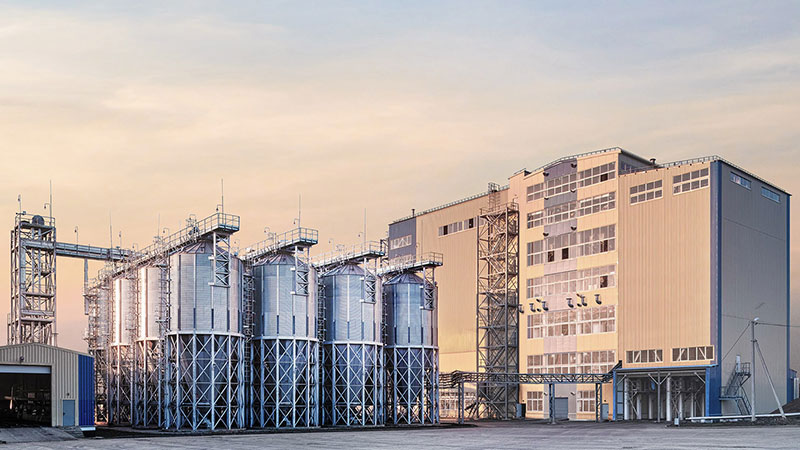
At RICHI, we go beyond project completion. With RICHI Servicee, we’re your dedicated partners in success. Count on us for expert guidance, minimal downtime, and optimized productivity. Choose RICHI for unmatched service and support.
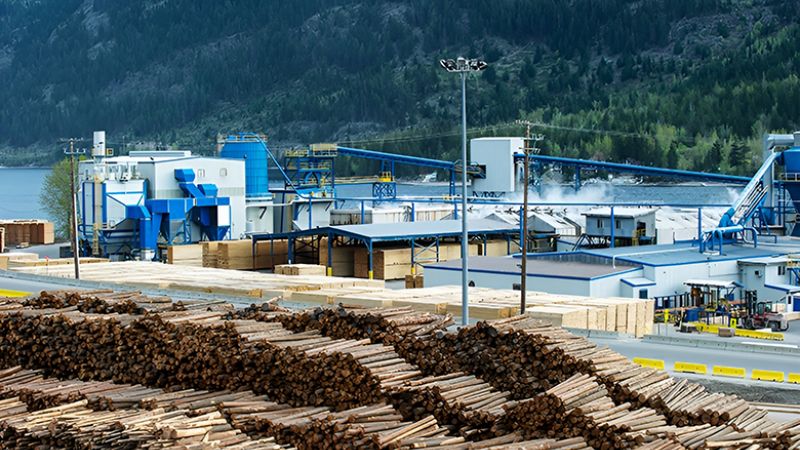


Meet global product demands and quality standards with industry-leading pellet plant design, engineering, equipment, and construction services for pellet processors.


Your Partner Beyond Project Completion
2000+ cases
RICHI is the leading designer, manufacturer and builder of pellet plants in the world, completing over 2000 projects in 140 countries across 6 continents.
Read More
Increase plant productivity, profitability, and safety by integrating high quality equipment into your pellet production line. Over the years, RICHI has become China's top pellet equipment manufacturer. At the same time, RICHI has established valuable partnerships with the world's leading component and raw material manufacturers to bring you the best there is in technology, automation, and efficiency in pelleting plant machinery.

For nearly 30 years, RICHI has been providing best-in-class pellet plant equipment and services to clients across a variety of industries, sizes, and needs. We pride ourselves on the knowledge and skill that each team member possesses – from our technical sales team to our process design engineers. You can count on RICHI Machinery to take your operation to the next level of innovation, quality, and success.
Need help with your pellet manufacturing plant project? Contact us today.
ANIMAL FEED
BIOMASS
WOOD
ORGANIC FERTILIZER
AQUA FEED
CAT LITTER
MUNICIPAL WASTE RECYCLING
SPECIAL PELLET PRODUCTION
RICHI Machinery continues to deliver world class pellet mill equipment, pellet plant engineering and project solutions that add value to our customers in the animal feed, wood waste, agriculture waste, organic fertilizer, cat litter and special pellet products industries. Throughout the years, we RICHI Machinery have built strong brand, becoming industry-leading pellet machine manufacturer. We value integrity, promise quality, and prioritize your success.
Learn MoreWith our expert team, we precisely implement your process engineering requirements in pellet mill and pelletizing plant systems. No matter which industry you’re in – we understand your needs and deliver solutions that meet the highest standards.
At RICHI, quality comes first. Our pellet making machine and related pellet line equipment undergo rigorous quality controls to ensure they meet the highest standards. Rely on products that are durable, safe, and efficient.
With decades of experience in pellet machine and pellet production line production, we have earned a reputation as a trusted partner in various industries. Our expertise allows us to cover a wide range of applications.
Not only do we offer premium pelleting equipment, but we are also experts at designing, building, installing, and maintaining facilities from the ground up. Our expertise is within pellt plant process design, discovering the most efficient, productive, and profitable way to handle your materials in an end-to-end cycle.
○ RICHI MACHINERY
Keeping in touch with us is an effective way to solve all your problems. If you have any needs or questions, please leave your contact information, then RICHI technical consultants will send design, quotation, videos to your mailbox. You can also contact us directly via WhatsApp: +86 13838389622
Copyright©2015-2026 by HENAN RICHI MACHINERY CO., LTD. All rights reserved.