
For a Finnish wood recycling company, the biggest processing problem was not ordinary clean sawmill residue. It was bulky waste wood: damaged transport pallets, packaging timber, demolition boards and selected discarded wooden products arriving in irregular sizes and often containing nails, screws or other metal fasteners. Manual dismantling consumed too much labor, while the company's smaller crushing equipment required excessive pre-processing before the material could be reduced efficiently.
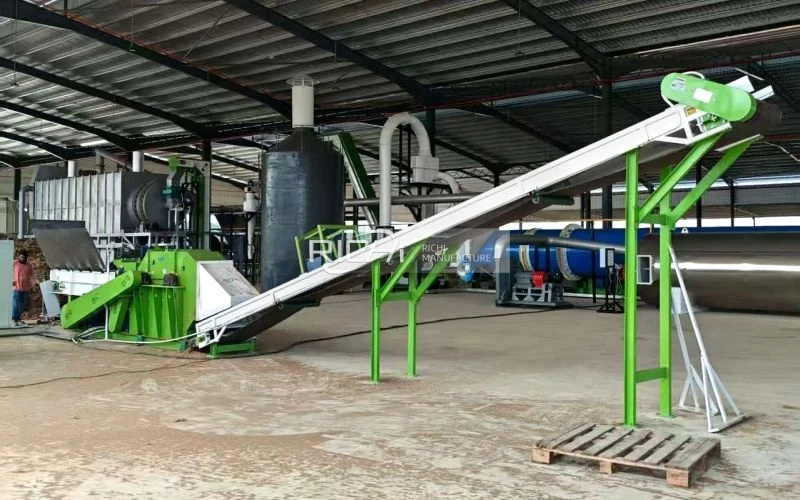
For a Finnish wood recycling company, the biggest processing problem was not ordinary clean sawmill residue. It was bulky waste wood: damaged transport pallets, packaging timber, demolition boards and selected discarded wooden products arriving in irregular sizes and often containing nails, screws or other metal fasteners. Manual dismantling consumed too much labor, while the company's smaller crushing equipment required excessive pre-processing before the material could be reduced efficiently.
The company therefore invested in two RIBPC 1250*500a units for its wood waste processing operation. The wood pallet shredder machine in Finland project was designed around a practical requirement: reduce bulky recovered wood to approximately 20–40 mm material for subsequent recycling and energy applications while maintaining enough capacity for seasonal fluctuations in incoming waste. Two machines were selected because the customer's collection volume justified parallel processing and because the second unit provided production flexibility during scheduled inspection and wear-part maintenance.
Name:
Wood Pallet Shredder
Country:
Finland
Date:
2026
Capacity:
8–10 T/H
Model:
2 × RIBPC 1250*500a
Main Motor Power:
160 kW
Hammer quantity:
28
Target discharge:
20–40 mm
The customer operates as a commercial wood waste collector and processor rather than a sawmill generating only one clean, homogeneous residue. Its incoming material comes from several channels, including logistics companies replacing damaged pallets, warehouses and industrial sites disposing of wooden packaging, construction and renovation contractors, and municipal or commercial wood-waste collection networks.
This creates a difficult feedstock stream. A broken pallet may contain relatively clean softwood but still carry nails. Construction timber can vary considerably in thickness and density. Old wooden products can include solid wood together with engineered panels, coatings, hardware or other unwanted components.
The customer had previously relied on manual dismantling followed by smaller crushing equipment. That arrangement worked at low volumes, but labor requirements increased rapidly when pallet and construction-waste deliveries accumulated. Large pieces also had to be reduced before entering the existing machines.
The investment was therefore not intended to replace every processing machine in the facility. The two RIBPC shredders were added as the heavy-duty size-reduction stage at the front of the customer's existing recycling process.
The principal feedstock is discarded wooden pallets and industrial packaging timber. The facility also receives selected construction and demolition wood and suitable discarded wooden products. The original project specification identifies pallets from logistics and industrial sources together with furniture and construction boards as the principal incoming materials.
Not every piece of collected wood, however, should be treated as equivalent feedstock.
Metal fasteners such as ordinary nails and screws can be encountered in pallet recycling, and the machine must therefore be designed for much harsher service than a conventional fine hammer mill processing clean sawdust. But large metal brackets, steel plates, stones and other heavy foreign objects should still be removed whenever possible. Allowing a shredder to tolerate incidental nails is different from deliberately feeding unrestricted scrap metal.
The same distinction applies to treated or contaminated wood. Painted, coated, chemically treated or demolition-derived wood has to be classified according to its downstream destination. Material intended for energy recovery, wood-based panels or another recycled product must satisfy the corresponding acceptance and regulatory requirements.
The customer selected two RIBPC 1250*500a machines. The 1250 × 500 mm feeding opening provides the larger inlet needed for bulky recovered wood, reducing the amount of manual size preparation required before shredding.
| Project Parameter | Configuration |
|---|---|
| Equipment | 2 × RIBPC 1250*500a |
| Feed opening | 1250 × 500 mm |
| Main motor | 160 kW per unit |
| Feeding motor | 11 kW + 7.5 kW |
| Hydraulic pump | 2.2 kW |
| Discharge conveyor | 1.5 kW |
| Hammer quantity | 28 |
| Nominal capacity | 4–5 T/H per unit |
| Combined nominal capacity | 8–10 T/H when both units operate |
| Target discharge | Approximately 20–40 mm |
| Export port | Qingdao Port, China |
These project parameters are consistent with the supplied RIBPC 1250*500a specification, including the 160 kW main motor, 28 hammers and nominal 4–5 T/H capacity for each machine.
The actual hourly output should not be treated as a fixed number for every pallet or waste-wood stream. Capacity changes with wood species, moisture, bulk density, dimensions, contamination, required discharge size and feeding continuity. The 4–5 T/H figure is therefore a project/model reference rather than a guarantee that every mixture of recovered wood will run at exactly the same rate.
One of the customer's main objectives was to reduce manual handling before crushing.
A small wood hammer mill may perform well once wood has already been converted into suitably sized chips, but it is not an efficient first machine for whole damaged pallets and large boards. Someone still has to dismantle or pre-cut the material before it can enter the crushing chamber.
The larger inlet of the RIBPC changes that workflow. Depending on pallet dimensions and condition, intact or partially broken pallet sections can be introduced with substantially less preparation. Hydraulic feeding then controls how the material enters the crushing area instead of depending on workers to force irregular pieces into a small opening.
For a commercial recycling operation, that reduction in manual preparation can be just as important as the nominal tonnes-per-hour rating of the shredder itself.
The presence of nails was one reason the Finnish company required equipment specifically intended for recovered wood.
The heavy-duty crushing structure and replaceable wear components allow the machine to process wooden pallets containing normal embedded fasteners more effectively than equipment designed only for clean wood fiber. Nevertheless, the customer's operating procedure includes upstream inspection rather than assuming that anything attached to a pallet can safely enter the machine.
Large metal components and abnormal contaminants are removed before shredding. After size reduction, magnetic separation can also be incorporated downstream to recover ferrous metal liberated from the wood.
This point is particularly important when the shredded material will later enter a pellet plant. Nails that pass through the primary shredder should not be allowed to reach downstream hammer mills, pellet mills or conveying equipment.
The original project specification identifies a conventional finished size of approximately 2–4 cm. For this customer, that size is best understood as primary shredded material rather than a universal finished product suitable for every downstream application.
If the material is accepted by an industrial biomass user at that specification, screened chips can potentially be supplied after the required contamination and quality controls. If it is destined for pellet production, however, 20–40 mm is only an intermediate size.
Pelletizing requires much finer and more uniform material. The shredded wood therefore passes through metal separation and, where necessary, secondary crushing before it reaches the pellet mill. Moisture also has to be controlled according to the requirements of the subsequent process.
Similarly, particleboard and other panel applications have their own requirements for particle geometry, contaminants and material classification. A primary pallet shredder prepares recovered wood for these processes; it does not automatically convert mixed demolition wood into finished MDF-quality fiber.
The decision to buy two pallet shredder machines was based on the customer's incoming wood volume and maintenance strategy.
When both RIBPC 1250*500a units operate under suitable feed conditions, their combined nominal processing capacity reaches approximately 8–10 T/H. More importantly, the machines do not always have to run simultaneously.
During normal periods, the customer can operate according to incoming feedstock volume. When accumulated pallets arrive from logistics customers or construction wood deliveries increase, both units can be brought online. During scheduled hammer, screen or bearing inspection on one shredder, the other machine can remain available.
This is a more realistic reason for purchasing two machines than describing one machine as permanently waiting idle as a backup. For a commercial recycler, both units contribute to production while also giving the plant greater maintenance flexibility.
The customer does not treat every incoming wood stream as suitable for every market. Material is separated according to quality and intended destination.
Clean recovered pallet and packaging wood represents the most flexible fraction. After shredding and metal removal, suitable material can enter further processing for biomass fuel applications or be sold to approved industrial users according to their feedstock specifications.
Selected recyclable wood can also undergo additional processing for wood-product applications where the material satisfies the buyer's requirements.
Lower-quality recovered wood is managed separately according to its classification and permitted end use. This segregation is especially important in Finland and the wider European market because the commercial value of recovered wood depends not merely on particle size but also on contamination, treatment history and downstream compliance.
Shredding pallets containing nails creates a second engineering question: what happens to the metal after the wood breaks apart?
RICHI therefore considered the shredder as one part of the customer's material-preparation system rather than an isolated machine. After the RIBPC reduces the pallets, exposed ferrous pieces become easier to separate magnetically.
For material going into secondary crushing, this separation stage protects downstream equipment and reduces the possibility of metal contamination in the final product.
Operators also inspect the magnetic separator and collected metal regularly. A sudden increase in large fragments can indicate that a particular incoming waste batch contains more hardware than normal and may require stronger upstream sorting.
Recovered pallet wood places a very different load on crushing components than clean sawdust.
The customer therefore pays particular attention to hammer condition, fasteners, screens, bearings and the feeding system. Wear is monitored by inspection rather than by assuming a fixed replacement interval, because pallet condition and contamination vary considerably from batch to batch.
The crusher machine uses detachable hammers so individual worn components can be serviced or replaced without treating the entire crushing assembly as a single disposable component. The supplied equipment specification also incorporates a heavy-duty housing and protected bearing arrangement intended for demanding wood-waste operation.
The customer keeps the most important wear and service components available locally. This is particularly valuable with two machines because planned maintenance can be staggered rather than shutting down the entire primary shredding section.
A Finnish installation has operating conditions that are not relevant to every RIBPC project.
Recovered pallets stored outdoors can arrive with snow, ice or frozen moisture during winter. Frozen material changes handling characteristics and can increase shock loading. Operators therefore avoid allowing heavily iced or snow-covered waste to enter uncontrolled, and the storage arrangement is designed to keep the feedstock as manageable as practical before processing.
Hydraulic systems, lubrication and electrical components also need to be operated within their specified temperature ranges. Where equipment is installed inside an industrial building, maintaining suitable ambient conditions simplifies winter operation and maintenance.
These considerations were incorporated into the operating instructions rather than assuming that a machine commissioned during mild weather would require exactly the same procedures during a Finnish winter.
The two shredders were incorporated into the customer's existing wood-waste operation. The project therefore concentrated on feeding, discharge, electrical load, maintenance access and downstream material handling rather than supplying an entirely new recycling plant.
Enough clearance was retained around each machine for hammer and screen inspection. The discharge conveyors were arranged so shredded material could move toward the subsequent separation and storage stages without requiring loaders to repeatedly handle material immediately below the crusher.
Because each shredder uses a 160 kW main motor, electrical supply and starting arrangements were confirmed before installation. The two units were also positioned so that maintenance on one would not unnecessarily obstruct operation of the other.
Commissioning started with controlled quantities of representative pallet wood. Feed rate and discharge characteristics were observed before moving toward sustained operation with mixed recovered material.
“The biggest change is the amount of preparation we no longer have to do by hand. Before, our team spent too much time breaking pallets and preparing large boards for smaller equipment. Now the bulky wood enters the primary shredding stage much more directly. We still sort abnormal metal and unsuitable waste, but ordinary pallet nails are no longer the reason the whole process stops. Having two machines also means we can schedule inspection on one side without losing all of our shredding capacity.”
The customer also found that consistent primary sizing made the downstream process easier to manage. Instead of receiving a mixture of long boards, broken pallet sections and irregular hand-cut pieces, the following separation and secondary-processing stages receive a much more controlled material stream.
The two machines were prepared for export from Qingdao Port, China. The original project configuration identifies Helsinki as the Finnish destination for the equipment.
Before shipment, the machines and auxiliary components were checked against the packing list, and installation documentation was prepared for the customer's team. Because the project involved two heavy-duty units rather than a small standalone crusher, lifting requirements, unloading conditions and installation space had to be confirmed before arrival.
RICHI also supplied commissioning guidance covering feeding, inspection, wear-part maintenance, abnormal-load response and safe shutdown procedures. The purpose was to ensure that the customer's operators understood not only how to start the equipment but also how to respond when the highly variable recovered-wood feedstock changed.
The wood pallet shredder machine in Finland was not selected simply because the customer needed smaller wood particles. The real requirement was to remove a labor-intensive primary preparation bottleneck from a commercial recycling operation.
Whole and broken pallets, packaging wood and selected construction timber are bulky, irregular and frequently contaminated with fasteners. A conventional fine-grinding hammer mill would still require extensive preparation before these materials could be processed. The RIBPC machines occupy an earlier position in the recycling chain: they perform heavy-duty primary size reduction so that metal separation, secondary crushing and downstream utilization become easier to control.
The dual RIBPC 1250*500a configuration gives the Finnish company a nominal combined capacity of 8–10 T/H under suitable operating conditions while allowing production to be adjusted according to incoming waste volumes. More importantly, it provides a processing route that is better matched to the physical characteristics of recovered pallet wood.
For recycling companies considering a similar system, RICHI Machinery evaluates pallet dimensions, wood types, moisture, contamination, required discharge size, hourly throughput and downstream use before recommending the shredder configuration. This ensures that the machine is selected as part of the actual recycling process rather than solely from a headline capacity figure.
Having the right mix of reliable, high-quality pellet machine and pelletizing systems and expert support is essential to your success. Watch how our end-to-end feed pellet plant solutions have helped our customers optimize their performance.
Our customized and future-proofed turnkey pellet plant solutions is designed with you at the core. From vision to reality and beyond, our team stays connected with yours. Giving you peace-of-mind with an expert at your side.
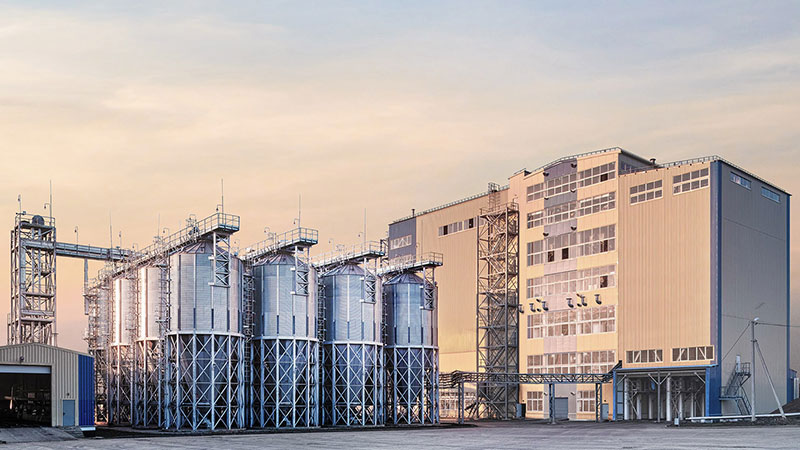
At RICHI, we go beyond project completion. With RICHI Servicee, we’re your dedicated partners in success. Count on us for expert guidance, minimal downtime, and optimized productivity. Choose RICHI for unmatched service and support.
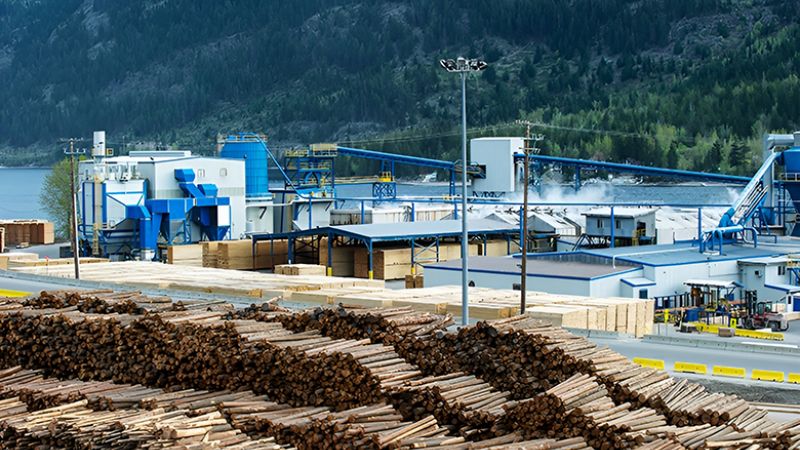


Meet global product demands and quality standards with industry-leading pellet plant design, engineering, equipment, and construction services for pellet processors.


Your Partner Beyond Project Completion
2000+ cases
RICHI is the leading designer, manufacturer and builder of pellet plants in the world, completing over 2000 projects in 140 countries across 6 continents.
Read More
Increase plant productivity, profitability, and safety by integrating high quality equipment into your pellet production line. Over the years, RICHI has become China's top pellet equipment manufacturer. At the same time, RICHI has established valuable partnerships with the world's leading component and raw material manufacturers to bring you the best there is in technology, automation, and efficiency in pelleting plant machinery.

For nearly 30 years, RICHI has been providing best-in-class pellet plant equipment and services to clients across a variety of industries, sizes, and needs. We pride ourselves on the knowledge and skill that each team member possesses – from our technical sales team to our process design engineers. You can count on RICHI Machinery to take your operation to the next level of innovation, quality, and success.
Need help with your pellet manufacturing plant project? Contact us today.
ANIMAL FEED
BIOMASS
WOOD
ORGANIC FERTILIZER
AQUA FEED
CAT LITTER
MUNICIPAL WASTE RECYCLING
SPECIAL PELLET PRODUCTION
RICHI Machinery continues to deliver world class pellet mill equipment, pellet plant engineering and project solutions that add value to our customers in the animal feed, wood waste, agriculture waste, organic fertilizer, cat litter and special pellet products industries. Throughout the years, we RICHI Machinery have built strong brand, becoming industry-leading pellet machine manufacturer. We value integrity, promise quality, and prioritize your success.
Learn MoreWith our expert team, we precisely implement your process engineering requirements in pellet mill and pelletizing plant systems. No matter which industry you’re in – we understand your needs and deliver solutions that meet the highest standards.
At RICHI, quality comes first. Our pellet making machine and related pellet line equipment undergo rigorous quality controls to ensure they meet the highest standards. Rely on products that are durable, safe, and efficient.
With decades of experience in pellet machine and pellet production line production, we have earned a reputation as a trusted partner in various industries. Our expertise allows us to cover a wide range of applications.
Not only do we offer premium pelleting equipment, but we are also experts at designing, building, installing, and maintaining facilities from the ground up. Our expertise is within pellt plant process design, discovering the most efficient, productive, and profitable way to handle your materials in an end-to-end cycle.
○ RICHI MACHINERY
Keeping in touch with us is an effective way to solve all your problems. If you have any needs or questions, please leave your contact information, then RICHI technical consultants will send design, quotation, videos to your mailbox. You can also contact us directly via WhatsApp: +86 13838389622
Copyright©2015-2026 by HENAN RICHI MACHINERY CO., LTD. All rights reserved.