
The Romanian customer did not begin this project by asking which dryer had the lowest purchase price. The engineering team started with a more important question: what type of drying system best matched a continuous stream of fine sawdust and planer shavings that would later be converted into wood pellets?
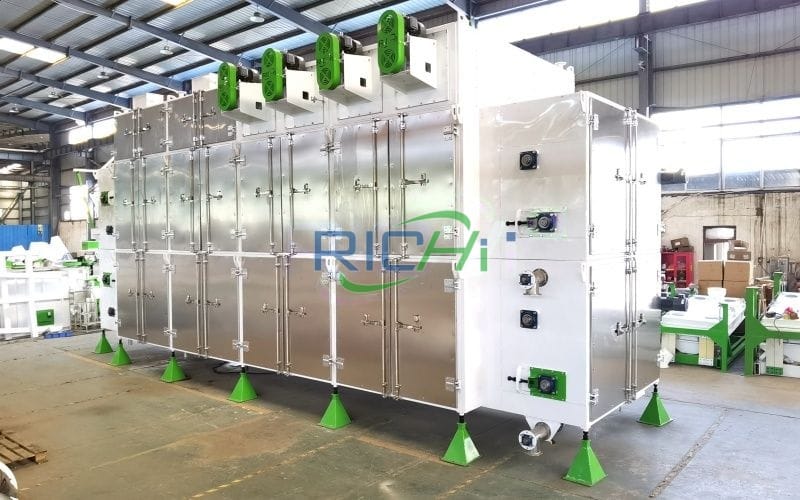
The Romanian customer did not begin this project by asking which dryer had the lowest purchase price. The engineering team started with a more important question: what type of drying system best matched a continuous stream of fine sawdust and planer shavings that would later be converted into wood pellets?
The answer was one DHG-1000 waste wood belt dryer in Romania, installed at a wood-processing operation in the Brașov area of Transylvania. The plant already generated clean sawmill residues every day and had enough dry wood demand to justify a dedicated pellet feedstock preparation section.
Instead of selecting the rotary drum dryer more commonly associated with large wood pellet plants, the customer chose a multi-layer belt dryer because the project favored lower-temperature drying, controlled residence time, stable final moisture and the use of an available low-grade thermal source.
Name:
Waste Wood Dryer
Country:
Romania
Date:
2026
Capacity:
1.5–2.0 T/H
Model:
DHG-1000
Moisture:
40–55%
Downstream Application:
Wood pellet production
Drying Area:
43 m²
The factory operates both sawmilling and secondary wood processing.
That produces several residue streams, but they do not all enter the dryer in the same condition.
Fine sawdust from sawing operations forms the main drying feedstock. Planer shavings can also be included after size control. Larger chips and irregular wood pieces are separated because their drying rate and downstream grinding requirement differ significantly from fine sawdust.
The pellet feedstock therefore consists mainly of clean, untreated sawdust and prepared shavings rather than a random mixture of furniture waste.
Painted panels, laminated boards, demolition timber, chemically treated wood, plastics and metal-contaminated residues are excluded from this wood pellet drying system.
The customer’s target is heating-grade wood pellets made from clean wood-processing residues.
That means raw-material origin matters before drying begins.
Clean sawdust and untreated wood-processing by-products can be suitable pellet raw materials, while chemically treated and demolition wood fall into a different category and should not simply be blended into premium wood pellet production.
The belt dryer therefore sits downstream of raw-material segregation, not at the beginning of an uncontrolled waste-recovery process.
Sawdust moisture varied with log condition, species, storage time and season.
Material generated from freshly processed timber could arrive well above 40% moisture, while residues from drier stock could be significantly lower.
The pellet mill could not operate efficiently with this level of variation.
The customer wanted the dried material to enter pelletizing around the low-teens moisture range, normally close to 10–12% for this project, with final adjustment based on actual pellet-mill behavior.
The task of the dryer was therefore not simply to “make sawdust dry.”
It was to turn a variable wet residue stream into a much narrower and more controllable pellet feedstock.
This is the central equipment decision in the Romanian project.
A rotary drum dryer could also process wet sawdust successfully. Rotary drying remains widely used in industrial wood pellet production, especially where very high evaporation capacity, high-temperature hot gas and large continuous material flows are available.
The Romanian customer’s conditions were different.
The factory placed more value on low-temperature drying, moisture uniformity and integration with a lower-grade thermal source than on maximizing evaporation intensity in the smallest possible drying volume.
The plant had access to usable thermal energy from its existing wood-processing and heating infrastructure.
A belt dryer can work with hot water, low-pressure steam, thermal oil, recovered hot air or other suitable low- to medium-temperature heat sources depending on project design.
This allowed the customer to recover energy that would otherwise have had limited value.
A conventional high-temperature rotary dryer would have pushed the project toward a different heat-generation arrangement.
For this factory, the heat source influenced the dryer type before machine capacity was even selected.
The main feedstock is already fine.
It does not need strong mechanical agitation to expose a large solid surface to hot gas.
Inside the multi-layer belt dryer, prepared sawdust is distributed in a controlled layer while heated air passes through the material.
The operator can change bed depth, airflow, temperature and belt speed to manage drying intensity.
This suited a fine sawdust stream better than designing the entire process around continuous lifting and falling inside a rotating drum.
Pellet mills react quickly to moisture changes.
If the feed becomes too wet, die performance and pellet formation can become unstable.
If the material is overdried, the factory spends extra thermal energy removing water that did not need to be removed and may later have to correct moisture before pelletizing.
The belt dryer gives the plant several independent adjustment points for residence time and airflow.
That was particularly attractive to a factory processing sawdust from different production shifts and timber batches.
Dry wood dust is combustible.
No industrial sawdust dryer is automatically safe simply because it is a belt dryer.
However, this customer preferred a process that could operate with lower-temperature drying air instead of making high-temperature direct gas the center of the system.
That reduces one part of the thermal risk profile while still requiring temperature monitoring, fire detection, dust management, emergency shutdown logic and suitable housekeeping.
A fixed residence time would not work throughout the year.
Wetter winter production may require a slower belt speed, a thinner material layer or greater thermal input.
Drier summer material can move through more quickly.
The multi-layer belt configuration gives the operator room to adjust the drying process without mechanically modifying the machine every time incoming moisture changes.
The choice of belt drying does not mean rotary dryers are inferior.
For another wood pellet producer processing a much larger wet sawdust stream, especially one with a dedicated biomass furnace and abundant high-temperature hot gas, a rotary drum dryer may offer a better capital and throughput balance.
It can be robust, continuous and highly effective at large evaporation duty.
The right question is therefore not “Which dryer is better?”
It is “Which dryer matches the heat source, evaporation load, particle distribution, final moisture requirement and plant layout?”
| Project Parameter | Configuration |
|---|---|
| Equipment | Waste wood belt dryer |
| Model | DHG-1000 |
| Dryer Type | Multi-layer continuous belt dryer |
| Reference Drying Area | Approximately 43 m² |
| Main Material | Clean sawdust and prepared wood shavings |
| Typical Wet Feed Moisture | Approximately 40–55%, depending on production conditions |
| Target Moisture for Pelletizing | Normally around 10–12% |
| Reference Dried Output | Approximately 1.5–2.0 T/H under suitable project conditions |
| Main Downstream Application | Wood pellet production |
| Heat Supply | Configured around suitable low-temperature or recovered thermal energy |
The drying capacity has to obey a water balance and an energy balance.
If wet sawdust enters at approximately 45% moisture and leaves near 10–12%, producing around 1.5–2.0 tonnes per hour of dried product means that a very substantial amount of water must be evaporated every hour.
The theoretical thermal energy required just to evaporate that water is already several hundred kilowatts before real heat losses are added.
For that reason, a statement that a 70 kW electric heater alone can continuously perform the full drying duty would not be credible.
The project instead treats electrical power as the requirement for fans, belts, drives, controls and auxiliary equipment, while the main evaporation energy comes from the designed thermal source.
A biomass belt dryer should not be selected only from tonnes of wet sawdust per hour.
Two customers can both feed 3 T/H of sawdust but require very different dryers if one starts at 30% moisture and the other at 55%.
RICHI therefore calculates dry solids and water evaporation separately.
This provides a much more useful engineering basis for selecting a sawdust belt dryer than simply copying a nominal throughput figure.
Drying air follows the path of least resistance.
If one side of the belt carries a deep bed and the other side is thin, the resulting moisture will not be uniform.
The Romanian customer therefore paid particular attention to the feed distributor.
The prepared sawdust is spread across the usable belt width before entering the drying zone.
Bed depth is controlled together with belt speed and airflow.
Fine sawdust and a 25 mm wood chip do not dry at the same rate.
If a large quantity of oversized wood enters a sawdust drying process, the fines may already reach target moisture while the chip center remains wet.
The customer therefore screens or classifies the residue stream before the DHG-1000.
Oversized pieces are routed to suitable size reduction and can re-enter the process later if they meet the required particle specification.
The correct screen size depends on the dryer bed, wood species, upstream residue form and downstream hammer-mill requirements.
For this project, screening is used to eliminate obvious oversize and foreign material rather than force every particle through one arbitrary mesh size.
Thin planer shavings are light and bulky.
A hopper containing a large volume of shavings may carry much less mass than the same hopper filled with sawdust.
They can therefore affect feeding stability and material-layer uniformity.
The customer blends suitable shavings with denser sawdust and reduces oversized curls where necessary.
This creates a more predictable bed for the biomass belt dryer.
Even when small chips can pass through the drying section, they may still be too large for stable pelletizing.
Dried oversized material therefore goes through downstream size reduction before the pellet mill.
The complete wood pellet preparation logic is classification, drying, final grinding where required, storage or buffering, pelletizing, cooling, screening and packing.
This distinction prevents the dryer from being described as if it also controls final pellet-feed particle size.
The factory measures incoming moisture before making major setting changes.
It also checks dried material before pelletizing.
A single outlet temperature cannot reliably replace actual moisture measurement.
This becomes especially important when the raw-material mix changes between sawdust and shavings.
Residence time can be changed by adjusting belt speed.
That gives the operator a direct response when incoming moisture moves outside the usual range.
Air temperature and air volume can then be adjusted together with material loading.
The goal is not to run the dryer as slowly as possible.
It is to remove only the water required to prepare the feedstock for pelletizing.
Drying sawdust below the necessary working range consumes extra heat.
It can also change pellet-mill behavior and increase dust generation in handling.
The Romanian customer therefore does not use “the lowest possible moisture” as its quality target.
The better target is stable moisture compatible with the selected wood pellet process.
Industrial belt-dryer technology is widely applied to sawdust, wood chips and other biomass precisely because it can use relatively low-grade thermal energy.
This makes it especially relevant where sawmills, CHP systems, boilers or other industrial processes already generate recoverable heat.
For a plant trying to increase the value of sawmill residues, the energy source can be as important as the dryer price.
Where the final dryer design permits it, part of the process air can be recirculated instead of exhausting all usable heat after one pass.
The control system still has to remove enough humid air to continue evaporation.
The exact recirculation ratio therefore changes with moisture load and ambient conditions.
This is another area where a modern biomass drying system is engineered around the specific plant rather than sold as a fixed-temperature box.
Sawdust drying combines combustible solids, air movement and heat.
The Romanian project therefore treats fire and explosion risk as an engineering issue rather than an optional accessory.
Temperature monitoring, interlocks, controlled shutdown, suitable dust management and project-specific detection or suppression measures are selected from the actual installation.
Safety measures are configured according to the actual installation rather than assigned one generic package price.
Fine particles can be generated at screens, conveyors, transfer points and downstream hammer mills.
The customer therefore manages dust across the complete dry-material section.
This improves housekeeping and reduces the buildup of combustible deposits.
The belt dryer should not be described as eliminating the need for plant-wide dust control.
Mesh condition, belt tracking, bearings, fans, ducts, drives and internal deposits are checked according to operating hours and actual buildup.
Fine sawdust can gradually reduce effective airflow if cleaning is neglected.
The maintenance team therefore watches pressure, airflow and visible accumulation and schedules cleaning according to actual operating conditions.
This project is centered on wood pellet production.
The customer may have other markets for sawmill residues, but the DHG-1000 was not purchased simultaneously to manufacture pellets, bedding and briquettes as three equal applications.
Keeping one principal downstream use makes dryer control and moisture targets much clearer.
The dried sawdust leaves the belt dryer at a moisture condition suitable for the customer’s ring-die pelletizing section.
The exact working point can move slightly according to wood species, particle distribution and pellet-mill response.
The operator therefore treats 10–12% as the project’s normal process window rather than a universal specification that applies to every pellet plant.
The customer intends to produce quality heating pellets, but no dryer can independently guarantee ENplus A1.
Pellet certification also depends on approved raw-material origin, ash, fines, durability, pellet dimensions, moisture, additives, production control and the certification system itself.
ENplus rules allow chemically untreated by-products and residues from the wood-processing industry for relevant quality classes, while demolition wood and chemically treated wood are excluded.
The DHG-1000 therefore prepares the material; it does not certify the final fuel.
A dryer producing approximately 1.5–2.0 T/H of prepared sawdust cannot continuously supply a 3–4 T/H pellet mill by itself unless another dry-material stream is available.
The Romanian system therefore balances actual dry output with downstream pelletizing demand.
This prevents the common project-writing mistake of combining impressive machine capacities that cannot physically operate together.
A small intermediate storage or buffer section decouples the dryer from moment-to-moment pellet-mill demand.
This helps stabilize both processes.
The dryer can continue operating under a steady thermal condition while the pellet mill pauses for die inspection, maintenance or production adjustment.
The buffer is designed to avoid excessive residence time or moisture reabsorption.
Transylvania experiences substantial seasonal temperature differences.
Cold ambient air changes the amount of sensible heat needed before drying air reaches the required condition.
Incoming timber moisture can also rise during wetter or colder production periods.
The dryer therefore cannot be commissioned in summer and assumed to behave identically throughout the year.
Central Romania has a substantial forestry and wood-processing base, making Transylvania a credible location for a sawmill and secondary wood manufacturer generating sawdust and shavings.
For this customer, pelletizing created a route to densify a residue already generated on-site rather than establishing a plant dependent on purchasing expensive prepared sawdust from distant suppliers.
The DHG-1000 was exported from Qingdao and delivered through the Port of Constanța before inland transport toward Brașov.
Constanța is Romania’s principal Black Sea port and a practical gateway for industrial equipment entering the country.
RICHI provided installation interfaces, equipment layout, thermal-system requirements, electrical information and maintenance-clearance data before shipment so that the customer could prepare the drying area in advance.
Voyage time, customs clearance and landed costs depend on actual shipping and import conditions.
The first task was not to maximize air temperature.
The commissioning team first checked whether the feeder could maintain an even sawdust layer across the belt.
Only after distribution became stable did they optimize belt speed, airflow and thermal input.
This sequence reduced the risk of using extra heat to compensate for a mechanical feeding problem.
Drying clearly increases the number of outlets available for wet wood residues, especially when the downstream objective is pellet production.
But payback depends on thermal-energy cost, electrical consumption, pellet price, raw-material value, labor, utilization, pellet-mill cost, maintenance and local market demand.
The financial justification for this project is based on using an existing residue stream more efficiently.
“Our biggest issue was not that we had no use for sawdust. It was that the moisture changed too much for stable pellet production. The belt dryer gives us more control over residence time and airflow, and it fits the lower-temperature heat available at our site. We still monitor the material closely, but the pellet section now receives a much more consistent feedstock.”
For buyers specifically searching for a sawdust belt dryer in Romania, this project shows why dryer selection should start with the actual moisture and heat balance.
Fine sawdust, shavings and mixed wood-processing residues cannot simply be assigned one nominal throughput.
Particle size, wet-basis moisture and required final moisture all change the water evaporation duty.
A biomass belt dryer becomes especially attractive when the plant already has recoverable low-temperature heat and needs controlled drying of sawmill residues.
Sawdust, prepared shavings and suitably sized wood chips can all be processed, but the feeding and screening system must match their different bulk-density and airflow characteristics.
Some customers already own hammer mills, pellet mills, coolers and packaging systems but remain limited by wet feedstock.
For those projects, a wood waste drying machine can be added as a dedicated upstream module rather than replacing the complete pellet production line.
Where hot water, low-pressure steam or another recoverable thermal source is available, a low-temperature wood dryer can create value from energy that would otherwise be rejected.
This is one of the strongest situations for comparing belt drying against a conventional high-temperature drum system.
A multi-layer belt dryer gives operators several ways to respond to seasonal feedstock changes without changing the basic machine.
Belt speed, airflow, bed depth and thermal input can be adjusted around incoming moisture and target output.
A waste heat belt dryer is not automatically the cheapest dryer to purchase, but it may produce better whole-project economics when low-grade heat is already available at the wood-processing site.
The customer must compare lifetime thermal cost, not only equipment price.
This waste wood belt dryer in Romania project uses one DHG-1000 to prepare clean sawmill residues for wood pellet production at a Transylvanian wood-processing facility near Brașov.
The customer’s main raw materials are sawdust and prepared planer shavings generated from untreated wood processing. Incoming moisture can vary widely with log condition and season, while the pelletizing section requires a much more stable low-teens moisture range.
The DHG-1000 provides approximately 43 m² of reference drying area and about 1.5–2.0 T/H dried-product capacity under suitable project conditions. Instead of relying on a small electric resistance heater as the primary evaporation source, the system is designed around a suitable low-temperature thermal supply, with electrical power serving fans, belts, drives and controls.
The complete preparation route includes residue separation, screening, controlled feeding, multi-layer belt drying, downstream grinding where required, buffering and pelletizing. Larger chips are not assumed to dry at the same rate as fine sawdust, and chemically treated or demolition wood is excluded from the clean pellet-feedstock route.
The main reason for choosing a belt dryer instead of a rotary dryer was project fit. The customer had fine wood residues, variable incoming moisture, a requirement for controlled outlet moisture and access to lower-temperature heat. Another producer with much higher evaporation demand and a dedicated high-temperature biomass furnace could reasonably reach a different conclusion.
For another company comparing a waste wood belt dryer in Romania, industrial sawdust dryer, biomass belt dryer, wood chip and sawdust dryer, low-temperature wood dryer, waste heat belt dryer or wood pellet drying system, RICHI Machinery would first calculate incoming moisture, dry-solid flow, required water evaporation, particle-size distribution, available heat source, target final moisture, downstream pellet capacity, seasonal operating conditions and available installation area.
The model number should come after that calculation, not before it.
Having the right mix of reliable, high-quality pellet machine and pelletizing systems and expert support is essential to your success. Watch how our end-to-end feed pellet plant solutions have helped our customers optimize their performance.
Our customized and future-proofed turnkey pellet plant solutions is designed with you at the core. From vision to reality and beyond, our team stays connected with yours. Giving you peace-of-mind with an expert at your side.
At RICHI, we go beyond project completion. With RICHI Servicee, we’re your dedicated partners in success. Count on us for expert guidance, minimal downtime, and optimized productivity. Choose RICHI for unmatched service and support.


Meet global product demands and quality standards with industry-leading pellet plant design, engineering, equipment, and construction services for pellet processors.


Your Partner Beyond Project Completion
2000+ cases
RICHI is the leading designer, manufacturer and builder of pellet plants in the world, completing over 2000 projects in 140 countries across 6 continents.
Read More
Increase plant productivity, profitability, and safety by integrating high quality equipment into your pellet production line. Over the years, RICHI has become China's top pellet equipment manufacturer. At the same time, RICHI has established valuable partnerships with the world's leading component and raw material manufacturers to bring you the best there is in technology, automation, and efficiency in pelleting plant machinery.

For nearly 30 years, RICHI has been providing best-in-class pellet plant equipment and services to clients across a variety of industries, sizes, and needs. We pride ourselves on the knowledge and skill that each team member possesses – from our technical sales team to our process design engineers. You can count on RICHI Machinery to take your operation to the next level of innovation, quality, and success.
Need help with your pellet manufacturing plant project? Contact us today.
ANIMAL FEED
BIOMASS
WOOD
ORGANIC FERTILIZER
AQUA FEED
CAT LITTER
MUNICIPAL WASTE RECYCLING
SPECIAL PELLET PRODUCTION
RICHI Machinery continues to deliver world class pellet mill equipment, pellet plant engineering and project solutions that add value to our customers in the animal feed, wood waste, agriculture waste, organic fertilizer, cat litter and special pellet products industries. Throughout the years, we RICHI Machinery have built strong brand, becoming industry-leading pellet machine manufacturer. We value integrity, promise quality, and prioritize your success.
Learn MoreWith our expert team, we precisely implement your process engineering requirements in pellet mill and pelletizing plant systems. No matter which industry you’re in – we understand your needs and deliver solutions that meet the highest standards.
At RICHI, quality comes first. Our pellet making machine and related pellet line equipment undergo rigorous quality controls to ensure they meet the highest standards. Rely on products that are durable, safe, and efficient.
With decades of experience in pellet machine and pellet production line production, we have earned a reputation as a trusted partner in various industries. Our expertise allows us to cover a wide range of applications.
Not only do we offer premium pelleting equipment, but we are also experts at designing, building, installing, and maintaining facilities from the ground up. Our expertise is within pellt plant process design, discovering the most efficient, productive, and profitable way to handle your materials in an end-to-end cycle.
○ RICHI MACHINERY
Keeping in touch with us is an effective way to solve all your problems. If you have any needs or questions, please leave your contact information, then RICHI technical consultants will send design, quotation, videos to your mailbox. You can also contact us directly via WhatsApp: +86 13838389622
Copyright©2015-2026 by HENAN RICHI MACHINERY CO., LTD. All rights reserved.