
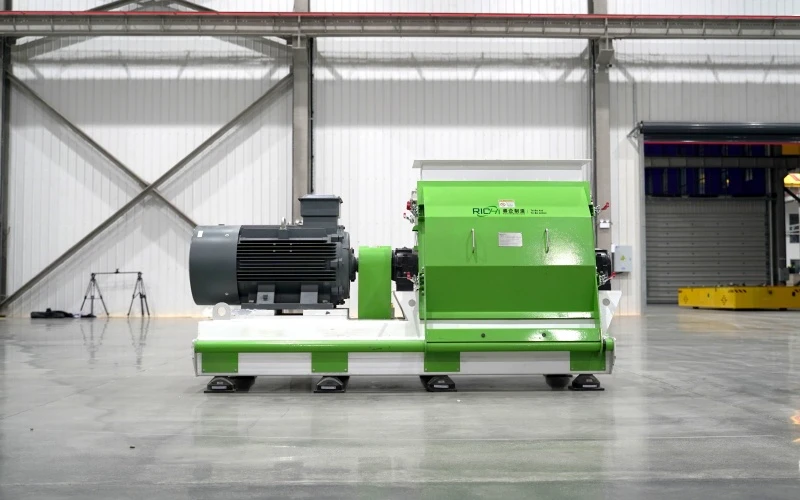
Sheep Hammer Mill Feed Grinder in South Africa: SFSP66×80 application for dry lucerne and maize stover, with particle control and existing-line integration.
A load of dry maize stover takes considerable space before it contributes much weight to a feed batch. At a regional sheep-feed mill in the Free State, that low bulk density makes roughage preparation a separate equipment duty from maize grinding.
This illustrative application for a sheep hammer mill feed grinder in South Africa centres on one SFSP66×80 with a 75 kW main motor. The buyer supplies supplements for growing and finishing lambs. Existing grain milling, mixing, pelleting, cooling and bagging equipment remain in service; the purchase addresses the dry roughage entering those formulations.
Name:
Sheep Hammer Mill
Country:
South Africa
Date:
2026
Capacity:
2,000–2,500 kg/h
Model:
SFSP66×80
Main Motor Power:
75 kW
rotor speed:
2,980 rpm
Final product size:
2–3 mm
The planning brief calls for eight tonnes of ground roughage per production day, prepared within four net grinding hours. This leaves the mill free to schedule grain preparation and batch mixing around a defined roughage stock. The SFSP66×80 animal feed hammer mill is sized against that requirement, with a proposed net throughput of 2,000 kg/h.
| Equipment parameter | Specification |
|---|---|
| Model and quantity | One SFSP66×80 hammer mill |
| Main motor | 75 kW |
| Rotor diameter | 660 mm |
| Grinding chamber width | 800 mm |
| Published rotor speed | 2,980 rpm |
| Approximate hammer tip speed | 103 m/s |
| Published grass/straw reference output | 2,000–2,500 kg/h |
| Application planning output | 2,000 kg/h, subject to material trials |
| Screen options for initial trials | 6 mm and 8 mm perforations |
| Additional electrical loads | Feeding, aspiration and discharge equipment specified separately |
Four net hours at 2,000 kg/h would prepare eight tonnes daily. Across 200 scheduled roughage-processing days, the planning total is 1,600 tonnes annually. These figures describe ground roughage; the mill's total feed output also includes cereals, protein ingredients and other formulation components.
The four-hour window helps explain the model choice. At 1,500 kg/h, the same eight tonnes would require more than five net grinding hours. A larger crusher machine would need a stronger feeding and collection system without serving an additional requirement in this brief.
The principal inputs are baled lucerne hay and field-dried maize stover. Lucerne provides a leaf-and-stem mixture; stover brings tougher stalk sections and greater variation between leaf, husk and stem. Both are relevant to sheep feeding in the Free State, but their nutritional value and grinding behaviour differ.
For commissioning, the proposed incoming moisture range is 12–14%. Each delivery needs sampling, including the interior of bales. Damp, heating or visibly spoiled material is held out of the grinding schedule. Grinding follows acceptance of the feedstock.
The existing bale-opening and cutting equipment prepares loose pieces approximately 20–30 mm long. Bale twine, wire, stones and soil are removed before the metered feeder. Magnetic separation provides another check for ferrous contamination. Whole compressed bales would make the hammer mill's feeding duty unnecessarily difficult.
Lucerne and stover are tested separately before approved blends. The records identify moisture, stem content, feed rate, screen and collected output. A performance figure from leafy lucerne alone would give the buyer little information about a later load of coarse stover.
The proposed trial target is a geometric mean particle size around 2–3 mm, with the fine fraction and longer fibres recorded separately. Tests with 6 mm and 8 mm screens establish the useful setting for each material. A screen aperture does not give every particle that diameter: slender fibres can pass lengthwise.
The mill can then compare ground meal in its existing pellet press. The product brief is a 5 mm sheep supplement pellet, approximately 8–12 mm long. Diameter comes from the feed pellet mill's ring die, and length from its cutter. The hammer mill prepares ingredients for that process.
Sheep rations require adequate fibre with suitable physical characteristics. The nutritionist determines roughage inclusion and the feeding instructions for supplements used alongside farm forage. Lucerne and stover retain their different nutritional values after grinding; forage analysis remains part of formulation.
Coarser hay intended for other products can bypass this grinding stage. Maize meal and hominy chop follow the mill's existing ingredient routes, while molasses and liquid additions enter downstream. This arrangement preserves flexibility between product batches.
Low-density material can bridge above an inlet or arrive in sudden clumps. The proposed package therefore needs a feeder suited to chopped forage, with feed rate controlled against main-motor load. Stable feeding gives the operator a more useful adjustment than repeatedly reducing the screen opening.
The receiving system also needs sufficient volume for light roughage meal. Bin sizing follows measured loose bulk density. Aspiration, duct resistance, dust collection and discharge capacity are checked together, including access for clearing and inspection. Loss of extraction or a full receiver should stop incoming material.
Site review covers foundation loads, inlet and outlet heights, lifting access and space to withdraw screens. South Africa's 50 Hz supply suits the specified speed basis; the electrician must confirm site voltage, motor starting arrangements and available electrical capacity. The 75 kW rating covers the main motor only.
Dry grinding needs no process steam or added water. If a pulse-cleaned bag filter is selected, its compressed-air demand belongs in the utility schedule.
A planning crew of one grinder operator and one bale-preparation worker assumes mechanically assisted bale handling. Their duties include material identification, sampling, feeding and housekeeping. Manual handling requirements need review against the actual bale format and layout.
A proposed shipment route is Qingdao Port to Durban, followed by inland trucking to the Free State. Packing and unloading arrangements follow the approved dimensions and lifting points. The equipment drawings and connection details should reach the mill before dispatch so its maintenance team can prepare the interfaces.
Acceptance should include representative stemmy stover as well as lucerne. The run records accepted kilograms per hour, particle distribution, total circuit electricity, interruptions and downstream pellet behaviour. Operators also need instruction in isolation, screen changes and replacing hammers as balanced sets according to the service procedure.
For this mill, the purchasing objective is a predictable roughage preparation window with repeatable meal quality. RICHI Machinery can develop the machine scope, material trial and spare-parts list around that objective. A useful running-cost comparison includes the feeder, fan, wear parts and operator time alongside the main motor.
When discussing a sheep hammer mill feed grinder in South Africa with RICHI, provide bale photographs, representative forage samples, measured moisture, daily roughage tonnage and the available grinding hours. Include the existing cutter and collection-system details. These establish what the quoted grinder package must handle.
Having the right mix of reliable, high-quality pellet machine and pelletizing systems and expert support is essential to your success. Watch how our end-to-end feed pellet plant solutions have helped our customers optimize their performance.
Our customized and future-proofed turnkey pellet plant solutions is designed with you at the core. From vision to reality and beyond, our team stays connected with yours. Giving you peace-of-mind with an expert at your side.

At RICHI, we go beyond project completion. With RICHI Servicee, we’re your dedicated partners in success. Count on us for expert guidance, minimal downtime, and optimized productivity. Choose RICHI for unmatched service and support.



Meet global product demands and quality standards with industry-leading pellet plant design, engineering, equipment, and construction services for pellet processors.


Your Partner Beyond Project Completion
2000+ cases
RICHI is the leading designer, manufacturer and builder of pellet plants in the world, completing over 2000 projects in 140 countries across 6 continents.
Read More
Increase plant productivity, profitability, and safety by integrating high quality equipment into your pellet production line. Over the years, RICHI has become China's top pellet equipment manufacturer. At the same time, RICHI has established valuable partnerships with the world's leading component and raw material manufacturers to bring you the best there is in technology, automation, and efficiency in pelleting plant machinery.

For nearly 30 years, RICHI has been providing best-in-class pellet plant equipment and services to clients across a variety of industries, sizes, and needs. We pride ourselves on the knowledge and skill that each team member possesses – from our technical sales team to our process design engineers. You can count on RICHI Machinery to take your operation to the next level of innovation, quality, and success.
Need help with your pellet manufacturing plant project? Contact us today.
ANIMAL FEED
BIOMASS
WOOD
ORGANIC FERTILIZER
AQUA FEED
CAT LITTER
MUNICIPAL WASTE RECYCLING
SPECIAL PELLET PRODUCTION
RICHI Machinery continues to deliver world class pellet mill equipment, pellet plant engineering and project solutions that add value to our customers in the animal feed, wood waste, agriculture waste, organic fertilizer, cat litter and special pellet products industries. Throughout the years, we RICHI Machinery have built strong brand, becoming industry-leading pellet machine manufacturer. We value integrity, promise quality, and prioritize your success.
Learn MoreWith our expert team, we precisely implement your process engineering requirements in pellet mill and pelletizing plant systems. No matter which industry you’re in – we understand your needs and deliver solutions that meet the highest standards.
At RICHI, quality comes first. Our pellet making machine and related pellet line equipment undergo rigorous quality controls to ensure they meet the highest standards. Rely on products that are durable, safe, and efficient.
With decades of experience in pellet machine and pellet production line production, we have earned a reputation as a trusted partner in various industries. Our expertise allows us to cover a wide range of applications.
Not only do we offer premium pelleting equipment, but we are also experts at designing, building, installing, and maintaining facilities from the ground up. Our expertise is within pellt plant process design, discovering the most efficient, productive, and profitable way to handle your materials in an end-to-end cycle.
○ RICHI MACHINERY
Keeping in touch with us is an effective way to solve all your problems. If you have any needs or questions, please leave your contact information, then RICHI technical consultants will send design, quotation, videos to your mailbox. You can also contact us directly via WhatsApp: +86 13838389622
Copyright©2015-2026 by HENAN RICHI MACHINERY CO., LTD. All rights reserved.