
A specialty feed producer in North Rhine-Westphalia upgraded its rabbit feed production line with one RICHI SKLF14×14 rabbit feed pellet cooler in Germany. The mill was producing approximately 4 T/H of pelleted rabbit feed, while an older cooling section had become increasingly difficult to balance with the pellet mill and downstream screening and packaging equipment.
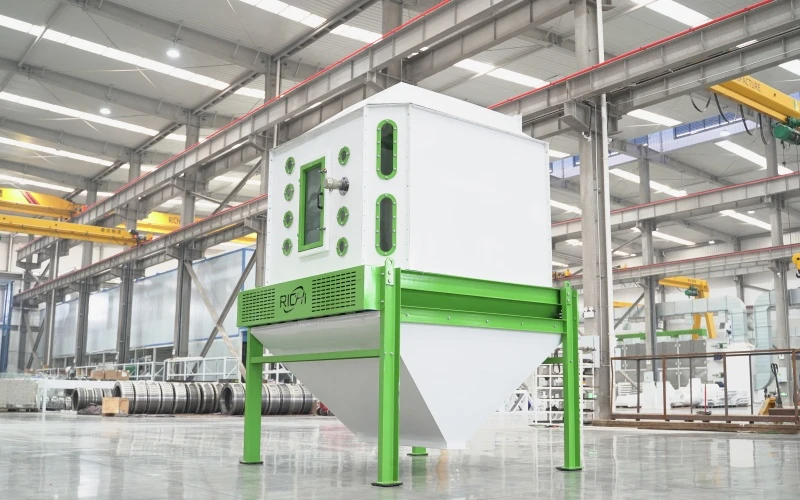
A specialty feed producer in North Rhine-Westphalia upgraded its rabbit feed production line with one RICHI SKLF14×14 rabbit feed pellet cooler in Germany. The mill was producing approximately 4 T/H of pelleted rabbit feed, while an older cooling section had become increasingly difficult to balance with the pellet mill and downstream screening and packaging equipment.
The customer did not need another complete feed plant. Grinding, batching, mixing, conditioning, pelletizing, screening and packaging systems were already available. The project focused on replacing the existing cooler with a 3–5 T/H counterflow model that could remove sensible heat and part of the moisture from freshly pelleted feed before final screening, storage and packing.
Name:
Rabbit Feed Pellet Cooler
Country:
Germany
Date:
2026
Capacity:
3–5 T/H
Model:
SKLF14×14
Main Product:
Rabbit feed pellets
Typical Pellet Diameter:
4 mm
Project Type:
Existing cooler replacement
Feed pellets leave the ring die warm and at a different moisture condition from the finished product.
They should therefore not move directly from the feed pellet machine into long-term storage or sealed packaging.
Cooling helps stabilize the physical condition of the pellets before they pass through the final screen and into the packaging system.
For the German customer, the existing pellet mill was capable of approximately 4 T/H, but the old cooling section did not provide enough confidence for continuous operation at that output.
This created a line-balance problem.
If the feed pellet mill produces four tonnes per hour but the cooler can only handle a lower continuous flow, hot pellets accumulate upstream.
If material is discharged from the cooler too quickly, the outlet product may remain excessively warm or may not have lost enough moisture for stable downstream handling.
The customer therefore needed a cooler sized around the real pellet-mill throughput rather than the total annual feed production of the factory.
| Project Parameter | Configuration |
|---|---|
| Equipment | Counterflow rabbit feed pellet cooler |
| Model | SKLF14×14 |
| Reference Capacity | Approximately 3–5 T/H |
| Discharge Motor | 1.5 kW |
| Reference Cooling Time | Approximately 6–15 minutes depending on operating conditions |
| Reference Outlet Target | Several degrees above ambient temperature under suitable conditions |
| Pellet Line Output | Approximately 4 T/H |
| Main Product | Rabbit feed pellets |
| Typical Pellet Diameter | Approximately 4 mm |
| Project Type | Existing feed-line cooler replacement |
The SKLF14×14 sits directly inside the required capacity range.
This is more important than selecting the smallest cooler that appears capable of handling the nominal pellet-mill output.
A cooler also needs enough operating margin for normal fluctuations in pellet production, bulk density and seasonal ambient conditions.
A 4 T/H pellet line working through a 3–5 T/H cooler leaves reasonable capacity margin without immediately moving to a much larger machine.
The reference cooling time of approximately 6–15 minutes is a machine operating range rather than a fixed requirement for 4 mm rabbit feed.
Actual residence time is adjusted according to pellet temperature, pellet bulk density, bed depth, airflow, ambient temperature, ambient humidity and the moisture that needs to be removed.
The role of the SKLF14×14 Counterflow Pellet Cooler is primarily physical.
Hot pellets enter the top of the cooling chamber while ambient air moves through the pellet bed in the opposite direction.
Heat transfers from the pellets to the cooling air.
At the same time, part of the moisture associated with freshly conditioned and pelletized feed can leave the pellet with the exhaust air.
The product then exits the lower part of the cooler and proceeds to final screening.
This process improves the stability of pellets before downstream handling.
It also reduces the risk of sealing excessively warm material in bags or allowing hot pellets to remain in storage bins.
The cooler is not a refrigerator.
It uses ambient air, so the achievable outlet temperature depends strongly on actual environmental conditions.
On a cool German day, the outlet target may naturally be lower than during warm summer weather.
This is why an absolute target such as 22–25°C should not be written into every project specification.
The customer produces specialty rabbit feed containing vitamin and mineral supplementation, but the cooling section should not be described as a vitamin-preservation machine.
Any heat-sensitive nutrient exposed to grinding, conditioning, pelleting, cooling, storage and time can respond differently depending on its chemical form, coating technology and the complete feed process.
A counterflow cooler removes heat after pellet formation.
It can shorten the period during which finished pellets remain at elevated temperature, but it cannot restore nutrients that have already degraded during conditioning or pelletizing.
This distinction is particularly important for probiotics.
If a feed contains live microorganisms that cannot tolerate the thermal conditions of pelleting, installing a better cooler after the pellet mill does not solve the upstream thermal-exposure problem.
In such cases, the feed manufacturer may need to evaluate heat-stable strains, protected ingredients or post-pellet application according to the product design.
The cooler’s job remains cooling and moisture stabilization.
Nutrition retention has to be verified through formulation, ingredient selection and laboratory quality control.
The German customer mainly produces approximately 4 mm rabbit feed pellets.
This pellet diameter is commercially realistic for rabbit-feed applications and is used by existing German rabbit-feed products.
The formula can include fibrous ingredients such as alfalfa meal together with cereal, protein, mineral and vitamin components according to the nutrition program.
Rabbit-feed pelleting often involves relatively fibrous formulations, which can change pellet bulk density and physical durability compared with some pig or poultry feeds.
Those differences matter to the cooler.
A lower-density or more porous pellet bed does not create exactly the same airflow resistance as a denser pellet product.
Pellet diameter alone therefore does not determine cooling time.
The engineer also looks at pellet length, bulk density, incoming temperature, moisture and the amount of fines entering the cooler.
The customer’s 4 mm product provides the starting point for commissioning, but airflow and discharge settings are finalized from actual line behavior.
One of the most important engineering decisions is how much air moves through the pellet bed.
Too little airflow can leave the product insufficiently cooled.
Excessive airflow can remove moisture too aggressively or create unnecessary fan-energy demand.
Pellet-bed depth also matters because air has to pass through the entire material layer.
A very deep bed creates a different pressure and heat-transfer condition from a shallow bed.
For this reason, cooler performance cannot be reduced to one instruction such as “set the timer to ten minutes.”
The practical commissioning sequence is:
This gives the customer a controlled operating window rather than one fixed cooling recipe.
The discharge mechanism is another important part of cooler operation.
The objective is to release cooled pellets in a controlled way while maintaining an appropriate material bed above the discharge section.
If one area discharges much faster than another, bed depth can become uneven.
That changes the amount of air passing through different parts of the cooler and can create uneven cooling conditions.
The SKLF design uses a controlled discharge arrangement to support steady pellet movement through the cooling chamber.
However, it should not be described as guaranteeing that every individual pellet exits at exactly the same temperature.
Industrial cooling always has some distribution around the average product condition.
The goal is to keep that variation within the customer’s acceptable operating range.
Pellet breakage is also affected by more than the cooler discharge.
Die condition, pellet formulation, cooling, elevator handling, conveyor transfer points, screening and packaging all contribute to fines generation.
Therefore, a reduction from 8–10% fines to 2–3% cannot be attributed to the cooler without actual production measurements.
This project is a retrofit rather than a greenfield installation.
The old cooler has to be removed without disrupting the surrounding pelletizing and packaging equipment more than necessary.
RICHI therefore evaluates building height, pellet inlet elevation, cooler discharge elevation, support structure, access for maintenance, fan and duct routing, dust separation and the position of the downstream screener.
Available installation height is particularly important for a counterflow cooler because the system requires vertical space for hot-pellet entry, the cooling chamber and gravity discharge.
The exhaust-air system also needs to be considered.
The cooler itself does not create the required airflow without the associated fan and duct system.
Fan selection is based on the required air volume and static pressure of the complete installation.
Duct length, bends, dust collection and building layout therefore influence actual performance.
The customer’s 50 Hz industrial electrical system is also considered during equipment configuration, but final motor voltage, protection and wiring are confirmed from the plant drawings rather than assuming one universal German electrical arrangement.
RICHI uses a final pellet temperature several degrees above ambient as a practical reference target for counterflow cooling under suitable conditions.
For the SKLF14×14, ambient plus approximately 3–5°C can be used as a selection and commissioning reference.
This is not the same as guaranteeing a fixed outlet temperature.
If ambient air is 18°C, a pellet outlet in the low twenties may be achievable under appropriate airflow and loading conditions.
If summer air entering the cooler is substantially warmer, the product cannot realistically be expected to leave at 24°C simply because the control system was set to that number.
Humidity also changes cooling behavior.
Cool dry air and warm humid air do not remove heat and moisture in exactly the same way.
The customer therefore monitors both ambient conditions and pellet outlet condition rather than treating one temperature as a year-round guarantee.
This is especially relevant in Germany, where winter and summer operating conditions can be very different.
This rabbit feed pellet cooler in Germany project uses one RICHI SKLF14×14 counterflow cooler to support an approximately 4 T/H specialty rabbit-feed pellet line in North Rhine-Westphalia.
The model has a reference capacity of approximately 3–5 T/H and a 1.5 kW discharge motor, making it appropriately sized for the existing pellet-mill output.
The product is primarily approximately 4 mm rabbit feed pellet.
Hot pellets enter the cooler after pelletizing, lose sensible heat and part of their moisture through counterflow air contact, then move to final screening and packaging.
The cooler is selected to stabilize the finished physical product rather than to guarantee vitamin retention, probiotic survival or animal-performance outcomes.
Nutrition-sensitive ingredients must be managed through formula design, ingredient technology, conditioning conditions and laboratory verification.
The SKLF14×14 is also not operated around one fixed ten-minute setting.
Reference cooling time may fall within approximately 6–15 minutes, but actual settings depend on bed depth, air-to-pellet flow, pellet bulk density, incoming temperature and moisture, ambient conditions and required final product condition.
For another buyer searching for a rabbit feed pellet cooler in Germany, rabbit pellet cooling machine, 4 T/H feed pellet cooler, SKLF14×14 counterflow cooler, specialty feed cooler or animal feed pellet cooling system, RICHI first evaluates the complete cooling interface rather than pellet diameter alone.
Useful project information includes pellet-mill output, pellet diameter and length, bulk density, pellet-mill discharge temperature, moisture before and after cooling, ambient temperature and humidity range, available building height, existing fan and duct system, dust collection, downstream screening capacity and packaging method.
If the pellet mill produces approximately 4 T/H continuously, the SKLF14×14 is a logical capacity match.
If actual production frequently exceeds 5 T/H or future expansion is already planned, a larger cooler may provide more operating margin.
If the problem is nutrient loss before the pellets reach the cooler, RICHI Machinery will not solve that issue by simply increasing cooler size. Conditioning, ingredient form or post-pellet application may need separate evaluation.
For a German rabbit-feed retrofit, send RICHI the current pellet-line capacity, pellet dimensions, inlet temperature and moisture, required outlet condition, ambient range, cooler installation height, fan and duct arrangement and downstream screen capacity. These parameters allow the cooler to be sized around the real heat and airflow conditions of the line.
Having the right mix of reliable, high-quality pellet machine and pelletizing systems and expert support is essential to your success. Watch how our end-to-end feed pellet plant solutions have helped our customers optimize their performance.
Our customized and future-proofed turnkey pellet plant solutions is designed with you at the core. From vision to reality and beyond, our team stays connected with yours. Giving you peace-of-mind with an expert at your side.
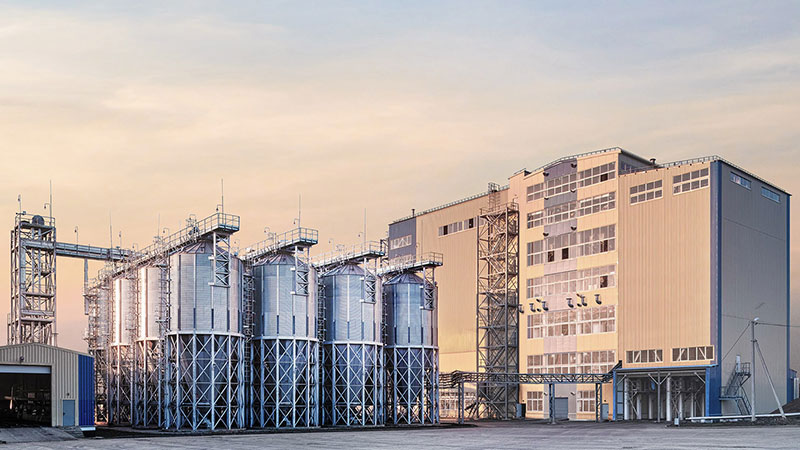
At RICHI, we go beyond project completion. With RICHI Servicee, we’re your dedicated partners in success. Count on us for expert guidance, minimal downtime, and optimized productivity. Choose RICHI for unmatched service and support.
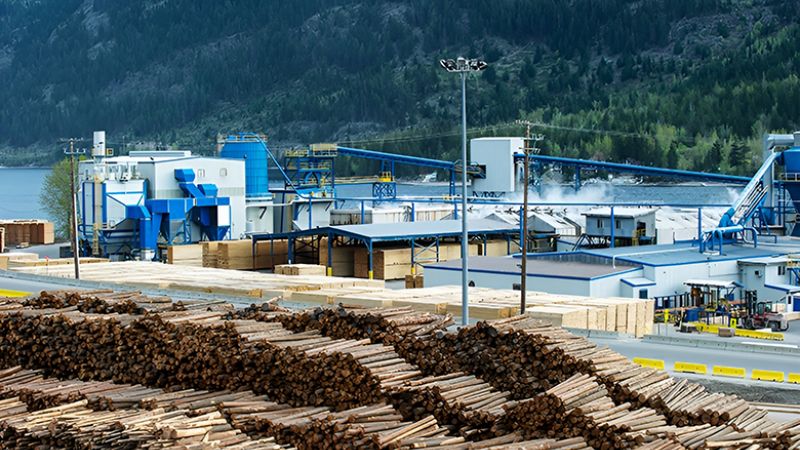


Meet global product demands and quality standards with industry-leading pellet plant design, engineering, equipment, and construction services for pellet processors.


Your Partner Beyond Project Completion
2000+ cases
RICHI is the leading designer, manufacturer and builder of pellet plants in the world, completing over 2000 projects in 140 countries across 6 continents.
Read More
Increase plant productivity, profitability, and safety by integrating high quality equipment into your pellet production line. Over the years, RICHI has become China's top pellet equipment manufacturer. At the same time, RICHI has established valuable partnerships with the world's leading component and raw material manufacturers to bring you the best there is in technology, automation, and efficiency in pelleting plant machinery.

For nearly 30 years, RICHI has been providing best-in-class pellet plant equipment and services to clients across a variety of industries, sizes, and needs. We pride ourselves on the knowledge and skill that each team member possesses – from our technical sales team to our process design engineers. You can count on RICHI Machinery to take your operation to the next level of innovation, quality, and success.
Need help with your pellet manufacturing plant project? Contact us today.
ANIMAL FEED
BIOMASS
WOOD
ORGANIC FERTILIZER
AQUA FEED
CAT LITTER
MUNICIPAL WASTE RECYCLING
SPECIAL PELLET PRODUCTION
RICHI Machinery continues to deliver world class pellet mill equipment, pellet plant engineering and project solutions that add value to our customers in the animal feed, wood waste, agriculture waste, organic fertilizer, cat litter and special pellet products industries. Throughout the years, we RICHI Machinery have built strong brand, becoming industry-leading pellet machine manufacturer. We value integrity, promise quality, and prioritize your success.
Learn MoreWith our expert team, we precisely implement your process engineering requirements in pellet mill and pelletizing plant systems. No matter which industry you’re in – we understand your needs and deliver solutions that meet the highest standards.
At RICHI, quality comes first. Our pellet making machine and related pellet line equipment undergo rigorous quality controls to ensure they meet the highest standards. Rely on products that are durable, safe, and efficient.
With decades of experience in pellet machine and pellet production line production, we have earned a reputation as a trusted partner in various industries. Our expertise allows us to cover a wide range of applications.
Not only do we offer premium pelleting equipment, but we are also experts at designing, building, installing, and maintaining facilities from the ground up. Our expertise is within pellt plant process design, discovering the most efficient, productive, and profitable way to handle your materials in an end-to-end cycle.
○ RICHI MACHINERY
Keeping in touch with us is an effective way to solve all your problems. If you have any needs or questions, please leave your contact information, then RICHI technical consultants will send design, quotation, videos to your mailbox. You can also contact us directly via WhatsApp: +86 13838389622
Copyright©2015-2026 by HENAN RICHI MACHINERY CO., LTD. All rights reserved.