
A modern poultry feed plant in Lower Saxony integrates two SZLH508 pellet mills for approximately 30–32 T/H of broiler, layer and turkey-feed pelleting capacity.
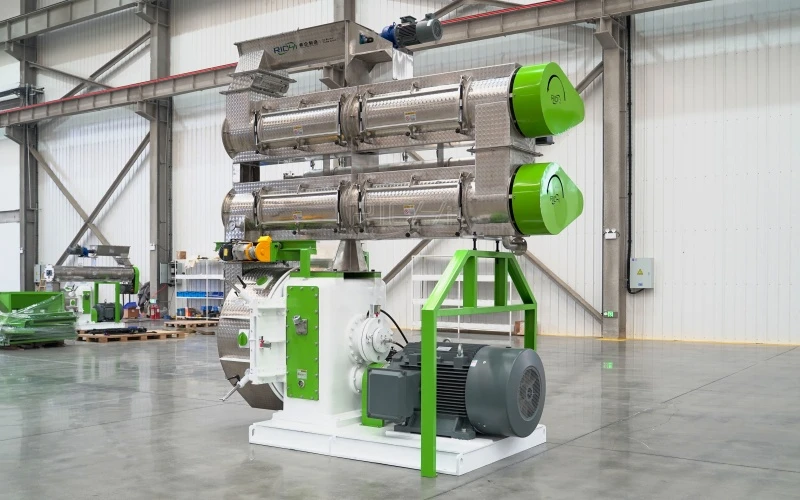
A modern compound-feed plant in Lower Saxony selected a two-mill Poultry Feed Pelleting System for Modern Plant in Germany to support high-volume broiler, layer and turkey-feed production. The facility already had automated grinding, batching, mixing, steam generation, cooling, screening and finished-feed handling, so the purchase focused on one coordinated pelleting module rather than another complete feed line.
The module uses two SZLH508 ring-die feed pellet mills, each with a 160 kW main motor, 1.5 kW feeder, 7.5 kW conditioner and 508 mm ring die. Each machine has a 15–16 T/H reference capacity under suitable compound-feed conditions, giving the pair about 30–32 T/H of nominal pelleting capacity while allowing the plant to schedule maintenance without depending on one press for all poultry products.
Name:
Parallel poultry-feed pelleting module
Country:
Germany
Date:
2026
Capacity:
15–16 T/H
Model:
SZLH508
Main Motor Power:
160 kW
Quantity:
2 units
Pellet diameter:
3–4.5 mm
Lower Saxony is one of Germany's strongest livestock and poultry regions, so a large commercial feed mill serving broiler, layer and turkey farms is a realistic customer profile. The plant is positioned as a regional compound-feed manufacturer rather than a single integrated farm, which better matches the throughput of two SZLH508 feed pellet machines and the requirement for multiple product campaigns across a long production week.
The project also fits Germany's mature grain and feed-material supply system. Wheat, maize, rapeseed products, soybean meal, minerals, amino acids, vegetable oils and approved by-products can all enter poultry formulas according to nutrition targets and market conditions. The mill does not rely on one permanent German formula, because ingredient economics and stage-specific nutrient requirements differ between broiler, layer and turkey products.
| Project Parameter | Configuration |
|---|---|
| Equipment | Parallel poultry-feed pelleting module |
| Pellet Mill Model | SZLH508 |
| Quantity | 2 units |
| Main Motor Power | 160 kW per unit |
| Feeder Power | 1.5 kW per unit |
| Conditioner Power | 7.5 kW per unit |
| Ring Die Inner Diameter | 508 mm |
| Available Pellet Diameter | 2–12 mm |
| Reference Capacity | Approximately 15–16 T/H per unit, formulation dependent |
| Combined Reference Capacity | Approximately 30–32 T/H under suitable conditions |
| Main Products | Broiler starter crumble, broiler grower and finisher pellets, layer feed and selected turkey feed |
| Installation Type | Standalone pelleting module integrated into an existing automated feed plant |
The two-unit configuration is sized around a realistic annual poultry-feed programme of roughly 160,000–180,000 tonnes rather than a 400,000 T/A claim that two SZLH508 mills could not support. At about 30 T/H combined useful output, 162,000 tonnes corresponds to roughly 18 effective pelleting hours per day over 300 production days before maintenance and lower-output formulas are considered.
The plant gains flexibility from parallel machines as well as throughput. One press can run a broiler or layer campaign while the other is prepared for another product, and one unit can remain available when the second requires die inspection or scheduled service. This does not mean every product should run simultaneously; the real advantage is avoiding a single-point pelleting bottleneck inside an otherwise highly automated factory.
Broiler starter feed is not treated as a direct 3 mm pellet for every flock. The plant can pellet suitable mash and then use its downstream pellet crumbler machine and screen to create the required starter particle range, while grower and finisher feeds can remain as intact pellets. Layer and turkey feeds can use different diameters when feeder design, bird age and commercial specification justify them.
For many broiler campaigns, grower and finisher pellets fall around the 3–4.5 mm class, while layer or turkey products may use larger diameters according to the customer's programme. Ring-die compression ratio is selected from the tested formula rather than fixed at 1:14 or 1:11 simply because the hole diameter differs. Fibre, fat, starch, mineral load and durability target all affect die resistance.
Formula control remains upstream of the pelleting system. Wheat, maize, soybean meal, rapeseed meal, vegetable oil, minerals, vitamins and amino acids are proportioned by the plant's nutrition programme before mash reaches the surge bins. High pre-pellet oil can reduce die friction and pellet strength, so liquid addition is coordinated with physical-quality targets instead of applying one permanent percentage to every poultry formula.
The modern plant can connect feeder speed, motor current, operating status, alarms and selected condition-monitoring signals to its central control architecture, but the interface is engineered from the customer's approved I/O list and communication standard. The article therefore does not assume one fixed Profibus, Profinet or Siemens arrangement for every project, because controls depend on the electrical design adopted at the site.
Variable-speed feeding lets the operator coordinate mash flow with main-motor load and product condition, but an automatic loop still needs sensible limits and operator oversight. Bearing temperature or vibration monitoring can also be included through specified sensors when required. These tools support maintenance decisions, yet they cannot guarantee that every developing fault will be detected before failure.
Energy performance is tracked from real power data and tonnes produced rather than a universal 8–10 kWh/T promise. Small die holes, high compression, high fibre, elevated durability targets and poor steam quality can all raise specific energy consumption. A modern plant therefore compares like-for-like formulas and die conditions when evaluating kWh/T, instead of treating one number as a permanent machine characteristic.
Each SZLH508 conditioner prepares mixed mash with steam before ring-die compression, but conditioning temperature and steam addition are not locked to one table for starter, grower, finisher or layer feed. The useful setting depends on incoming mash moisture, starch, protein, fibre, fat, hygienic objectives and pellet quality. Steam quality and condensate management matter as much as the nominal boiler output.
Two poultry feed pellet machines delivering close to 30 T/H together require downstream cooling and screening capacity that can accept the same instantaneous flow. A smaller cooler would immediately restrict the system even if the presses themselves were capable of more. Starter crumble routes also need enough crumbler and screening capacity, while products that bypass crumbling should move directly to the appropriate finished-feed path.
Pellet durability, fines, moisture, temperature and bulk density are monitored against product specifications rather than assigned one guaranteed result to the SZLH508. The pellet mill cannot independently improve broiler growth, layer performance or turkey feed intake. Biological results depend on nutrition, animal genetics, housing, health, water and farm management as well as the physical quality of the delivered feed.
For machinery destined for Lower Saxony, the Port of Hamburg provides a practical import gateway before inland movement to the feed plant. Final routing can use container or project-cargo handling according to package dimensions and shipment planning. The project does not rely on a fixed ocean-transit or customs period, because vessel service, terminal handling and inland transport conditions vary by booking.
Before delivery, the plant confirms foundation loads, maintenance clearances, mash-bin outlets, feeder elevations, steam connections, electrical interfaces, pellet discharge heights and access for ring-die service. The two-machine layout also needs safe working space between presses and downstream equipment. A modern control room does not solve poor physical integration, so mechanical, utility and automation interfaces are reviewed together.
If annual poultry-feed demand rises, the first question is whether the two SZLH508 mills are truly the limiting section. Grinding, batching, mixing, steam generation, cooling, crumbling, screening, finished bins and dispatch all have to support more tonnes. Adding a third press before those sections have reserve can create idle installed power while shifting the bottleneck only a few metres downstream.
For another buyer evaluating a Poultry Feed Pelleting System for Modern Plant in Germany, RICHI Machinery would review annual product mix, required T/H, starter-crumble share, pellet diameters, formula fat and fibre, mixer cycle, surge-bin capacity, steam supply, cooler and screener capacity, electrical service, automation interface, operating hours and available layout before confirming the number and model of pellet mills.
Having the right mix of reliable, high-quality pellet machine and pelletizing systems and expert support is essential to your success. Watch how our end-to-end feed pellet plant solutions have helped our customers optimize their performance.
Our customized and future-proofed turnkey pellet plant solutions is designed with you at the core. From vision to reality and beyond, our team stays connected with yours. Giving you peace-of-mind with an expert at your side.
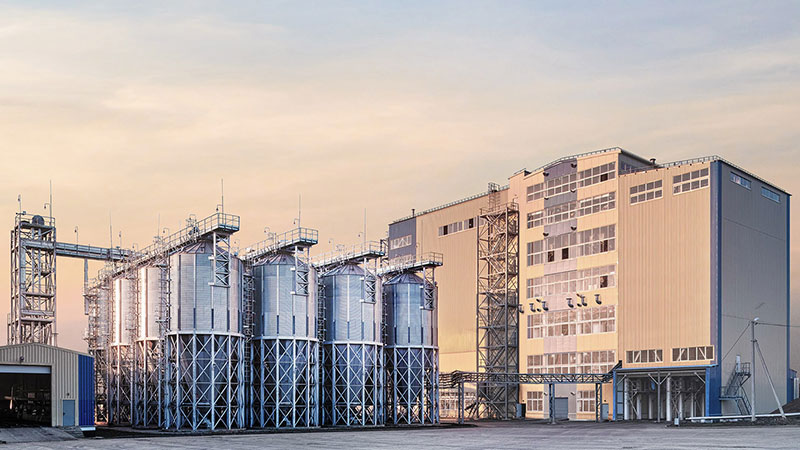
At RICHI, we go beyond project completion. With RICHI Servicee, we’re your dedicated partners in success. Count on us for expert guidance, minimal downtime, and optimized productivity. Choose RICHI for unmatched service and support.
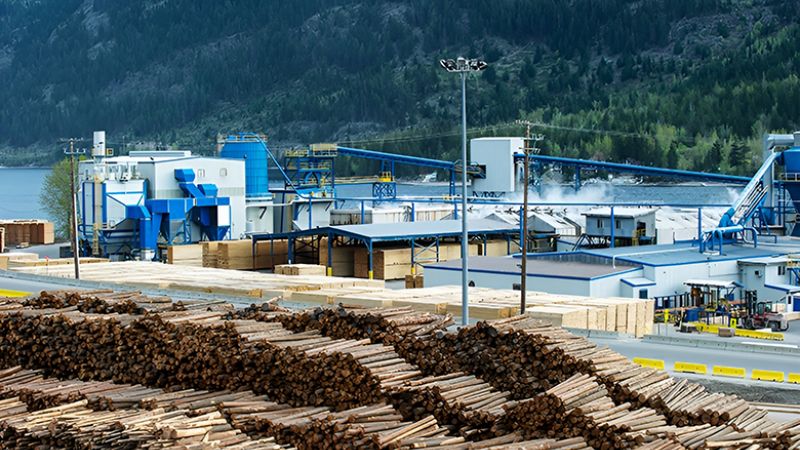


Meet global product demands and quality standards with industry-leading pellet plant design, engineering, equipment, and construction services for pellet processors.


Your Partner Beyond Project Completion
2000+ cases
RICHI is the leading designer, manufacturer and builder of pellet plants in the world, completing over 2000 projects in 140 countries across 6 continents.
Read More
Increase plant productivity, profitability, and safety by integrating high quality equipment into your pellet production line. Over the years, RICHI has become China's top pellet equipment manufacturer. At the same time, RICHI has established valuable partnerships with the world's leading component and raw material manufacturers to bring you the best there is in technology, automation, and efficiency in pelleting plant machinery.

For nearly 30 years, RICHI has been providing best-in-class pellet plant equipment and services to clients across a variety of industries, sizes, and needs. We pride ourselves on the knowledge and skill that each team member possesses – from our technical sales team to our process design engineers. You can count on RICHI Machinery to take your operation to the next level of innovation, quality, and success.
Need help with your pellet manufacturing plant project? Contact us today.
ANIMAL FEED
BIOMASS
WOOD
ORGANIC FERTILIZER
AQUA FEED
CAT LITTER
MUNICIPAL WASTE RECYCLING
SPECIAL PELLET PRODUCTION
RICHI Machinery continues to deliver world class pellet mill equipment, pellet plant engineering and project solutions that add value to our customers in the animal feed, wood waste, agriculture waste, organic fertilizer, cat litter and special pellet products industries. Throughout the years, we RICHI Machinery have built strong brand, becoming industry-leading pellet machine manufacturer. We value integrity, promise quality, and prioritize your success.
Learn MoreWith our expert team, we precisely implement your process engineering requirements in pellet mill and pelletizing plant systems. No matter which industry you’re in – we understand your needs and deliver solutions that meet the highest standards.
At RICHI, quality comes first. Our pellet making machine and related pellet line equipment undergo rigorous quality controls to ensure they meet the highest standards. Rely on products that are durable, safe, and efficient.
With decades of experience in pellet machine and pellet production line production, we have earned a reputation as a trusted partner in various industries. Our expertise allows us to cover a wide range of applications.
Not only do we offer premium pelleting equipment, but we are also experts at designing, building, installing, and maintaining facilities from the ground up. Our expertise is within pellt plant process design, discovering the most efficient, productive, and profitable way to handle your materials in an end-to-end cycle.
○ RICHI MACHINERY
Keeping in touch with us is an effective way to solve all your problems. If you have any needs or questions, please leave your contact information, then RICHI technical consultants will send design, quotation, videos to your mailbox. You can also contact us directly via WhatsApp: +86 13838389622
Copyright©2015-2026 by HENAN RICHI MACHINERY CO., LTD. All rights reserved.