
Pellet cooling system in Zambia was selected for a commercial poultry feed manufacturer that needed to improve the handling of finished feed pellets without replacing its existing production equipment.
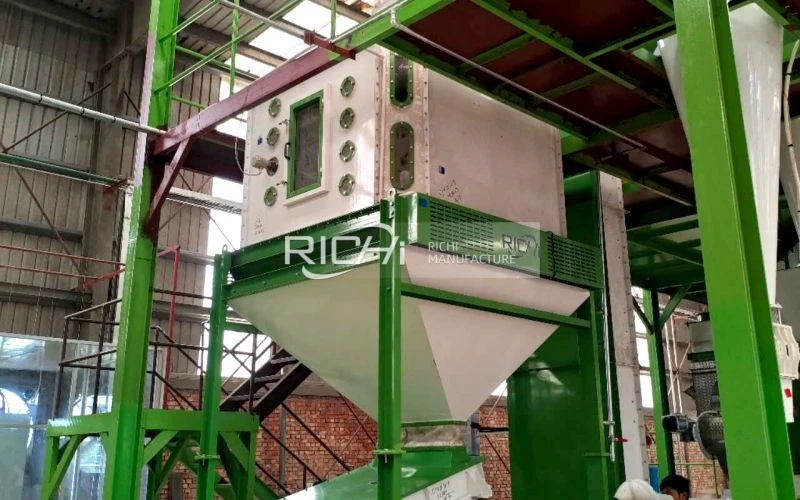
Pellet cooling system in Zambia was selected for a commercial poultry feed manufacturer that needed to improve the handling of finished feed pellets without replacing its existing production equipment. The plant served poultry farms and feed distributors in a market where consistent feed quality, dependable production schedules, and manageable operating costs were important to day-to-day business.
Its existing pellet mill could produce the required feed, but the cooling stage had become a constraint during busy production periods. Rather than invest in a complete new line, the manufacturer decided to purchase one RICHI counterflow pellet cooler to improve the process immediately after pelleting.
Name:
poultry feed pellets cooler
Country:
Zambia
Date:
2026
Capacity:
3–5 T/H
Model:
SKLF14*14
Main Motor Power:
1.5 kW
cooling time:
6–15 minutes
Main product:
3–4mm
The project centered on cooling approximately 3–4 mm poultry feed pellets made from a grain-and-protein formula based on locally available maize, soybean meal, and other suitable feed ingredients. The new machine would receive hot pellets from the existing pellet mill, reduce their temperature before screening and bagging, and help prepare the finished product for storage and delivery.
The purchase was limited to one cooling machine, making it a targeted equipment upgrade rather than a full feed mill installation. This approach allowed the customer to retain serviceable machinery while addressing a specific production bottleneck.
Zambia has an established poultry sector supported by commercial broiler production, egg farming, feed distribution, and a network of small and medium-sized livestock businesses. Maize is an important ingredient in poultry feed formulations, while soybean meal and other protein sources help balance the nutritional requirements of different bird groups. For feed manufacturers supplying growing farms, producing a consistent pellet is only one part of the job. The product must also remain in suitable condition during conveying, storage, transport, and use.
At this plant, the main concern was not the grinding or mixing stage. The existing feed production line could prepare the formulation and press it into pellets, but the post-pelleting section did not always provide sufficient cooling capacity for the required production rhythm. When hot pellets move into downstream equipment before they have cooled adequately, operators may need to slow the process, wait longer between batches, or pay closer attention to the condition of the finished product.
Freshly pressed feed pellets retain heat and moisture from conditioning and compression. If they are transferred into bags or storage bins while still excessively warm, temperature differences can contribute to condensation under unsuitable storage conditions. The resulting moisture problems can affect pellet durability and storage stability. Excessive handling of inadequately cooled pellets may also increase breakage and fines, creating additional work for screening equipment and reducing the proportion of intact pellets delivered to customers.
The manufacturer therefore needed a more controlled cooling stage rather than another pellet mill. Adding a dedicated pellet cooling system offered a practical way to address the limitation while preserving the existing grinding, batching, mixing, and pelleting equipment. It also gave the plant an opportunity to improve the coordination between the pellet mill and the downstream screening and packaging stages.
For this application, the selected machine is the RICHI SKLF14*14 counterflow pellet cooler. Its rated throughput is 3–5 T/H, with a listed drive power of 1.5 kW. This capacity is suitable as a reference selection for a small-to-medium commercial feed operation that needs to handle a moderate volume of poultry feed pellets without installing an unnecessarily large cooling machine.
The SKLF series uses a counterflow cooling arrangement in which the cooling air moves through the material in the opposite direction to the pellets. This supports gradual heat removal as the pellets pass through the cooling chamber. Under suitable operating conditions, the typical cooling period is approximately 6–15 minutes, and the discharged pellets can reach a temperature around 3–5°C above ambient temperature.
These values are equipment reference specifications, not a guarantee that every formula will achieve the same result. Actual cooling performance depends on incoming pellet temperature, moisture content, pellet diameter, bulk density, airflow, material-bed depth, ambient conditions, and the way the cooler is integrated into the line. The final operating settings should therefore be confirmed during commissioning using the customer's actual feed product.
| Project item | Specification |
|---|---|
| Equipment | Automatic counterflow pellet cooler |
| Model | SKLF14*14 |
| Rated throughput | 3–5 T/H |
| Drive power | 1.5 kW |
| Typical cooling time | 6–15 minutes |
| Reference discharge temperature | Approximately 3–5°C above ambient temperature |
| Main product | Approximately 3–4 mm poultry feed pellets |
| Purchase scope | One standalone cooling machine |
| Shipping origin | Qingdao Port, China |
| Destination port | Port of Dar es Salaam, Tanzania |
The SKLF14*14 was chosen to suit the intended production rate and the customer's preference for a focused upgrade. The final selection should still be checked against the pellet mill's actual output, the feed's physical characteristics, and the capacity of the equipment that follows the cooler. A machine rated at 3–5 T/H does not automatically guarantee the same continuous output under every operating condition.
The primary product for this project is compound poultry feed in pellet form. A representative formula may use maize as its principal energy ingredient, soybean meal as a major protein source, and wheat bran or another suitable ingredient to contribute additional nutrients and influence the physical characteristics of the mixture. Depending on the product specification, the formula may also include vegetable oil, limestone, phosphate sources, salt, a vitamin-mineral premix, and other approved feed additives.
The exact inclusion rates depend on whether the finished feed is intended for broilers, layers, or another poultry category. A broiler grower or finisher formula, for example, has different nutritional targets from a layer ration. The customer's formulation and quality-control requirements therefore remain separate from the function of the pellet cooler.
For the selected application, approximately 3–4 mm pellets provide a practical reference size for commercial poultry feed. The actual diameter should follow the customer's product specification and the requirements of the birds being fed. The cooler does not determine the pellet diameter; that is primarily established by the feed pellet machine's die and the production settings.
Once the hot pellets leave the pellet mill, the cooler reduces their temperature before the material reaches the next handling stage. This helps the plant move the product toward screening, where fines and unsuitable particles can be separated, and then toward bulk storage or bagging. Cooling is especially important when the finished feed will be packed and held for distribution rather than delivered immediately after production.
The cooler is not intended to dry wet feed or correct an unsuitable formulation. Its purpose is to remove heat and support appropriate post-pelleting handling. If the incoming pellets have excessive moisture or the formulation is not producing a stable pellet, those issues need to be addressed through the relevant upstream process controls rather than relying on the cooler alone.
In a counterflow pellet cooling machine, hot pellets enter the chamber from the upper section while air passes through the material in the opposite direction. This arrangement allows the pellets to cool progressively as they move through the cooling zone. Compared with simply leaving a pile of hot pellets to cool, a dedicated counterflow cooler provides a controlled process with defined material movement and airflow.
One important factor is the distribution of material across the cooling chamber. If pellets accumulate heavily on one side, airflow may favor thinner sections of the bed, leaving other areas less effectively cooled. The SKLF cooler uses a four-way adjustable distributor to help spread material more evenly. This supports better use of the cooling area and helps reduce differences in cooling conditions across the product flow.
Mechanical material-level control helps maintain a suitable quantity of pellets in the chamber. A stable material bed is important because the airflow must pass through the pellets rather than escaping too easily through gaps or thin sections. Correct adjustment of the feed and discharge rates therefore contributes to consistent cooling performance.
The SKLF series also uses a swing-flap discharge mechanism controlled by a flexible hydraulic transmission system. Its purpose is to release cooled pellets smoothly and maintain a steady flow. Gentle discharge is useful in poultry feed production because unnecessary impact and rough handling can generate fines after the pellets have already been formed.
The octagonal chamber design helps reduce dead zones where material might otherwise remain trapped. The curved discharge hopper is designed to support material flow and limit residual accumulation. Stainless steel is used for the cooler's top section and rotary airlock feeder, helping improve corrosion resistance in areas exposed to feed dust and normal operating conditions.
For this Zambian manufacturer, replacing the entire feed production line would have been a much broader investment than the immediate process problem required. The grinding, mixing, and pelleting machinery was already in place. The main need was to improve the stage between pellet formation and finished-feed handling.
A standalone pellet cooling system can be a cost-conscious way to improve an existing plant when the cooling stage is the principal constraint. It also allows the customer to schedule installation around the existing production arrangement, provided that the machine interfaces, structural requirements, and material-transfer points are properly assessed in advance.
The SKLF14*14 has a listed drive power of 1.5 kW, making its direct drive requirement relatively modest. However, the total electrical demand of a complete cooling section may also include the associated cooling fan and other auxiliary equipment. The customer's electrical assessment should account for those loads separately rather than treating the cooler's drive rating as the total demand of the entire cooling system.
RICHI offers several counterflow cooler sizes, ranging from models rated at 1–3 T/H to larger units rated at 30–40 T/H. This range allows equipment selection to follow the actual process requirement. Installing a larger cooler is not automatically better: the machine needs to suit the production rate, available space, material characteristics, and downstream equipment.
For a plant that produces several poultry feed formulations, the selection process should also consider whether the same machine will handle different pellet diameters and moisture levels. The cooler may serve multiple suitable products, but its settings and actual performance should be checked whenever the product changes significantly.
Adding a counterflow pellet cooler to an operating feed mill involves more than positioning the machine beneath the pellet mill. The incoming conveyor must deliver pellets at a suitable rate, and the cooler's discharge needs to connect properly with the next conveying or screening stage. The available headroom, structural support, maintenance access, and position of dust-control equipment also need to be reviewed.
For this project, the technical review should begin with the existing line layout and the customer's normal production data. Relevant information includes the pellet mill's actual throughput, typical pellet diameter, inlet temperature, product moisture, downstream screening capacity, and the space available for installation. These details help determine whether the selected model can operate effectively within the existing production arrangement.
RICHI can provide equipment selection guidance, layout coordination, interface information, operating recommendations, and installation support. Clear technical documentation is particularly useful for an overseas installation where the customer's maintenance staff or a local engineering contractor may carry out much of the installation work.
During commissioning, the distributor, material-level control, airflow, and discharge mechanism should be checked under actual operating conditions. Temperature measurements at the cooler inlet and outlet can then help determine whether the cooling time and operating settings are suitable for the product. If the results are inconsistent, the operator should review material distribution, bed depth, airflow, feed rate, and pellet condition before changing the production target.
Routine maintenance should include inspection of the discharge mechanism, drive components, seals, air passages, and areas where feed dust can accumulate. Providing adequate access around the machine during layout design makes these tasks easier and can help prevent avoidable interruptions.
The equipment is planned for sea shipment from Qingdao Port in China to the Port of Dar es Salaam in Tanzania. Dar es Salaam is a major regional gateway for imported goods and is commonly used for cargo serving landlocked markets in the region, including Zambia.
Before dispatch, the cooler should be checked against the agreed order specifications, including the model designation, drive rating, supplied components, packing protection, and shipping documentation. Proper preparation helps protect the equipment during handling and makes it easier for the receiving party to identify the machine and its accessories when the shipment arrives.
The importer should confirm the applicable documentation and import requirements before shipment. The details depend on the order and the relevant regulations, so they should be verified for the specific consignment rather than assumed to be the same for every machinery shipment.
For the feed manufacturer, the most important measure of the investment is whether the new cooling stage can keep pace with the feed pellet mill while delivering pellets in suitable condition for screening, storage, and distribution. The objective is not to change the feed formula or increase the pellet mill's mechanical capacity. It is to make the post-pelleting process more predictable and reduce the likelihood that cooling becomes the factor limiting normal production.
During the initial operating period, the plant can evaluate the cooler by recording inlet and outlet pellet temperatures, monitoring the stability of the discharge flow, and checking whether the downstream equipment receives material at a consistent rate. The team can also compare the amount of fines produced during handling and observe whether the finished product is suitable for the plant's usual storage and bagging practices.
These checks provide a practical basis for assessing the equipment. Actual benefits should be confirmed through production measurements and operating records rather than assumed from the model's rated capacity alone. This also gives the operator useful information for adjusting the cooling process when the feed formulation, pellet diameter, or production rate changes.
The Pellet cooling system in Zambia project demonstrates how one carefully selected machine can address a specific weakness in an existing feed production line. By adding the SKLF14*14 counterflow pellet cooler, the manufacturer can focus its investment on cooling and post-pelleting handling instead of replacing machinery that remains suitable for its current production needs.
The selected model has a rated throughput of 3–5 T/H, a drive power of 1.5 kW, and a typical cooling time of 6–15 minutes. Its counterflow principle, adjustable material distribution, controlled material level, and gentle discharge mechanism are intended to support gradual cooling and reduce unnecessary pellet damage. Actual performance depends on the feed characteristics, operating conditions, and installation arrangement.
For poultry feed manufacturers in Zambia and other regional markets, choosing a pellet cooling machine should begin with the actual production rate, pellet diameter, incoming pellet temperature, and downstream handling requirements. A properly matched cooler can help improve process coordination while allowing the factory to retain its existing equipment where appropriate.
RICHI Machinery can assist prospective buyers with model selection, technical coordination, and project-specific equipment recommendations. To assess a pellet cooling system for an existing or planned production line, buyers can provide the target throughput, pellet size, normal inlet temperature, and current process layout. These details give the technical team a practical starting point for confirming the suitable cooler configuration and preparing a quotation.
Having the right mix of reliable, high-quality pellet machine and pelletizing systems and expert support is essential to your success. Watch how our end-to-end feed pellet plant solutions have helped our customers optimize their performance.
Our customized and future-proofed turnkey pellet plant solutions is designed with you at the core. From vision to reality and beyond, our team stays connected with yours. Giving you peace-of-mind with an expert at your side.

At RICHI, we go beyond project completion. With RICHI Servicee, we’re your dedicated partners in success. Count on us for expert guidance, minimal downtime, and optimized productivity. Choose RICHI for unmatched service and support.



Meet global product demands and quality standards with industry-leading pellet plant design, engineering, equipment, and construction services for pellet processors.


Your Partner Beyond Project Completion
2000+ cases
RICHI is the leading designer, manufacturer and builder of pellet plants in the world, completing over 2000 projects in 140 countries across 6 continents.
Read More
Increase plant productivity, profitability, and safety by integrating high quality equipment into your pellet production line. Over the years, RICHI has become China's top pellet equipment manufacturer. At the same time, RICHI has established valuable partnerships with the world's leading component and raw material manufacturers to bring you the best there is in technology, automation, and efficiency in pelleting plant machinery.

For nearly 30 years, RICHI has been providing best-in-class pellet plant equipment and services to clients across a variety of industries, sizes, and needs. We pride ourselves on the knowledge and skill that each team member possesses – from our technical sales team to our process design engineers. You can count on RICHI Machinery to take your operation to the next level of innovation, quality, and success.
Need help with your pellet manufacturing plant project? Contact us today.
ANIMAL FEED
BIOMASS
WOOD
ORGANIC FERTILIZER
AQUA FEED
CAT LITTER
MUNICIPAL WASTE RECYCLING
SPECIAL PELLET PRODUCTION
RICHI Machinery continues to deliver world class pellet mill equipment, pellet plant engineering and project solutions that add value to our customers in the animal feed, wood waste, agriculture waste, organic fertilizer, cat litter and special pellet products industries. Throughout the years, we RICHI Machinery have built strong brand, becoming industry-leading pellet machine manufacturer. We value integrity, promise quality, and prioritize your success.
Learn MoreWith our expert team, we precisely implement your process engineering requirements in pellet mill and pelletizing plant systems. No matter which industry you’re in – we understand your needs and deliver solutions that meet the highest standards.
At RICHI, quality comes first. Our pellet making machine and related pellet line equipment undergo rigorous quality controls to ensure they meet the highest standards. Rely on products that are durable, safe, and efficient.
With decades of experience in pellet machine and pellet production line production, we have earned a reputation as a trusted partner in various industries. Our expertise allows us to cover a wide range of applications.
Not only do we offer premium pelleting equipment, but we are also experts at designing, building, installing, and maintaining facilities from the ground up. Our expertise is within pellt plant process design, discovering the most efficient, productive, and profitable way to handle your materials in an end-to-end cycle.
○ RICHI MACHINERY
Keeping in touch with us is an effective way to solve all your problems. If you have any needs or questions, please leave your contact information, then RICHI technical consultants will send design, quotation, videos to your mailbox. You can also contact us directly via WhatsApp: +86 13838389622
Copyright©2015-2026 by HENAN RICHI MACHINERY CO., LTD. All rights reserved.