
A specialty feed manufacturer in Singapore uses one SPHS75×2 twin-screw extruder to produce 1–2 mm floating ornamental fish feed for small commercial batches.
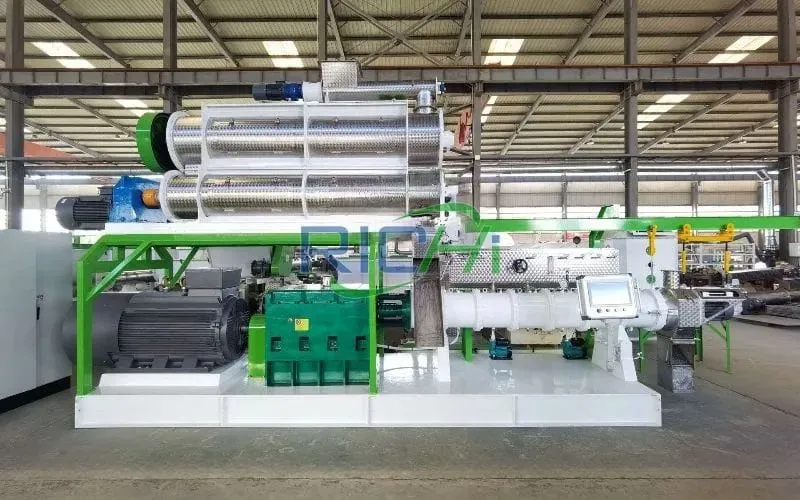
A specialty feed manufacturer in Singapore selected one SPHS75×2 Ornamental Fish Feed Making Extruder in Singapore to add floating micro-pellet production for aquarium-fish farms and distributors. The factory already had fine grinding, batch mixing, drying, cooling and small-pack handling, so the investment focused on the extrusion stage rather than another complete aquafeed line.
The project is built around small commercial campaigns rather than commodity fish-feed volume. The twin-screw extruder has a 55 kW main motor, 1.5 kW feeder and project-configured 7.5 kW conditioner, with about 0.5–1.0 T/H reference output depending on formula, die restriction, expansion and moisture. Small-diameter ornamental feeds can run below the upper end of that range.
Name:
ornamental fish feed extruder
Country:
Singapore
Date:
2026
Capacity:
0.5–1.0 T/H
Model:
SPHS75×2
Main Motor Power:
55 kW
Main Product:
ornamental fish feed
Final product size:
1.0–3.0 mm
The customer serves breeders, aquarium distributors and private-label buyers that require several small feed formats rather than one high-volume grower pellet. Singapore’s limited industrial space and specialty ornamental-fish market make flexible campaign production more relevant than a large commodity aquafeed plant, especially when each SKU may use a different protein, pigment or functional ingredient package.
The manufacturer therefore schedules products in commercial batches large enough to justify start-up, stabilization, drying and cleanout. A nominal 500 kg run is technically possible near the lower production range, but it is not treated as the ideal batch for every SKU because extrusion creates start-up material and cleaning time. Longer campaigns improve utilization when the same die and formulation can remain in production.
The project also avoids the assumption that ornamental fish require brightly colored pellets. Carotenoids, spirulina or other permitted ingredients may be included when a formula is designed to support fish pigmentation, but feed appearance is secondary to nutritional specification, palatability, water behavior and particle size. The fish feed extruder processes the formula; it does not guarantee fish coloration.
| Project Parameter | Configuration |
|---|---|
| Equipment | Twin-screw floating aquafeed extruder |
| Model | SPHS75×2 |
| Quantity | 1 unit |
| Main Motor Power | 55 kW |
| Feeder Power | 1.5 kW |
| Conditioner | Single-stage conditioner, project configuration 7.5 kW |
| Reference Capacity | Approximately 0.5–1.0 T/H, formula and size dependent |
| Main Direct-Extruded Product | Approximately 1.0–2.0 mm floating micro-pellets |
| Secondary Product | Approximately 2.0–3.0 mm floating pellets for larger ornamental fish |
| Very Small Feed Route | Sub-1 mm products through a validated microfeed or crumble-and-screen route |
| Installation Type | Standalone extrusion-stage addition |
The 0.5–1.0 T/H capacity is a reference range, not a promise that every micro-pellet will run at one rate. Smaller die openings increase restriction, while high protein, fat, fibre or low-starch formulas can alter expansion and throughput. The operator therefore balances feed rate, moisture, screw loading, die pressure and cutter speed around the actual product instead of forcing every SKU toward maximum tonnage.
Twin-screw processing was selected because the plant expects frequent formula and density variation across ornamental-feed products. The two screws provide active conveying and mixing through the barrel, which can offer a wider operating window for specialty recipes. That does not make single-screw extrusion unsuitable for ornamental feed; the decision reflects this customer’s multi-SKU production plan.
The main direct-extruded products are approximately 1.0–2.0 mm because this range can serve many juvenile and small adult ornamental-fish applications without pushing the machine toward extremely fine die openings. Larger aquarium species can use approximately 2.0–3.0 mm products, but the correct feed size is selected from fish mouth size, feeding behavior and breeder specification.
Very small fry require a different approach. Products below about 1 mm may be made through a dedicated microfeed process or by producing a larger stable feed and then crumbling and screening it into controlled fractions. The case therefore does not claim that the SPHS75×2 should directly extrude every 0.3 or 0.5 mm fry feed at commercial efficiency simply because small particles are needed.
Pellet length is not fixed across the range. Cutter speed, die design and expansion determine the final piece length, while some microfeeds are better described by particle-size fraction than by cylinder length. This is why the product table specifies diameter bands but avoids inventing one exact length for guppy, betta, discus or other ornamental species without a confirmed buyer specification.
The RICHI extruder is only one unit operation. Fresh floating feed leaving the die contains too much moisture for shelf-stable packaging, so a correctly sized dryer remains essential. Cooling follows drying before the product is sealed, while screening separates oversize and fines. Existing upstream and downstream equipment stays in service only when its hourly capacity and hygiene design match the extruder’s real production duty.
The existing animal feed hammer mill is also checked rather than automatically accepted. Small ornamental-feed formats require a fine and consistent ingredient grind so coarse particles do not block restricted die openings or create weak pieces. If the current grinder cannot deliver the required particle distribution, the plant needs a finer grinding step even though the extruder itself was the only machine purchased in this project.
The plant does not specify a universal thirty-minute floating time. Floatability depends on finished density and expansion, which are influenced by starch functionality, formulation moisture, mechanical energy, screw configuration, barrel conditions and die restriction. A 1.5 mm pellet can sink while a 2 mm pellet floats if the two products leave the extruder with different densities.
Water stability is treated separately from floating time. A feed can remain on the surface yet soften or lose nutrients rapidly, while another can sink slowly and still maintain strong structural integrity. The manufacturer evaluates floatability, water stability, fines, bulk density and moisture as separate quality attributes rather than using one floating-time number as proof that the extrusion process is correct.
Recipe fat also needs careful placement. High fat before extrusion can reduce friction and expansion, while liquid oil or palatant can be applied later when the product design allows it. The plant therefore evaluates pre-extrusion and post-drying liquid addition separately for each formula instead of loading all desired fat into the mixer and expecting the extruder to preserve the same floating density.
Singapore’s warm, humid environment makes the post-extrusion section important for small retail packs. The belt dryer establishes the required shelf-stable moisture range, and the cooler then lowers product temperature before screening and packing. Hot feed should not be sealed simply because it feels dry at the surface, since residual heat can promote moisture migration inside barrier packaging after filling.
Dryer capacity is checked from water evaporation rather than extruder tonnes alone. A denser 2 mm feed and a more expanded 1 mm feed can leave extrusion with different moisture and bulk volume even at similar mass flow. The plant therefore measures wet-product moisture, target moisture and hourly feed rate before setting dryer residence time, airflow and temperature for each product family.
Packaging also forms part of the moisture-control strategy. Small ornamental-feed packs may remain open repeatedly in aquarium shops or breeding rooms, so barrier properties and pack size matter after manufacturing. The extruder cannot compensate for poor storage after production, and the article does not claim a fixed shelf life without validated moisture, water activity, packaging and storage tests.
A second extruder is not the first expansion step simply because the ornamental-feed portfolio grows. The plant first checks whether fine grinding, mixing, drying, cooling, screening and small-pack filling can handle more SKU hours. If the dryer is already full or cleanout time dominates the schedule, another extruder would create waiting product rather than more finished feed.
For another buyer evaluating an Ornamental Fish Feed Making Extruder in Singapore, the key inputs are species groups, fish size, direct-extruded diameter, fry-feed route, formula protein and fat, starch system, target density, hourly output, minimum practical campaign size, dryer evaporation duty, cooler capacity, packaging format, power supply and available workshop dimensions.
Having the right mix of reliable, high-quality pellet machine and pelletizing systems and expert support is essential to your success. Watch how our end-to-end feed pellet plant solutions have helped our customers optimize their performance.
Our customized and future-proofed turnkey pellet plant solutions is designed with you at the core. From vision to reality and beyond, our team stays connected with yours. Giving you peace-of-mind with an expert at your side.
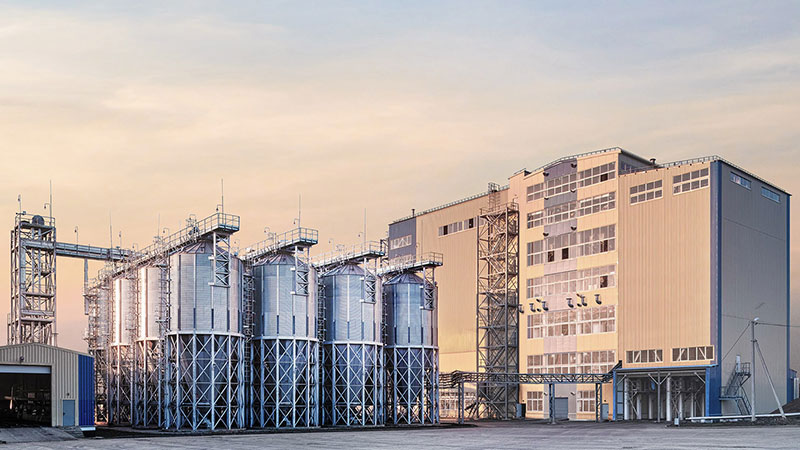
At RICHI, we go beyond project completion. With RICHI Servicee, we’re your dedicated partners in success. Count on us for expert guidance, minimal downtime, and optimized productivity. Choose RICHI for unmatched service and support.
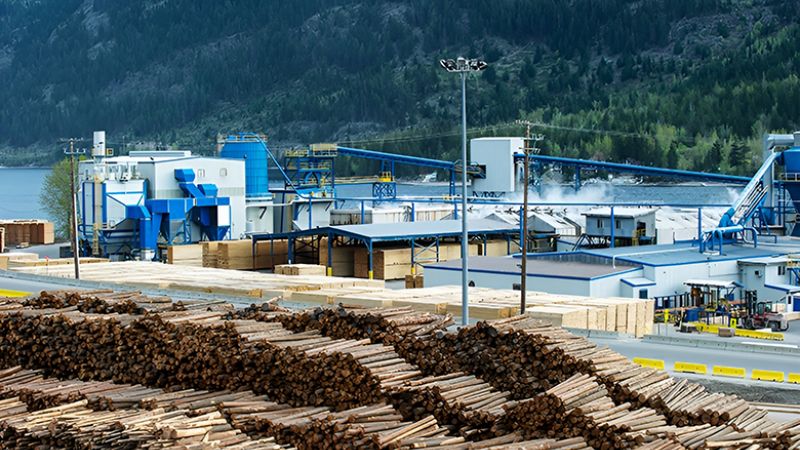


Meet global product demands and quality standards with industry-leading pellet plant design, engineering, equipment, and construction services for pellet processors.


Your Partner Beyond Project Completion
2000+ cases
RICHI is the leading designer, manufacturer and builder of pellet plants in the world, completing over 2000 projects in 140 countries across 6 continents.
Read More
Increase plant productivity, profitability, and safety by integrating high quality equipment into your pellet production line. Over the years, RICHI has become China's top pellet equipment manufacturer. At the same time, RICHI has established valuable partnerships with the world's leading component and raw material manufacturers to bring you the best there is in technology, automation, and efficiency in pelleting plant machinery.

For nearly 30 years, RICHI has been providing best-in-class pellet plant equipment and services to clients across a variety of industries, sizes, and needs. We pride ourselves on the knowledge and skill that each team member possesses – from our technical sales team to our process design engineers. You can count on RICHI Machinery to take your operation to the next level of innovation, quality, and success.
Need help with your pellet manufacturing plant project? Contact us today.
ANIMAL FEED
BIOMASS
WOOD
ORGANIC FERTILIZER
AQUA FEED
CAT LITTER
MUNICIPAL WASTE RECYCLING
SPECIAL PELLET PRODUCTION
RICHI Machinery continues to deliver world class pellet mill equipment, pellet plant engineering and project solutions that add value to our customers in the animal feed, wood waste, agriculture waste, organic fertilizer, cat litter and special pellet products industries. Throughout the years, we RICHI Machinery have built strong brand, becoming industry-leading pellet machine manufacturer. We value integrity, promise quality, and prioritize your success.
Learn MoreWith our expert team, we precisely implement your process engineering requirements in pellet mill and pelletizing plant systems. No matter which industry you’re in – we understand your needs and deliver solutions that meet the highest standards.
At RICHI, quality comes first. Our pellet making machine and related pellet line equipment undergo rigorous quality controls to ensure they meet the highest standards. Rely on products that are durable, safe, and efficient.
With decades of experience in pellet machine and pellet production line production, we have earned a reputation as a trusted partner in various industries. Our expertise allows us to cover a wide range of applications.
Not only do we offer premium pelleting equipment, but we are also experts at designing, building, installing, and maintaining facilities from the ground up. Our expertise is within pellt plant process design, discovering the most efficient, productive, and profitable way to handle your materials in an end-to-end cycle.
○ RICHI MACHINERY
Keeping in touch with us is an effective way to solve all your problems. If you have any needs or questions, please leave your contact information, then RICHI technical consultants will send design, quotation, videos to your mailbox. You can also contact us directly via WhatsApp: +86 13838389622
Copyright©2015-2026 by HENAN RICHI MACHINERY CO., LTD. All rights reserved.