
A floating fish feed producer in Punjab integrates one SKLF20×20 industrial counterflow cooler for 2–5 mm dried aquafeed at an 8–10 T/H production scale.
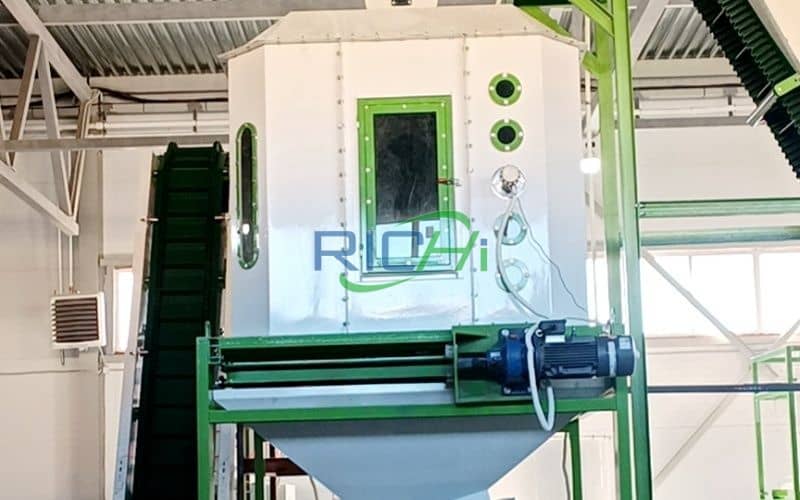
A floating-feed manufacturer in Punjab selected one SKLF20×20 Industrial Pellet Cooler in Pakistan to strengthen the post-drying section of an 8–10 T/H aquafeed line. The factory already operated extrusion, drying, screening, conveying and packing equipment, so the investment focused on cooling dried feed before final handling rather than replacing the complete production system.
The cooler handles finished floating pellets after most process moisture has already been reduced in the dryer. With an 8–13 T/H reference capacity, counterflow cooling and a 1.5 kW discharge drive, the SKLF20×20 gives the plant enough working margin for its dry-product flow while avoiding the error of treating a cooler as a substitute for aquafeed drying.
Name:
Industrial Pellet Cooler
Country:
Pakistan
Date:
2026
Capacity:
8–13 T/H
Model:
SKLF20×20
Main Motor Power:
1.5 kW
Main Product:
Dried floating fish feed
Residence Time:
6–15 minutes
The production bottleneck appeared after the factory increased finished floating-feed output while keeping a smaller cooling section. Warm product could remain above a suitable packing temperature when the upstream dryer ran near its normal production rate. The customer therefore targeted one downstream machine instead of investing again in extrusion, grinding or mixing equipment that still had usable capacity.
This project also differs from a conventional livestock-feed cooler retrofit. Floating fish feed is formed by extrusion, not by a standard ring-die feed pellet mill, and wet extrudate must be dried before it is ready for final cooling. The cooler receives a substantially drier product and removes sensible heat so the feed can move toward screening, coating where required, storage and packing under controlled conditions.
Punjab is a practical setting because the customer serves freshwater fish-feed buyers that need several pellet sizes rather than one universal product. The plant schedules different runs for juvenile and grower fish, so cooling duty varies with pellet diameter, bulk density and line rate. That makes airflow and bed loading more important than simply matching one nameplate tonnes-per-hour figure.
| Project Parameter | Configuration |
|---|---|
| Equipment | Counterflow pellet cooler |
| Model | SKLF20×20 |
| Quantity | 1 unit |
| Reference Capacity | Approximately 8–13 T/H |
| Discharge Drive | 1.5 kW |
| Reference Residence Time | Approximately 6–15 minutes, adjusted to operating conditions |
| Main Product | Dried floating fish feed |
| Main Pellet Diameter | 3–4 mm |
| Additional Product Range | Approximately 2–5 mm depending on fish size and formula |
| Line Duty | Approximately 8–10 T/H finished dry feed |
| Installation Type | Standalone post-drying cooling retrofit |
The 8–13 T/H figure is a reference cooling range rather than a guaranteed result for every floating-feed product. Expanded pellets can have much lower bulk density than dense livestock feed, so the same mass flow can occupy more cooler volume. Pellet size, bed depth, inlet temperature, airflow resistance and fines all influence the practical rate that the cooler can handle without reducing temperature uniformity.
The customer selected this size because a cooler rated only around the lower edge of the 8–10 T/H production window would leave little reserve for low-density product or warmer dryer discharge. The SKLF20×20 gives more operating headroom without jumping to a much larger cooling section that would require additional height, airflow and supporting equipment beyond the plant's present production plan.
Fresh extrudate leaves the extruder with far more moisture than a counterflow cooler should be expected to remove. The rotary or belt dryer performs the main dehydration duty first, bringing the product into the moisture range required by the feed specification. Only then does the cooler remove process heat and allow the dried pellet structure to stabilize before later handling and packing.
This process boundary is critical. Cooling may remove a limited amount of residual moisture as warm air passes through the product bed, but it is not designed to replace controlled drying. If pellets enter the cooler too wet, increasing airflow or residence time does not provide the same moisture control as a dryer and can create uneven surface drying while the pellet core remains unsuitable for storage.
Oil or palatant application is positioned according to the plant's actual formulation and coating system. Some products can be coated after cooling, while other processes apply liquids to warm dried pellets before a final temperature-stabilization step. The cooler selection therefore follows the confirmed process sequence instead of assuming that every aquafeed factory uses the same location for coating equipment.
The Industrial Pellet Cooler in Pakistan therefore receives a finished-size product whose moisture has already been controlled by the dryer. Its job is temperature stabilization, not extrusion or dehydration. This distinction protects line balance because the extruder, dryer and cooler are sized as separate unit operations with different design duties even though they operate continuously in one production train.
The fan, ducting and dust-separation system are part of the cooling duty even though the cooler body is the main purchased machine. Air must pass evenly through the pellet bed and then leave the system without carrying excessive fines into the work area. The plant therefore reviews fan pressure, duct resistance and separator capacity together rather than selecting the cooler body in isolation.
The main commercial products in this project are 3–4 mm floating pellets, while smaller juvenile feeds can be around 2 mm and larger grower products can reach about 5 mm. These diameters are realistic for freshwater aquafeed, but the plant does not assign one fixed pellet length to every product because cutter speed, expansion and die geometry determine the final length for each production run.
Final pellet size also affects cooling behaviour. Smaller pellets create a different void structure and pressure drop through the bed than larger expanded feed, while highly expanded pellets occupy more volume per tonne. The operator therefore adjusts bed depth and airflow from the actual product rather than assuming that a setting developed for 4 mm feed will automatically suit a 2 mm juvenile product.
Pellet diameter is kept separate from claims about floating time or water stability. A 3 mm pellet does not float for a certain period simply because of its size, and cooling cannot create floatability after extrusion. Density and water behaviour come mainly from formula, starch gelatinization, moisture, mechanical energy, screw configuration, die conditions and drying, with cooling preserving the physical state already produced upstream.
Pakistan's hot production seasons make absolute outlet temperature a poor fixed target. The practical objective is to bring feed reasonably close to prevailing ambient conditions before storage or packing, while avoiding excessive product temperature that can contribute to condensation later. The plant therefore monitors both ambient air and pellet discharge temperature instead of enforcing one permanent 30°C or 35°C setpoint.
Cooling air must be sufficient without becoming aggressive. Too little airflow leaves a warm pellet core, while excessive air velocity can entrain fines and increase dust loading in the exhaust system. Operators use temperature distribution, pressure behaviour and product condition to tune the fan and bed depth, and they inspect ducts and separators because dust accumulation can reduce cooling performance over time.
The 1.5 kW discharge drive is not the total electrical load of the cooling section. The exhaust fan, rotary airlock or separator where fitted, conveying and dust-control equipment can require substantially more power than the cooler discharge mechanism itself. Electrical planning therefore uses the complete fan-and-cooler package rather than presenting the small discharge motor as the energy demand of the whole process.
For machinery moving to a Punjab feed plant, Karachi is a practical maritime gateway before inland road or rail transport. Final routing depends on carrier service, package dimensions and the customer's forwarder, so the project does not assign fixed sea days, customs time or installation duration. Site preparation is based on confirmed support loads, inlet height, discharge elevation, fan location and duct routing.
Future expansion begins with the complete extrusion-to-packing balance. If the cooler still has reserve but the dryer, screener or packing section is full, adding another cooler would not raise saleable output. A second cooling unit or a larger model becomes relevant only when dried warm feed regularly accumulates ahead of the SKLF20×20 and the surrounding air-handling and downstream systems can accept more product.
For another buyer evaluating an Industrial Pellet Cooler in Pakistan, RICHI Machinery would review feed type, 2–5 mm product range, finished dry throughput, bulk density, dryer discharge temperature, coating sequence, allowable fines, ambient conditions, fan and duct layout, dust separation, downstream screening and available installation height before confirming the cooler and air-system configuration.
Having the right mix of reliable, high-quality pellet machine and pelletizing systems and expert support is essential to your success. Watch how our end-to-end feed pellet plant solutions have helped our customers optimize their performance.
Our customized and future-proofed turnkey pellet plant solutions is designed with you at the core. From vision to reality and beyond, our team stays connected with yours. Giving you peace-of-mind with an expert at your side.
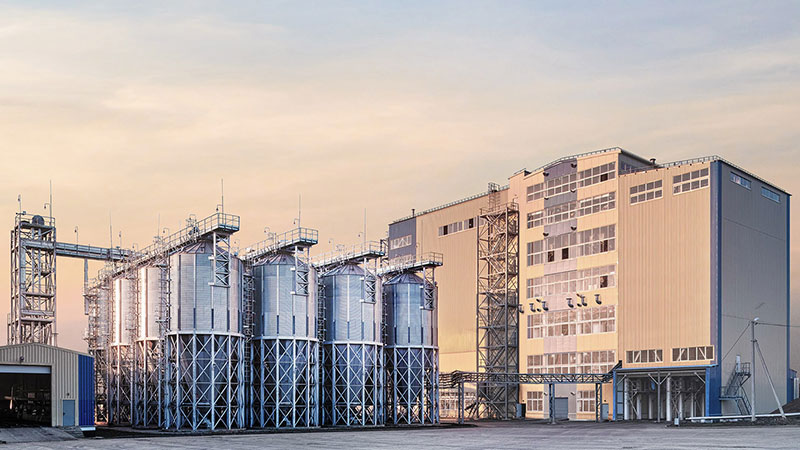
At RICHI, we go beyond project completion. With RICHI Servicee, we’re your dedicated partners in success. Count on us for expert guidance, minimal downtime, and optimized productivity. Choose RICHI for unmatched service and support.
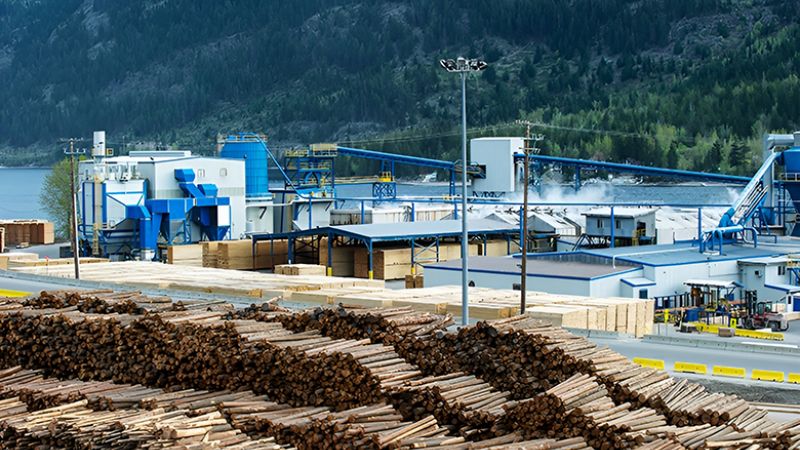


Meet global product demands and quality standards with industry-leading pellet plant design, engineering, equipment, and construction services for pellet processors.

Your Partner Beyond Project Completion
2000+ cases
RICHI is the leading designer, manufacturer and builder of pellet plants in the world, completing over 2000 projects in 140 countries across 6 continents.
Read More
Increase plant productivity, profitability, and safety by integrating high quality equipment into your pellet production line. Over the years, RICHI has become China's top pellet equipment manufacturer. At the same time, RICHI has established valuable partnerships with the world's leading component and raw material manufacturers to bring you the best there is in technology, automation, and efficiency in pelleting plant machinery.

For nearly 30 years, RICHI has been providing best-in-class pellet plant equipment and services to clients across a variety of industries, sizes, and needs. We pride ourselves on the knowledge and skill that each team member possesses – from our technical sales team to our process design engineers. You can count on RICHI Machinery to take your operation to the next level of innovation, quality, and success.
Need help with your pellet manufacturing plant project? Contact us today.
ANIMAL FEED
BIOMASS
WOOD
ORGANIC FERTILIZER
AQUA FEED
CAT LITTER
MUNICIPAL WASTE RECYCLING
SPECIAL PELLET PRODUCTION
RICHI Machinery continues to deliver world class pellet mill equipment, pellet plant engineering and project solutions that add value to our customers in the animal feed, wood waste, agriculture waste, organic fertilizer, cat litter and special pellet products industries. Throughout the years, we RICHI Machinery have built strong brand, becoming industry-leading pellet machine manufacturer. We value integrity, promise quality, and prioritize your success.
Learn MoreWith our expert team, we precisely implement your process engineering requirements in pellet mill and pelletizing plant systems. No matter which industry you’re in – we understand your needs and deliver solutions that meet the highest standards.
At RICHI, quality comes first. Our pellet making machine and related pellet line equipment undergo rigorous quality controls to ensure they meet the highest standards. Rely on products that are durable, safe, and efficient.
With decades of experience in pellet machine and pellet production line production, we have earned a reputation as a trusted partner in various industries. Our expertise allows us to cover a wide range of applications.
Not only do we offer premium pelleting equipment, but we are also experts at designing, building, installing, and maintaining facilities from the ground up. Our expertise is within pellt plant process design, discovering the most efficient, productive, and profitable way to handle your materials in an end-to-end cycle.
○ RICHI MACHINERY
Keeping in touch with us is an effective way to solve all your problems. If you have any needs or questions, please leave your contact information, then RICHI technical consultants will send design, quotation, videos to your mailbox. You can also contact us directly via WhatsApp: +86 13838389622
Copyright©2015-2026 by HENAN RICHI MACHINERY CO., LTD. All rights reserved.