
A pet food manufacturer in western Poland installs one horizontal moving-bed cooler for gentle cooling of 6–10 mm dog and cat kibble in a low-headroom finishing area.
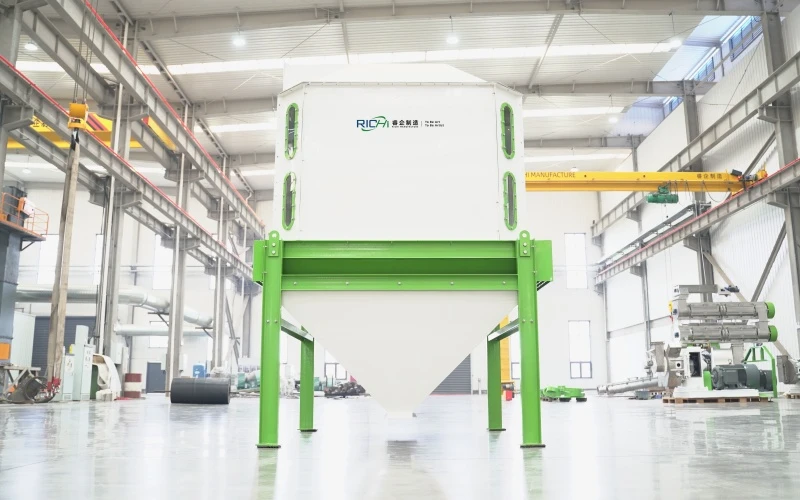
A specialty pet food producer in western Poland selected one Horizontal Pellet Cooler in Poland for a retrofit of its dry kibble finishing area. The factory already had extrusion, drying, coating, screening and packing equipment, but limited building height and difficult access around the cooling position made a tall vertical arrangement inconvenient for the new layout.
The customer therefore specified a low-profile moving-bed cooler sized for about 6 T/H of coated dog and cat kibble. The purchase remained a single-machine retrofit rather than a complete pet food line. Its job is to remove process heat gently before final screening and packing while fitting beneath the existing roof structure and preserving access for cleaning around the finishing section.
Name:
Horizontal Pellet Cooler
Country:
Poland
Date:
2026
Capacity:
6–8 T/H
Model:
SKLF17*17
Main Motor Power:
1.5 KW
Main Products:
Dry dog and cat kibble
Quantity:
1 unit
The decision was driven by plant geometry rather than a claim that horizontal cooling is universally better. A moving-bed cooler occupies more floor length than a conventional vertical counterflow unit, but it can reduce the height required above and below the machine. That trade-off suited this factory because the finishing room had enough horizontal space but limited headroom for a tall cooling tower and gravity transitions.
Cleaning access also mattered because the plant runs several dog and cat food recipes with different surface coatings. Large side-access areas let operators inspect the product bed, air passages and discharge section without working through a tall tower. Product-contact surfaces were specified for hygienic cleaning, while the surrounding conveyor and extraction points were arranged so residue could be cleared between scheduled recipe runs.
The cooler was not selected to compensate for an undersized belt dryer machine. Shelf-stable kibble moisture is established primarily in the drying stage, while cooling removes sensible heat and may release a limited amount of residual moisture. Treating the cooler as a second dryer would make product condition too dependent on ambient air and could leave packaging quality unstable across Polish summer and winter conditions.
| Project Parameter | Configuration |
|---|---|
| Equipment | Horizontal moving-bed pellet cooler |
| Quantity | 1 unit |
| Design Duty | Approximately 6 T/H of dry extruded pet food |
| Capacity Class | 6–8 T/H class, subject to product and airflow design |
| Main Products | Dry dog and cat kibble |
| Main Kibble Size | Approximately 6–10 mm nominal size |
| Occasional Larger Shapes | Up to approximately 12 mm where the recipe and die require it |
| Cooling Target | Near ambient before final screening and packing |
| Product-Contact Specification | Hygienic, cleanable surfaces specified for the pet food duty |
| Installation Type | Standalone finishing-section retrofit |
The counterflow pellet cooler is deliberately sized above the routine 5–6 T/H production window. A 3–5 T/H unit would leave too little reserve when the extruder and dryer are running near peak rate, and any downstream restriction would force upstream throttling. A 6–8 T/H cooling class gives the plant operating margin for bulk-density variation without pretending that every recipe will use the full installed capacity.
The plant does not describe every kibble as a round pellet with one fixed diameter. Small discs, rings and shaped pieces are better specified by nominal width or overall size, so the main commercial range is treated as roughly 6–10 mm, with some larger shapes approaching 12 mm. This is more accurate than calling every dog and cat product a 5 mm or 12 mm diameter pellet regardless of geometry.
Cooling capacity is also based on real bulk density and bed depth rather than line nameplate alone. A 6 T/H stream of small dense kibble can behave differently from the same mass flow of larger expanded pieces. Air resistance, coating level, product temperature and fines influence residence time and fan duty, so the cooler is selected with margin above routine production instead of being sized exactly at one hourly number.
For this factory, coating occurs before final cooling because the coating system is designed to work with warm dried kibble. That sequence should not be treated as a universal rule for every pet food plant; coating technology and formulation determine the correct location. The important requirement here is that coated product reaches packaging cool enough to avoid heat buildup, condensation and coating migration in the finished bag.
The Horizontal Pellet Cooler in Poland therefore receives product that is already dry enough for the final product specification. Its duty is temperature stabilization and gentle handling, not large-scale water removal. Incoming product temperature varies with dryer discharge, coating conditions and production rate, so fan airflow and bed residence time are adjusted from actual outlet temperature instead of one permanent temperature setting.
Expanded pet food is more fragile than a dense ring-die feed pellet, particularly when products use thin rings, small discs or shaped pieces. The moving bed supports the kibble while it travels through the cooling zone instead of relying on repeated long vertical drops. Transfer heights are still kept short, because even a gentle cooler cannot prevent breakage created by poorly designed elevators, chutes or high-speed conveyors around it.
Uniform product distribution across the deck is essential. If kibble forms a deep ridge on one side and a shallow layer on the other, cooling air follows the lower-resistance path and outlet temperature becomes uneven. The inlet distributor, bed depth and extraction system are therefore commissioned together, and the plant checks temperature across the discharge rather than relying on a single sensor at one point.
Coating adds another reason to limit unnecessary mechanical agitation. Surface fat and palatants should remain distributed on the kibble rather than accumulate on equipment or become concentrated in fines. The cooler does not guarantee coating retention by itself, so operators also control coater settings, transfer speed, bed loading and cleaning frequency when evaluating appearance and finished-product consistency.
The cooling fan is selected from required airflow and system resistance, including the product bed, ducting, separators and filtration. More airflow is not automatically better: excessive velocity can entrain fines and dry the surface too aggressively, while insufficient airflow leaves a warm product core. The plant therefore balances air volume with kibble size, bed depth, inlet temperature and the actual pressure drop across the system.
Pet food hygiene requires the cooler to be included in the plant's sanitation and cross-contact plan. Product-contact areas, access doors, seals and low points are inspected for accumulated crumbs or coating buildup. Cleaning frequency follows the recipe schedule and risk assessment rather than a fixed number of minutes, and any wet-cleaning procedure must include adequate drying before production resumes.
Fines captured from the cooling and screening area are not automatically returned to every product. Rework rules depend on the recipe, traceability system, contamination risk and quality specification. This is especially important when dog and cat foods contain different proteins, palatants or functional ingredients, because indiscriminate recycle can create cross-contact even when the cooler itself has been cleaned correctly.
The horizontal arrangement reduces vertical demand but increases floor-length requirements, so the retrofit checks aisle width, service access, conveyor elevations and duct routing before equipment placement. The customer also confirms floor loading and vibration isolation for the moving-bed drive. Enough clearance is kept along the access side so operators can inspect the deck and discharge mechanism without dismantling neighboring equipment.
For a western Poland facility, imported machinery can enter through a Baltic port such as Gdańsk or Gdynia and continue inland by road or rail according to the freight plan. The article does not assign a fixed transit or customs period. Final routing depends on package dimensions, carrier service and site access, while installation preparation is based on confirmed foundation, electrical, airflow and interface drawings.
The cooler drive is only one part of the utility picture. Fans and dust-separation equipment can account for a meaningful share of connected power, so the plant checks the whole cooling circuit rather than quoting only the bed-drive motor. Control interlocks also coordinate upstream coating and downstream screening so product does not continue entering the cooler when discharge or extraction is unavailable.
A horizontal cooler makes sense when limited headroom, gentle moving-bed handling or side access has greater value than minimizing floor area. A vertical counterflow cooler may still be preferable where building height is available and footprint is tight. The selection should therefore begin with product geometry, hourly flow, inlet temperature, allowable breakage, sanitation method and building layout rather than equipment fashion.
For another buyer evaluating a Horizontal Pellet Cooler in Poland, RICHI Machinery would review product type, nominal pellet or kibble size, bulk density, hourly throughput, inlet and target outlet temperature, dryer and coater sequence, coating level, available L × W × H, allowable fines, cleaning method, airflow path, dust collection and downstream screening capacity before confirming the cooler configuration.
Having the right mix of reliable, high-quality pellet machine and pelletizing systems and expert support is essential to your success. Watch how our end-to-end feed pellet plant solutions have helped our customers optimize their performance.
Our customized and future-proofed turnkey pellet plant solutions is designed with you at the core. From vision to reality and beyond, our team stays connected with yours. Giving you peace-of-mind with an expert at your side.
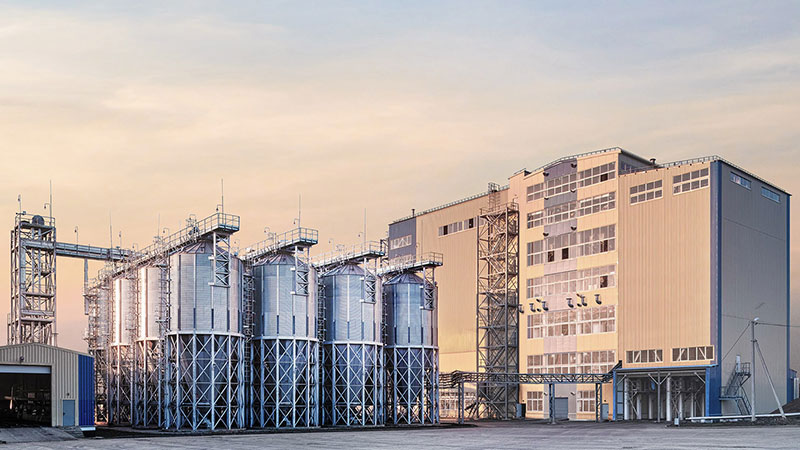
At RICHI, we go beyond project completion. With RICHI Servicee, we’re your dedicated partners in success. Count on us for expert guidance, minimal downtime, and optimized productivity. Choose RICHI for unmatched service and support.
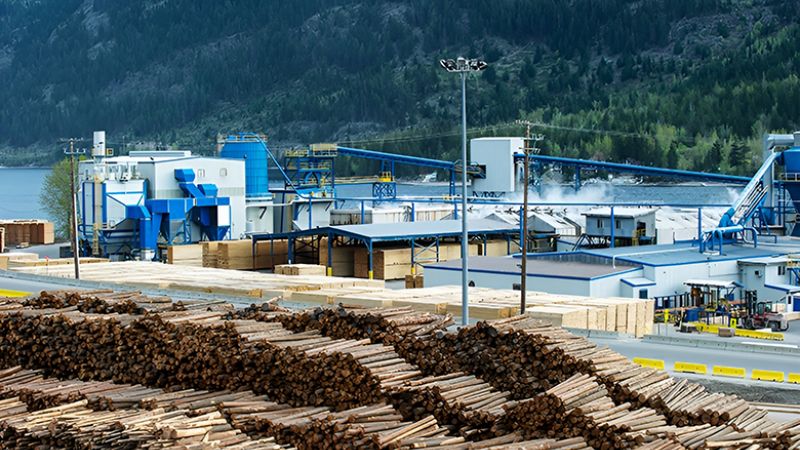


Meet global product demands and quality standards with industry-leading pellet plant design, engineering, equipment, and construction services for pellet processors.


Your Partner Beyond Project Completion
2000+ cases
RICHI is the leading designer, manufacturer and builder of pellet plants in the world, completing over 2000 projects in 140 countries across 6 continents.
Read More
Increase plant productivity, profitability, and safety by integrating high quality equipment into your pellet production line. Over the years, RICHI has become China's top pellet equipment manufacturer. At the same time, RICHI has established valuable partnerships with the world's leading component and raw material manufacturers to bring you the best there is in technology, automation, and efficiency in pelleting plant machinery.

For nearly 30 years, RICHI has been providing best-in-class pellet plant equipment and services to clients across a variety of industries, sizes, and needs. We pride ourselves on the knowledge and skill that each team member possesses – from our technical sales team to our process design engineers. You can count on RICHI Machinery to take your operation to the next level of innovation, quality, and success.
Need help with your pellet manufacturing plant project? Contact us today.
ANIMAL FEED
BIOMASS
WOOD
ORGANIC FERTILIZER
AQUA FEED
CAT LITTER
MUNICIPAL WASTE RECYCLING
SPECIAL PELLET PRODUCTION
RICHI Machinery continues to deliver world class pellet mill equipment, pellet plant engineering and project solutions that add value to our customers in the animal feed, wood waste, agriculture waste, organic fertilizer, cat litter and special pellet products industries. Throughout the years, we RICHI Machinery have built strong brand, becoming industry-leading pellet machine manufacturer. We value integrity, promise quality, and prioritize your success.
Learn MoreWith our expert team, we precisely implement your process engineering requirements in pellet mill and pelletizing plant systems. No matter which industry you’re in – we understand your needs and deliver solutions that meet the highest standards.
At RICHI, quality comes first. Our pellet making machine and related pellet line equipment undergo rigorous quality controls to ensure they meet the highest standards. Rely on products that are durable, safe, and efficient.
With decades of experience in pellet machine and pellet production line production, we have earned a reputation as a trusted partner in various industries. Our expertise allows us to cover a wide range of applications.
Not only do we offer premium pelleting equipment, but we are also experts at designing, building, installing, and maintaining facilities from the ground up. Our expertise is within pellt plant process design, discovering the most efficient, productive, and profitable way to handle your materials in an end-to-end cycle.
○ RICHI MACHINERY
Keeping in touch with us is an effective way to solve all your problems. If you have any needs or questions, please leave your contact information, then RICHI technical consultants will send design, quotation, videos to your mailbox. You can also contact us directly via WhatsApp: +86 13838389622
Copyright©2015-2026 by HENAN RICHI MACHINERY CO., LTD. All rights reserved.