
Fine powder grinder for pet food in United Kingdom: the SWFL110 processes peas, lentils and chickpeas to 100–150 μm for grain-free kibble at 2.2 T/H.
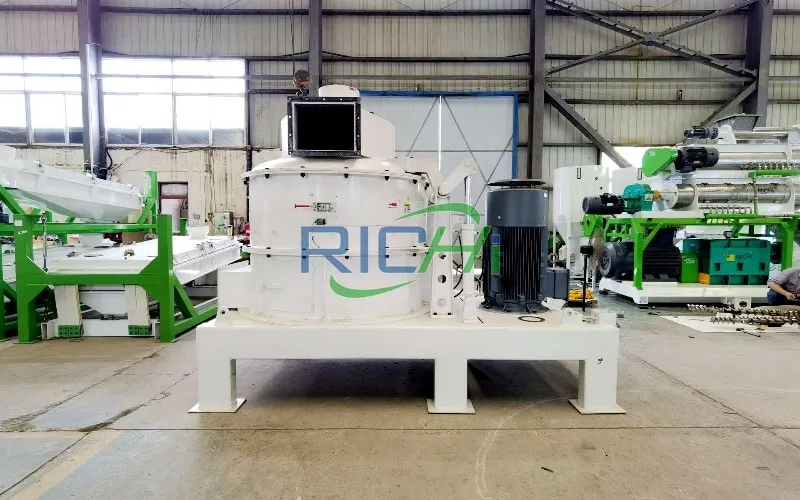
A premium pet food manufacturer in Yorkshire, England, needed a different grinding approach when it began developing grain-free dog and cat food. The company produces approximately 12,000 tons of dry pet food annually, but its existing hammer mill could not consistently reduce peas, lentils and chickpeas to the fineness required for the new recipes. Coarse particles affected kibble texture, while the grinding process limited the output of the new product range.
Instead of replacing its entire grinding department, the manufacturer purchased an SWFL110 ultrafine grinder from RICHI Machinery. This single-machine investment was dedicated to pulse ingredients for grain-free formulations, while the existing hammer mill remained in service for conventional recipes. The new fine powder grinder for pet food in United Kingdom production was selected to achieve a target particle size of 100–150 μm and an average output of approximately 2.2 T/H.
Name:
Pet Food Powder Grinder
Country:
United Kingdom
Date:
2026
Capacity:
2–3 T/H
Model:
SWFL110
Main Motor Power:
110 kW
Classifier wheel motor:
7.5 kW
Target powder size:
100–150 μm
Peas, lentils and chickpeas behave differently from the cereals commonly used in conventional pet food. Their seed coats and internal structures can be difficult to break down uniformly, particularly when the formulation requires fine powder for consistent mixing and extrusion.
The manufacturer's existing animal feed hammer mill produced pulse particles typically measuring 300–500 μm. Although this was acceptable for some conventional recipes, the resulting powder was too coarse for the texture targets of its premium grain-free range. Output was also limited to approximately 1.2 T/H when processing these ingredients.
The company needed more than a higher-capacity grinder. It required closer control over the final particle-size distribution, repeatable results across different pulse varieties, and a dedicated machine that would not disrupt its established production schedule.
RICHI recommended the SWFL110 Ultrafine Pulverizer because its ultrafine grinding and classification arrangement matched the manufacturer's fineness and throughput requirements. The rated capacity is 2–3 T/H, depending on the material characteristics, incoming particle size and required grinding fineness.
| Parameter | Specification |
|---|---|
| Model | SWFL110 |
| Main motor power | 110 kW |
| Classifier wheel motor | 7.5 kW |
| Feeder motor | 1.5 kW |
| Rated capacity | 2–3 T/H |
| Target powder size | 100–150 μm |
| Main grinding materials | Yellow peas, red lentils and chickpeas |
| Production application | Grain-free dog and cat food ingredients |
The separate grinding arrangement allowed the manufacturer to process pulse ingredients without repeatedly changing the setup of its existing hammer mill. It also gave the production team greater flexibility when scheduling conventional and grain-free products.
The grain-free formulations use yellow peas as a principal carbohydrate ingredient, alongside red lentils and chickpeas. Chicken meal supplies animal protein, while potato protein, poultry fat, vitamins and minerals contribute to the finished recipe. The precise proportions vary according to the nutritional requirements of each product.
Incoming pulses undergo preliminary size reduction before entering the SWFL110. Yellow peas and chickpeas are generally pre-crushed through a 2.0 mm screen, while red lentils can be prepared using a 1.5 mm screen. This step helps establish a more consistent feed condition for the fine grinding stage.
After preliminary crushing, the material enters the grinding chamber, where high-speed hammers reduce particle size. Airflow carries the ground material toward the classifier wheel. Particles that meet the required separation conditions proceed to collection, while coarser material returns for further grinding.
This arrangement is particularly useful when a pet food ingredient grinding machine must handle several pulse varieties. The team can adjust the operating settings according to the material and verify the result through sieve testing rather than assuming that one setting will work equally well for every batch.
For this project, the target was 100–150 μm. Achieving that range consistently was important because the manufacturer wanted a uniform flour-like ingredient before mixing and extrusion.
During commissioning, yellow peas were pre-crushed and processed through the SWFL110. A sieve test showed that approximately 93% of the sample passed a 100-mesh sieve with an opening of about 150 μm, while approximately 85% passed a 120-mesh sieve with an opening of about 125 μm.
These results provided a practical basis for adjusting the classifier and checking subsequent batches. Mesh designations are not interchangeable with micron measurements, so the manufacturer continued to evaluate the actual particle-size distribution against its production requirements.
The finer powder helped the formulation team obtain a more uniform mixture for extrusion. The grinder prepares the ingredient; the downstream extruder and its die determine the final kibble shape and dimensions.
The SWFL110 was shipped from Qingdao, China, to the Port of Immingham in the United Kingdom. Sea transit took approximately 30–35 days, followed by customs clearance and road transport to the Yorkshire facility.
Because the main grinder weighs approximately 5.5 tons, the installation plan accounted for foundation loading, vibration control, equipment access and maintenance clearance. The customer prepared a reinforced concrete foundation with vibration-damping mounts before positioning the machine.
The electrical installation was specified for a 415 V, 50 Hz, three-phase supply, with the site's electrical team responsible for confirming the final protective devices and cable sizing against the equipment documentation and applicable requirements.
Dust collection also required careful planning. Fine pulse flour can form combustible dust clouds, so the customer incorporated a dust collection arrangement with appropriate explosion-protection measures, including venting provisions selected for the installation. The delivered equipment package included the main grinding unit, classifier assembly, feeder, cyclone and airlock discharge components, spare wear parts, and English-language operating and electrical documentation.
Installation and commissioning took approximately two weeks. Initial trials focused on yellow peas, classifier adjustment, powder collection and verification of the finished particle size.
After six months of operation, the manufacturer reported improvements in both throughput and ingredient consistency. Its internal production records showed the following comparison for pulse grinding:
| Performance indicator | Previous hammer mill | SWFL110 |
|---|---|---|
| Typical particle size | 300–500 μm | 120–150 μm |
| Average production rate | 1.2 T/H | 2.2 T/H |
| Output over an 8-hour shift | 9.6 tons | 17.6 tons |
| Internal palatability trial score | 6.8/10 | 8.5/10 |
| In-vitro digestibility result | 78% | 86% |
The finer ingredient powder supported a smoother, more uniform kibble texture. The manufacturer also reported that complaints concerning gritty product texture had stopped during the six-month observation period.
The reported palatability and in-vitro digestibility figures came from the manufacturer's own trials. They should be understood as results from this particular formulation and operating setup, not as guaranteed improvements for every grain-free pet food recipe.
At an average output of 2.2 T/H, an eight-hour shift produces approximately 17.6 tons of pulse flour. The manufacturer estimated annual throughput at about 4,500 tons for the dedicated grain-free line, while its wider business continued producing other dry pet food recipes.
Pulse ingredients place different demands on the grinding components from those encountered with conventional cereals. The Yorkshire team found that standard hammers wore more quickly when processing peas and lentils. Alloy-protected hammers extended the observed service interval, although actual wear depended on material characteristics and operating conditions.
The team also established separate preliminary screen settings for different pulse varieties and routinely checked powder fineness with sieve tests. This allowed operators to identify changes in incoming material and adjust the grinding settings when necessary.
Because fine powder production creates dust, the operating routine includes inspection of the grinding chamber, dust collection equipment and wear components. Regular cleaning and maintenance help limit buildup, support stable airflow and reduce the risk of unexpected production interruptions.
The manufacturer reported a delivered equipment cost of approximately £52,000 and estimated a payback period of around nine months. These figures reflected its own production volumes, product positioning and commercial assumptions; actual returns will depend on equipment utilization, ingredient costs, maintenance, energy consumption and market demand.
The main investment advantage was the ability to improve one constrained process without replacing equipment that remained suitable for other products. The SWFL110 created a dedicated route for fine pulse grinding, while the original hammer mill continued serving conventional recipes.
For other pet food manufacturers in the United Kingdom, the appropriate solution depends on the target powder size, material characteristics and required throughput. A plant processing mainly cereals may have different requirements from one developing recipes around peas, lentils or chickpeas. These differences should be considered before selecting a fine grinding system.
This Yorkshire project demonstrates how an SWFL110 fine powder grinder for pet food can address the specific demands of pulse-based ingredient preparation. The 110 kW machine achieved an average output of 2.2 T/H in the manufacturer's application and provided a more controlled route to 100–150 μm powder.
Rather than rebuilding the entire production line, the manufacturer added one machine to handle the grinding duty that its existing hammer mill could not perform to the required standard. The resulting arrangement improved production flexibility and helped the company support its premium grain-free product range.
RICHI Machinery supplies ultrafine grinding equipment for pet food ingredient processing. For a project involving peas, lentils, chickpeas or other challenging raw materials, the recommended configuration should be based on the actual ingredients, incoming particle size, target fineness and production capacity. Contact RICHI Machinery to discuss the appropriate grinding arrangement for your pet food manufacturing facility.
Having the right mix of reliable, high-quality pellet machine and pelletizing systems and expert support is essential to your success. Watch how our end-to-end feed pellet plant solutions have helped our customers optimize their performance.
Our customized and future-proofed turnkey pellet plant solutions is designed with you at the core. From vision to reality and beyond, our team stays connected with yours. Giving you peace-of-mind with an expert at your side.
At RICHI, we go beyond project completion. With RICHI Servicee, we’re your dedicated partners in success. Count on us for expert guidance, minimal downtime, and optimized productivity. Choose RICHI for unmatched service and support.


Meet global product demands and quality standards with industry-leading pellet plant design, engineering, equipment, and construction services for pellet processors.


Your Partner Beyond Project Completion
2000+ cases
RICHI is the leading designer, manufacturer and builder of pellet plants in the world, completing over 2000 projects in 140 countries across 6 continents.
Read More
Increase plant productivity, profitability, and safety by integrating high quality equipment into your pellet production line. Over the years, RICHI has become China's top pellet equipment manufacturer. At the same time, RICHI has established valuable partnerships with the world's leading component and raw material manufacturers to bring you the best there is in technology, automation, and efficiency in pelleting plant machinery.

For nearly 30 years, RICHI has been providing best-in-class pellet plant equipment and services to clients across a variety of industries, sizes, and needs. We pride ourselves on the knowledge and skill that each team member possesses – from our technical sales team to our process design engineers. You can count on RICHI Machinery to take your operation to the next level of innovation, quality, and success.
Need help with your pellet manufacturing plant project? Contact us today.
ANIMAL FEED
BIOMASS
WOOD
ORGANIC FERTILIZER
AQUA FEED
CAT LITTER
MUNICIPAL WASTE RECYCLING
SPECIAL PELLET PRODUCTION
RICHI Machinery continues to deliver world class pellet mill equipment, pellet plant engineering and project solutions that add value to our customers in the animal feed, wood waste, agriculture waste, organic fertilizer, cat litter and special pellet products industries. Throughout the years, we RICHI Machinery have built strong brand, becoming industry-leading pellet machine manufacturer. We value integrity, promise quality, and prioritize your success.
Learn MoreWith our expert team, we precisely implement your process engineering requirements in pellet mill and pelletizing plant systems. No matter which industry you’re in – we understand your needs and deliver solutions that meet the highest standards.
At RICHI, quality comes first. Our pellet making machine and related pellet line equipment undergo rigorous quality controls to ensure they meet the highest standards. Rely on products that are durable, safe, and efficient.
With decades of experience in pellet machine and pellet production line production, we have earned a reputation as a trusted partner in various industries. Our expertise allows us to cover a wide range of applications.
Not only do we offer premium pelleting equipment, but we are also experts at designing, building, installing, and maintaining facilities from the ground up. Our expertise is within pellt plant process design, discovering the most efficient, productive, and profitable way to handle your materials in an end-to-end cycle.
○ RICHI MACHINERY
Keeping in touch with us is an effective way to solve all your problems. If you have any needs or questions, please leave your contact information, then RICHI technical consultants will send design, quotation, videos to your mailbox. You can also contact us directly via WhatsApp: +86 13838389622
Copyright©2015-2026 by HENAN RICHI MACHINERY CO., LTD. All rights reserved.