
The East Java poultry company did not decide to manufacture feed because it wanted to become a commercial feed seller. Its concern was much narrower: feed represented the largest recurring cost across its broiler operations, while relying completely on outside suppliers left little room to adjust formulations, pellet size, delivery timing, or raw-material purchasing. The company therefore chose to bring part of its broiler-feed production in-house and began with the pelleting section that matched its actual internal demand.
The East Java poultry company did not decide to manufacture feed because it wanted to become a commercial feed seller. Its concern was much narrower: feed represented the largest recurring cost across its broiler operations, while relying completely on outside suppliers left little room to adjust formulations, pellet size, delivery timing, or raw-material purchasing. The company therefore chose to bring part of its broiler-feed production in-house and began with the pelleting section that matched its actual internal demand.
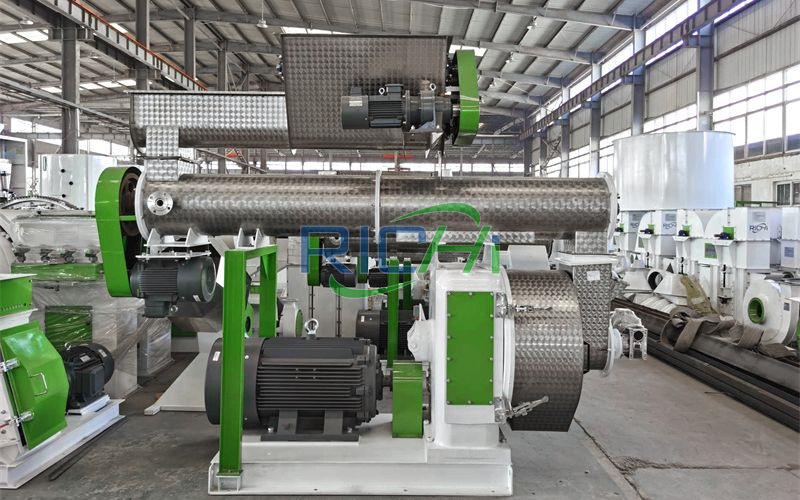
For this project, the customer installed one SZLH350 commercial pellet machine in Indonesia as the core pelletizing unit in an existing feed-processing setup near Surabaya. The 55 kW ring-die animal feed pellet machine is used mainly for broiler grower and finisher feeds at approximately 5–6 T/H under suitable formulation and conditioning conditions, while starter feed is produced through pelleting followed by crumbling rather than attempting to feed day-old chicks with large intact pellets.
Name:
Poultry pellet machine
Country:
Indonesia
Date:
2025
Capacity:
5–6 T/H
Model:
SZLH350
Main Motor Power:
55 kW
Main Product:
Broiler grower and finisher pellets
Pellet diameter:
3–4.5 mm
The customer operates an integrated poultry business in East Java with breeder and broiler farming activities and an established internal feed-distribution network. Unlike the largest Indonesian poultry groups, this client does not need tens of thousands of tonnes of feed every month. Its own requirement is at a level where a single 5–6 T/H pellet mill can be used efficiently during planned production shifts without becoming either severely undersized or unnecessarily large.
The company had already invested in grain receiving, storage, grinding, batching, mixing, steam supply, cooling, crumbling, screening, and bagging. The new purchase therefore focused on the pellet mill itself rather than another complete feed plant.
This was important commercially. The customer could improve the pelleting stage without discarding useful equipment that had already been installed. It also allowed the technical team to concentrate on pellet quality, die selection, steam conditioning, and line balancing instead of managing a much larger greenfield project.
The SZLH350 provided a practical balance between commercial feed-mill construction and manageable capacity.
| Project Parameter | Configuration |
|---|---|
| Equipment | Commercial poultry feed pellet machine |
| Model | SZLH350 |
| Quantity | 1 unit |
| Main Motor Power | 55 kW |
| Feeder Power | 1.5 kW |
| Conditioner Power | 4 kW |
| Ring Die Inner Diameter | 350 mm |
| Typical Broiler Pellet Size | Approximately 3–4.5 mm before any required crumbling |
| Reference Capacity | Approximately 5–6 T/H, formulation dependent |
| Main Product | Broiler grower and finisher pellets; starter crumble produced downstream |
The 350 mm ring-die platform gives the customer enough throughput for commercial internal feed production while remaining suitable for shorter formulation runs and regular product changeovers. The SZLH350 configuration uses a 55 kW main motor, 4 kW conditioner and broiler pellet sizes in the 3–4 mm to approximately 4–5 mm range.
Actual output is not treated as a permanent 6 T/H regardless of feed. Small die holes, formula composition, fibre content, fat inclusion, mash particle size, conditioning quality, steam availability and required pellet durability all influence the real operating rate.
East Java is a logical location for a broiler-feed project because maize and rice-processing by-products are widely available through regional agricultural supply chains. Soybean meal remains an important protein ingredient and may be imported or purchased through domestic feed-material distributors. Other locally available ingredients can be introduced when their nutritional value and economics justify inclusion.
The customer’s broiler formulations use maize as the principal energy ingredient, supplemented by soybean meal, rice bran or other approved cereal by-products, vegetable oil, mineral sources, vitamins, amino acids and feed additives according to the formulation.
Palm kernel meal can also be evaluated in some Indonesian poultry formulations because Indonesia has a large palm-oil industry, but its inclusion is controlled rather than used automatically at a high percentage. Fibre level, amino-acid profile and digestibility need to be considered before replacing more conventional feed ingredients.
Fish meal may be used selectively in younger-bird or specialty formulations when the nutritionist requires it, but it is not fixed into every broiler feed recipe simply because Indonesia has access to marine protein resources.
The customer does not manufacture one formula from placement to slaughter.
Starter, grower and finisher diets differ in energy density, amino-acid balance, mineral requirements, ingredient cost and physical feed form. These differences are reflected in both formulation and pellet processing.
For young birds, the mill normally produces a small pellet and then passes it through the existing crumbler. This provides a controlled starter particle without requiring the pellet mill to operate permanently with extremely small die openings.
As broilers grow, intact pellets can be used. Grower and finisher feeds are generally produced in a larger diameter that provides better throughput and mechanical strength while remaining suitable for the birds’ feeding system.
Producing starter feed as crumble is important for both process and animal handling reasons.
If the mill attempted to manufacture extremely small intact pellets for very young chicks, die resistance would increase and pellet-mill capacity could fall significantly. A conventional commercial solution is to form pellets first and then reduce them to an appropriate crumble size through a dedicated crumbler.
This also allows the same commercial pellet machine in Indonesia to serve several broiler growth stages without requiring a separate pellet mill for starter feed.
The customer therefore keeps different ring dies available and uses the crumbler only when the feed program requires it.
The SZLH350 feed pellet machine is equipped with a 4 kW conditioner upstream of the pelleting chamber.
Steam conditioning prepares the mixed mash before compression. Heat and moisture soften the material, influence starch and protein behavior, improve binding and reduce unnecessary resistance through the ring die when the process is adjusted correctly.
The feed mill does not use one permanent conditioner temperature for every broiler diet.
A maize-rich finisher ration can respond differently from a starter formula containing more protein or other ingredients. Initial mash moisture also changes with raw-material storage conditions.
Operators therefore monitor conditioner discharge condition, main-motor amperage, pellet appearance, throughput, fines and finished pellet durability together.
The purpose of conditioning is not to chase the highest possible temperature. It is to prepare the feed consistently enough for stable pelleting while remaining compatible with the formulation and the plant’s feed-safety requirements.
The customer initially evaluated suppliers by machine capacity, but operation quickly made another point clear: the highest instantaneous tonnage is not automatically the most profitable operating point.
If feeder speed is increased beyond the condition that the die and conditioner can handle, motor load rises while pellet quality may deteriorate. More fines can increase recycling load and reduce the proportion of finished feed reaching storage as saleable pellets.
The plant therefore operates the SZLH350 inside a repeatable range rather than forcing the machine to remain at its theoretical maximum throughout every production shift.
For an integrated poultry company, stable feed quality and predictable production are more valuable than occasionally recording a higher T/H number.
The new pelletizer did not eliminate the importance of upstream preparation.
Maize, soybean meal and other ingredients must be ground to a particle-size distribution appropriate for the formula and intended pellet specification. Large or inconsistent particles can affect conditioning, die flow and finished pellet quality.
Mixing is equally important. The pellet mill cannot correct uneven distribution of vitamins, minerals, amino acids or other low-inclusion ingredients.
For this reason, the company maintained its existing grinding and batching controls when the SZLH350 was installed. The pelletizer became one part of a controlled feed-manufacturing process rather than a machine expected to solve formulation problems created elsewhere.
Fresh feed pellets leave the ring die hot and contain additional moisture introduced during conditioning.
The customer therefore sends them directly to the existing cooler rather than into finished-feed storage.
Cooling brings pellet temperature closer to ambient conditions and allows the product to stabilize before crumbling, screening or bagging. Starter pellets then enter the crumbler, while grower and finisher pellets can continue to screening after cooling.
This sequence also prevents the common mistake of judging finished feed quality only at the pellet-mill outlet. Pellet durability and fines should be checked after the product has passed through downstream handling.
The company schedules feed production according to flock requirements rather than assuming that one eight-hour shift will cover any monthly tonnage.
At 5 T/H, six net pelleting hours produce about 30 tonnes. At 6 T/H, the same operating period provides about 36 tonnes before allowance for startup, changeovers and interruptions.
Over multiple production days, this capacity is appropriate for a regional integrated poultry business consuming roughly around one thousand tonnes per month rather than several thousand tonnes monthly.
If internal feed demand eventually grows substantially beyond this range, the company can evaluate longer operating hours, a second pellet mill or a larger poultry feed production line. Expansion will be based on measured capacity of the grinder, mixer, pelletizer, cooler and bagging sections together.
Indonesia has a large poultry sector and a substantial demand for maize, soybean meal and other feed ingredients. Commercial and integrated poultry production creates a realistic market for medium- and large-capacity feed machinery.
East Java is particularly suitable for this project because poultry farming, maize production, rice milling and major logistics infrastructure are all present within the region.
For a vertically integrated poultry company, internal feed production can provide more control over procurement and formulation. However, the investment only makes sense when feed demand is high enough to utilize the equipment and the company has the technical capability to manage formulation, quality control and feed safety.
The SZLH350 commercial pellet machine in Indonesia was selected because the customer had already reached that point.
The SZLH350 was exported from Qingdao Port in China to Tanjung Perak Port in Surabaya.
This is a practical route for a project in East Java because Tanjung Perak is one of Indonesia’s major cargo gateways and directly serves the Surabaya industrial region.
The shipment included the feed pellet mill, feeder, conditioner, selected ring dies and specified spare and wear parts. Tanjung Perak was selected as the Surabaya port for the SZLH350 shipment.
Final sailing and customs times were not treated as fixed project guarantees because carrier schedules, transshipment arrangements and customs procedures can change.
Because the pelletizer had to connect with existing equipment, RICHI reviewed more than the machine footprint.
Feeder elevation, conditioner inlet, steam piping, discharge height, cooler connection, maintenance access, foundation load and electrical supply all had to fit the customer’s available building.
Clearance around the ring-die area was particularly important. A feed mill that installs the machine too tightly against structural columns or other equipment may save floor space initially but create long maintenance shutdowns later.
The final arrangement therefore left working space for ring-die, roller and bearing inspection and replacement.
Ring dies and roller shells are normal wear components.
Their life is influenced by feed formulation, die specification, raw-material cleanliness, mineral content, throughput, roller adjustment and operating practices. The customer therefore does not assume that one die will always last a predetermined number of tonnes.
Maintenance personnel track pellet-mill amperage and output together. If the same formula begins producing less feed at a higher electrical load, roller and die condition become part of the inspection.
The customer keeps selected wear parts locally so planned production is not interrupted by waiting for an international shipment.
The poultry company already employed feed-mill operators, but they still required training on the new pelletizer.
RICHI provided guidance on startup, shutdown, feeder adjustment, steam conditioning, roller-die clearance, ring-die replacement, lubrication and response to abnormal motor load.
More importantly, the team learned not to compensate for every problem by increasing feeder speed or steam.
If pellet quality changes, operators now check formulation, grinding, mash moisture, steam condition, feeder stability, die wear and downstream cooling before deciding which parameter needs adjustment.
“The advantage for us is control. We are not trying to replace every feed supplier overnight, but we now manufacture an important share of our broiler feed ourselves. We can change pellet size and formulation according to the flock instead of waiting for another mill to schedule our order. Once the operators learned how feed moisture, steam and die condition work together, production became much more predictable.”
The customer has also gained better visibility into its real feed-manufacturing cost. Instead of relying on theoretical savings percentages, management records raw-material cost, electricity, steam, labour, maintenance, wear parts and production losses per tonne.
This gives the company a realistic basis for deciding when additional capacity will be justified.
This customer is an integrated poultry producer manufacturing primarily for internal consumption.
That business model is different from a merchant feed mill operating continuously for dozens or hundreds of external customers. The Indonesian client needs flexibility between broiler stages and predictable internal supply more than maximum daily output.
This is why the SZLH350 fits the project better than a much larger pellet mill.
A bigger machine could reduce net operating hours, but it would also require sufficient upstream grinding and mixing capacity, a larger cooler, greater steam capacity and potentially larger conveying and electrical systems.
For another Indonesian feed project, selecting a pellet mill should begin with actual feed demand rather than the number of birds alone.
The customer should determine monthly feed consumption, required operating days, daily production hours, number of formulas, pellet sizes, raw-material characteristics, grinder capacity, mixer batch size, available steam, cooler capacity, electrical supply and future expansion target.
Those figures determine whether an SZLH350 is appropriate or whether a smaller or larger commercial pellet machine would provide a better overall balance.
This commercial pellet machine in Indonesia project supports the East Java poultry company’s move into internal broiler-feed production without installing unnecessarily oversized pelleting capacity.
One SZLH350 with a 55 kW main motor provides approximately 5–6 T/H of commercial broiler-feed pelleting capacity under suitable processing conditions. The machine handles grower and finisher feeds directly, while starter pellets can be crumbled downstream into a more appropriate particle form for young chicks.
The value of the investment is not limited to tons per hour. It gives the customer greater control over raw-material purchasing, formulation scheduling, pellet size, production timing and finished-feed consistency while retaining existing grinding, mixing, cooling and packaging equipment.
For poultry companies, feed mills and livestock-feed producers evaluating a commercial pellet machine in Indonesia, RICHI Machinery can match the pelletizer to actual monthly demand and the capacity of the surrounding process. That prevents the pellet mill from becoming either an expensive oversized asset or a permanent bottleneck and provides a clearer foundation for future expansion.
Having the right mix of reliable, high-quality pellet machine and pelletizing systems and expert support is essential to your success. Watch how our end-to-end feed pellet plant solutions have helped our customers optimize their performance.
Our customized and future-proofed turnkey pellet plant solutions is designed with you at the core. From vision to reality and beyond, our team stays connected with yours. Giving you peace-of-mind with an expert at your side.
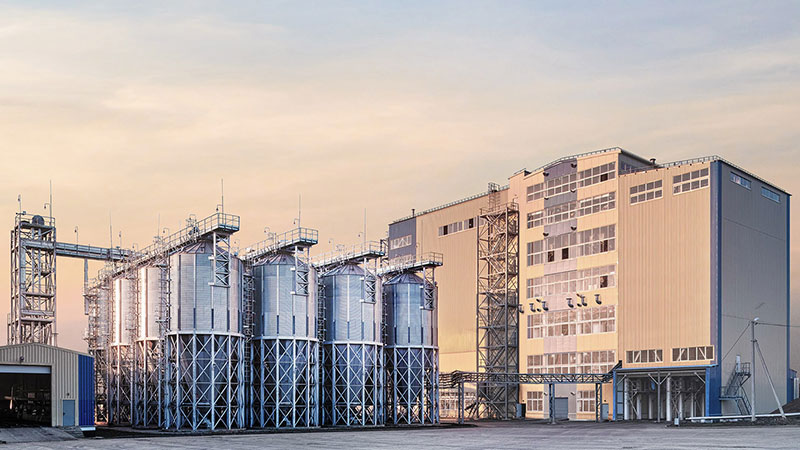
At RICHI, we go beyond project completion. With RICHI Servicee, we’re your dedicated partners in success. Count on us for expert guidance, minimal downtime, and optimized productivity. Choose RICHI for unmatched service and support.
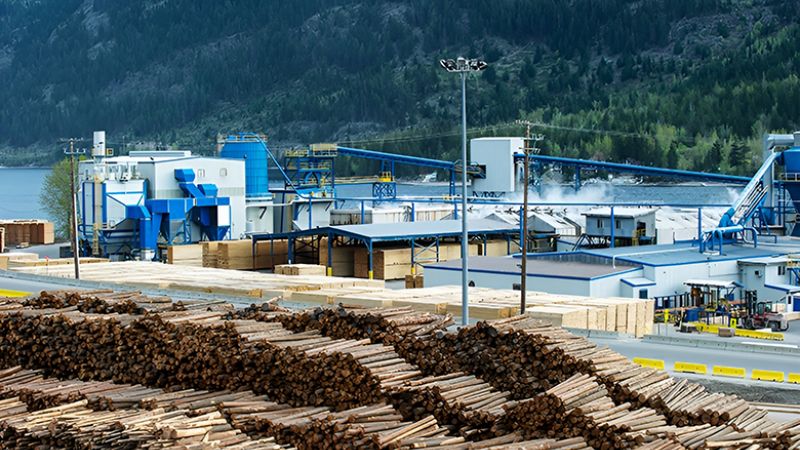


Meet global product demands and quality standards with industry-leading pellet plant design, engineering, equipment, and construction services for pellet processors.


Your Partner Beyond Project Completion
2000+ cases
RICHI is the leading designer, manufacturer and builder of pellet plants in the world, completing over 2000 projects in 140 countries across 6 continents.
Read More
Increase plant productivity, profitability, and safety by integrating high quality equipment into your pellet production line. Over the years, RICHI has become China's top pellet equipment manufacturer. At the same time, RICHI has established valuable partnerships with the world's leading component and raw material manufacturers to bring you the best there is in technology, automation, and efficiency in pelleting plant machinery.

For nearly 30 years, RICHI has been providing best-in-class pellet plant equipment and services to clients across a variety of industries, sizes, and needs. We pride ourselves on the knowledge and skill that each team member possesses – from our technical sales team to our process design engineers. You can count on RICHI Machinery to take your operation to the next level of innovation, quality, and success.
Need help with your pellet manufacturing plant project? Contact us today.
ANIMAL FEED
BIOMASS
WOOD
ORGANIC FERTILIZER
AQUA FEED
CAT LITTER
MUNICIPAL WASTE RECYCLING
SPECIAL PELLET PRODUCTION
RICHI Machinery continues to deliver world class pellet mill equipment, pellet plant engineering and project solutions that add value to our customers in the animal feed, wood waste, agriculture waste, organic fertilizer, cat litter and special pellet products industries. Throughout the years, we RICHI Machinery have built strong brand, becoming industry-leading pellet machine manufacturer. We value integrity, promise quality, and prioritize your success.
Learn MoreWith our expert team, we precisely implement your process engineering requirements in pellet mill and pelletizing plant systems. No matter which industry you’re in – we understand your needs and deliver solutions that meet the highest standards.
At RICHI, quality comes first. Our pellet making machine and related pellet line equipment undergo rigorous quality controls to ensure they meet the highest standards. Rely on products that are durable, safe, and efficient.
With decades of experience in pellet machine and pellet production line production, we have earned a reputation as a trusted partner in various industries. Our expertise allows us to cover a wide range of applications.
Not only do we offer premium pelleting equipment, but we are also experts at designing, building, installing, and maintaining facilities from the ground up. Our expertise is within pellt plant process design, discovering the most efficient, productive, and profitable way to handle your materials in an end-to-end cycle.
○ RICHI MACHINERY
Keeping in touch with us is an effective way to solve all your problems. If you have any needs or questions, please leave your contact information, then RICHI technical consultants will send design, quotation, videos to your mailbox. You can also contact us directly via WhatsApp: +86 13838389622
Copyright©2015-2026 by HENAN RICHI MACHINERY CO., LTD. All rights reserved.