
Chicken pellet mill for feed manufacturing line in Colombia designed for 10–12 T/H pelleting capacity, helping poultry feed manufacturers increase output and integrate new equipment with existing production systems.
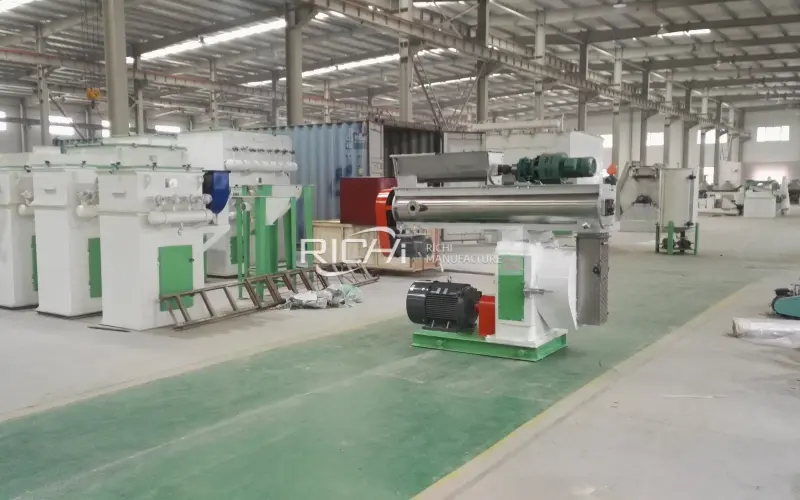
A poultry feed manufacturer in Antioquia, Colombia, needed to increase production without rebuilding its existing manufacturing facilities. The plant, located near Medellín, produces broiler and layer feed for a competitive market in which consistent pellet quality, reliable delivery schedules and production costs all influence customer retention. With annual feed production of approximately 250,000 tons across its operation, the company had been relying on older pellet mills that increasingly restricted throughput during busy production periods.
The plant already had animal feed hammer mills for maize grinding, twin-shaft paddle mixers with a 6,000 kg batch capacity, cooling equipment and bulk load-out facilities. Replacing the entire production system would have required unnecessary expenditure on equipment that remained serviceable. Instead, management decided to add one new ring die pellet mill to the existing pelleting section, targeting an increase of approximately 60 tons per day in production capacity.
Name:
Chicken Pellet Mill
Country:
Colombia
Date:
2026
Capacity:
10–12 T/H
Model:
SZLH420
Main Motor Power:
110 kW
Applications:
Broiler starter, grower, finisher and layer feed
Pellet diameter:
3.5-5mm
After reviewing the required throughput, feed types, steam supply and downstream material handling, RICHI Machinery recommended the SZLH420 chicken pellet mill. Equipped with a 110 kW main motor, the model has a nominal production capacity of 10–12 tons per hour under suitable operating conditions. The project focused on increasing pelleting capacity while retaining the existing grinding, mixing, cooling and bulk handling equipment wherever compatible.
The main challenge was not simply to purchase a larger pellet mill. The new equipment had to operate alongside the plant's existing machinery without creating another bottleneck at the mixer discharge, cooler intake or finished-feed handling stage.
The SZLH420 chicken poultry feed pellet machine was selected for its production capacity and suitability for continuous commercial feed manufacturing. Its ring die and roller assembly compress conditioned feed mash into pellets, while the drive system provides the mechanical power required for routine production. Different feed formulations and pellet diameters require corresponding die configurations and operating adjustments.
| Parameter | Specification |
|---|---|
| Machine model | SZLH420 |
| Equipment type | Ring die chicken feed pellet mill |
| Main motor power | 110 kW |
| Nominal production capacity | 10–12 T/H |
| Primary raw materials | Ground maize, soybean meal, rice bran and other formulated ingredients |
| Pellet diameters specified for the project | 3.5 mm, 4.0 mm, 4.5 mm and 5.0 mm |
| Primary applications | Broiler starter, grower, finisher and layer feed |
| Installation arrangement | Integration with existing feed manufacturing equipment |
Actual production depends on the feed formula, moisture content, conditioning conditions, die compression ratio, pellet diameter and required durability. The stated 10–12 T/H capacity should therefore be treated as a nominal range rather than a guaranteed output for every product.
The plant manufactures several poultry feed products, so the new machine needed to accommodate different die sizes and processing conditions. Starter feed generally requires smaller pellets or crumbles, while grower and finisher diets can use progressively larger pellets. Layer feed specifications depend on the feeding system, bird age and the manufacturer's product requirements.
The following operating ranges represent the project's planned configurations. Final settings should be confirmed through material testing and commissioning rather than applied universally to every formulation.
| Feed type | Die diameter | Indicative output | Conditioning temperature | Steam addition |
|---|---|---|---|---|
| Broiler starter | 3.5 mm | 8–9 T/H | 85–90°C | 6–7% |
| Broiler grower | 4.0 mm | 9–10 T/H | 80–85°C | 5–6% |
| Broiler finisher | 4.5 mm | 10–11 T/H | 75–80°C | 4–5% |
| Layer feed | 5.0 mm | 11–12 T/H | 70–75°C | 3–4% |
The proposed ring dies use different compression ratios according to the intended feed product. The original project specification listed ratios of 1:12 for starter feed, 1:11 for grower feed, 1:10 for finisher feed and 1:9 for layer feed. These are project-specific selections, not fixed settings for all poultry diets. The appropriate ratio must be confirmed against the actual formulation, die geometry and required pellet durability.
Conditioning also requires careful control. Steam introduces heat and moisture, helping prepare the mash for compression. Excessive moisture can produce soft pellets and increase the cooling load, while insufficient conditioning may increase die resistance, power consumption and fines. The plant therefore needs to coordinate steam supply, feed rate and die selection rather than relying on motor capacity alone.
Colombia's poultry feed industry uses maize as a major energy ingredient, alongside protein meals, cereal by-products, oils, minerals and premixes. The precise sourcing pattern varies with the region, season and procurement arrangements. For this project, the feed plant planned to use locally sourced maize alongside soybean meal and other ingredients selected for its broiler and layer products.
These example formulas total 100% and illustrate the range of ingredients the manufacturing line may handle. They are not universal nutritional recommendations. In commercial production, a qualified poultry nutritionist must validate nutrient specifications, amino acid balance, calcium and available phosphorus, premix inclusion rates, ingredient quality and suitability for the intended birds.
For the feed pellet machine, the important practical consideration is that each formulation behaves differently during conditioning and compression. Fiber content, oil inclusion, starch availability, moisture and particle size can all influence throughput and pellet durability. Changes in the formula may therefore require adjustments to the conditioning process, die configuration and feed rate.
The SZLH420 was installed as an additional pelleting unit rather than as a replacement for the complete manufacturing line. The existing mixer remained responsible for blending ground maize, protein meals, minerals and other ingredients before the mash was transferred to the pelleting section.
The revised material flow included the following stages:
One important lesson from the project was that increasing pellet mill capacity does not automatically increase the output of the entire production line. Conveyors, surge bins, steam conditioning equipment, cooler capacity, screening and bulk handling must all accommodate the revised material flow.
During the upgrade, the plant identified the distribution conveyor as a limiting component. The original conveyor could not reliably handle the increased flow, so its capacity was upgraded. This additional work helped prevent feed accumulation before the pellet mills and supported more stable operation across the pelleting section.
After commissioning, the plant reported that the additional SZLH420 helped relieve the pelleting bottleneck. Management targeted an increase of approximately 60 tons per day, while retaining the two existing pellet mills for continued production. Actual daily output depended on the combination of products being manufactured, scheduled changeovers, maintenance and the capacity of upstream and downstream equipment.
The new unit was assigned a substantial share of the pelleting workload. Keeping the older mills in operation also gave the plant flexibility to allocate products according to die size, production schedules and maintenance requirements. This arrangement reduced the need to shut down the entire pelleting section whenever one machine required servicing.
The plant manager's reported experience after approximately 16 months included around 11,000 operating hours on the new machine. The plant also reported cumulative production exceeding 22,000 tons across its 4.5 mm finisher dies. Die life varied by feed type, ingredient abrasiveness, operating conditions and maintenance practice.
The reported operating history highlighted the importance of planning spare dies and roller shells according to actual wear. A high-throughput pellet mill depends on more than its main motor. Die condition, roller adjustment, lubrication, bearing temperature, feed consistency and operator procedures all affect stable production.
The plant manager reported that the new pellet mill helped address the production constraint and that the conveyor upgrade was necessary to obtain the expected benefit. The customer also planned to purchase another SZLH420 to replace its oldest existing pellet mill, while evaluating a larger model for a future manufacturing facility.
The decision to expand gradually reflects a practical approach to equipment investment. Retaining functional machinery can reduce initial capital expenditure, but older units still require maintenance and may consume more production time as wear increases. A staged replacement strategy allows the plant to prioritize the equipment that has the greatest effect on output and operating reliability.
The SZLH420 feed pellet mill was shipped from Qingdao, China, to the Port of Cartagena on Colombia's Caribbean coast. The reported sea transit was approximately 30 days, followed by inland transport to the Antioquia region. Actual delivery schedules depend on vessel availability, customs clearance, port handling and road transport arrangements.
Before delivery, RICHI provided technical consultation covering production capacity, integration points, conveyor sizing, control-system coordination and steam requirements. The planned steam demand for the new pellet mill was approximately 700–900 kg per hour, subject to the actual formulation and conditioning conditions. The boiler and steam distribution system needed to be checked against the required pressure, quality and available operating capacity.
The project also included spare parts planning for roller shells, die screws and drive belts, along with commissioning support. These preparations helped the plant organize routine maintenance and coordinate the new equipment with its existing operating procedures.
For a commercial poultry feed manufacturer, selecting a chicken pellet mill involves more than comparing motor power or nominal hourly capacity. Buyers need to evaluate the current production bottleneck, required pellet sizes, formulations, steam availability, cooler capacity, conveying arrangements and expected operating hours.
The Colombian project demonstrates the role of a targeted equipment upgrade. Rather than replacing the complete feed manufacturing line, the plant added an SZLH420 with a 110 kW main motor and addressed the distribution conveyor limitation identified during integration. This approach allowed the company to focus its investment on the pelleting stage while retaining compatible upstream and downstream equipment.
RICHI Machinery supplies ring die pellet mills and supporting equipment for poultry feed manufacturing operations of different scales. For a project in Colombia, providing the target capacity, annual production plan, feed formulations, required pellet diameters, existing equipment specifications and available utilities helps establish a more realistic equipment configuration.
A well-matched chicken pellet mill can support higher production throughput and consistent feed manufacturing, provided that the complete process is designed around the raw materials, product specifications and operating conditions. Contact RICHI Machinery to discuss your pelleting requirements and determine a suitable machine configuration for your existing or planned feed manufacturing line.
Having the right mix of reliable, high-quality pellet machine and pelletizing systems and expert support is essential to your success. Watch how our end-to-end feed pellet plant solutions have helped our customers optimize their performance.
Our customized and future-proofed turnkey pellet plant solutions is designed with you at the core. From vision to reality and beyond, our team stays connected with yours. Giving you peace-of-mind with an expert at your side.

At RICHI, we go beyond project completion. With RICHI Servicee, we’re your dedicated partners in success. Count on us for expert guidance, minimal downtime, and optimized productivity. Choose RICHI for unmatched service and support.



Meet global product demands and quality standards with industry-leading pellet plant design, engineering, equipment, and construction services for pellet processors.


Your Partner Beyond Project Completion
2000+ cases
RICHI is the leading designer, manufacturer and builder of pellet plants in the world, completing over 2000 projects in 140 countries across 6 continents.
Read More
Increase plant productivity, profitability, and safety by integrating high quality equipment into your pellet production line. Over the years, RICHI has become China's top pellet equipment manufacturer. At the same time, RICHI has established valuable partnerships with the world's leading component and raw material manufacturers to bring you the best there is in technology, automation, and efficiency in pelleting plant machinery.

For nearly 30 years, RICHI has been providing best-in-class pellet plant equipment and services to clients across a variety of industries, sizes, and needs. We pride ourselves on the knowledge and skill that each team member possesses – from our technical sales team to our process design engineers. You can count on RICHI Machinery to take your operation to the next level of innovation, quality, and success.
Need help with your pellet manufacturing plant project? Contact us today.
ANIMAL FEED
BIOMASS
WOOD
ORGANIC FERTILIZER
AQUA FEED
CAT LITTER
MUNICIPAL WASTE RECYCLING
SPECIAL PELLET PRODUCTION
RICHI Machinery continues to deliver world class pellet mill equipment, pellet plant engineering and project solutions that add value to our customers in the animal feed, wood waste, agriculture waste, organic fertilizer, cat litter and special pellet products industries. Throughout the years, we RICHI Machinery have built strong brand, becoming industry-leading pellet machine manufacturer. We value integrity, promise quality, and prioritize your success.
Learn MoreWith our expert team, we precisely implement your process engineering requirements in pellet mill and pelletizing plant systems. No matter which industry you’re in – we understand your needs and deliver solutions that meet the highest standards.
At RICHI, quality comes first. Our pellet making machine and related pellet line equipment undergo rigorous quality controls to ensure they meet the highest standards. Rely on products that are durable, safe, and efficient.
With decades of experience in pellet machine and pellet production line production, we have earned a reputation as a trusted partner in various industries. Our expertise allows us to cover a wide range of applications.
Not only do we offer premium pelleting equipment, but we are also experts at designing, building, installing, and maintaining facilities from the ground up. Our expertise is within pellt plant process design, discovering the most efficient, productive, and profitable way to handle your materials in an end-to-end cycle.
○ RICHI MACHINERY
Keeping in touch with us is an effective way to solve all your problems. If you have any needs or questions, please leave your contact information, then RICHI technical consultants will send design, quotation, videos to your mailbox. You can also contact us directly via WhatsApp: +86 13838389622
Copyright©2015-2026 by HENAN RICHI MACHINERY CO., LTD. All rights reserved.