
Chicken Feed Pellet Production System for Farm Use in Kenya featuring a 22 kW SZLH250, 1–1.5 T/H rated capacity, steam conditioning and pellet cooling for on-farm poultry feed production.
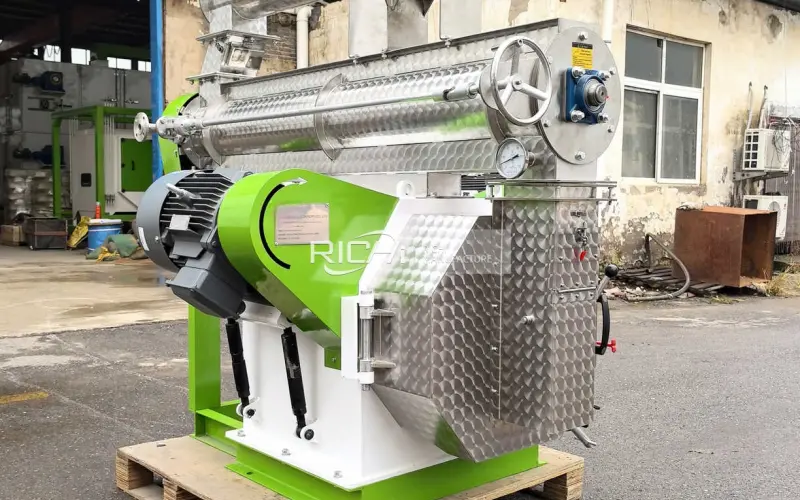
A commercial poultry farm in the Thika area of Kenya, north of Nairobi, invested in a chicken feed pellet production system for farm use to gain greater control over feed costs and supply. The business had expanded from 5,000 laying hens to approximately 50,000 layers, while also raising around 30,000 broilers annually.
Buying all its feed from commercial suppliers in Nairobi had become increasingly difficult to manage, particularly during the rainy season, when transport delays could disrupt deliveries.
The farm did not need to build a feed factory from scratch. It already owned a 30 kW hammer mill for grinding maize and a vertical mixer with a 500 kg batch capacity. The missing stage was pelletizing, together with the cooling and steam-conditioning equipment needed to produce stable finished pellets.
RICHI recommended the SZLH250 ring die feed pellet mill, rated at 1–1.5 T/H, as the core machine for this phased investment. The farm retained its existing grinding and mixing equipment, allowing the project to focus its budget on the new pelletizing section.
Name:
Chicken Feed Pellet System
Country:
Kenya
Date:
2026
Capacity:
1–1.5 T/H
Model:
SZLH250
Main Motor Power:
22 kW
Primary products:
Broiler grower, broiler finisher and layer feed pellets
Pellet diameter:
3.5-4.5mm
The farm's annual feed requirement was assessed against its actual flock size and expected feed consumption. For a first-stage on-farm production plan, approximately 1,700–1,900 tonnes of pellets per year was a practical target, with purchased feed remaining available during demand peaks or periods of maintenance. The final production schedule would depend on actual feed formulations, machine utilization and seasonal operating conditions.
| Project Item | Configuration |
|---|---|
| Location | Thika region, Kenya |
| Customer type | Integrated layer and broiler farm |
| Layer flock | Approximately 50,000 birds |
| Broiler production | Approximately 30,000 birds annually |
| Pellet mill model | SZLH250 ring die pellet mill |
| Main motor | 22 kW |
| Rated pelletizing capacity | 1–1.5 T/H |
| Existing upstream equipment | 30 kW hammer mill and 500 kg vertical mixer |
| Additional process equipment | Counterflow cooler, steam supply and transfer equipment |
| Primary products | Broiler grower, broiler finisher and layer feed pellets |
The SZLH250 was selected because its capacity matched the farm's phased production target without requiring the investment associated with a larger commercial pellet mill. Its nominal capacity is a reference for equipment selection rather than a guaranteed output for every formula. Actual throughput depends on die diameter, compression ratio, ingredient composition, moisture and conditioning conditions.
The project was designed to reuse as much of the farm's existing equipment as possible. The animal feed hammer mill continued to prepare maize and other suitable grains, while the vertical mixer blended ground ingredients before they entered the new pelletizing section.
This arrangement avoids replacing functional upstream equipment simply to add pelleted feed production. It also creates a clear upgrade path: the farm can improve conveying, weighing, automation or packaging later without necessarily replacing the core pellet mill.
The farm needed more than one pellet specification. Broiler diets change with bird age, while laying hens require a different nutrient balance and mineral inclusion. Interchangeable ring dies allow the same pellet mill to process different formulations, provided the die configuration and operating parameters are appropriate for each product.
| Feed Type | Pellet Diameter | Die Compression Ratio | Indicative Output | Conditioning Temperature |
|---|---|---|---|---|
| Broiler grower | 3.5 mm | 1:12 | 0.8–1.0 T/H | 80–85°C |
| Broiler finisher | 4.0 mm | 1:11 | 0.9–1.1 T/H | 75–80°C |
| Layer feed | 4.5 mm | 1:10 | 1.0–1.2 T/H | 70–75°C |
These figures are initial operating references for the specified machine configuration. They should be verified during commissioning with the farm's actual formulas and ingredient moisture levels. A 3.5 mm pellet is more appropriate for many grower applications than for very young chicks. If the farm intends to produce starter feed for the youngest broilers, it should evaluate a smaller die or a crumbler for converting suitable pellets into starter crumbles.
The steam addition rate also needs to be adjusted to the formula and incoming material condition. As a starting point, the farm can evaluate approximately 5–6% steam addition for broiler grower feed, 4–5% for finisher feed and 3–4% for layer feed. These are process settings to validate, not fixed requirements for every batch.
The farm can source several feed ingredients locally, including maize, rice bran and sunflower cake. Soybean meal and selected additives may be purchased through local distributors or import channels. Using these materials in a controlled formula can reduce reliance on finished commercial feed, but the nutrient value of each batch should be checked before formulation adjustments are made.
| Ingredient | Inclusion Rate |
|---|---|
| Ground maize | 56% |
| Soybean meal | 20% |
| Rice bran | 10% |
| Fishmeal | 4% |
| Vegetable oil | 5% |
| Wheat bran | 4% |
| Vitamin-mineral premix | 1% |
| Total | 100% |
| Ingredient | Inclusion Rate |
|---|---|
| Ground maize | 51% |
| Soybean meal | 15% |
| Rice bran | 12% |
| Limestone | 10% |
| Sunflower cake | 6% |
| Vegetable oil | 5% |
| Vitamin-mineral premix | 1% |
| Total | 100% |
These formulas are illustrative starting points rather than verified commercial rations for the customer's flock. A poultry nutritionist should balance protein, energy, amino acids, calcium, available phosphorus and other nutrients using laboratory analysis and the birds' production stage. The 10% limestone inclusion in the layer formula is not equivalent to 10% elemental calcium; total dietary calcium must be calculated from all ingredients.
Vegetable oil also requires attention during pelleting. Excessive oil added before the die can reduce friction and weaken pellet binding. Where the formula requires substantial oil addition, the farm should assess how much can be incorporated before pelleting and whether additional coating after cooling would be more suitable.
The initial steam arrangement used a small boiler rated at approximately 100 kg/h. During periods when incoming maize was wetter, the farm found it difficult to maintain consistent conditioning conditions. It subsequently upgraded the boiler to approximately 150 kg/h to provide a more reliable steam supply.
The experience illustrates why boiler selection cannot be based solely on the pellet mill's motor power. Steam demand changes with production rate, formulation, incoming moisture and the temperature required for conditioning. A boiler with insufficient usable steam output can restrict pellet quality and reduce effective throughput even when the pellet mill itself is correctly sized.
The 150 kg/h figure represents the upgraded boiler's nominal capacity in this project. It should not be treated as a universal boiler specification for every SZLH250 feed pellet machine installation.
Because the customer was expanding an existing farm operation, the installation needed to fit within the available building and work with the equipment already on site.
| Planning Item | Project Consideration |
|---|---|
| Pellet mill power | 22 kW main motor |
| Existing grinding power | 30 kW hammer mill, retained in service |
| Steam system | Boiler upgraded from 100 kg/h to 150 kg/h nominal capacity |
| Water supply | Boiler make-up water and treatment based on the selected boiler specification |
| Installation space | Allow approximately 25–35 m² as a preliminary planning allowance for the pelletizing and cooling section, excluding existing grinding and mixing equipment, boiler space, raw material storage and finished-feed storage |
| Operating staff | Plan for approximately 2–3 operators per shift, depending on the level of automation and how bagging and material handling are organized |
| Packaging | Manual bagging or a suitable bagging scale can be used according to daily output and labor availability |
The space allowance is for preliminary layout planning, not a substitute for the manufacturer's general arrangement drawing. The final layout must provide access for die and roller maintenance, cooling equipment, steam piping, dust collection and safe movement of operators and bags.
The total electrical demand will be higher than the pellet mill's 22 kW main motor rating. The final supply and protection arrangement should be determined from the nameplate data of all operating equipment, particularly if an electric boiler is used.
The most important benefit was greater control over the timing and composition of feed production. Instead of relying entirely on deliveries from Nairobi, the farm could prepare its regular diets using available raw materials and schedule production around flock requirements.
The farm owner estimated that the investment recovered its cost within approximately eight months, based on avoided purchases of commercial feed. This is a site-specific estimate rather than a guaranteed payback period. Actual returns depend on maize and protein-meal prices, electricity and steam costs, labor, wear parts, machine utilization and the proportion of feed that can be produced economically on site.
The project also made it easier to identify production bottlenecks. Grinding and mixing capacity could be reviewed separately from pelletizing performance, while the boiler upgrade addressed a specific constraint in the conditioning process. This approach allowed the farm to improve the system step by step rather than replacing all of its equipment at once.
The main benefit has been a more dependable feed supply, especially when heavy rain affects deliveries from Nairobi. We can prepare our own feed and adjust production to our flock's needs instead of depending entirely on commercial pellets.
The steam supply was the main challenge during the early operating period. Our original 100 kg/h boiler struggled when the maize was wetter than usual, so we upgraded to a 150 kg/h unit. After adjusting the conditioning process and paying closer attention to raw material moisture, pellet quality became more consistent.
We have also been monitoring die wear and maintenance more carefully. The 3.5 mm die required attention after about 800 operating hours, while the 4.0 mm die remained in service after approximately 900 hours. The 4.5 mm layer die had produced around 1,500 tonnes. We are now evaluating another SZLH250 for our planned farm expansion.
The follow-up experience highlights two practical lessons for farm-scale pellet production. First, ring die selection and maintenance should be based on the actual formulation and operating conditions. Second, reliable steam conditioning and upstream moisture control are essential to obtaining consistent pellets from batch to batch.
With suitable dies and correctly balanced formulations, the SZLH250 can also be considered for other conventional livestock feed applications.
The SZLH250 is a conventional ring die feed pellet mill, not a substitute for an extrusion system. Floating fish feed normally requires an extruder, while specialized shrimp feed may require additional conditioning and process controls to achieve the required water stability.
The pellet mill was shipped from Qingdao, China, to the Port of Mombasa, Kenya. The ocean freight leg took approximately 28 days in the project plan. After customs clearance, the equipment was transported inland by road to the Thika region, with total transit time estimated at about 38 days.
As delivery schedules vary with vessel routing, customs clearance and inland transport conditions, these figures should be treated as project-specific planning estimates rather than fixed transit guarantees.
RICHI's support focused on integrating the pellet mill into the farm's existing production arrangement and resolving practical operating issues.
For a farm that is new to pelleted feed production, this type of support helps connect equipment selection with the daily realities of formulation changes, moisture variation, cleaning, maintenance and output planning.
The farm is considering a second SZLH250 for a new broiler operation and evaluating a larger SZLH320 for a possible future feed sales business. These are different investment decisions. A second SZLH250 could provide additional capacity or operational flexibility for the farm, while a commercial feed sales operation would also require attention to raw material storage, batch traceability, product consistency, packaging and local feed regulations.
For poultry farmers in Kenya considering a similar upgrade, the first step is to compare the flock's actual feed consumption with the realistic output of the proposed equipment. The next is to determine which existing machines can be retained and which supporting systems need upgrading.
RICHI Machinery supplies ring die pellet mills and supporting feed processing equipment for farm-scale and commercial applications. If you are planning a chicken feed pellet production system for farm use in Kenya, provide your flock size, annual feed requirement, available raw materials, existing equipment and target pellet sizes. These details allow the equipment configuration, steam supply and production schedule to be assessed as one integrated system rather than as a standalone machine purchase.
Having the right mix of reliable, high-quality pellet machine and pelletizing systems and expert support is essential to your success. Watch how our end-to-end feed pellet plant solutions have helped our customers optimize their performance.
Our customized and future-proofed turnkey pellet plant solutions is designed with you at the core. From vision to reality and beyond, our team stays connected with yours. Giving you peace-of-mind with an expert at your side.

At RICHI, we go beyond project completion. With RICHI Servicee, we’re your dedicated partners in success. Count on us for expert guidance, minimal downtime, and optimized productivity. Choose RICHI for unmatched service and support.



Meet global product demands and quality standards with industry-leading pellet plant design, engineering, equipment, and construction services for pellet processors.


Your Partner Beyond Project Completion
2000+ cases
RICHI is the leading designer, manufacturer and builder of pellet plants in the world, completing over 2000 projects in 140 countries across 6 continents.
Read More
Increase plant productivity, profitability, and safety by integrating high quality equipment into your pellet production line. Over the years, RICHI has become China's top pellet equipment manufacturer. At the same time, RICHI has established valuable partnerships with the world's leading component and raw material manufacturers to bring you the best there is in technology, automation, and efficiency in pelleting plant machinery.

For nearly 30 years, RICHI has been providing best-in-class pellet plant equipment and services to clients across a variety of industries, sizes, and needs. We pride ourselves on the knowledge and skill that each team member possesses – from our technical sales team to our process design engineers. You can count on RICHI Machinery to take your operation to the next level of innovation, quality, and success.
Need help with your pellet manufacturing plant project? Contact us today.
ANIMAL FEED
BIOMASS
WOOD
ORGANIC FERTILIZER
AQUA FEED
CAT LITTER
MUNICIPAL WASTE RECYCLING
SPECIAL PELLET PRODUCTION
RICHI Machinery continues to deliver world class pellet mill equipment, pellet plant engineering and project solutions that add value to our customers in the animal feed, wood waste, agriculture waste, organic fertilizer, cat litter and special pellet products industries. Throughout the years, we RICHI Machinery have built strong brand, becoming industry-leading pellet machine manufacturer. We value integrity, promise quality, and prioritize your success.
Learn MoreWith our expert team, we precisely implement your process engineering requirements in pellet mill and pelletizing plant systems. No matter which industry you’re in – we understand your needs and deliver solutions that meet the highest standards.
At RICHI, quality comes first. Our pellet making machine and related pellet line equipment undergo rigorous quality controls to ensure they meet the highest standards. Rely on products that are durable, safe, and efficient.
With decades of experience in pellet machine and pellet production line production, we have earned a reputation as a trusted partner in various industries. Our expertise allows us to cover a wide range of applications.
Not only do we offer premium pelleting equipment, but we are also experts at designing, building, installing, and maintaining facilities from the ground up. Our expertise is within pellt plant process design, discovering the most efficient, productive, and profitable way to handle your materials in an end-to-end cycle.
○ RICHI MACHINERY
Keeping in touch with us is an effective way to solve all your problems. If you have any needs or questions, please leave your contact information, then RICHI technical consultants will send design, quotation, videos to your mailbox. You can also contact us directly via WhatsApp: +86 13838389622
Copyright©2015-2026 by HENAN RICHI MACHINERY CO., LTD. All rights reserved.