
Chicken feed milling machine in Czech Republic: see how an SFSP56*40 hammer mill helps a poultry farm grind wheat, barley and corn for consistent feed production.
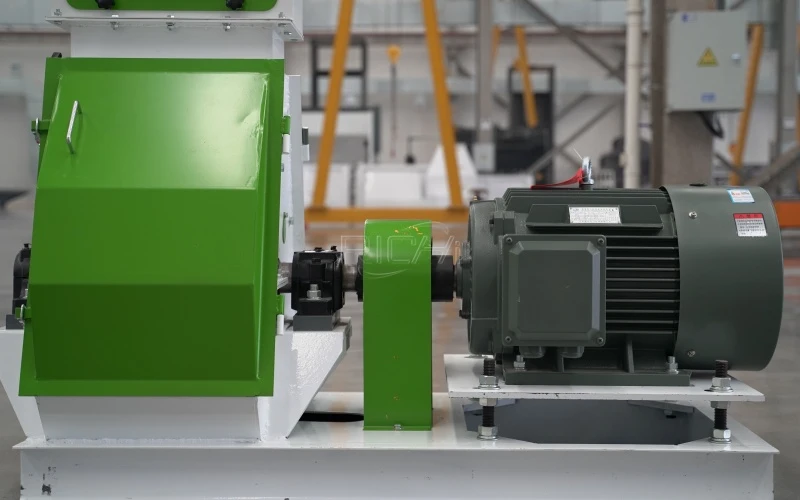
A family-owned poultry farm in the eastern Czech Republic wanted greater control over the grain used in its broiler and layer diets. The farm had basic mixing equipment and an older pellet mill, but grain preparation remained a weak point. Wheat and barley were crushed manually or sourced in pre-ground form, making it difficult to maintain consistent particle sizes and plan feed production around changing ingredient prices.
The farm produced approximately 60,000 birds annually and sold its products through local buyers and agricultural cooperatives. Rather than invest in a complete feed manufacturing line, the owner decided to mechanize the grinding stage first. A dedicated hammer mill would allow the farm to process purchased corn, wheat and barley before mixing them with protein meals, oils and premixes.
After reviewing the available installation space, electrical supply and expected grain requirements, the customer selected an SFSP56*40 hammer mill from RICHI Machinery. With a 37 kW main motor and an indicative capacity of 0.8–1.0 tons per hour, the machine offered a practical starting point for intermittent, batch-based grinding without requiring a major expansion of the farm's existing facilities.
Name:
Chicken Feed Milling Machine
Country:
Czech Republic
Date:
2026
Capacity:
0.8–1.0 T/H
Model:
SFSP56*40
Main Motor Power:
37 kW
Raw Materials:
corn, wheat and barley
Final product size:
2-4mm
The main concern was not simply how quickly grain could be crushed. Particle consistency also affected the next stages of feed preparation. When coarse and fine particles varied considerably between batches, mixing became less predictable, and the existing feed pellet machine did not always produce the same finished-feed texture.
The farm needed a machine that could handle its principal cereal ingredients while allowing the operator to adjust the grinding fineness for different feed formulations. Purchasing a complete automated plant would have introduced additional equipment costs and installation work before the farm had fully established its in-house production schedule.
A standalone chicken feed milling machine provided a more manageable investment. The SFSP56*40 was selected to replace the improvised grinding method while retaining the mixer and pellet mill already available on-site.
The selected water-drop-type hammer mill uses a high-speed rotor and replaceable hammers to reduce cereal grains to the required particle size. Its configuration was intended for the farm's grain preparation needs rather than continuous operation at the maximum rated output.
| Parameter | Specification |
|---|---|
| Machine model | SFSP56*40 |
| Machine type | Water-drop-type animal feed hammer mill |
| Rotor diameter | 560 mm |
| Grinding chamber width | 400 mm |
| Rotor speed | 2,980 rpm |
| Hammer tip speed | Approximately 88 m/s |
| Main motor power | 37 kW |
| Indicative throughput | 0.8–1.0 T/H |
| Primary application | Grinding corn, wheat and barley for poultry feed |
Actual throughput depends on grain type, incoming moisture, screen aperture, required fineness and the condition of the wearing parts. The farm therefore needed to evaluate the machine against its own recipes rather than assume that every raw material would reach the same output rate.
The Czech Republic has an established grain-growing sector, giving poultry producers access to wheat, barley and corn through local farms, grain merchants and agricultural cooperatives. For this project, these cereals formed the main grinding workload, while protein ingredients and premixes were handled separately.
The farm did not need to grind every ingredient. Soybean meal, sunflower meal, premixes and other formulated components could be purchased in a suitable processed form or handled according to their individual requirements. This kept the new machine focused on the materials for which on-site grinding offered the greatest practical benefit.
Different poultry diets do not necessarily require identical grinding settings. Very fine grinding can improve uniformity in some starter formulations, but excessive fines may increase dust and affect feed handling. Coarser particles may be suitable for other products, depending on bird age, feed form and formulation.
For this farm, the operator planned to use interchangeable screens to establish separate settings for different batches. A fine-grinding setting could be tested for starter formulations, while a moderately coarser setting could be evaluated for grower, finisher or layer feed. As a practical starting point, cereal grinding around 0.8–1.2 mm may suit some finely ground poultry formulations, while other diets may require a broader or coarser particle distribution.
These values are not universal specifications. The appropriate screen depends on the actual diet, the bird's age and whether the ground material will be used in mash feed or passed through a pellet mill. The operator must assess the resulting particle-size distribution and finished-feed quality before fixing the production settings.
The SFSP56*40 was purchased as a single machine, but its value depended on how well it worked with the farm's existing equipment. The planned material route was straightforward:
This arrangement avoided unnecessary replacement of machinery that remained serviceable. It also allowed the farm to introduce mechanical grinding before deciding whether additional conveying, storage or automation would be justified.
Because the grinder was being integrated into an existing facility, installation planning focused on the machine foundation, motor connection, inlet and discharge arrangements, dust extraction and safe access for maintenance. The electrical system also needed to accommodate the 37 kW motor and its starting requirements.
Although the hammer mill simplified grain preparation, consistent operation still depended on raw-material management. Grain with excessive moisture can reduce grinding efficiency and contribute to handling problems. Foreign objects can damage hammers, screens or other internal components, making incoming-material inspection important even when grain is purchased from established local suppliers.
The farm also needed to monitor the condition of its screens and hammers. Worn components can alter particle-size distribution and increase the time required to achieve the desired fineness. Periodic checks of motor current, bearing temperature, vibration and unusual noise provide practical indicators of developing problems.
Dust control was another consideration. Fine cereal particles can accumulate around transfer points and electrical equipment. Appropriate extraction, housekeeping, grounding and protection against combustible dust hazards are important parts of a safe grinding installation. The final arrangement should follow the applicable Czech and European safety requirements.
For a farm producing feed in batches, recording the material processed, screen configuration, operating time and maintenance performed can help identify which settings provide the best balance between throughput and grinding quality. These records also provide a useful basis for deciding whether the existing machine has sufficient capacity as feed demand changes.
The feed crusher machine was shipped from China through the Port of Hamburg, Germany, before continuing by road to the customer's facility in eastern Czech Republic. This route provided a practical logistics option for the landlocked destination.
RICHI supplied equipment documentation and installation guidance to support integration with the farm's existing feed preparation system. The customer could use this information to coordinate the machine foundation, electrical connection and material-transfer arrangements before commissioning.
Technical support also covered screen selection, operating procedures and routine inspection of wearing parts. For a single-machine purchase, this preparation mattered because the grinder had to fit an established workflow rather than operate as part of a newly engineered production line.
With a dedicated hammer mill available, the farm gained a more controlled method of preparing cereal ingredients. Instead of relying on manual crushing or the availability of pre-ground grain, the operator could schedule grinding according to feed requirements and select settings for different formulations.
The existing mixer machine and feed pellet mill remained in service, allowing the farm to introduce the new equipment without committing to a full factory reconstruction. This staged approach also gave the owner a clearer basis for assessing future investment priorities, including whether additional material-handling equipment or a mixer upgrade would be worthwhile.
The farm's experience illustrates an important consideration for poultry producers: mechanization does not always require a complete new line. When grinding is the main constraint, upgrading that stage can be a practical first step toward more consistent feed preparation.
The SFSP56*40 was selected for this project because its grinding function, motor rating and indicative output were better aligned with the farm's planned batch-based operation than a larger industrial mill. Its role was specific: prepare cereal ingredients for the existing mixing and pelleting process, rather than replace the entire feed manufacturing system.
For poultry farms and small feed producers in the Czech Republic considering a similar investment, the right chicken feed milling machine depends on annual feed demand, daily operating hours, the range of grains processed and the required particle size. Equipment selection should account for the complete material route, including dust collection, mixing, pelleting and finished-feed handling.
RICHI Machinery supplies feed hammer mills and other feed processing equipment for farms and commercial manufacturers. By matching machine capacity and configuration to the customer's actual raw materials and production requirements, a single grinding-machine investment can provide a practical foundation for improving feed preparation without unnecessary capital expenditure.
Having the right mix of reliable, high-quality pellet machine and pelletizing systems and expert support is essential to your success. Watch how our end-to-end feed pellet plant solutions have helped our customers optimize their performance.
Our customized and future-proofed turnkey pellet plant solutions is designed with you at the core. From vision to reality and beyond, our team stays connected with yours. Giving you peace-of-mind with an expert at your side.

At RICHI, we go beyond project completion. With RICHI Servicee, we’re your dedicated partners in success. Count on us for expert guidance, minimal downtime, and optimized productivity. Choose RICHI for unmatched service and support.



Meet global product demands and quality standards with industry-leading pellet plant design, engineering, equipment, and construction services for pellet processors.


Your Partner Beyond Project Completion
2000+ cases
RICHI is the leading designer, manufacturer and builder of pellet plants in the world, completing over 2000 projects in 140 countries across 6 continents.
Read More
Increase plant productivity, profitability, and safety by integrating high quality equipment into your pellet production line. Over the years, RICHI has become China's top pellet equipment manufacturer. At the same time, RICHI has established valuable partnerships with the world's leading component and raw material manufacturers to bring you the best there is in technology, automation, and efficiency in pelleting plant machinery.

For nearly 30 years, RICHI has been providing best-in-class pellet plant equipment and services to clients across a variety of industries, sizes, and needs. We pride ourselves on the knowledge and skill that each team member possesses – from our technical sales team to our process design engineers. You can count on RICHI Machinery to take your operation to the next level of innovation, quality, and success.
Need help with your pellet manufacturing plant project? Contact us today.
ANIMAL FEED
BIOMASS
WOOD
ORGANIC FERTILIZER
AQUA FEED
CAT LITTER
MUNICIPAL WASTE RECYCLING
SPECIAL PELLET PRODUCTION
RICHI Machinery continues to deliver world class pellet mill equipment, pellet plant engineering and project solutions that add value to our customers in the animal feed, wood waste, agriculture waste, organic fertilizer, cat litter and special pellet products industries. Throughout the years, we RICHI Machinery have built strong brand, becoming industry-leading pellet machine manufacturer. We value integrity, promise quality, and prioritize your success.
Learn MoreWith our expert team, we precisely implement your process engineering requirements in pellet mill and pelletizing plant systems. No matter which industry you’re in – we understand your needs and deliver solutions that meet the highest standards.
At RICHI, quality comes first. Our pellet making machine and related pellet line equipment undergo rigorous quality controls to ensure they meet the highest standards. Rely on products that are durable, safe, and efficient.
With decades of experience in pellet machine and pellet production line production, we have earned a reputation as a trusted partner in various industries. Our expertise allows us to cover a wide range of applications.
Not only do we offer premium pelleting equipment, but we are also experts at designing, building, installing, and maintaining facilities from the ground up. Our expertise is within pellt plant process design, discovering the most efficient, productive, and profitable way to handle your materials in an end-to-end cycle.
○ RICHI MACHINERY
Keeping in touch with us is an effective way to solve all your problems. If you have any needs or questions, please leave your contact information, then RICHI technical consultants will send design, quotation, videos to your mailbox. You can also contact us directly via WhatsApp: +86 13838389622
Copyright©2015-2026 by HENAN RICHI MACHINERY CO., LTD. All rights reserved.