
RICHI supplied a 5–6 T/H SZLH350 Broiler Pellet Production Machine for Poultry Farm in Uruguay, producing starter crumble and 3.5–4.5 mm grower and finisher pellets in Canelones.
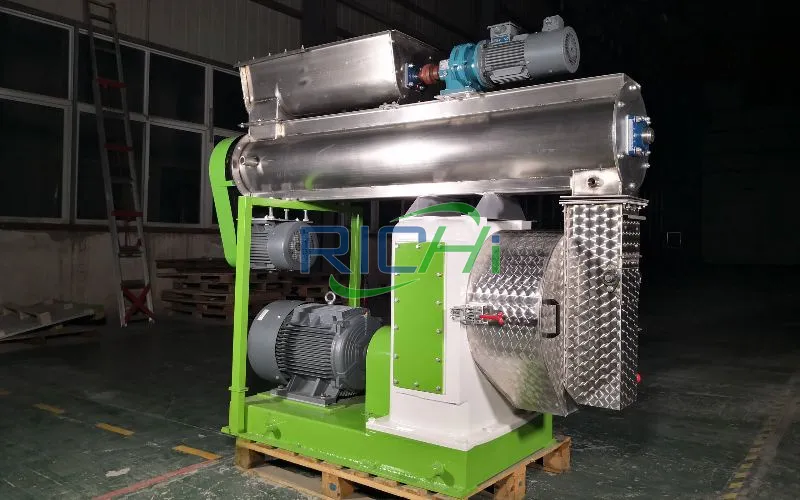
An integrated poultry company in the Canelones Department selected one RICHI SZLH350 Broiler Pellet Production Machine for Poultry Farm in Uruguay to upgrade the pelleting section of its existing feed mill. The company manages breeder and hatchery operations together with commercial broiler farms and produces approximately 1.5 million broilers per year. Its grinding, batching, mixing, steam supply, cooling, screening and finished-feed handling systems were already in place, so the project focused on replacing the pelleting bottleneck rather than constructing another complete poultry feed production line.
The customer’s annual broiler-feed requirement is approximately 5,000–6,000 tonnes, a production level consistent with the size of the poultry operation and much better matched to one SZLH350 than a 25,000 T/Y feed target. The selected machine uses a 55 kW main motor and provides a reference output of approximately 5–6 T/H for suitable compound poultry-feed formulations. Upstream grain ingredients are ground through approximately 2–3 mm hammer-mill screens before batching and mixing, while the finished products include roughly 1.5–3 mm starter crumble and approximately 3.5–4.5 mm grower and finisher pellets.
Name:
Country:
Uruguay
Date:
Capacity:
:
:
:
Pellet diameter:
3.5–4.5mm
The customer did not need another grinder, mixer or complete feed plant. The existing line could already receive grain, reduce particle size, weigh ingredients and prepare compound mash. The limiting stage was pelletizing. Adding one SZLH350 feed pellet machine allowed the company to retain usable equipment and convert the prepared mash into physical feed forms better suited to its broiler production program.
This is a practical retrofit for an integrated poultry company because the farm controls both feed manufacturing and downstream feed use. The mill can schedule starter, grower and finisher production according to chick placement and farm demand instead of manufacturing speculative stock for an external retail market.
The machine also provides substantial hourly capacity relative to the company’s annual feed requirement. At 5 T/H, producing 5,000 tonnes requires approximately 1,000 effective pelleting hours per year. At 6 T/H, producing 6,000 tonnes also requires around 1,000 hours. This gives the mill room for formula changes, maintenance and scheduled production rather than forcing the pellet machine to operate continuously throughout every shift.
| Project Parameter | Configuration | Project Basis |
|---|---|---|
| Equipment | Ring die broiler feed pellet machine | Standalone upgrade inside existing feed mill |
| Model | SZLH350 | Selected for integrated poultry feed production |
| Main Motor | 55 kW | SZLH350 project configuration |
| Reference Capacity | 5–6 T/H | Suitable compound broiler-feed formulas |
| Annual Feed Requirement | Approximately 5,000–6,000 T/Y | Internal supply for approximately 1.5 million broilers/year |
| Upstream Grinding Screen | Approximately 2–3 mm | For cereal and other ingredients requiring grinding |
| Starter Feed Form | Approximately 1.5–3 mm crumble | Produced from a parent pellet through a crumbler |
| Grower/Finisher Pellet Diameter | Approximately 3.5–4.5 mm | Selected according to bird stage and farm specification |
| Main Application | Broiler feed for company-owned poultry farms | Single use scenario |
The 5–6 T/H range is the machine capacity used throughout this project. It should not be divided into unsupported figures such as 4.5 T/H for starter and 5.5 T/H for finisher simply because pellet sizes differ. Formula, die resistance, conditioning, oil level, mash moisture and feed rate can change actual throughput, but the equipment remains a 5–6 T/H class poultry pellet mill.
The SZLH350 feed pellet mill does not receive whole maize or unprocessed raw materials. Ingredients requiring size reduction first pass through the existing hammer-mill section. For this project, cereal grinding generally uses approximately 2–3 mm screen openings, producing a mixed particle distribution suitable for subsequent batching and pelleting. The screen size should not be confused with exact finished particle diameter because hammer milling always creates a range of particle sizes.
After grinding, ingredients are weighed according to the current broiler formula and mixed before entering the mash buffer above the pellet mill. This upstream preparation matters because excessively coarse cereal particles can interfere with pellet formation, while unnecessary over-grinding increases electrical consumption and the proportion of fine material in the feed.
The pelletizing section therefore begins with a prepared compound mash rather than with individual raw materials. Stable particle preparation, accurate batching and uniform mixing all affect the physical quality of the pellet coming out of the SZLH350.
Uruguay has a strong grain sector, and corn is an important energy ingredient for commercial livestock and poultry feeding. The customer uses corn as the main cereal base while purchasing soybean meal and other protein and micro-ingredients according to commercial availability and nutrition specifications.
The exact formula is not permanently fixed at 55% maize, 22% soybean meal or any other single percentage. Starter, grower and finisher diets require different nutrient densities, amino-acid profiles and energy levels. Ingredient prices also change, so the nutrition team may adjust the formulation while keeping the finished feed within the required specification.
This variability is one reason RICHI does not establish one permanent die compression ratio or conditioning setting for the machine. The animal feed pellet machine has to handle a family of broiler formulas rather than one static recipe.
For the early broiler stage, the project does not rely on a 3.5 mm full-size pellet being fed directly to newly placed chicks. The more practical route is to manufacture a parent pellet and then use the existing crumbler to reduce it into approximately 1.5–3 mm starter crumble.
Grower and finisher feed remain as intact pellets, generally within an approximately 3.5–4.5 mm diameter range for this project. The exact final size is selected according to bird age, feeder design and the company’s farm specification.
This arrangement allows one pellet mill to produce the parent physical form while the downstream crumbler creates the smaller starter product. It also avoids unnecessary die changes simply to manufacture very small starter feed.
The prepared mash enters the conditioner before ring die compression. Steam changes mash temperature and moisture and influences how starch, protein and fiber behave during pellet formation. However, the customer does not use a fixed table stating that starter feed must always be conditioned at 85–90°C and finisher feed at 75–80°C.
The operating window is determined by actual feed composition, mash moisture, steam quality, oil inclusion and throughput. During commissioning, operators monitor pellet formation, motor current, discharge condition, fines and cooler performance while adjusting steam and feed rate.
The same principle applies to steam percentage. A fixed addition of 6–7% or 4–5% cannot be prescribed simply from the broiler stage. The correct quantity is the amount needed to reach the target mash condition without creating excessive moisture or unstable operation.
The customer maintains ring die configurations suitable for its grower and finisher products, but die design is not reduced to a fixed 1:12 or 1:10 compression ratio. Effective die working length, pellet diameter, formula composition and required physical durability all influence compression resistance.
A high-oil formula can respond differently from a cereal-rich formulation. Higher fiber content can also change motor load and throughput. Too much die resistance can reduce output and increase electrical load, while insufficient resistance can create weak pellets and additional fines.
For this reason, RICHI selects die specifications using actual product requirements rather than applying one universal compression table to every Uruguay broiler formula.
A poultry feed pellet machine upgrade only works when the downstream cooling section can accept the new output. The SZLH350 can supply approximately 5–6 T/H of hot pellets under suitable conditions, so the customer’s existing cooler, screener, elevator and finished-feed bins all need to accommodate the same production range.
Cooling reduces pellet temperature and removes part of the moisture associated with conditioning and compression before the feed enters storage or bulk delivery. If the cooler can process only 3 T/H, the customer cannot make effective use of a 5–6 T/H pellet mill even though the pelletizer itself performs correctly.
The retrofit therefore includes a line-balance review rather than only a pellet-mill specification check. Mixer batch cycle, mash-buffer volume, steam capacity, cooler throughput, screening and bulk handling all have to support the selected production rate.
The company requires stable physical feed quality across its broiler farms, but RICHI does not promise a fixed PDI or a guaranteed reduction in feed conversion ratio simply from installing the SZLH350.
Pellet durability is influenced by grinding, mixing, conditioning, formula, die configuration, cooling and transport. Fines can also be generated after the pellets leave the mill if elevators, conveyors or bulk-truck transfer points are too aggressive.
For an integrated company, one useful quality-control method is to compare samples not only immediately after the cooler but also after feed reaches the farms. This shows whether pellet damage is being created during manufacture or during bulk transport.
Broiler growth and feed conversion are also influenced by genetics, nutrition, health, environmental management, feeder settings and stocking conditions. The pellet machine controls physical feed manufacture; it does not independently determine farm performance.
The approximately 5,000–6,000 T/Y feed requirement gives the customer considerable scheduling flexibility with one 5–6 T/H machine. At a practical average of 5 T/H, 5,000 tonnes requires about 1,000 pelleting hours per year. At 6 T/H, 6,000 tonnes also requires about 1,000 hours.
If the feed mill operates 300 days per year, this averages around 3–4 effective pelleting hours per operating day. The plant does not need to run the SZLH350 continuously simply because its installed capacity is higher than average daily demand.
Instead, production can be concentrated into scheduled batches according to broiler placements and finished-feed storage capacity. This is particularly useful for an integrated operation because the company can coordinate feed production directly with farm consumption.
The SZLH350 Broiler Pellet Production Machine for Poultry Farm in Uruguay is shipped from Qingdao, China, to the Port of Montevideo before inland delivery to the customer’s feed mill in Canelones.
Before shipment, RICHI reviews machine dimensions, electrical conditions, feed inlet and discharge elevation, steam connection, cooler interface and maintenance space. These checks are especially important because the new machine must integrate with an existing feed mill rather than a completely new RICHI production line.
The customer therefore prepares the installation position using the supplied equipment information so the new pellet mill can connect correctly with the existing mash bin, cooler and conveying system.
The customer's existing feed mill already covered most of the production process, so purchasing a complete new line would have duplicated usable equipment. One SZLH350 broiler chicken feed making machine solved the immediate pelleting requirement and provided enough capacity for approximately 5,000–6,000 T/Y of internal broiler feed.
The machine also has sufficient capacity margin if the poultry operation grows. Expansion planning should still begin with actual feed demand rather than automatically adding another pellet mill. If annual production rises, RICHI first checks whether the bottleneck is pelletizing, grinding, mixing, steam supply, cooling or finished-feed storage.
This prevents the company from purchasing a second pelletizer when another part of the plant is actually limiting output.
This Broiler Pellet Production Machine for Poultry Farm in Uruguay project uses one RICHI SZLH350 ring die pellet mill at an integrated poultry operation in Canelones. The company raises approximately 1.5 million broilers annually and requires about 5,000–6,000 tonnes of broiler feed per year. The SZLH350 provides a clear production capacity of approximately 5–6 T/H, allowing the feed mill to manufacture its annual requirement within roughly 1,000 effective pelleting hours.
Raw cereal ingredients are ground through approximately 2–3 mm hammer-mill screens before batching and mixing. Prepared mash then enters conditioning and the SZLH350. Starter feed is produced as approximately 1.5–3 mm crumble from a parent pellet, while grower and finisher feeds are produced as approximately 3.5–4.5 mm intact pellets. The pellets then pass through the existing cooling, screening and bulk handling system before delivery to company farms.
For another poultry company evaluating a broiler pellet machine in Uruguay, RICHI Machinery needs the annual bird volume, annual feed requirement, target T/H, starter/grower/finisher production proportions, raw-material list, hammer-mill screen size, mixer capacity, steam conditions, cooler capacity, pellet or crumble sizes and daily operating hours. These data allow the pellet mill to be selected around the actual integrated production system rather than an oversized or undersized annual tonnage assumption.
Having the right mix of reliable, high-quality pellet machine and pelletizing systems and expert support is essential to your success. Watch how our end-to-end feed pellet plant solutions have helped our customers optimize their performance.
Our customized and future-proofed turnkey pellet plant solutions is designed with you at the core. From vision to reality and beyond, our team stays connected with yours. Giving you peace-of-mind with an expert at your side.
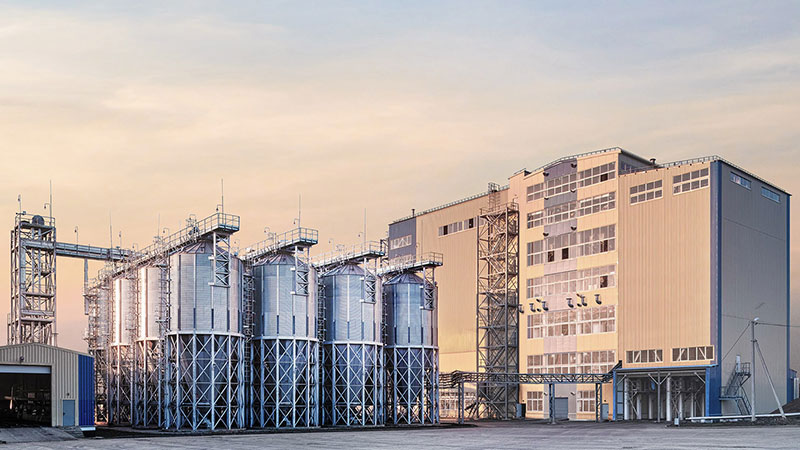
At RICHI, we go beyond project completion. With RICHI Servicee, we’re your dedicated partners in success. Count on us for expert guidance, minimal downtime, and optimized productivity. Choose RICHI for unmatched service and support.
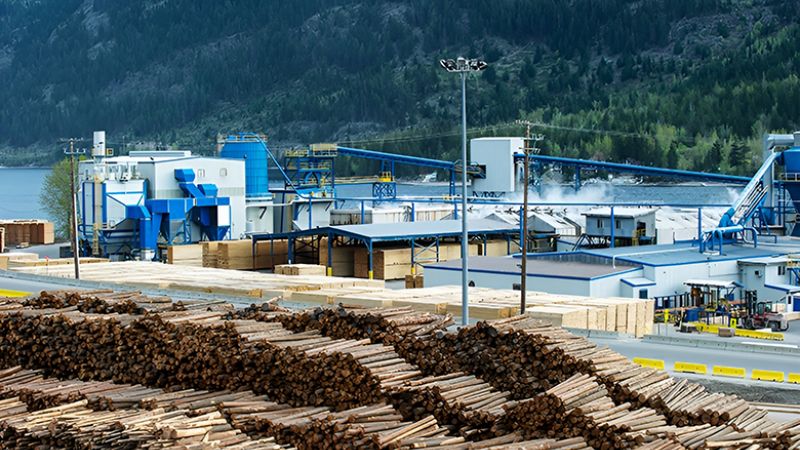


Meet global product demands and quality standards with industry-leading pellet plant design, engineering, equipment, and construction services for pellet processors.


Your Partner Beyond Project Completion
2000+ cases
RICHI is the leading designer, manufacturer and builder of pellet plants in the world, completing over 2000 projects in 140 countries across 6 continents.
Read More
Increase plant productivity, profitability, and safety by integrating high quality equipment into your pellet production line. Over the years, RICHI has become China's top pellet equipment manufacturer. At the same time, RICHI has established valuable partnerships with the world's leading component and raw material manufacturers to bring you the best there is in technology, automation, and efficiency in pelleting plant machinery.

For nearly 30 years, RICHI has been providing best-in-class pellet plant equipment and services to clients across a variety of industries, sizes, and needs. We pride ourselves on the knowledge and skill that each team member possesses – from our technical sales team to our process design engineers. You can count on RICHI Machinery to take your operation to the next level of innovation, quality, and success.
Need help with your pellet manufacturing plant project? Contact us today.
ANIMAL FEED
BIOMASS
WOOD
ORGANIC FERTILIZER
AQUA FEED
CAT LITTER
MUNICIPAL WASTE RECYCLING
SPECIAL PELLET PRODUCTION
RICHI Machinery continues to deliver world class pellet mill equipment, pellet plant engineering and project solutions that add value to our customers in the animal feed, wood waste, agriculture waste, organic fertilizer, cat litter and special pellet products industries. Throughout the years, we RICHI Machinery have built strong brand, becoming industry-leading pellet machine manufacturer. We value integrity, promise quality, and prioritize your success.
Learn MoreWith our expert team, we precisely implement your process engineering requirements in pellet mill and pelletizing plant systems. No matter which industry you’re in – we understand your needs and deliver solutions that meet the highest standards.
At RICHI, quality comes first. Our pellet making machine and related pellet line equipment undergo rigorous quality controls to ensure they meet the highest standards. Rely on products that are durable, safe, and efficient.
With decades of experience in pellet machine and pellet production line production, we have earned a reputation as a trusted partner in various industries. Our expertise allows us to cover a wide range of applications.
Not only do we offer premium pelleting equipment, but we are also experts at designing, building, installing, and maintaining facilities from the ground up. Our expertise is within pellt plant process design, discovering the most efficient, productive, and profitable way to handle your materials in an end-to-end cycle.
○ RICHI MACHINERY
Keeping in touch with us is an effective way to solve all your problems. If you have any needs or questions, please leave your contact information, then RICHI technical consultants will send design, quotation, videos to your mailbox. You can also contact us directly via WhatsApp: +86 13838389622
Copyright©2015-2026 by HENAN RICHI MACHINERY CO., LTD. All rights reserved.