
Aquarium Fish Food Extruder in Saudi Arabia for producing floating ornamental fish feed. Explore RICHI's SPHS75×2 wet twin screw extruder, raw material preparation, pellet sizing and customized extrusion solutions.
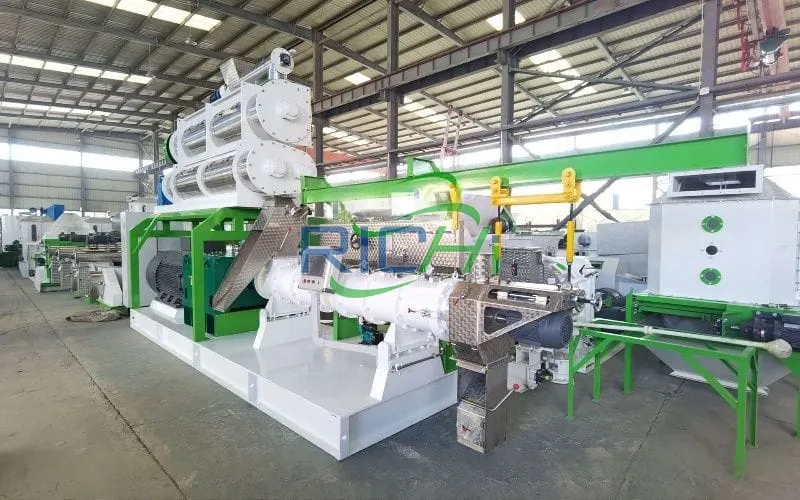
The Aquarium Fish Food Extruder in Saudi Arabia was selected for a specialist aquatic feed manufacturer planning to expand into commercial ornamental fish food. The company already handles dry ingredients and has basic weighing and powder-mixing equipment. Rather than replace its existing machinery or purchase a complete production line, the buyer chose one RICHI SPHS75×2 wet twin screw extruder to add an extrusion stage for floating aquarium fish feed.
The project focuses on producing small, water-stable pellets for ornamental fish retailers, aquarium breeders and specialist aquatic suppliers. The selected machine has a 55 kW main motor, 75 mm screw diameter and a rated capacity of 0.5–1.0 T/H. This is a proposed equipment configuration, with final output and pellet quality subject to the actual formula, die design and commissioning trials.
Name:
Aquarium Fish Food Extruder
Country:
Saudi Arabia
Date:
2026
Capacity:
0.5–1.0 T/H
Model:
SPHS75×2
Main Motor Power:
55 kW
Extrusion process:
Wet twin screw extrusion
Feeder motor power:
1.5 kW
Saudi Arabia has an established aquaculture sector, including tilapia, Asian seabass and other farmed species. The country's aquatic feed market also creates opportunities for businesses serving smaller, more specialized customer groups. Ornamental fish food is one such segment, where buyers may value pellet size, floating behavior, water stability and consistent appearance.
The proposed customer is a regional aquatic feed manufacturer rather than a hobbyist or a single aquarium shop. Its existing business is based on purchasing feed ingredients, preparing formulated blends and supplying products through local distribution channels. The company wants to add a dedicated aquarium fish food range without immediately investing in a complete new factory.
That decision affects the equipment requirement. The buyer needs an extruder that can accept prepared feed mixtures and form them into expanded pellets. Existing ingredient storage, weighing and mixing equipment can remain in use if their capacity and condition are suitable for the new process.
The new machine is intended to handle the extrusion stage. It is not an animal feed hammer mill, mixer machine or complete feed production line. The upstream equipment must still prepare a consistent blend, while suitable downstream drying, cooling, screening and packing arrangements are required to finish the product.
For this project, RICHI's SPHS75×2 wet type fish feed extruder machine was selected from the supplied SPHS series. The twin screw configuration is suitable for a manufacturer seeking flexibility when working with formulated aquatic feed mixtures. Its wet process includes conditioning before extrusion, helping prepare the material for shaping and expansion.
| Specification | Selected configuration |
|---|---|
| Machine model | SPHS75×2 |
| Equipment quantity | 1 unit |
| Extrusion process | Wet twin screw extrusion |
| Main motor power | 55 kW |
| Screw diameter | 75 mm |
| Feeder motor power | 1.5 kW |
| Conditioner motor power | 7.5 kW |
| Differential conditioner motor power | 11 kW |
| Conditioner specification | DC400-244 |
| Differential conditioner specification | DC400×300-244 |
| Rated capacity | 0.5–1.0 T/H |
The rated capacity is a reference for equipment selection, not a guaranteed output for every aquarium feed formula. Fine pellets, high-fiber recipes and formulations with different starch contents may require different operating conditions. The final production rate should be confirmed using the intended ingredients and product specifications.
The proposed raw material system combines protein sources, digestible carbohydrates, fats and selected functional ingredients. Fish meal can supply marine protein, while soybean meal provides another protein source. Wheat flour or another suitable starch-bearing ingredient can support pellet formation when used at an appropriate inclusion level.
Depending on the target fish species and product positioning, the formulation may also include shrimp meal, fish oil, a vitamin and mineral premix, and selected ingredients such as spirulina. These are possible formulation components, not a fixed recipe. Their inclusion must be determined by a qualified aquatic nutritionist.
The ingredient proportions should reflect the intended fish species, life stage, feeding behavior and nutritional requirements. A small ornamental fish pellet is not simply a miniature version of a commercial grow-out feed. Its formulation and physical properties must be developed for the target animals and feeding conditions.
Before extrusion, the ingredients must be weighed and mixed into a reasonably uniform blend. Particle size also needs attention because coarse particles can affect small-die performance and the appearance of fine aquarium pellets.
Pellet size is one of the main selling points in aquarium fish food. Small fish may struggle with large pellets, while larger ornamental species require a different feeding size. The product range should therefore be developed around the intended fish and its feeding behavior.
For this proposed project, an initial product range could include approximately 0.8–1.2 mm micro pellets for smaller ornamental fish and 1.5–2.5 mm pellets for medium-sized fish. These are development targets rather than guaranteed machine outputs. The actual sizes depend on die openings, cutting arrangements, expansion and the required finished-pellet dimensions.
The customer may begin with two or three standard sizes instead of launching a large catalogue immediately. This keeps initial production easier to organize and allows the manufacturer to evaluate pellet durability, water stability and customer acceptance before expanding the range.
RICHI can review the intended pellet dimensions and formulation when discussing the extrusion equipment. Die selection and cutter configuration should be considered together, because the diameter and length of the finished pellet affect both feeding suitability and packing presentation.
The wet extrusion process begins with a prepared mixture entering the feeder. The conditioner introduces moisture and heat under controlled conditions, preparing the ingredients for extrusion. The twin screws then convey, compress and process the conditioned mixture before forcing it through the die.
As the material leaves the die, the pressure change can cause expansion, depending on the formulation and operating conditions. The cutter then controls pellet length. The resulting product may float or exhibit other water behavior according to its density, expansion, ingredients and processing conditions.
For aquarium fish food, the target is not simply to make a pellet that expands. The manufacturer must also consider pellet integrity, feeding size, nutritional composition and how the product behaves in water. Excessive breakdown can leave residues in aquariums, while unsuitable floating behavior may make feeding less convenient for the intended fish.
Moisture, temperature, screw speed, feed rate and cutting settings need to be developed through trials. The exact operating values cannot be responsibly specified from the model name alone. They depend on the formula, raw material properties and the required finished product.
The customer intends to integrate the extruder with existing ingredient preparation equipment. Before installation, the production layout should be checked to confirm that the mixer can supply the required feed rate and that the extruder discharge can connect to suitable downstream equipment.
Drying is particularly important for shelf-stable aquarium food. The extrusion machine alone does not complete the entire production process. A suitable belt dryer and cooling arrangement must be available, whether already installed at the factory or purchased as additional equipment.
Packaging should protect the finished pellets against moisture pickup during storage and distribution. Depending on the product, the manufacturer may also need to consider oxygen exposure, oil stability and the declared storage conditions.
Before confirming the machine, the buyer and supplier should review the target formulas, expected production schedule, pellet dimensions and available utilities. The existing mixer, transfer equipment and proposed dryer should be assessed as a connected process rather than as unrelated machines.
Particular attention should be given to the following items during technical planning:
These checks help prevent a common planning mistake: selecting an extruder by nominal capacity alone without considering the equipment before and after it. A balanced process depends on the complete production sequence, even when the buyer is purchasing only one machine.
For this project, the proposed technical support starts with understanding the product rather than immediately recommending the largest available model. The buyer's intended pellet sizes, ingredient system, batch preparation method and expected operating schedule all influence whether the SPHS75×2 is the appropriate choice.
RICHI can help review the process arrangement, identify information needed for machine selection and discuss the relationship between extrusion, drying and packing. The purpose is to help the customer make an informed equipment decision and understand which existing machines can be retained.
RICHI Machinery supplies individual extruders as well as complete aquatic feed and pet food processing lines. Depending on the project, a complete system may include grinding, mixing, feeding, conditioning, extrusion, drying, coating, cooling, screening and packing equipment.
The company has supplied equipment to customers in more than 100 countries. Different raw materials, finished products and production scales require different process arrangements, so the final configuration should be developed around the buyer's actual production goals rather than copied from another installation.
The proposed shipment would depart from Qingdao Port in China, with Jeddah Islamic Port as the intended destination port for this Saudi Arabian project. The final shipping route, schedule and cargo arrangement should be confirmed with the freight forwarder before dispatch.
Before shipment, the buyer should confirm the machine's packing dimensions, total weight, electrical requirements and installation documentation. These details help coordinate the import process and prepare the site for equipment arrival.
The main objective is to add a dedicated extrusion capability without replacing the existing ingredient preparation section. If the upstream and downstream equipment is suitable, the SPHS75×2 can become the central processing machine for the planned aquarium fish food range.
Project acceptance should focus on measurable results, including the finished pellet dimensions, moisture after drying, physical durability, water behavior and batch-to-batch consistency. The production team should confirm these characteristics through trials with the intended formulations rather than relying only on nominal equipment specifications.
Illustrative project feedback: “The priority is to introduce a consistent range of small aquarium pellets without rebuilding the whole factory. The technical discussion helped clarify the relationship between the extruder, die selection and drying section before the equipment configuration was finalized.”
This feedback is an illustrative example for the proposed project scenario, not a verified quotation from an actual customer. No completed installation or measured production result is being claimed.
Choosing an aquarium fish food extruder involves more than matching motor power to a target capacity. The formulation, pellet size, floating behavior, drying requirements and existing production equipment all influence the final selection.
For an Aquarium Fish Food Extruder in Saudi Arabia, the proposed SPHS75×2 wet twin screw model provides a starting point for a 0.5–1.0 T/H production plan. The next step is to confirm the raw materials, target pellet specifications and site conditions so that RICHI's technical team can evaluate the configuration and prepare a suitable equipment proposal.
Having the right mix of reliable, high-quality pellet machine and pelletizing systems and expert support is essential to your success. Watch how our end-to-end feed pellet plant solutions have helped our customers optimize their performance.
Our customized and future-proofed turnkey pellet plant solutions is designed with you at the core. From vision to reality and beyond, our team stays connected with yours. Giving you peace-of-mind with an expert at your side.

At RICHI, we go beyond project completion. With RICHI Servicee, we’re your dedicated partners in success. Count on us for expert guidance, minimal downtime, and optimized productivity. Choose RICHI for unmatched service and support.



Meet global product demands and quality standards with industry-leading pellet plant design, engineering, equipment, and construction services for pellet processors.


Your Partner Beyond Project Completion
2000+ cases
RICHI is the leading designer, manufacturer and builder of pellet plants in the world, completing over 2000 projects in 140 countries across 6 continents.
Read More
Increase plant productivity, profitability, and safety by integrating high quality equipment into your pellet production line. Over the years, RICHI has become China's top pellet equipment manufacturer. At the same time, RICHI has established valuable partnerships with the world's leading component and raw material manufacturers to bring you the best there is in technology, automation, and efficiency in pelleting plant machinery.

For nearly 30 years, RICHI has been providing best-in-class pellet plant equipment and services to clients across a variety of industries, sizes, and needs. We pride ourselves on the knowledge and skill that each team member possesses – from our technical sales team to our process design engineers. You can count on RICHI Machinery to take your operation to the next level of innovation, quality, and success.
Need help with your pellet manufacturing plant project? Contact us today.
ANIMAL FEED
BIOMASS
WOOD
ORGANIC FERTILIZER
AQUA FEED
CAT LITTER
MUNICIPAL WASTE RECYCLING
SPECIAL PELLET PRODUCTION
RICHI Machinery continues to deliver world class pellet mill equipment, pellet plant engineering and project solutions that add value to our customers in the animal feed, wood waste, agriculture waste, organic fertilizer, cat litter and special pellet products industries. Throughout the years, we RICHI Machinery have built strong brand, becoming industry-leading pellet machine manufacturer. We value integrity, promise quality, and prioritize your success.
Learn MoreWith our expert team, we precisely implement your process engineering requirements in pellet mill and pelletizing plant systems. No matter which industry you’re in – we understand your needs and deliver solutions that meet the highest standards.
At RICHI, quality comes first. Our pellet making machine and related pellet line equipment undergo rigorous quality controls to ensure they meet the highest standards. Rely on products that are durable, safe, and efficient.
With decades of experience in pellet machine and pellet production line production, we have earned a reputation as a trusted partner in various industries. Our expertise allows us to cover a wide range of applications.
Not only do we offer premium pelleting equipment, but we are also experts at designing, building, installing, and maintaining facilities from the ground up. Our expertise is within pellt plant process design, discovering the most efficient, productive, and profitable way to handle your materials in an end-to-end cycle.
○ RICHI MACHINERY
Keeping in touch with us is an effective way to solve all your problems. If you have any needs or questions, please leave your contact information, then RICHI technical consultants will send design, quotation, videos to your mailbox. You can also contact us directly via WhatsApp: +86 13838389622
Copyright©2015-2026 by HENAN RICHI MACHINERY CO., LTD. All rights reserved.