
A commercial pig feed mill in Laguna Province upgraded its pelleting section with one RICHI SZLH320 animal feed pellet press in Philippines. The mill already had ingredient receiving, grinding, batching, mixing, steam supply, cooling, screening and packaging equipment, but its older 22 kW pellet press had become the main production bottleneck as feed demand increased.
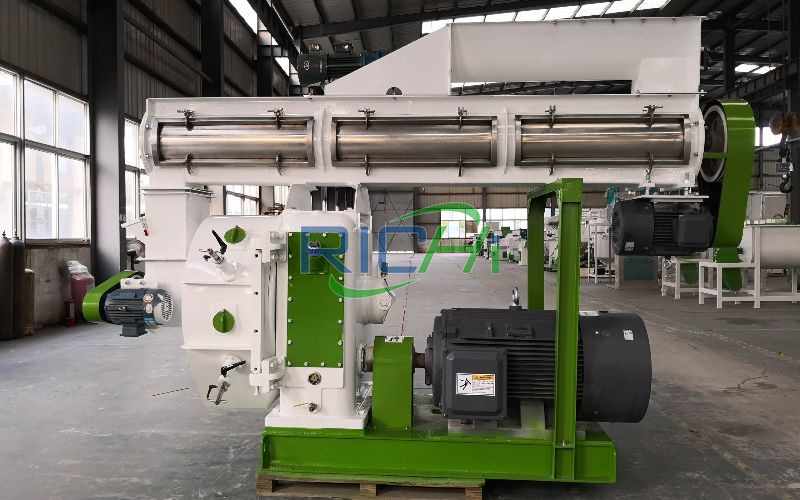
A commercial pig feed mill in Laguna Province upgraded its pelleting section with one RICHI SZLH320 animal feed pellet press in Philippines. The mill already had ingredient receiving, grinding, batching, mixing, steam supply, cooling, screening and packaging equipment, but its older 22 kW pellet press had become the main production bottleneck as feed demand increased.
Instead of rebuilding the complete feed plant, the customer replaced the undersized pellet mill with an SZLH320 ring die machine using a 37 kW main motor, 1.5 kW feeder and 4 kW conditioner. With a reference capacity of approximately 3–4 T/H for suitable compound-feed formulations, the new pellet press better matched the mill’s production target while allowing most of the existing upstream and downstream equipment to remain in service.
Name:
Pig feed pellet press
Country:
Philippines
Date:
2026
Capacity:
3–4 T/H
Model:
SZLH320
Main Motor Power:
37 kW
Typical Product:
Grower and finisher pig pellets
Pellet Diameter:
4–5 mm
The previous feed pellet mill operated in the approximately 1.0–1.5 T/H class.
That output can be adequate for a small feed operation, but it becomes restrictive when a commercial mill needs several thousand tonnes of pig feed per year.
If a machine produces 1.5 T/H and runs for eight actual pelleting hours per day over 300 days, its theoretical annual output is only about 3,600 tonnes before downtime, die changes, formula changes and maintenance.
Even at sixteen pelleting hours per day, theoretical annual output would be around 7,200 tonnes.
The customer therefore needed more hourly capacity rather than simply extending the operating day further.
The SZLH320 moves the reference range to approximately 3–4 T/H.
At eight operating hours per day and 300 days per year, that corresponds to a theoretical 7,200–9,600 tonnes before production losses.
This makes it more suitable for a medium-scale commercial pig-feed operation while also giving the mill more room for maintenance and product changeovers.
| Project Parameter | Configuration |
|---|---|
| Equipment | Animal feed pellet machine |
| Model | SZLH320 |
| Main Motor | 37 kW |
| Feeder Motor | 1.5 kW |
| Conditioner Motor | 4 kW |
| Reference Capacity | Approximately 3–4 T/H |
| Main Feed Type | Commercial pig feed |
| Typical Product | Grower and finisher pig pellets |
| Typical Pellet Diameter | Approximately 4–5 mm depending on customer specification |
| Project Type | Replacement of an undersized pellet mill |
The 37 kW SZLH320 was selected because the customer needed a clear capacity step above the previous 22 kW machine without moving immediately to a much larger feed-mill platform.
The important point is not that a 37 kW motor is automatically more energy-efficient than a 22 kW motor.
A larger motor draws more power when heavily loaded.
The relevant comparison is energy consumed per tonne of acceptable finished pellets.
If a larger pellet press produces more saleable feed per operating hour and reduces the need to run an undersized machine near its limit for extended periods, the complete production schedule may become more efficient.
That result has to be measured in kWh per tonne rather than by multiplying motor nameplate power by shift length alone.
The customer mainly produces compound feed for grower and finisher pigs.
The formulation is not locked to one permanent percentage of corn, soybean meal, rice bran or fishmeal.
Philippine feed mills commonly work with a broad ingredient base that can include corn, rice bran, soybean meal, feed wheat, copra meal, cassava and selected animal or marine protein ingredients depending on economics and nutritional requirements.
Corn remains an important feed grain, while imported and domestic ingredients can both play a role depending on price, quality and availability.
The feed formulation team therefore sets nutrient specifications first.
The pellet press then has to handle the resulting mash consistently.
A corn-soy dominant formula can behave differently from a ration with higher rice bran, copra meal or oil levels.
Higher fibre can increase die resistance.
Additional oil can affect pellet binding.
Particle size distribution and mash moisture also influence throughput and physical pellet quality.
This is why RICHI evaluates the formula family during machine selection instead of prescribing one generic Philippine pig-feed recipe.
The SZLH320 feed pellet machine includes a 4 kW conditioner ahead of the ring die.
Steam conditioning changes mash temperature and moisture before compression and can improve the physical response of starch- and protein-containing ingredients during pellet formation.
However, pig feed should not be assigned one permanent setting such as 80–85°C and 17% moisture.
The correct operating window depends on incoming mash moisture, formula composition, steam quality, feed rate, target physical quality and the feed mill’s quality-control program.
A formula containing more oil or fibrous by-products may require different settings from a cereal-rich formula.
During commissioning, the operator monitors motor current, pellet formation, throughput, fines and finished-product condition while adjusting feed rate and steam.
The goal is stable production within the machine’s operating range.
Conditioning can contribute to pellet binding, but the pellet press should not be described as producing a fixed starch-gelatinization percentage unless the customer has actual laboratory data.
For grower and finisher pig feed, an approximately 4–5 mm pellet diameter is a practical commercial range for this project.
The exact size depends on pig age, feeding system and the customer’s product specification.
It is not technically necessary to claim that 4.5 mm is universally optimal or that 3 mm creates choking risk while 6 mm is unsuitable for all pigs.
Ring die selection involves more than hole diameter.
Effective die working length and compression resistance have to match the formula.
A highly fibrous ration may require a different die configuration from a conventional corn-soy formula.
Using too much compression can increase motor load and reduce capacity.
Using too little can increase fines or produce weak pellets.
This is why a fixed 1:10 compression ratio should not be applied automatically to every grower-pig formula.
RICHI selects the die around the combination of pellet diameter, ingredient mix, target throughput and required physical quality.
Reducing fines was one of the reasons the customer replaced its older pellet press, but the SZLH320 should not be marketed with a guaranteed 95% or 96% PDI for every formula.
Pellet durability depends on grinding, mixing, conditioning, die configuration, feed rate, ingredient composition, cooling and downstream handling.
A pellet that leaves the die in good condition can still generate excessive fines if it is inadequately cooled or transferred through aggressive conveying equipment.
The customer therefore evaluates pellet quality as a complete-line result.
PDI or another defined durability test can be used if the feed mill requires a numerical specification.
Screened fines should also be monitored at the final product stage rather than estimated only at the pellet-mill discharge.
This distinction is important for pig feed.
Excessive fines can affect feeder behavior and product consistency, but it is not correct to say that every percentage point of fines is automatically an equal percentage of feed waste.
Likewise, an improvement in pellet durability does not independently guarantee a specific improvement in feed conversion ratio.
Animal performance depends on formulation, health, genetics, housing, management, feed intake and many other factors.
The customer retained most of the existing feed mill, so RICHI had to check whether those systems could support approximately 3–4 T/H.
The hammer mill has to produce enough ground ingredients.
The batching and mixing section must complete enough cycles to supply the pellet press continuously.
A mash bin between the mixer and pellet mill provides buffer capacity and helps separate batch mixing from continuous pelleting.
Steam generation must support the conditioner without large pressure fluctuations.
After pelletizing, the existing cooler must be able to handle the increased hot-pellet flow.
The screener, elevator, conveyors and bagging section also need adequate capacity.
If one downstream machine is limited to 2 T/H, replacing the old pellet press with an SZLH320 will simply move the production bottleneck to another part of the plant.
This line-balance review is one of the most important steps in a retrofit project because it allows the customer to reuse existing equipment without assuming that everything automatically matches the new pellet-mill capacity.
The SZLH320 was prepared for a Philippine industrial project where 60 Hz compatibility is an important electrical consideration.
The final motor voltage, starter arrangement, cable sizing and protection equipment still need to match the customer’s actual plant power system.
It is therefore not sufficient to specify one generic breaker size for every installation.
RICHI Machinery provides the required electrical data for the delivered machine so the customer’s electrical contractor can confirm transformer capacity, motor starting and protection before commissioning.
Foundation and structural requirements are handled in the same way.
The customer prepares the machine support according to the supplied installation drawings and actual building structure rather than relying on a universal 200 mm concrete slab specification.
The replacement layout also has to consider feeder elevation, conditioner access, discharge alignment, maintenance space and the connection to the existing cooler.
Because this is a replacement project rather than a greenfield feed mill, accurate measurement of the old equipment position is important before shipment.
This animal feed pellet press in Philippines project uses one RICHI SZLH320 ring die pellet mill to upgrade a commercial pig-feed operation in Laguna Province.
The machine uses a 37 kW main motor, 1.5 kW feeder and 4 kW conditioner and provides a reference capacity of approximately 3–4 T/H for suitable compound-feed formulations.
The customer’s main product is grower and finisher pig feed, with pellet diameter generally selected in the approximately 4–5 mm range according to product requirements.
The equipment replaces an older 22 kW pellet press rather than operating as a parallel addition.
This gives the customer more hourly pelleting capacity while retaining usable grinding, mixing, cooling, screening and packaging equipment.
The machine selection is not based on claims of guaranteed PDI, automatic FCR improvement or fixed energy savings.
Instead, the retrofit is evaluated through practical production indicators: tonnes per hour of acceptable pellets, motor load, steam stability, fines after cooling and screening, line balance and production hours required to meet annual demand.
The Philippine raw-material environment also requires flexibility.
Corn remains an important feed ingredient, while rice bran, soybean meal, feed wheat, copra meal and other materials may enter commercial formulas depending on nutrition and economics.
Changes in formula can alter die resistance and pellet quality, so conditioning and die configuration are adjusted accordingly.
For another buyer searching for an animal feed pellet press in Philippines, pig feed pellet machine Philippines, SZLH320 feed pellet mill, 3–4 T/H feed pellet press or commercial pig feed pellet machine, RICHI first reviews the existing production line.
Useful project information includes current pellet-mill output, annual feed requirement, major formulas, pellet diameter, operating hours, hammer-mill capacity, mixer size and cycle time, steam conditions, cooler capacity, electrical supply and the equipment the customer wants to retain.
If the current feed mill already has sufficient upstream and downstream capacity, replacing only the old pellet press can be a practical way to increase production.
If the existing cooler, mixer or grinding section is undersized, those constraints should be identified before commissioning rather than after the new pellet mill reaches the site.
For a Philippine pig-feed retrofit, send RICHI your current production rate, target T/H, main feed ingredients, pellet specification, existing equipment list and daily operating schedule. These parameters provide the basis for confirming whether the SZLH320 is the right animal feed pellet press for the actual feed mill.
Having the right mix of reliable, high-quality pellet machine and pelletizing systems and expert support is essential to your success. Watch how our end-to-end feed pellet plant solutions have helped our customers optimize their performance.
Our customized and future-proofed turnkey pellet plant solutions is designed with you at the core. From vision to reality and beyond, our team stays connected with yours. Giving you peace-of-mind with an expert at your side.
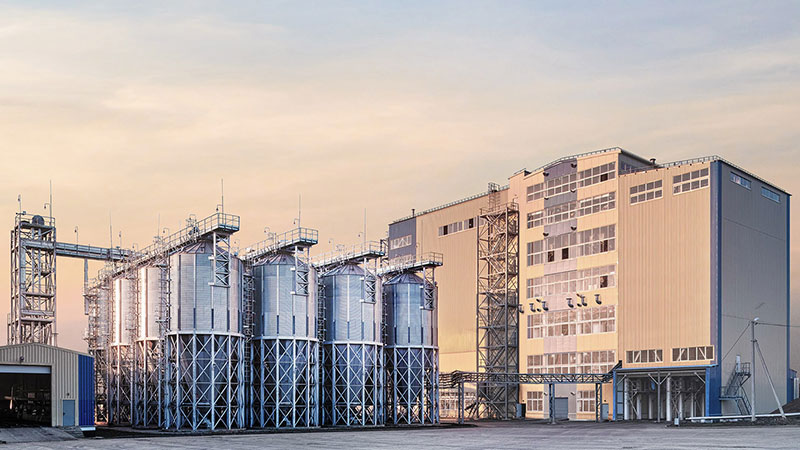
At RICHI, we go beyond project completion. With RICHI Servicee, we’re your dedicated partners in success. Count on us for expert guidance, minimal downtime, and optimized productivity. Choose RICHI for unmatched service and support.
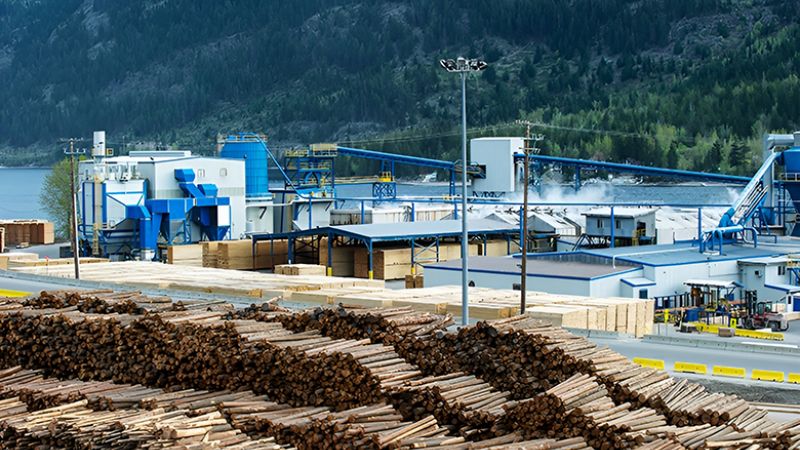


Meet global product demands and quality standards with industry-leading pellet plant design, engineering, equipment, and construction services for pellet processors.


Your Partner Beyond Project Completion
2000+ cases
RICHI is the leading designer, manufacturer and builder of pellet plants in the world, completing over 2000 projects in 140 countries across 6 continents.
Read More
Increase plant productivity, profitability, and safety by integrating high quality equipment into your pellet production line. Over the years, RICHI has become China's top pellet equipment manufacturer. At the same time, RICHI has established valuable partnerships with the world's leading component and raw material manufacturers to bring you the best there is in technology, automation, and efficiency in pelleting plant machinery.

For nearly 30 years, RICHI has been providing best-in-class pellet plant equipment and services to clients across a variety of industries, sizes, and needs. We pride ourselves on the knowledge and skill that each team member possesses – from our technical sales team to our process design engineers. You can count on RICHI Machinery to take your operation to the next level of innovation, quality, and success.
Need help with your pellet manufacturing plant project? Contact us today.
ANIMAL FEED
BIOMASS
WOOD
ORGANIC FERTILIZER
AQUA FEED
CAT LITTER
MUNICIPAL WASTE RECYCLING
SPECIAL PELLET PRODUCTION
RICHI Machinery continues to deliver world class pellet mill equipment, pellet plant engineering and project solutions that add value to our customers in the animal feed, wood waste, agriculture waste, organic fertilizer, cat litter and special pellet products industries. Throughout the years, we RICHI Machinery have built strong brand, becoming industry-leading pellet machine manufacturer. We value integrity, promise quality, and prioritize your success.
Learn MoreWith our expert team, we precisely implement your process engineering requirements in pellet mill and pelletizing plant systems. No matter which industry you’re in – we understand your needs and deliver solutions that meet the highest standards.
At RICHI, quality comes first. Our pellet making machine and related pellet line equipment undergo rigorous quality controls to ensure they meet the highest standards. Rely on products that are durable, safe, and efficient.
With decades of experience in pellet machine and pellet production line production, we have earned a reputation as a trusted partner in various industries. Our expertise allows us to cover a wide range of applications.
Not only do we offer premium pelleting equipment, but we are also experts at designing, building, installing, and maintaining facilities from the ground up. Our expertise is within pellt plant process design, discovering the most efficient, productive, and profitable way to handle your materials in an end-to-end cycle.
○ RICHI MACHINERY
Keeping in touch with us is an effective way to solve all your problems. If you have any needs or questions, please leave your contact information, then RICHI technical consultants will send design, quotation, videos to your mailbox. You can also contact us directly via WhatsApp: +86 13838389622
Copyright©2015-2026 by HENAN RICHI MACHINERY CO., LTD. All rights reserved.