

This is where you find all our press releases and news articles.
RICHI Machinery has completed the shipment of animal feed processing equipment ordered by a customer from Algeria after a demanding supplier-selection and equipment-review process. The buyer was highly critical of equipment quality and project details and had previously evaluated other suppliers without reaching a satisfactory conclusion before ultimately choosing RICHI.
The cooperation did not stop at order confirmation. During the evaluation process, the customer pointed out several details he believed could be improved. RICHI reviewed the comments, adjusted the relevant work and completed the requested improvements before delivery. The equipment was shipped on May 27, with installation planned for mid-July according to the original project schedule.
The customer approached the project differently from buyers who make a decision mainly from quotations or catalog specifications. According to the original project record, he made three rounds of supplier visits during the purchasing process.
The first two evaluations did not lead to a satisfactory supplier selection. By the third round, the customer chose RICHI Machinery and moved forward with the animal feed pellet equipment project.
This type of buyer places more emphasis on manufacturing details, equipment quality, project completeness and whether the supplier responds seriously to technical concerns. For a feed processing investment, these factors can be just as important as the nominal machine capacity or quoted price.
The customer also had trading experience, which meant the equipment was being evaluated from a commercial purchasing perspective rather than only as a one-time machine purchase. A trader or project intermediary needs equipment that can withstand scrutiny from the eventual end user as well as from the buyer himself.
One of the most valuable details in this Algeria cooperation is that the customer's evaluation did not end after he selected RICHI.
He continued to identify areas where he believed the equipment or project preparation could be improved. Instead of treating those comments as a problem, RICHI used them as part of the manufacturing and project-review process.
For machinery suppliers, a demanding customer can expose weaknesses that are easy to overlook during routine production. Details involving fabrication, assembly, finishing, component arrangement, equipment access or project coordination may not always appear clearly in a quotation, but they can influence the customer's final acceptance of the machinery.
RICHI reviewed the customer's concerns and completed the required improvements before shipment.
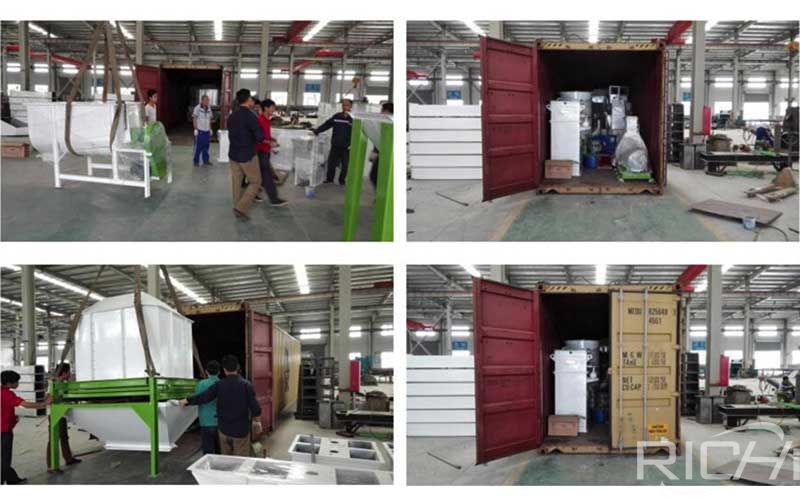
Animal feed processing equipment prepared for shipment to Algeria after customer review
For a complete feed processing project, inspection should cover more than whether a machine starts and stops normally. Buyers need to understand whether the equipment has been built and prepared in a way that supports long-term operation.
Depending on the project scope, a serious feed machinery inspection may consider equipment structure, weld quality, component installation, drive arrangements, protective guards, maintenance access, electrical control, conveying interfaces and the compatibility between individual machines.
For a pellet production system, the buyer should also check whether the upstream and downstream equipment has been selected around the intended production rate. A pellet mill cannot deliver the expected plant output if grinding, batching, mixing, cooling or conveying sections are incorrectly matched.
This is one reason experienced buyers often spend more time on factory inspection and technical discussions than first-time purchasers.
Customers comparing several feed machinery manufacturers often move beyond basic specifications once they understand that two quotations with similar capacity may represent very different engineering scopes.
The Algerian customer's repeated supplier visits reflect this type of purchasing process. The final decision was not simply about finding an animal feed pellet machine; it was about deciding which manufacturer could respond to a demanding project review.
The historical information confirms that the order involved an animal feed pellet line, but it does not provide the final hourly capacity, feed formula, animal species or detailed equipment list. Those details should therefore not be invented as facts about this project.
In Algeria, feed manufacturers and livestock-related businesses may work with grains and feed ingredients such as maize, barley, wheat bran, soybean meal and other locally available or imported feed materials depending on the formulation and target livestock sector.
These materials do not all require the same processing route. Whole grains normally require grinding, while many meals and bran-type ingredients can move more directly into batching and mixing. Small-dose minerals and premixes require different weighing accuracy from major ingredients.
For this reason, selecting a feed pelletizer without first confirming the customer's formula structure can lead to an incomplete equipment solution.
A complete animal feed pellet production line normally connects several processing sections rather than relying on a single pellet mill.
Depending on the customer's actual feed products and raw materials, the production route can include raw material receiving and cleaning, grinding, batching, mixing, conditioning and pelletizing, followed by cooling, screening and finished-feed handling.
For customers producing several formulas, the storage and batching arrangement also becomes important. More ingredients and more frequent formula changes usually require greater flexibility in raw material bins and production control.
The pelletizing section then needs to be matched to both the formula and the finished-feed specification. Pellet diameter, raw material particle size, moisture, fiber level and fat content can all influence actual pellet mill performance.
The original record identifies the Algerian customer as a trader, which changes some of the commercial logic behind the purchase.
An end user buying equipment for his own factory can accept a solution based mainly on his specific production requirements. A trader or machinery intermediary may also need to consider whether the equipment is easy to explain, inspect and support for the final user.
That can make equipment appearance, manufacturing consistency, documentation, installation planning and supplier responsiveness more important during the purchasing process.
A trader also carries reputational risk. If the supplied equipment does not meet the final user's expectations, the intermediary may be responsible for resolving the resulting technical and commercial problems.
This helps explain why experienced trading customers can be particularly demanding during supplier selection.
RICHI did not treat the Algerian customer's criticism as an obstacle to delivery. The comments became part of the equipment improvement process before shipment.
For a machinery manufacturer, this type of feedback has practical value because customers view equipment from a different perspective. Engineers may focus on processing logic and mechanical performance, while buyers may also notice fabrication details, service access, installation convenience and visual finishing.
When a customer's request is technically reasonable, correcting the issue before export is far more efficient than discovering it after the equipment has arrived overseas.
This is especially important for international projects because even a relatively small modification can become more complicated after shipping, customs clearance and site installation.
After the required work and project preparation were completed, the animal feed equipment was shipped on May 27.
Shipment marked the transition from factory manufacturing to overseas project implementation. For a feed processing line containing several machines and auxiliary components, proper delivery preparation needs to consider equipment identification, packing, component protection and the subsequent installation sequence.
The original project schedule planned installation for the middle of July, allowing the customer and RICHI team to move from equipment delivery into the next stage of project execution.
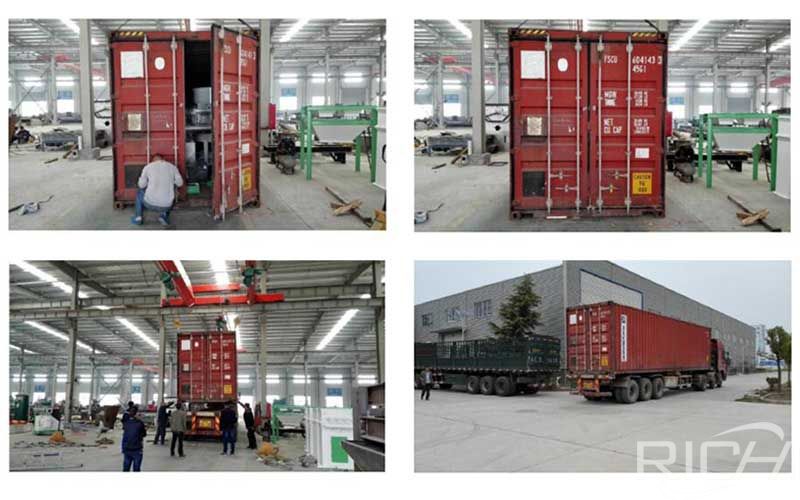
RICHI animal feed machinery prepared for export to the Algerian customer
International shipment is not the end of a feed mill project. After the equipment reaches the site, the individual machines need to be positioned and connected according to the designed material flow.
Installation can involve mechanical positioning, structural connections, conveying systems, electrical work, piping where required and preparation for system commissioning.
The installation stage is also where workshop conditions and layout quality become visible. Equipment that looks acceptable on a process diagram still needs enough space for operation, maintenance, cleaning and future component replacement.
After installation, commissioning normally focuses on verifying individual machines first and then the complete process. Grinding, batching, mixing, pelletizing, cooling and finished-feed handling need to operate as one coordinated line.
The original news described this customer as highly critical. Rather than presenting that as a negative characteristic, RICHI sees demanding project reviews as an opportunity to improve manufacturing and engineering work.
Customers who question equipment details, compare several suppliers and request corrections can help reveal where a manufacturer still has room to improve. The important issue is whether the supplier responds with engineering solutions instead of simply defending the original design.
In this Algeria project, the customer identified several points he wanted improved, RICHI carried out the required work, and the equipment subsequently entered shipment.
This sequence provides stronger evidence of supplier responsiveness than simply stating that RICHI offers "high quality" equipment.
For customers comparing feed machinery suppliers, a useful technical proposal requires more information than the country and hourly capacity.
Providing these details allows RICHI Machinery to develop the equipment configuration around the real project and also makes it easier for buyers to compare different manufacturers on the same technical basis.
The Algeria cooperation moved through a supplier-selection process that was more demanding than a typical equipment purchase. The customer compared manufacturers, visited suppliers repeatedly, selected RICHI, requested further improvements and then approved the project to proceed toward shipment.
The equipment left on May 27, with installation planned for mid-July. For RICHI, the significance of this order is not simply that another animal feed equipment set was exported. It demonstrates the value of responding to detailed buyer feedback before the machinery reaches the customer's site.
If you are currently comparing feed machinery manufacturers, send RICHI your raw materials, formulas, capacity, finished-feed requirements, operating schedule and any specific factory-inspection standards your team uses. Our engineers can review both the process requirements and the equipment details before a final proposal is confirmed.
Having the right mix of reliable, high-quality pellet machine and pelletizing systems and expert support is essential to your success. Watch how our end-to-end feed pellet plant solutions have helped our customers optimize their performance.
Our customized and future-proofed turnkey pellet plant solutions is designed with you at the core. From vision to reality and beyond, our team stays connected with yours. Giving you peace-of-mind with an expert at your side.
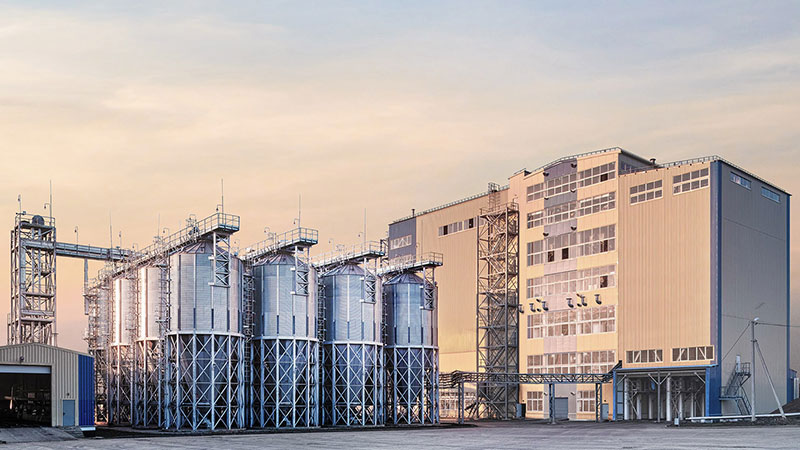
At RICHI, we go beyond project completion. With RICHI Servicee, we’re your dedicated partners in success. Count on us for expert guidance, minimal downtime, and optimized productivity. Choose RICHI for unmatched service and support.
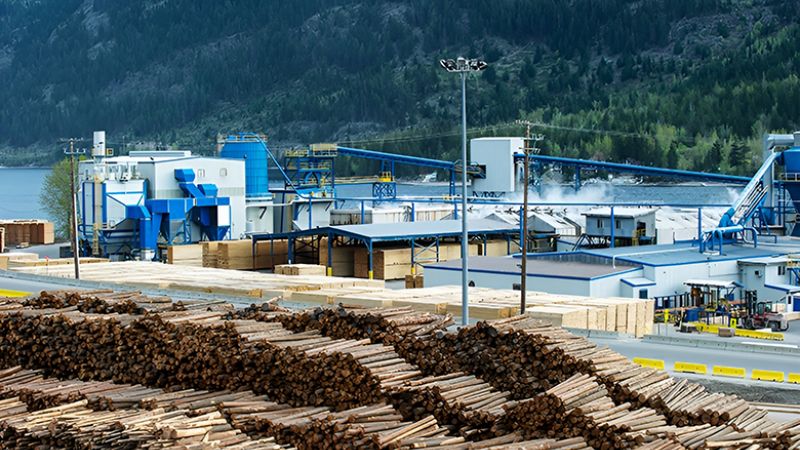


Meet global product demands and quality standards with industry-leading pellet plant design, engineering, equipment, and construction services for pellet processors.


Your Partner Beyond Project Completion
2000+ cases
RICHI is the leading designer, manufacturer and builder of pellet plants in the world, completing over 2000 projects in 140 countries across 6 continents.
Read More
Increase plant productivity, profitability, and safety by integrating high quality equipment into your pellet production line. Over the years, RICHI has become China's top pellet equipment manufacturer. At the same time, RICHI has established valuable partnerships with the world's leading component and raw material manufacturers to bring you the best there is in technology, automation, and efficiency in pelleting plant machinery.

For nearly 30 years, RICHI has been providing best-in-class pellet plant equipment and services to clients across a variety of industries, sizes, and needs. We pride ourselves on the knowledge and skill that each team member possesses – from our technical sales team to our process design engineers. You can count on RICHI Machinery to take your operation to the next level of innovation, quality, and success.
Need help with your pellet manufacturing plant project? Contact us today.
ANIMAL FEED
BIOMASS
WOOD
ORGANIC FERTILIZER
AQUA FEED
CAT LITTER
MUNICIPAL WASTE RECYCLING
SPECIAL PELLET PRODUCTION
RICHI Machinery continues to deliver world class pellet mill equipment, pellet plant engineering and project solutions that add value to our customers in the animal feed, wood waste, agriculture waste, organic fertilizer, cat litter and special pellet products industries. Throughout the years, we RICHI Machinery have built strong brand, becoming industry-leading pellet machine manufacturer. We value integrity, promise quality, and prioritize your success.
Learn MoreWith our expert team, we precisely implement your process engineering requirements in pellet mill and pelletizing plant systems. No matter which industry you’re in – we understand your needs and deliver solutions that meet the highest standards.
At RICHI, quality comes first. Our pellet making machine and related pellet line equipment undergo rigorous quality controls to ensure they meet the highest standards. Rely on products that are durable, safe, and efficient.
With decades of experience in pellet machine and pellet production line production, we have earned a reputation as a trusted partner in various industries. Our expertise allows us to cover a wide range of applications.
Not only do we offer premium pelleting equipment, but we are also experts at designing, building, installing, and maintaining facilities from the ground up. Our expertise is within pellt plant process design, discovering the most efficient, productive, and profitable way to handle your materials in an end-to-end cycle.
○ RICHI MACHINERY
Keeping in touch with us is an effective way to solve all your problems. If you have any needs or questions, please leave your contact information, then RICHI technical consultants will send design, quotation, videos to your mailbox. You can also contact us directly via WhatsApp: +86 13838389622
Copyright©2015-2026 by HENAN RICHI MACHINERY CO., LTD. All rights reserved.