

This is where you find all our press releases and news articles.
RICHI Machinery completed the manufacturing, pre-delivery testing and export of a 10 T/H animal feed pellet production line ordered by a customer from Cambodia. The customer originally found RICHI through our website and, after project communication and equipment selection, placed the order for a complete feed processing system designed around a 10-ton-per-hour production target.
The project later progressed beyond the delivery stage and the production line was installed at the customer's site. This makes the Cambodia order a useful example of how an overseas feed mill project moves through several connected stages: supplier selection, contract confirmation, equipment manufacturing, factory testing, export delivery and on-site installation.
The Cambodian customer first contacted RICHI Machinery after finding our animal feed processing equipment online. Rather than purchasing only a standalone pelletizer, the customer selected a complete 10 T/H feed production solution.
At this capacity, the project requires considerably more coordination than a small farm-use feed line. Raw material receiving, grinding, batching, mixing, pelletizing, cooling, screening, conveying and finished-feed handling all need to work around the same production target.
The project therefore moved through technical communication before the equipment entered manufacturing. Capacity was only one part of the discussion. Raw material type, formula structure, finished feed form, operating hours, automation level and site conditions all influence the final configuration of a complete feed mill.
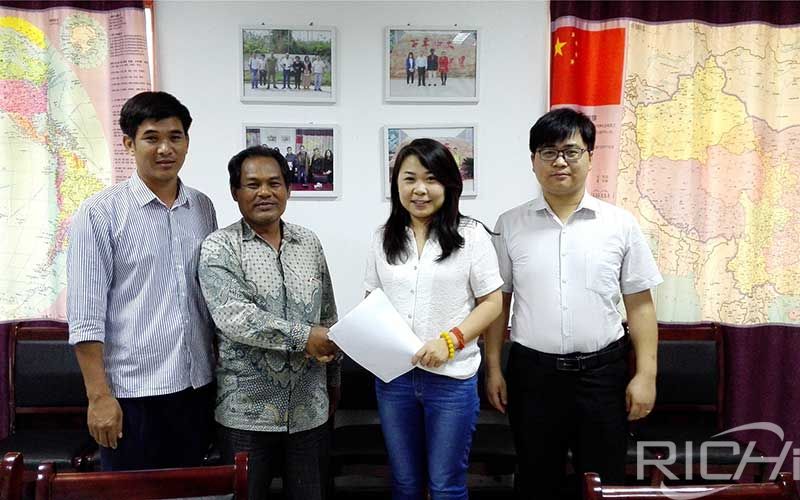
Contract stage for the Cambodian customer's 10 T/H feed mill project
A 10 T/H feed production line operates at a scale where raw material supply and production planning become major engineering considerations.
At the nominal design rate, eight hours of production corresponds to approximately 80 tons of finished feed. A 16-hour operating day corresponds to approximately 160 tons, while 20 hours of production can theoretically reach around 200 tons.
Actual output depends on formula changes, pellet size, raw material characteristics, maintenance, production scheduling and equipment utilization, but these figures show why a 10 T/H feed mill needs a stable ingredient supply rather than occasional raw material purchasing.
Ingredient storage, receiving capacity and downstream finished-feed handling must therefore be sized around daily throughput. If raw materials cannot enter the plant quickly enough, the pelletizing section will not maintain its design output. If packing or storage cannot handle the finished feed leaving the line, the same problem occurs downstream.
The original project information does not specify the customer's exact formulas, so RICHI does not present a particular ingredient ratio as a confirmed fact about this Cambodia project.
For commercial or livestock feed production in Cambodia, practical formula planning may involve locally available materials such as maize, rice bran, broken rice, cassava-derived ingredients, soybean meal and other protein, mineral and premix components depending on the target animal and nutritional formulation.
These materials cannot all be handled identically. Whole grains such as maize normally require grinding. Rice bran and meal ingredients may enter the batching and mixing system without the same size-reduction route. Cassava-based materials can vary in form and moisture and therefore need to be evaluated before they are included in a stable feed production process.
For a 10 T/H plant, ingredient variety also affects the number of storage and batching positions required. A customer producing several formulas may need more raw material separation and more flexible batching than a plant producing one relatively stable livestock feed product.
One of the most useful details preserved in the original project record is that the equipment was tested before delivery. For a complete overseas feed mill, this stage is important because it allows individual machines and relevant system functions to be checked before the equipment leaves the factory.
Factory testing can help confirm equipment rotation, mechanical operation, electrical control and the basic coordination of relevant components before shipment. The exact testing scope depends on the equipment and the project, but the objective is the same: identify avoidable problems before installation begins overseas.
For customers purchasing feed machinery internationally, pre-delivery testing is also a useful point for reviewing equipment condition, confirming project documentation and preparing for the next installation stage.
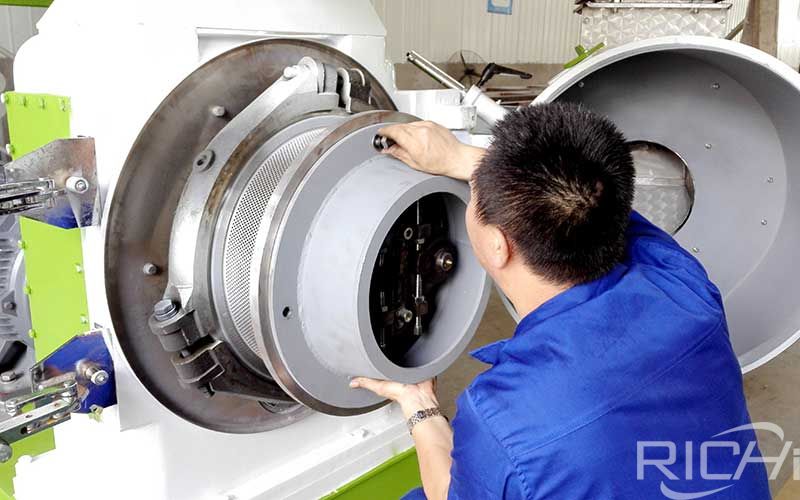
Pre-delivery testing of feed mill equipment for the Cambodia project
A complete animal feed pellet production line should be designed as one material-flow system rather than as a collection of independently selected machines.
The exact configuration depends on the customer's formulas and production plan, but the main processing logic normally includes the following sections.
At 10 T/H, every section needs sufficient effective capacity. An undersized hammer mill, mixer, cooler or conveying system can limit the real output of the entire plant even when the pellet mill itself is capable of higher throughput.
As feed mill capacity increases, the number of machines, drives, conveyors, bins and control points usually increases as well. This makes equipment coordination more important before shipment.
A 10 T/H line can involve several material-transfer stages between receiving, grinding, batching, mixing, pelletizing and finished-feed handling. Problems in one section can therefore affect multiple downstream processes.
Pre-delivery checks help the project team verify the equipment before international transport and prepare documentation for installation. They also give the customer greater confidence that the machines entering the shipment stage have already passed through a structured manufacturing and inspection process.
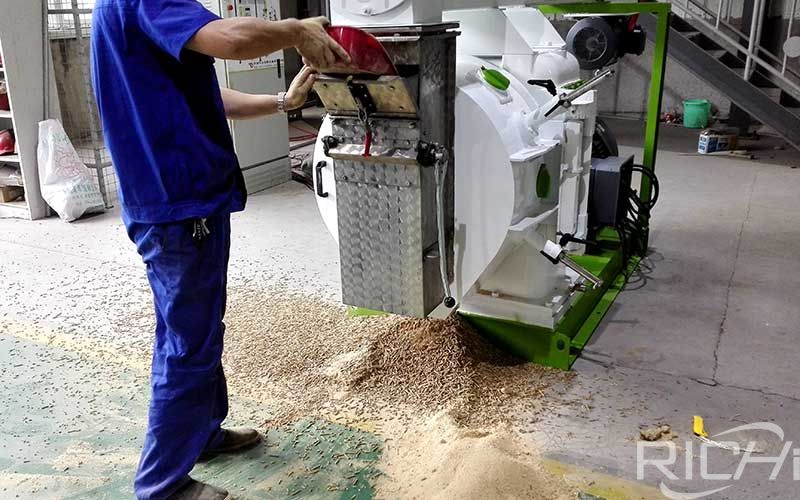
RICHI testing feed processing equipment before export to Cambodia
The project record refers broadly to animal and livestock feed pellet production but does not specify the customer's final feed portfolio. This distinction matters because a 10 T/H line does not automatically mean that every feed product should be produced with exactly the same process settings.
Poultry, pig, cattle and other livestock feeds may differ in raw material composition, grinding fineness, fiber level, conditioning requirements and pellet size. A plant producing several products also needs to manage formula changeover and finished-feed segregation.
For this reason, RICHI does not use the old marketing assumption that the same standard pellet line can produce poultry, livestock, fish and pet feed without process differences. Aquatic feed and pet food may require different equipment routes, including extrusion, finer grinding, drying or coating, depending on the product.
For conventional livestock and poultry pellet feed, the process can be configured around the customer's actual formula and desired product range rather than a generic equipment list.
After manufacturing and testing were completed, the equipment entered the export stage. According to the original project record, the 10 T/H feed line was exported in August.
For a turnkey feed mill, shipment preparation involves more than loading one pelletizer. Multiple machines, supporting components, electrical elements and installation-related parts need to be organized so that they can later be identified and assembled at the customer site.
This becomes especially important for a 10 T/H system because the final plant depends on the correct connection of all upstream and downstream equipment.
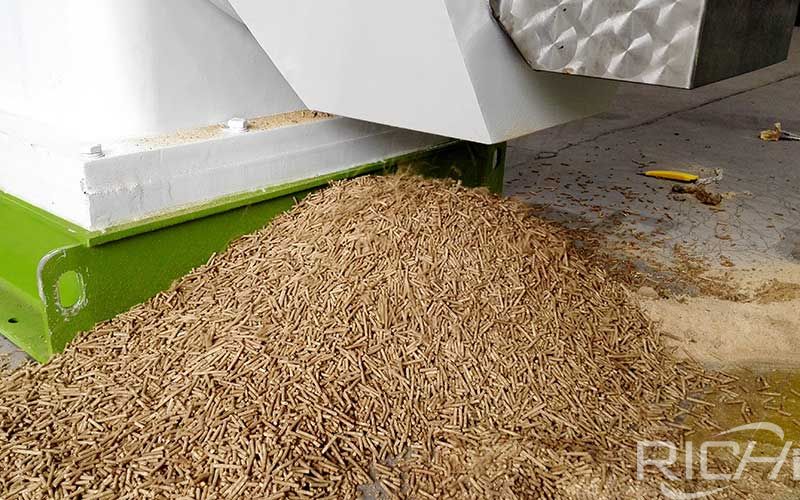
10 T/H feed mill equipment prepared for export to the Cambodian customer
The Cambodia project later progressed beyond the delivery stage and the equipment was installed at the customer's site. This is an important distinction because shipment is only one milestone in the implementation of a complete feed mill.
After equipment arrival, the main installation work can include machine positioning, structural and conveying connections, electrical installation, piping where required and the integration of individual sections according to the designed process layout.
The next stage is system commissioning. At that point, the project focus moves from individual machine operation to complete-line coordination.
Material flow, batching cycles, mixing time, pelletizing conditions, cooler operation, screening and finished-feed handling need to work together so that the production line can move toward its intended operating capacity.
For customers planning a feed plant of this scale, the most important decisions need to be made before the equipment reaches manufacturing.
These details allow the supplier to design the line around the customer's actual business rather than simply quoting a standard "10 T/H feed pellet plant" package.
For a complete 10 T/H feed project, buyers should compare the scope behind each quotation rather than only the total price.
A supplier may quote a lower figure by excluding raw material bins, automatic batching, dust collection, packing or part of the conveying system. Another proposal may include a more complete project boundary and therefore appear more expensive at first glance.
Buyers should also compare whether the crushing, mixing, pelletizing and cooling sections are actually matched to the same hourly output. Nominal capacity written beside one machine does not guarantee the same production rate for the whole line.
Manufacturing quality, factory testing, documentation, installation guidance, commissioning support and spare-parts planning should also be considered when evaluating an overseas feed machinery manufacturer.
This 10 T/H project progressed through several visible milestones: the Cambodian customer found RICHI online, confirmed the equipment order, the machinery was manufactured and tested before shipment, the equipment was exported, and the line was later installed at the customer site.
That sequence is more representative of a complete feed mill project than the old idea of simply purchasing a feed pelletizer and starting production. Each stage affects the next, from formula and equipment selection to manufacturing, testing, logistics and installation.
For customers evaluating a similar 5 T/H, 10 T/H or larger feed mill, RICHI Machinery recommends starting with the actual raw material list, approximate formulas, target animal species, pellet specifications, daily production requirement, working hours, workshop dimensions and desired automation level. These details make it possible to define a realistic process and equipment scope before quotation and manufacturing begin.
Having the right mix of reliable, high-quality pellet machine and pelletizing systems and expert support is essential to your success. Watch how our end-to-end feed pellet plant solutions have helped our customers optimize their performance.
Our customized and future-proofed turnkey pellet plant solutions is designed with you at the core. From vision to reality and beyond, our team stays connected with yours. Giving you peace-of-mind with an expert at your side.
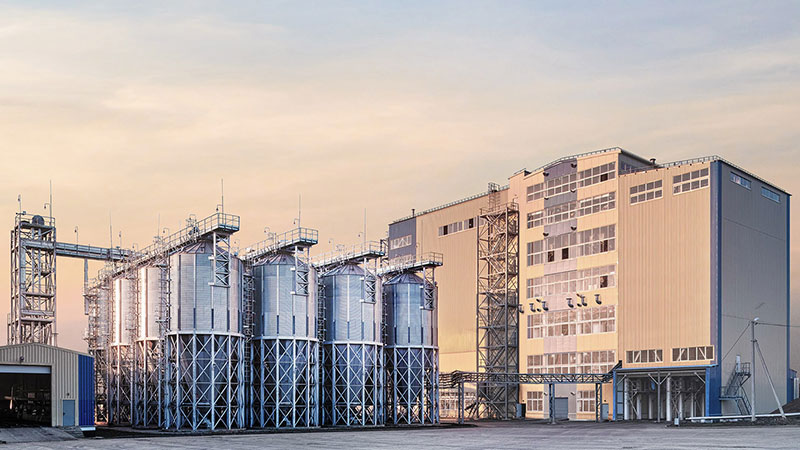
At RICHI, we go beyond project completion. With RICHI Servicee, we’re your dedicated partners in success. Count on us for expert guidance, minimal downtime, and optimized productivity. Choose RICHI for unmatched service and support.
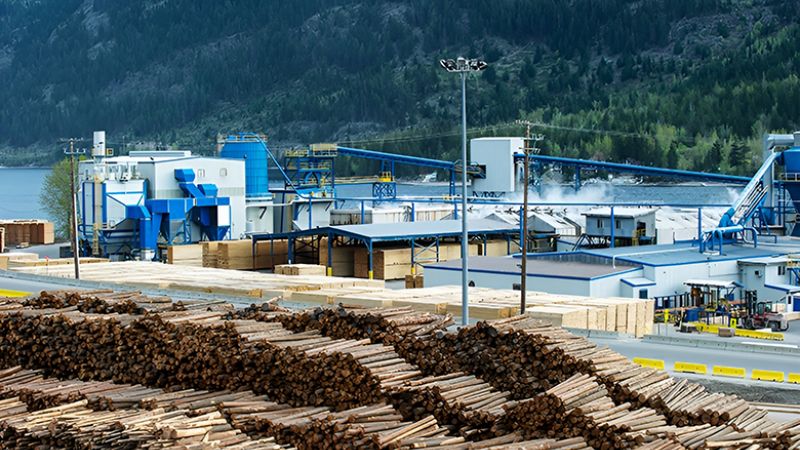


Meet global product demands and quality standards with industry-leading pellet plant design, engineering, equipment, and construction services for pellet processors.

Your Partner Beyond Project Completion
2000+ cases
RICHI is the leading designer, manufacturer and builder of pellet plants in the world, completing over 2000 projects in 140 countries across 6 continents.
Read More
Increase plant productivity, profitability, and safety by integrating high quality equipment into your pellet production line. Over the years, RICHI has become China's top pellet equipment manufacturer. At the same time, RICHI has established valuable partnerships with the world's leading component and raw material manufacturers to bring you the best there is in technology, automation, and efficiency in pelleting plant machinery.

For nearly 30 years, RICHI has been providing best-in-class pellet plant equipment and services to clients across a variety of industries, sizes, and needs. We pride ourselves on the knowledge and skill that each team member possesses – from our technical sales team to our process design engineers. You can count on RICHI Machinery to take your operation to the next level of innovation, quality, and success.
Need help with your pellet manufacturing plant project? Contact us today.
ANIMAL FEED
BIOMASS
WOOD
ORGANIC FERTILIZER
AQUA FEED
CAT LITTER
MUNICIPAL WASTE RECYCLING
SPECIAL PELLET PRODUCTION
RICHI Machinery continues to deliver world class pellet mill equipment, pellet plant engineering and project solutions that add value to our customers in the animal feed, wood waste, agriculture waste, organic fertilizer, cat litter and special pellet products industries. Throughout the years, we RICHI Machinery have built strong brand, becoming industry-leading pellet machine manufacturer. We value integrity, promise quality, and prioritize your success.
Learn MoreWith our expert team, we precisely implement your process engineering requirements in pellet mill and pelletizing plant systems. No matter which industry you’re in – we understand your needs and deliver solutions that meet the highest standards.
At RICHI, quality comes first. Our pellet making machine and related pellet line equipment undergo rigorous quality controls to ensure they meet the highest standards. Rely on products that are durable, safe, and efficient.
With decades of experience in pellet machine and pellet production line production, we have earned a reputation as a trusted partner in various industries. Our expertise allows us to cover a wide range of applications.
Not only do we offer premium pelleting equipment, but we are also experts at designing, building, installing, and maintaining facilities from the ground up. Our expertise is within pellt plant process design, discovering the most efficient, productive, and profitable way to handle your materials in an end-to-end cycle.
○ RICHI MACHINERY
Keeping in touch with us is an effective way to solve all your problems. If you have any needs or questions, please leave your contact information, then RICHI technical consultants will send design, quotation, videos to your mailbox. You can also contact us directly via WhatsApp: +86 13838389622
Copyright©2015-2026 by HENAN RICHI MACHINERY CO., LTD. All rights reserved.