
Wood Shavings Pellet Machine for Animal Bedding in Latvia for converting clean, untreated wood shavings into compact bedding pellets. Discover the RICHI MZLH420, equipment specifications, raw material preparation, and customized bedding pellet production solutions.
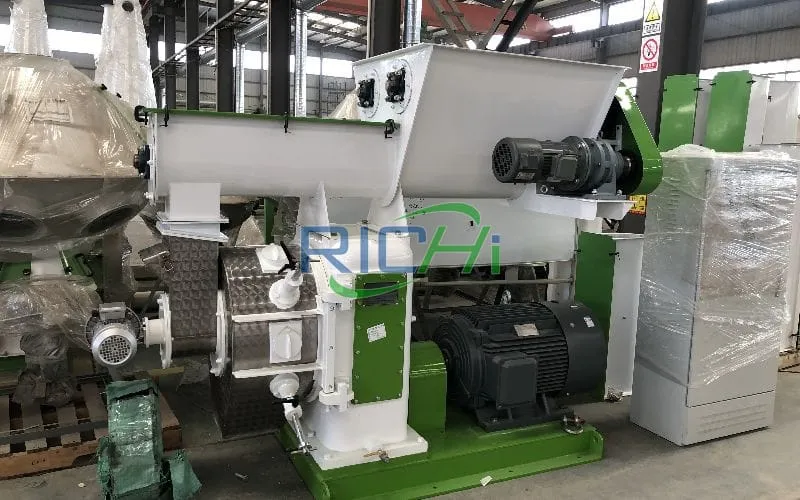
The Wood Shavings Pellet Machine for Animal Bedding in Latvia was selected for a wood-processing by-product business looking to turn loose planer shavings into compact bedding pellets for the equine market. Operating in a country with an established forestry and wood-processing sector, the customer had access to clean softwood shavings from sawmilling, timber finishing, and planing operations.
Rather than investing in an entirely new pellet production plant, the business planned to purchase one RICHI MZLH420 ring die biomass pellet machine and integrate it with suitable existing material preparation and handling equipment. The selected model has a rated capacity of 1.0–1.2 T/H, providing a practical starting point for a small commercial bedding pellet operation.
Name:
Wood Shavings Pelletizer
Country:
Latvia
Date:
2026
Capacity:
1.0–1.2 T/H
Model:
MZLH420
Main Motor Power:
90 kW
Raw Materials:
softwood shavings
Pellet diameter:
6mm
The purpose of the investment was different from conventional fuel pellet production. The finished product was intended for use as horse bedding, where the pellet's absorption behavior, ease of handling, dust level, and performance after moisture exposure are important to stable operators.
The proposed raw material was untreated softwood shavings with a controlled proportion of clean, dry sawdust. RICHI's equipment selection and process planning focused on whether this material could be consistently compacted, what preparation would be required, and how the finished pellets could be cooled, screened, stored, and supplied to bedding customers.
Latvia has a significant forestry and wood-processing industry, with sawmills, timber manufacturers, and woodworking businesses generating residues such as sawdust, wood shavings, and offcuts. These by-products do not all have the same characteristics. Sawdust is generally finer, while planer shavings may be thin, curled, springy, and irregular in shape. Their bulk density and feeding behavior can vary considerably, even when the material comes from the same timber-processing facility.
For the customer in this project scenario, the commercial opportunity was to convert a relatively bulky residue into a product that could be measured, packed, stored, and transported more conveniently. Loose shavings can take up substantial warehouse space, and their shape makes consistent bag filling difficult. Compressing them into pellets reduces the volume occupied during storage and shipment, although the actual space saving depends on the raw material and finished pellet density.
The business was a small-to-medium-sized wood-residue processor supplying agricultural and animal-care customers. It was not a sawmill seeking to replace its primary timber-processing equipment. Its existing operation already collected suitable shavings from local woodworking activities, and the planned wood pellet mill would add a new processing stage to that material stream.
The customer wanted to begin with one machine rather than commit to a complete automated line. This made sense because the immediate requirement was to establish a reliable bedding pellet product and build a regular customer base before expanding production. Suitable existing equipment would be retained wherever possible, while the new pelletizer would handle the main compression process.
Horse bedding needs to do more than look uniform in a bag. Stable operators need a material that is practical to distribute, can absorb moisture after preparation, and can be removed during routine stall cleaning. Bedding pellets are commonly supplied in a compact form and are then exposed to moisture during use. Depending on their formulation and manufacturing conditions, they may soften and break apart into a loose bedding material.
For this Latvian project, the intended customers were equestrian facilities, riding schools, private horse owners, and stable operators purchasing bedding in bags or larger bulk packages. These buyers may prefer compressed bedding because it is easier to store than loose shavings and can be portioned into stalls as required. The pellet form also allows the supplier to provide a more standardized package than uncompressed planer shavings.
The proposed product was a nominal 6 mm softwood bedding pellet. This diameter was a project specification to be confirmed during production trials, rather than a guaranteed result from the machine model alone. The final product would need to be assessed for durability during packing and transport, fines generation, moisture absorption, expansion after wetting, and the ease with which used bedding could be removed from a stall.
Importantly, the product was not intended to be marketed as animal feed. The selected MZLH420 is a ring die biomass pellet machine without a feed conditioning system. Its role in this project was to compress prepared wood residues into bedding pellets, not to manufacture nutritionally formulated livestock feed.
The customer selected the RICHI MZLH420 ring die biomass pellet machine because its listed production range suited the planned commercial operation. With a rated capacity of 1.0–1.2 T/H, the model offers more throughput than the smaller MZLH320 and MZLH350 models while avoiding the higher capacity and investment associated with larger machines such as the MZLH520.
The MZLH420 is designed for suitable biomass materials, including wood shavings, sawdust, and other prepared agricultural or forestry residues. In this application, the ring die and rollers compress the prepared wood material into cylindrical pellets. Actual output depends on the wood species, raw material moisture, particle size, bulk density, die configuration, and operating conditions. Springy planer shavings may behave differently from fine sawdust, so the rated output should be treated as a reference rather than a guaranteed production rate for every raw material.
| Equipment specification | Selected configuration |
|---|---|
| Machine model | MZLH420 |
| Equipment type | Ring die |
| Main motor power | 90 kW |
| Arch-breaking feeder power | 3 kW |
| Forced feeder power | 1.5 kW |
| Ring die inner diameter | 420 mm |
| Listed production capacity | 1.0–1.2 T/H |
| Target finished pellet diameter | 6 mm, subject to product testing |
| Primary raw material | Clean, untreated softwood shavings |
| Secondary raw material | Suitable clean softwood sawdust |
| Finished product | Compressed wood bedding pellets |
| Primary application | Horse and stable bedding |
The machine's arch-breaking feeder and forced feeder support material delivery into the pelletizing section. These functions are useful when handling lightweight shavings that can bridge, settle unevenly, or feed inconsistently. However, the feeder cannot replace proper screening, grinding, moisture control, or material blending. The raw material still needs to meet the requirements established for the intended bedding product.
The main raw material was planned to come from untreated softwood used in local timber processing. Spruce and pine are plausible feedstocks for this application, provided that the shavings are clean and suitable for animal bedding. The material would be collected from controlled woodworking processes rather than from mixed demolition waste or general waste collection.
Planer shavings and sawdust have different physical properties. Thin, curled shavings can occupy a large volume and may interlock during storage or feeding. Fine sawdust can help fill the spaces between larger particles and produce a more uniform mixture. For preliminary planning, the customer considered a blend containing approximately 70% clean softwood shavings and 30% clean softwood sawdust. This was a starting formulation for testing, not a validated commercial recipe.
The final ratio would depend on the shavings' thickness and length, the sawdust's particle-size distribution, moisture content, pellet durability, and the degree of breakdown required during use. A mixture containing too much coarse or springy material may be harder to feed and compact consistently. Conversely, excessive fines can increase dust generation and change the way the finished bedding behaves after wetting.
Material cleanliness was a firm requirement. Wood from painted, varnished, chemically treated, or otherwise contaminated sources would not be included in the bedding formulation. The customer also planned to remove metal fragments, stones, plastic, and other foreign matter before the material entered the wood hammer mill grinder or pellet mill. This protects the equipment and helps ensure that the finished bedding remains suitable for its intended animal-care application.
Wood shavings are not automatically ready for pellet production when they leave a planer or sawmill. Their moisture content can vary with timber condition, storage, and the surrounding environment. If the collected material has a moisture content above 20%, the customer would need to dry it before pelletizing. For initial process planning, the target moisture content of the prepared mixture was approximately 10–15%, with the final operating range to be confirmed through trials.
Moisture control affects both compression and finished pellet stability. Material that is too wet can be difficult to process consistently and may produce pellets that are less suitable for storage. Material that is excessively dry may also compact differently, depending on the species and particle structure. The objective is to establish a repeatable moisture range rather than simply dry the material as much as possible.
The customer intended to retain suitable existing grinding equipment. Long or irregular shavings would be reduced to a more uniform size before entering the wood biomass pellet mill. A preliminary target of approximately 3 mm or smaller could be used as a starting point for process evaluation, although the exact particle-size requirement should be confirmed against the shavings' structure and the machine's operating results.
If the existing grinder could not handle the material consistently, a suitable hammer mill or other size-reduction machine would need to be added. Likewise, if moisture exceeded the required range, the preparation system would need a suitable dryer. These supporting requirements were reviewed as part of the equipment planning so that the standalone pellet mill would not be expected to compensate for unsuitable incoming material.
After screening, moisture adjustment, and size reduction, the prepared wood mixture would be conveyed to the MZLH420. The pellet mill compresses the material through the ring die, forming compact cylinders that can be handled in bulk or packed into bags. The newly produced pellets would then pass through a cooling stage and a screen before storage or packaging.
Cooling is important because pellets may leave the compression process warm and mechanically vulnerable. Allowing them to cool under controlled conditions helps stabilize the product before it is handled further. Screening removes loose fines and gives the operator a clearer view of the proportion of pellets meeting the required product specification.
For the intended equine market, the finished bedding would be assessed not only for appearance but also for practical use. Stable operators need to understand how much water the material can absorb, how it breaks down after wetting, whether it generates excessive dust during handling, and how much material must be removed during routine cleaning. These characteristics cannot be established from pellet diameter alone; they depend on the raw material and manufacturing conditions.
Packaging would be selected according to the customer base. Smaller bags can suit private horse owners and smaller stables, while larger bags or bulk deliveries may be more practical for equestrian centers with higher consumption. The pellets would need to be stored in a dry warehouse and protected from rain, condensation, and ground moisture to prevent premature softening or degradation.
The customer's immediate need was a pelletizing stage, not a new wood-processing facility. It already had access to a steady stream of suitable shavings and intended to retain the preparation equipment that could meet the required material specification. Purchasing one MZLH420 wood pellet machine allowed the business to focus its initial investment on the machine responsible for converting loose residues into a higher-value bedding product.
This approach also provided a way to test the market before committing to a larger plant. Initial production could be used to establish a consistent product specification, evaluate packaging options, and obtain feedback from stable operators. Actual output and production costs could then be measured against sales demand before the business considered additional capacity.
A standalone pellet mill does not eliminate the need for supporting equipment. If the existing operation lacks adequate grinding, drying, conveying, cooling, screening, or dust collection, those requirements must be included in the investment plan. The purpose of the project review was to identify which stages were already available and which would need to be upgraded.
RICHI supplies individual biomass pellet machines as well as complete wood pellet production lines. A customer with suitable existing equipment can purchase a standalone pellet mill, while a new investor can request a coordinated line configured around the raw material, output target, finished pellet dimensions, and packaging requirements. The process can be customized rather than forcing every wood residue project into the same equipment arrangement.
For this type of application, equipment selection begins with the raw material rather than capacity alone. Before finalizing the configuration, the main factors to review include the wood species, the shape and size of the shavings, moisture content, contamination risk, expected output, and the required characteristics of the finished bedding pellets.
RICHI's equipment planning can cover the relationship between the pellet mill and the upstream and downstream machinery. For an existing operation, this includes reviewing the available grinder, dryer, transfer equipment, cooler, and screening arrangements. For a new project, the same process can be extended to a complete production layout, with the machinery selected according to the actual material flow.
Pre-purchase discussions can also address the installation footprint, motor requirements, equipment connections, maintenance access, and the customer's intended working schedule. These details matter when adding a machine to an existing workshop because the pelletizer must operate as part of a connected process, not as an isolated unit.
Once production begins, the operator should record the moisture content of incoming material, the blend ratio, throughput, power consumption, pellet durability, fines generation, and finished-product behavior after wetting. Such records help the business identify whether variations in performance are associated with the raw material, the preparation process, or the pelletizing conditions. They also provide a basis for improving the bedding specification as customer feedback accumulates.
The planned sea-freight route for this project is from Qingdao Port in China to the Port of Riga in Latvia. Riga is a major Baltic port and a suitable destination to specify for the shipment of the MZLH420 biomass pellet machine and its ordered components.
Before shipment, the equipment model, motor specifications, supplied accessories, and packing list would be checked against the purchase scope. The customer would also need to prepare the installation area and confirm the electrical supply and the connections to the existing material preparation and finishing equipment.
For a single-machine purchase, it is particularly important to distinguish the pellet mill from equipment that may already be available at the site. Any separate grinder, dryer, cooler, conveyor, screening unit, dust collection system, or packing machine should be clearly identified as included or excluded from the order. This makes the scope of supply easier to understand and supports more efficient installation planning.
In this project scenario, the buyer's main concern was whether loose planer shavings could be converted into a consistent bedding product without rebuilding the entire operation. The MZLH420 offered a defined production capacity around which the customer could plan raw material preparation, cooling, screening, and packaging.
The equipment selection also highlighted an important distinction between producing bedding pellets and producing fuel pellets. Although both products may use similar biomass pelletizing equipment, their commercial requirements differ. Bedding customers care about moisture absorption, dust, breakdown behavior, and ease of stall cleaning, while fuel buyers focus more heavily on combustion characteristics, calorific value, ash, and compatibility with the heating equipment.
The proposed next step was to evaluate a controlled batch of softwood shavings and sawdust, confirm the operating conditions, and assess the finished pellets in practical bedding use. That approach would allow the customer to develop a product specification based on observed performance rather than relying on pellet appearance or diameter alone.
The RICHI MZLH420 was selected for this biomass pellet project because it matched the intended scale of a commercial bedding pellet operation using clean softwood shavings. Its listed capacity of 1.0–1.2 T/H and 90 kW main motor provide a defined starting point for planning the pelletizing stage, while the customer's existing preparation equipment offers a potential route to a lower initial investment.
The most important consideration is the relationship between the incoming wood material and the required bedding performance. Untreated softwood shavings and suitable sawdust must be prepared to a consistent moisture and particle-size range, then evaluated for pellet durability, fines, moisture absorption, and behavior during stable cleaning. These practical factors determine whether the finished product can meet the expectations of horse owners and stable operators.
RICHI Machinery can supply a standalone wood shavings pellet machine or provide a customized complete pellet production line. Buyers can discuss their available raw materials, existing equipment, target capacity, desired pellet diameter, and intended animal bedding market to determine a suitable configuration. For businesses looking to turn woodworking residues into a more manageable commercial product, that discussion provides a practical starting point for equipment selection and project planning.
Having the right mix of reliable, high-quality pellet machine and pelletizing systems and expert support is essential to your success. Watch how our end-to-end feed pellet plant solutions have helped our customers optimize their performance.
Our customized and future-proofed turnkey pellet plant solutions is designed with you at the core. From vision to reality and beyond, our team stays connected with yours. Giving you peace-of-mind with an expert at your side.

At RICHI, we go beyond project completion. With RICHI Servicee, we’re your dedicated partners in success. Count on us for expert guidance, minimal downtime, and optimized productivity. Choose RICHI for unmatched service and support.



Meet global product demands and quality standards with industry-leading pellet plant design, engineering, equipment, and construction services for pellet processors.


Your Partner Beyond Project Completion
2000+ cases
RICHI is the leading designer, manufacturer and builder of pellet plants in the world, completing over 2000 projects in 140 countries across 6 continents.
Read More
Increase plant productivity, profitability, and safety by integrating high quality equipment into your pellet production line. Over the years, RICHI has become China's top pellet equipment manufacturer. At the same time, RICHI has established valuable partnerships with the world's leading component and raw material manufacturers to bring you the best there is in technology, automation, and efficiency in pelleting plant machinery.

For nearly 30 years, RICHI has been providing best-in-class pellet plant equipment and services to clients across a variety of industries, sizes, and needs. We pride ourselves on the knowledge and skill that each team member possesses – from our technical sales team to our process design engineers. You can count on RICHI Machinery to take your operation to the next level of innovation, quality, and success.
Need help with your pellet manufacturing plant project? Contact us today.
ANIMAL FEED
BIOMASS
WOOD
ORGANIC FERTILIZER
AQUA FEED
CAT LITTER
MUNICIPAL WASTE RECYCLING
SPECIAL PELLET PRODUCTION
RICHI Machinery continues to deliver world class pellet mill equipment, pellet plant engineering and project solutions that add value to our customers in the animal feed, wood waste, agriculture waste, organic fertilizer, cat litter and special pellet products industries. Throughout the years, we RICHI Machinery have built strong brand, becoming industry-leading pellet machine manufacturer. We value integrity, promise quality, and prioritize your success.
Learn MoreWith our expert team, we precisely implement your process engineering requirements in pellet mill and pelletizing plant systems. No matter which industry you’re in – we understand your needs and deliver solutions that meet the highest standards.
At RICHI, quality comes first. Our pellet making machine and related pellet line equipment undergo rigorous quality controls to ensure they meet the highest standards. Rely on products that are durable, safe, and efficient.
With decades of experience in pellet machine and pellet production line production, we have earned a reputation as a trusted partner in various industries. Our expertise allows us to cover a wide range of applications.
Not only do we offer premium pelleting equipment, but we are also experts at designing, building, installing, and maintaining facilities from the ground up. Our expertise is within pellt plant process design, discovering the most efficient, productive, and profitable way to handle your materials in an end-to-end cycle.
○ RICHI MACHINERY
Keeping in touch with us is an effective way to solve all your problems. If you have any needs or questions, please leave your contact information, then RICHI technical consultants will send design, quotation, videos to your mailbox. You can also contact us directly via WhatsApp: +86 13838389622
Copyright©2015-2026 by HENAN RICHI MACHINERY CO., LTD. All rights reserved.