
A wood hammer crusher in Kenya was selected by a biomass pellet producer in Nakuru County to replace an aging fine-grinding machine that had become the main bottleneck in its existing wood-processing system. The customer already had wood receiving, coarse chipping, conveying, drying and pelletizing equipment, so the project focused on upgrading the secondary crushing stage rather than purchasing another complete biomass pellet line.
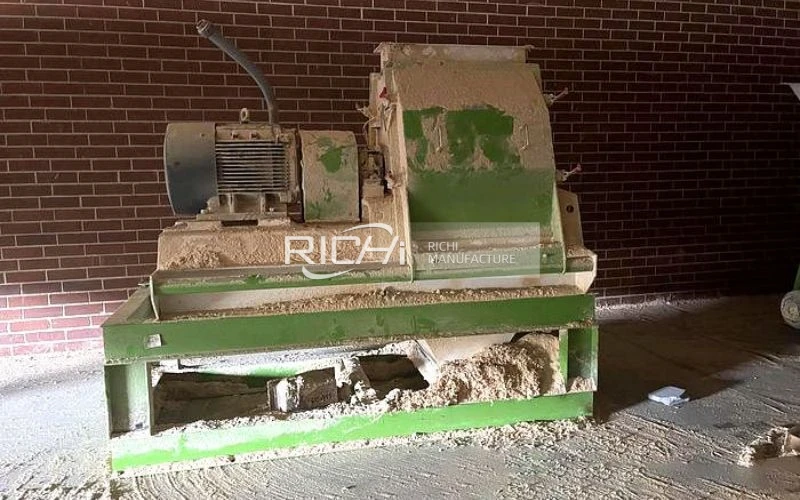
A wood hammer crusher in Kenya was selected by a biomass pellet producer in Nakuru County to replace an aging fine-grinding machine that had become the main bottleneck in its existing wood-processing system. The customer already had wood receiving, coarse chipping, conveying, drying and pelletizing equipment, so the project focused on upgrading the secondary crushing stage rather than purchasing another complete biomass pellet production line.
The customer purchased one RICHI SFSP66×60 hammer crusher with a 55 kW main motor. Its main job is to reduce prepared eucalyptus and pine chips, together with suitable sawmill offcuts, into a controlled particle size for the company's existing biomass pellet production section, giving the pellet mill a more consistent raw material supply.
Name:
wood hammer mill
Country:
Kenya
Date:
2025
Capacity:
1.0-1.2 T/H
Model:
SFSP66×60
Main Motor Power:
55 kW
Raw Materials:
eucalyptus and pine wood residue
Final product size:
1-5mm
The customer processes plantation and sawmill residues rather than harvesting natural forest specifically for pellet production. Its raw material supply includes chipped eucalyptus residues, pine processing waste and suitable offcuts collected from wood-processing operations serving the central Kenyan market.
This raw-material setting is realistic for Kenya. Public industrial forest plantations in the country include pine and eucalyptus species, providing a practical basis for wood-processing residues and sawmill by-products to enter secondary biomass applications.
The customer's old wood hammer mill could still operate, but output had become increasingly unstable. The problem was most obvious when batches changed between relatively uniform pine chips and denser eucalyptus residues. Operators had to reduce the feed rate more frequently, while worn screens and hammers made it difficult to keep the ground material within the desired size range.
These variations were beginning to affect the pelletizing section. When oversized wood particles passed through the preparation system, pellet mill feeding became less predictable. When the grinder could not prepare material fast enough, the pelletizing equipment had to wait.
The company therefore did not need to expand every process stage. It needed a wood hammer crusher in Kenya that could replace the weak grinder and fit the capacity of equipment already installed around it.
This is a typical retrofit project rather than a greenfield biomass plant.
The customer already owned a chipper for larger wood residues. It also had conveyors, a drying section, temporary sawdust storage and a biomass pellet mill. Replacing those machines simply because the fine grinder had become unreliable would have added unnecessary investment.
RICHI therefore evaluated the interface between the existing chip preparation system and the new SFSP66×60.
The customer purchased only one machine because its required fine-grinding output was around the capacity range needed by the downstream pelletizing section. If future pellet production increases substantially, the grinding section can be reassessed based on actual operating hours and material supply rather than installing redundant equipment at the beginning.
The main feedstock is prepared eucalyptus and pine wood residue.
Eucalyptus offcuts and branches are first reduced to chips by the customer's existing coarse size-reduction equipment. Pine residues enter the same preparation route when their initial dimensions are too large for stable hammer-mill feeding.
The customer also processes clean sawmill offcuts after primary chipping. Bark can be present in controlled amounts, although batches with significantly more bark may grind differently and can influence ash content if the material is subsequently used for fuel pellets.
The project does not describe whole logs or large branches as direct hammer-mill feed.
This is an important distinction for customers evaluating a wood hammer crusher in Kenya. The SFSP66×60 is a fine crushing machine. Large logs, long branches and oversized wood pieces require chipping or coarse crushing first.
Trying to make one hammer mill perform both primary log reduction and fine grinding would create unstable feeding, unnecessary wear and a poorly balanced production system.
After reviewing the raw material dimensions, required finished particle size and capacity of the existing pelletizing section, RICHI selected the SFSP66×60 with a 55 kW main motor.
| Project Item | Specification |
|---|---|
| Equipment | Wood hammer crusher |
| Model | SFSP66×60 |
| Quantity | 1 unit |
| Main Motor Power | 55 kW |
| Rotor Diameter | 660 mm |
| Crushing Chamber Width | 600 mm |
| Rotating Speed | 2980 rpm |
| Hammer Line Speed | 103 m/s |
| Main Raw Materials | Prepared eucalyptus chips, pine residues and clean chipped sawmill offcuts |
| Main Application | Fine grinding before biomass pellet production |
RICHI's published SFSP wood hammer mill specifications confirm the 660 mm rotor diameter, 600 mm chamber width, 2980 rpm speed, 103 m/s hammer line speed and 55 kW power for the SFSP66×60.
The customer does not treat one catalog capacity as a guaranteed result for every wood species. Actual output changes with initial chip size, moisture, wood density, bark content and the screen installed in the machine.
This customer's main product is biomass fuel pellets, so the grinder is configured primarily around the particle-size requirement of the existing biomass pellet machine.
Particleboard manufacturers can have their own wood-particle specifications, while MDF production requires a fiber-preparation process that cannot be reduced to simply producing hammer-milled sawdust.
The customer may sell suitable ground wood externally when a buyer's specification matches its material, but the project does not claim that one screen automatically creates the correct feedstock for several unrelated wood industries.
This keeps the wood hammer crusher in Kenya project focused on the application for which the machine was actually purchased.
Moisture is one of the first raw material conditions RICHI asks about when configuring a wood hammer crusher.
Relatively dry chips fracture more readily than freshly cut wet wood. When moisture is high, fibers can become more difficult to break cleanly and material may pass through the screen more slowly.
This can reduce throughput and change the amount of power required per ton.
For this customer, the hammer crusher works together with the existing moisture-management process rather than independently from it. The production team checks incoming wood condition and coordinates grinding with drying according to the needs of the downstream pellet process.
The correct position of drying and fine grinding can depend on the initial material form and complete plant design, so RICHI does not assume one fixed arrangement is suitable for every Kenyan biomass project.
The customer does not grind wood as fine as technically possible.
A smaller screen can produce finer material, but it also forces particles to remain in the grinding chamber longer before they can leave. That generally increases the grinding work and can reduce hourly throughput.
Grinding much finer than the pelletizing process requires therefore adds operating cost without necessarily improving pellet quality.
The customer's screen configuration is selected around the raw material size accepted by its existing ring die pellet mill.
If the company later changes pellet specification, wood species or pelletizer configuration, the screen arrangement can be reassessed rather than assuming the original setting will remain optimal forever.
The processing route begins before the SFSP66×60.
Larger branches and sawmill offcuts first pass through the customer's existing wood chipper. Oversized foreign materials are removed, and the prepared chips are conveyed toward the fine crushing section.
The SFSP66×60 then uses high-speed hammer impact to continue reducing the material. Particles remain inside the crushing chamber until they are sufficiently small to pass through the installed screen.
Ground material is discharged into the existing downstream handling system and proceeds toward the next stage required by the biomass pellet process.
This arrangement is why replacing one machine made commercial sense. The new wood hammer crusher in Kenya solves the size-reduction bottleneck without forcing the customer to discard useful equipment before and after it.
A 55 kW motor cannot compensate for a poorly designed feed system.
If wood chips enter in large surges and then stop, machine load fluctuates and usable output becomes less predictable. Oversized chips can create another problem if the upstream chipper is not producing a reasonably controlled feed size.
RICHI therefore reviewed the customer's existing conveyor and feeding arrangement when configuring the replacement machine.
The objective was to deliver prepared chips continuously rather than repeatedly overloading and underloading the grinding chamber.
This type of interface work matters more in a retrofit project because the new crusher has to work with machinery installed before the purchase was made.
Fine wood grinding inevitably generates dust.
The amount changes with wood moisture, screen size, bark content and the proportion of fines already present in the incoming chips.
The customer therefore operates the SFSP66×60 together with an aspiration and dust-separation arrangement.
Airflow also influences how efficiently ground material leaves the crushing chamber. Dust collection should consequently be treated as part of the grinding system rather than as a housekeeping accessory added after installation.
For another wood hammer crusher in Kenya project, RICHI would size the relevant airflow and dust-handling equipment according to the actual crusher capacity and workshop configuration.
Sawmill and plantation residues are not always perfectly clean.
Metal fragments, stones or other foreign objects can cause unnecessary hammer and screen damage if they reach the high-speed rotor.
The customer's raw material preparation therefore includes inspection and suitable metal-removal measures before fine grinding.
This does not eliminate routine wear, but it helps prevent abnormal damage that should not be treated as normal hammer consumption.
Hammers and screens are normal wear components of the SFSP66×60.
Their actual life depends on wood hardness, bark and mineral contamination, screen opening, daily operating hours and whether unsuitable foreign material enters the machine.
This is why the revised project does not claim that a reversible rotor automatically produces a fixed percentage increase in hammer life.
The customer instead follows a condition-based maintenance routine. Operators check hammer edges, screen condition, rotor operation, bearings and other key points before deterioration begins to affect particle size or machine load.
RICHI also discusses recommended wear-part inventory with the customer so that a screen or hammer replacement does not create avoidable production delays.
The customer was not looking only for a machine with a 55 kW motor.
The key issue was whether the new grinder could fit into an existing biomass system.
RICHI reviewed input material size, wood species, required particle range, available power, feeding height, discharge arrangement and downstream equipment before finalizing the model.
This is especially important when replacing another manufacturer's crusher.
A machine can have suitable grinding capacity but still create additional expense if the inlet, outlet, foundation or maintenance space does not work with the existing workshop.
The project therefore focused on practical integration rather than selling additional machinery the customer did not require.
The SFSP66×60 crusher machine was shipped by sea from Qingdao Port in China to the Port of Mombasa in Kenya.
Mombasa is Kenya's principal maritime gateway and one of the major ports serving East and Central African cargo flows, making it a practical destination for industrial machinery imported into Kenya.
Before shipment, RICHI supplied dimensional drawings, electrical information and installation requirements so that the customer could prepare the existing grinding position.
Feed and discharge interfaces, foundation requirements and maintenance clearance were checked in advance because the machine had to replace an older grinder without major changes to the rest of the workshop.
The main improvement was a more controllable fine-grinding stage.
The customer could prepare chipped wood for pellet production without relying on an aging machine whose output increasingly changed with wear and raw material variation.
Operators also developed a clearer understanding of how different wood batches affect grinding.
Pine residues do not necessarily require exactly the same feeding rate as denser eucalyptus material. Wetter chips also need different attention from properly conditioned dry feedstock.
Instead of forcing one machine setting onto every load, the production team adjusts operation according to material condition while keeping the downstream pellet mill's requirements in mind.
This provides a more credible project result than claiming an unsupported 30% efficiency increase or a fixed reduction in maintenance cost.
The SFSP hammer mill platform can be used for different fibrous biomass materials when the machine and screen configuration are appropriate.
However, this does not mean eucalyptus chips, maize stalks, rice husks and bagasse all have the same output on one setting.
Their bulk density, fiber structure, moisture and abrasive characteristics differ substantially.
If the Kenyan customer later wants to process an agricultural residue, RICHI would evaluate that material separately and determine whether the existing feed system, screen and hammer configuration remain suitable.
Machine versatility should give a biomass processor more options, not encourage uncontrolled switching between unrelated materials.
This wood hammer crusher in Kenya project is most relevant to biomass pellet manufacturers, sawmills and wood-residue processors that already have access to chipped or otherwise prepared wood but need a more consistent fine-grinding stage.
A business starting with whole logs requires additional primary size reduction.
A company receiving wet branches may also need a different moisture-management arrangement from a pellet factory buying relatively dry sawmill chips.
The correct hammer crusher therefore depends on what actually arrives at the factory, not simply on how many tons of pellets the customer eventually wants to sell.
The SFSP66×60 was selected for this customer because the biomass plant already had coarse wood preparation and downstream pelletizing equipment while the existing fine grinder had become the limiting machine.
Another Kenyan project may require a different model.
Before selecting a wood hammer crusher, RICHI Machinery needs to know the wood species, whether the material arrives as logs, branches, offcuts or chips, maximum input dimensions, approximate moisture, required finished particle size and target T/H.
Customers replacing existing equipment should also provide information about the current chipper, dryer, conveyors, pellet mill and dust-control system, together with dimensions or photographs of the installation area.
With these details, RICHI Machinery can determine whether the SFSP66×60 used in this wood hammer crusher in Kenya project is appropriate, whether another hammer mill capacity would match the pellet plant more closely, or whether additional primary size reduction is required before fine grinding.
The objective is not simply to produce smaller wood particles. It is to remove the actual grinding bottleneck, make full use of equipment the customer already owns and supply the downstream pelletizing process with a raw material condition it can handle consistently.
Having the right mix of reliable, high-quality pellet machine and pelletizing systems and expert support is essential to your success. Watch how our end-to-end feed pellet plant solutions have helped our customers optimize their performance.
Our customized and future-proofed turnkey pellet plant solutions is designed with you at the core. From vision to reality and beyond, our team stays connected with yours. Giving you peace-of-mind with an expert at your side.
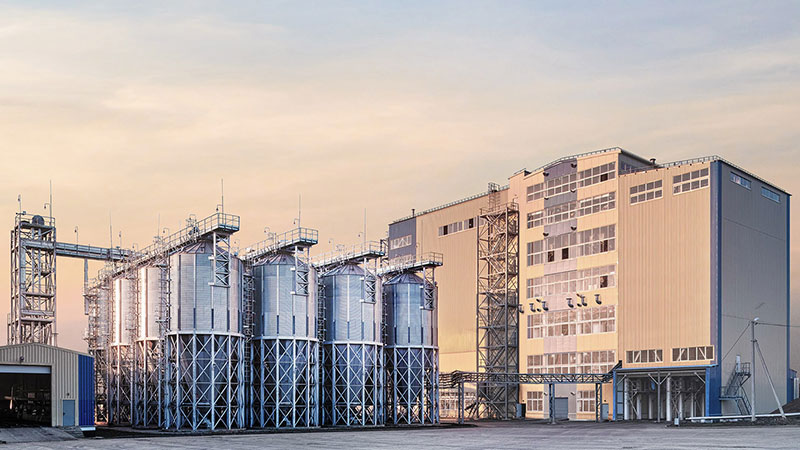
At RICHI, we go beyond project completion. With RICHI Servicee, we’re your dedicated partners in success. Count on us for expert guidance, minimal downtime, and optimized productivity. Choose RICHI for unmatched service and support.
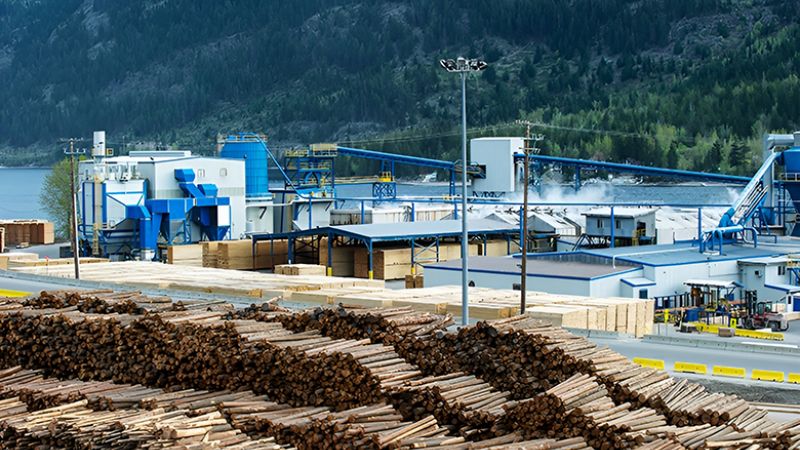


Meet global product demands and quality standards with industry-leading pellet plant design, engineering, equipment, and construction services for pellet processors.


Your Partner Beyond Project Completion
2000+ cases
RICHI is the leading designer, manufacturer and builder of pellet plants in the world, completing over 2000 projects in 140 countries across 6 continents.
Read More
Increase plant productivity, profitability, and safety by integrating high quality equipment into your pellet production line. Over the years, RICHI has become China's top pellet equipment manufacturer. At the same time, RICHI has established valuable partnerships with the world's leading component and raw material manufacturers to bring you the best there is in technology, automation, and efficiency in pelleting plant machinery.

For nearly 30 years, RICHI has been providing best-in-class pellet plant equipment and services to clients across a variety of industries, sizes, and needs. We pride ourselves on the knowledge and skill that each team member possesses – from our technical sales team to our process design engineers. You can count on RICHI Machinery to take your operation to the next level of innovation, quality, and success.
Need help with your pellet manufacturing plant project? Contact us today.
ANIMAL FEED
BIOMASS
WOOD
ORGANIC FERTILIZER
AQUA FEED
CAT LITTER
MUNICIPAL WASTE RECYCLING
SPECIAL PELLET PRODUCTION
RICHI Machinery continues to deliver world class pellet mill equipment, pellet plant engineering and project solutions that add value to our customers in the animal feed, wood waste, agriculture waste, organic fertilizer, cat litter and special pellet products industries. Throughout the years, we RICHI Machinery have built strong brand, becoming industry-leading pellet machine manufacturer. We value integrity, promise quality, and prioritize your success.
Learn MoreWith our expert team, we precisely implement your process engineering requirements in pellet mill and pelletizing plant systems. No matter which industry you’re in – we understand your needs and deliver solutions that meet the highest standards.
At RICHI, quality comes first. Our pellet making machine and related pellet line equipment undergo rigorous quality controls to ensure they meet the highest standards. Rely on products that are durable, safe, and efficient.
With decades of experience in pellet machine and pellet production line production, we have earned a reputation as a trusted partner in various industries. Our expertise allows us to cover a wide range of applications.
Not only do we offer premium pelleting equipment, but we are also experts at designing, building, installing, and maintaining facilities from the ground up. Our expertise is within pellt plant process design, discovering the most efficient, productive, and profitable way to handle your materials in an end-to-end cycle.
○ RICHI MACHINERY
Keeping in touch with us is an effective way to solve all your problems. If you have any needs or questions, please leave your contact information, then RICHI technical consultants will send design, quotation, videos to your mailbox. You can also contact us directly via WhatsApp: +86 13838389622
Copyright©2015-2026 by HENAN RICHI MACHINERY CO., LTD. All rights reserved.