
The South African recycler was not looking for a machine that could turn compressed bottle bales directly into finished recycled plastic pellets. The immediate problem was farther upstream. Irregular post-consumer bottle bales were arriving faster than the existing pre-processing section could open and reduce them, creating unstable feeding into the plant’s sorting and secondary size-reduction equipment.
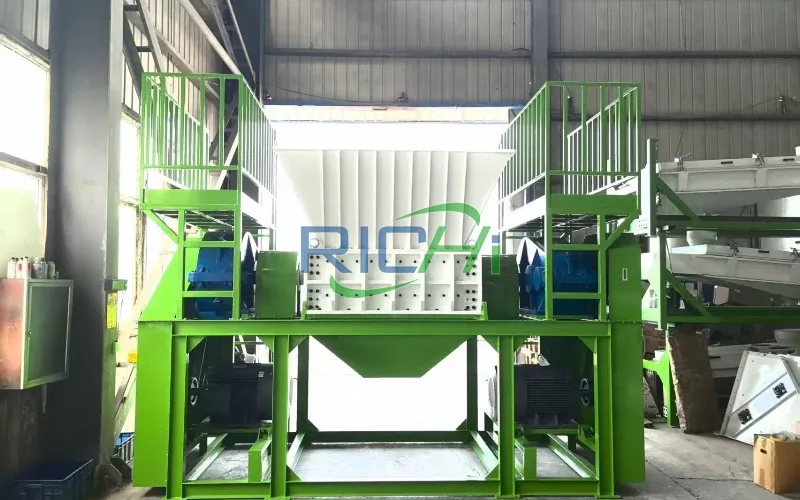
The South African recycler was not looking for a machine that could turn compressed bottle bales directly into finished recycled plastic pellets. The immediate problem was farther upstream. Irregular post-consumer bottle bales were arriving faster than the existing pre-processing section could open and reduce them, creating unstable feeding into the plant’s sorting and secondary size-reduction equipment.
A medium-sized recycling company in Gauteng therefore installed one RICHI SSJ1000 twin-shaft shredder in South Africa as a standalone primary-shredding upgrade. The machine was positioned near the front of the existing plastic recycling system, where it breaks compacted and tangled plastic packaging into a loose, manageable stream before polymer sorting and finer granulation. The rest of the washing, separation, drying and pelletizing equipment remained in service.
Name:
Double Shaft Shredder
Country:
South Africa
Date:
2026
Capacity:
Flexible
Model:
SSJ1000
Main Motor Power:
37 kW × 2
Cutter Material:
55CrSi alloy steel
Machine Dimensions:
3900 × 1800 × 2200 mm
Post-consumer plastic bottles often arrive at recycling plants compressed into dense transport bales.
Baling is useful for collection and logistics because empty bottles have very low bulk density, but the same compacted form becomes a processing problem once the material reaches the recycling plant.
The customer’s previous equipment struggled to pull apart the irregular mass consistently.
Some bales entered slowly, some broke apart suddenly, and some created large material surges toward the next machine.
Gauteng contains South Africa’s largest concentration of population, manufacturing, retail distribution and urban consumption.
It also has an established recycling network connecting waste pickers, buy-back centres, collection companies and commercial reprocessors.
PETCO currently lists multiple contracted PET recyclers operating in Gauteng, confirming that the province has an established commercial market for post-consumer PET bottle recovery rather than being an invented project location.
The customer is operating inside an existing recycling economy rather than trying to introduce PET recycling for the first time.
South Africa’s producer responsibility system has developed a nationwide collection network for PET bottles and associated packaging.
PETCO reported that collection of PET bottles and jars represented nearly 76% of the volume placed on the market by its members in 2024, while its 2025 results again showed strong collection and recycling performance.
That creates a realistic supply environment for a Gauteng recycler investing in better bottle pre-processing equipment.
The plant receives PET beverage bottle bales from buy-back centres, collection companies and other material aggregation points.
Bales can include flattened bottles, caps, labels and some unacceptable packaging that must later be removed.
The shredder’s purpose is to loosen and reduce the compacted material so downstream sorting equipment can work more consistently.
HDPE containers collected as a separate packaging stream are sorted and processed according to their own recycling route.
The SSJ1000 Double Shaft Shredder Machine can mechanically shred suitable HDPE packaging, but the customer does not deliberately blend bulk HDPE bottle material into PET feedstock before final extrusion.
This distinction is important.
Many PET beverage bottles carry closures manufactured from lighter polyolefins such as HDPE or PP.
Those closures can remain attached during parts of the PET recycling process and later be separated from PET because their density behavior differs.
That does not mean entire HDPE detergent or milk bottles should automatically be mixed with PET beverage bottle bales.
After the compacted bottles have been opened and reduced to a manageable condition, the plant removes incompatible materials.
Colour, resin type, unsuitable sleeves, metals and other contamination all influence final rPET quality.
Primary shredding makes the feed easier to handle, but it does not replace sorting.
A low-speed twin-shaft shredder uses two intermeshing cutter shafts to grab, tear and shear bulky material.
Its strength is robust primary size reduction.
A PET granulator works differently, using higher-speed cutting and a sizing screen to produce a more controlled flake fraction for washing.
The customer therefore uses the two machine types for different jobs. Without a precision sizing screen controlling every particle, output contains a range of strips, pieces and partially opened bottle sections.
Cutter width, hook geometry, shaft speed and material condition influence the discharge distribution.
For this project, the target is manageable coarse material rather than finished washing-line flake.
After sorting, PET bottles move to the plant’s existing secondary crusher or granulator.
This machine performs the finer cutting required before washing.
The process distinction is simple:
SSJ1000 = coarse opening and pre-shredding.
Secondary granulator = controlled PET flaking.
Sending a heavily compacted bale directly into a high-speed granulator can create unstable feeding and shock loading.
The twin-shaft shredder first opens the structure and reduces the size of the largest sections.
The granulator then receives a more manageable feed and can focus on creating the required flake size.
| Project Parameter | Specification |
|---|---|
| Equipment | Twin-shaft shredder |
| Model | SSJ1000 |
| Quantity | 1 unit |
| Drive | 37 kW × 2 |
| Cutter Disk Diameter | 400 mm |
| Cutter Material | 55CrSi alloy steel |
| Reference Machine Dimensions | Approximately 3900 × 1800 × 2200 mm |
| Main Material | Baled post-consumer plastic bottles |
| Main Function | Primary bale opening and coarse shredding |
| Downstream Process | Sorting, secondary granulation, washing, drying and recycling |
Baled bottles are lightweight individually but become mechanically awkward when compressed together.
Two counter-rotating shafts can grab irregular sections of the bale from both sides and pull the material into the cutting zone.
This creates a different feeding action from a high-speed single-rotor granulator.
The SSJ1000 does not need extremely high rotor speed to tear open bottle bales.
The machine relies on cutter engagement and torque to pull material between the two shafts.
This operating principle is useful for bulky, hollow and tangled plastic products where controlled grabbing is more important than fine cutting during the first stage.
The recycler was upgrading one bottleneck inside an existing medium-sized plant.
Selecting the largest shredder available would have increased capital cost, footprint and connected electrical load without guaranteeing better line performance.
The SSJ1000 was selected around the actual bale size, required feed rate and capacity of the downstream sorting and granulation equipment.
If primary shredding produces material faster than the sorting and granulation sections can accept it, the new machine simply moves the bottleneck downstream.
The customer therefore operates the SSJ1000 according to complete-line demand instead of chasing the maximum theoretical shredder throughput.
Plastic bottles differ from tyres, pallets or thick molded plastics.
The cutter thickness, hook shape and spacing must create enough engagement to pull bottles and compressed bale sections into the shafts.
A configuration optimized for large rubber pieces would not automatically be the best configuration for PET packaging.
The SSJ1000 uses 55CrSi alloy steel cutter components for the bottle-bale pre-shredding application.
The customer evaluates cutter condition through wear inspection rather than assuming alloy specification alone guarantees unlimited service life.
Actual wear still depends on contamination, operating hours and foreign materials entering the machine.
Plastic bottle bales can occasionally contain wires, steel strapping or other foreign objects from collection and baling.
A heavy-duty twin-shaft shredder is more tolerant of difficult feed than a precision granulator, but it should not be used intentionally as a metal recycling machine in this application.
Visible heavy metal contamination is removed before shredding where practical.
The SSJ series can be configured for several waste streams, but this specific customer bought the machine for plastic packaging.
Promoting pallets, e-waste, tyres, metal drums and municipal waste equally inside the same case would weaken the equipment-selection logic.
The article therefore focuses on one use: post-consumer plastic bottle pre-processing.
A machine family may process several materials, but that does not mean the same cutter arrangement is optimal for every material.
Plastic bottle projects prioritize gripping, opening and controlled coarse reduction.
Wood, tyres or bulky municipal waste may require different cutter thickness, hook geometry, shaft speed and protection strategy.
If the shafts encounter a load above the configured operating range, the control system can stop and reverse to release the cutting chamber before attempting to continue.
This reduces the need for immediate manual clearing every time the machine experiences temporary overload.
Very large foreign objects, wrapped material or severe contamination can still require operator intervention.
The reverse function is a protection and recovery feature, not a guarantee that every unsuitable object will pass through automatically.
The customer monitors the two drive loads during operation.
If the bale feeder continuously pushes material faster than the shafts can process it, motor current rises.
Feed control can then slow or pause until the shredding chamber clears.
A compressed bale can contain hundreds or thousands of bottles.
Dropping the entire bale abruptly into the machine can impose a very different load from gradually presenting the material to the shafts.
The plant therefore coordinates bale opening or feed conveyor behavior with the shredder load.
One of the reasons for introducing the twin-shaft shredder is to reduce dependence on manual mechanical separation of compacted bottle structures.
Workers still inspect and sort the stream, but they do not need to pull every compressed bottle apart individually before the material enters primary size reduction.
Shredding efficiency cannot compensate for poor polymer sorting.
PVC contamination, unsuitable PET colours, incompatible shrink sleeves and other plastics can cause serious problems in high-quality PET recycling.
The plant therefore retains dedicated sorting before final flaking and washing.
This process order reflects established local recycling practice.
South Africa’s PET collection and recycling guidance describes post-consumer bottles being collected, transported, de-baled and sorted before the material moves into the flaking and washing stages.
The SSJ1000 supports this workflow by making compressed material easier to present to the sorting section.
Not all PET bottles have the same commercial value.
Clear and light-blue material is generally preferred for higher-value recycling routes, while heavily coloured PET can have more limited outlets.
This makes colour sorting an important commercial step even after the shredder has solved the mechanical feeding problem.
PETCO’s South African design guidance identifies certain incompatible shrink sleeves as problematic in the PET recycling stream.
The plant therefore cannot assume that every label attached to a bottle will simply disappear in hot washing.
Problematic sleeves and incompatible packaging are separated according to the recycler’s quality requirements.
Many caps are made from polyolefins with lower density than PET.
After grinding, suitable sink-float separation can use this density difference to help separate PET from caps and label fractions.
PET sinks while lighter PP and HDPE components generally float under appropriately controlled conditions.
The customer is not trying to manufacture one resin pellet containing PET, HDPE and PP together.
The recycling system separates polymer fractions so they can enter suitable downstream markets.
Maintaining resin purity is essential for producing a commercially useful recycled plastic.
Post-consumer bottles can carry beverage residues, dust, adhesives and labels.
Once the material reaches the correct flake size, washing exposes a much larger surface area for cleaning.
Hot washing may be used where the required product quality justifies it.
The PET granulator and its screen determine the washing-line particle distribution much more directly than the SSJ1000.
The shredder’s job is to ensure the granulator receives loose, manageable material instead of large compacted bale sections.
After washing and separation, clean PET flakes pass through drying equipment.
Residual water must be controlled before the polymer moves into subsequent extrusion and pelletizing.
The SSJ1000 has no role in this moisture-removal stage.
The recycling extruder melts clean prepared polymer and filters the melt before pellet production.
Sending dirty shredded bottle material directly from the twin-shaft shredder to the extruder would bypass essential sorting and washing steps.
The complete route therefore remains physically and commercially separated.
The recycler had functioning washing, separation, drying and extrusion equipment.
That is why purchasing one standalone twin-shaft shredder was commercially reasonable.
RICHI did not recommend replacing downstream machines simply to sell a larger project.
The old pre-crushing system was producing unstable feed for the rest of the plant.
Replacing that point allowed the customer to retain capital already invested in the washing line.
This is a common reason industrial recyclers purchase a single shredder rather than a complete recycling system.
The SSJ1000 and the secondary granulator do not have to process exactly the same instantaneous mass every second.
A controlled conveyor or intermediate feed section can absorb short-term fluctuations.
This helps prevent a large bale fragment from creating an immediate surge into the higher-speed granulator.
Shredded bottles are lightweight relative to their volume.
A conveyor designed only from tonnes per hour can therefore be physically too small.
Belt width, sidewall height and material bulk density must be considered together.
Coarse twin-shaft shredding generally creates less fine material than high-speed granulation, but labels, brittle bottles and contamination can still generate dust and small fragments.
Housekeeping and appropriate enclosure remain part of the installation.
Impact from bottles, foreign material and the mechanical drive creates industrial noise.
The customer evaluates machine placement, guarding and operator exposure as part of site safety instead of treating the shredder as silent equipment because it is low-speed.
Sealed bearing arrangements can improve protection against contamination, but the whole shredder should not be interpreted as a machine intended to operate submerged or under uncontrolled wash-water exposure.
Installation still requires appropriate environmental protection.
Residual beverages and rainwater add unnecessary mass to collected bottle bales.
Excessive organic residue can also increase odor and housekeeping problems.
South African collection guidance recommends recyclable packaging be emptied and kept reasonably clean before entering the recycling chain.
The recycling company assesses bale quality when purchasing material.
High contamination means more sorting labor, more rejected material and more downstream cleaning.
A stronger shredder does not make poor-quality incoming material economically equivalent to a clean sorted bale.
Improved collection and sorting remain fundamental to plastics recycling.
Mechanical equipment can process recovered material more efficiently, but it cannot transform every mixed-waste input into high-quality recycled polymer.
South Africa now operates mandatory extended producer responsibility requirements for identified packaging streams.
Producer responsibility organisations support collection and recycling networks, creating stronger commercial demand for verified recovery of post-consumer packaging.
This provides a more credible market context for equipment investment than simply saying the country “has a plastic waste problem.”
Plastics SA reported approximately 485,000 tonnes of plastics recycled during 2025, showing that the country already has a substantial mechanical recycling industry.
The Gauteng customer is therefore adding capacity within an established sector rather than pioneering an experimental waste technology.
Clean PET can be converted into applications such as recycled packaging, fibre, strapping and other PET products depending on quality.
Recovered polyolefin closures and labels enter different downstream markets.
The recycler does not sell every separated fraction as the same pellet.
If the customer later targets bottle-to-bottle or food-contact applications, the recycling system must meet significantly stricter decontamination, process-control and regulatory requirements.
Installing the SSJ1000 alone does not create food-grade recycled PET.
The crusher machine improves the consistency of the first processing stage.
Final recycled pellet quality still depends on sorting accuracy, wash performance, moisture, melt filtration and extrusion conditions.
The case therefore avoids attributing final resin quality entirely to primary shredding.
The SSJ1000 is manufactured and exported from Qingdao and enters South Africa through the Port of Durban before inland delivery to Gauteng.
Durban provides a practical gateway for containerized machinery moving inland to Gauteng through South Africa’s established freight corridor.
Transnet describes the approximately 688 km Container Corridor between the Port of Durban and Gauteng as a core rail freight artery serving inland terminals and industrial customers.
That makes Qingdao to Durban followed by inland transport a technically credible logistics plan for a Johannesburg/Pretoria-area recycling project.
The project equipment is supplied from RICHI Machinery’s production and export system through Qingdao.
After ocean transport to Durban, the SSJ1000 continues inland to the customer’s recycling plant in Gauteng.
Ocean schedules, port congestion, customs procedures and inland transport availability change.
RICHI therefore confirms delivery against the actual order and vessel schedule rather than advertising one fixed transit duration as if it applied to every South African shipment.
Because this was a retrofit, the important measurements were feed-conveyor height, shredder inlet position, discharge elevation and available maintenance clearance.
The machine was aligned with the customer’s existing material route instead of forcing the recycling plant to rebuild around a standard drawing.
The SSJ1000 uses two 37 kW main drives according to the project configuration.
Feed conveyors, discharge conveyors, hydraulic or control auxiliaries and downstream recycling equipment create additional connected load.
Plant electrical planning therefore covers the complete processing section.
The first functional tests used loose post-consumer bottles rather than the densest available bale.
This allowed the customer to confirm shaft direction, current load, auto-reverse response and discharge behavior under a controlled feed.
Once loose material ran steadily, the team introduced more compacted feed.
Bale density and feed rate were increased gradually until the operators established a stable working range.
This made troubleshooting easier than beginning commissioning with maximum bale load.
A severely compacted contaminated bale introduces several variables at once.
If the machine stalls, the operator may not know whether the cause is feed density, foreign metal, cutter engagement or control settings.
Progressive commissioning separates those variables.
Uneven material engagement can temporarily load one drive more heavily than the other.
The control system and operators therefore monitor current and shaft behavior rather than judging performance only from total tonnes shredded.
There is no fixed universal cutter life for post-consumer plastics.
Clean PET bottles create a different wear environment from contaminated mixed plastics containing sand, glass or metal.
The customer schedules inspection according to actual operating condition.
Thin PET bottle walls themselves are not an extremely abrasive feedstock.
Embedded sand, glass and metal can be far more damaging to cutter edges and downstream granulator knives.
Better collection and sorting can therefore extend wear-part life.
Industrial recyclers eventually need to inspect cutters, shafts, bearings and gear-drive components.
The machine layout therefore provides access for planned maintenance rather than relying on a promise of “low maintenance.”
The new shredder improves upstream feed consistency and reduces interruptions associated with the previous bottleneck.
Its value is measured by how reliably it prepares dense bottle bales for sorting and secondary granulation while fitting the operating rate of the existing recycling line.
“Our problem was not that we lacked a washing line. The issue was getting dense bottle bales into that line consistently. The twin-shaft shredder now opens and reduces the bulky material before sorting and final granulation, so the rest of the recycling equipment receives a much more manageable feed. We also learned quickly that coarse shredding and final flaking are two separate jobs.”
A PET bottle twin-shaft shredder is best understood as heavy-duty primary size-reduction equipment.
For compressed bottle bales, it can reduce bulky structures before sorting and higher-speed granulation.
A plastic bottle bale shredder becomes useful when the recycler receives compacted packaging that cannot feed consistently into a conventional crusher.
Bale dimensions, density, wire removal and downstream capacity should all be checked before machine selection.
A plastic recycling pre-shredder reduces the mechanical load on downstream granulation equipment by opening large or dense material first.
It should not be confused with the machine responsible for final washed-flake sizing.
For a Gauteng recycler, an industrial plastic shredder can be integrated into an existing sorting and washing plant without replacing the entire recycling system.
This retrofit approach is particularly suitable where only the front-end size-reduction section has become a bottleneck.
A dual-shaft plastic shredder uses opposing cutter shafts to grab and tear bulky material.
The configuration is well suited to bottle bales, hollow plastic products and other irregular plastic feed where low-speed pulling action is valuable.
A waste plastic shredding machine should always be configured around the specific resin and physical form.
PET bottle bales, HDPE drums, plastic film and thick injection-molded scrap impose very different feeding and cutter requirements.
Customers searching for a plastic bale crusher are often trying to solve the same front-end problem as this South African recycler: dense material must be opened before sorting, washing and secondary grinding can operate steadily.
The correct solution may be a twin-shaft shredder rather than a high-speed precision granulator.
The SSJ1000 selected for this project uses dual 37 kW drives, 400 mm cutter disks and 55CrSi cutter material.
Its actual processing rate is determined by bottle-bale density, cutter configuration, contamination and the allowable feed rate of the downstream recycling system.
This twin-shaft shredder in South Africa project uses one RICHI SSJ1000 as a standalone pre-processing upgrade at a plastic recycling plant in Gauteng.
The customer mainly receives baled post-consumer PET bottles from collection companies and buy-back networks serving Johannesburg, Pretoria and surrounding urban areas. Instead of attempting to send dense bales directly into a high-speed PET granulator, the plant now uses the SSJ1000 to open and coarsely reduce the material first.
The SSJ1000 is equipped with dual 37 kW drives, 400 mm cutter disks and 55CrSi cutter components. Its purpose in this project is to provide stable coarse size reduction, while downstream sorting and secondary granulation create the more controlled PET flake required for washing.
The complete processing logic is bale receiving, inspection, primary twin-shaft shredding, polymer and contamination sorting, secondary granulation, washing, density separation, drying, final sorting and extrusion where recycled pellets are required. PET and bulk HDPE bottle streams are managed separately rather than intentionally converted into one mixed recycled resin.
For another buyer comparing a twin-shaft shredder in South Africa, PET bottle twin-shaft shredder, plastic bottle bale shredder, industrial plastic shredder, plastic recycling pre-shredder, dual-shaft plastic shredder, waste plastic shredding machine or SSJ1000 plastic shredder, RICHI Machinery would first review bale dimensions, bale density, PET/HDPE composition, contamination level, required primary discharge size, downstream granulator capacity, washing-line throughput, cutter configuration, daily operating hours and available feed and discharge conveyors.
The right question is not whether the shredder can create the smallest plastic piece. It is whether it can prepare the incoming bale in the most stable form for the next recycling stage.
Having the right mix of reliable, high-quality pellet machine and pelletizing systems and expert support is essential to your success. Watch how our end-to-end feed pellet plant solutions have helped our customers optimize their performance.
Our customized and future-proofed turnkey pellet plant solutions is designed with you at the core. From vision to reality and beyond, our team stays connected with yours. Giving you peace-of-mind with an expert at your side.
At RICHI, we go beyond project completion. With RICHI Servicee, we’re your dedicated partners in success. Count on us for expert guidance, minimal downtime, and optimized productivity. Choose RICHI for unmatched service and support.


Meet global product demands and quality standards with industry-leading pellet plant design, engineering, equipment, and construction services for pellet processors.


Your Partner Beyond Project Completion
2000+ cases
RICHI is the leading designer, manufacturer and builder of pellet plants in the world, completing over 2000 projects in 140 countries across 6 continents.
Read More
Increase plant productivity, profitability, and safety by integrating high quality equipment into your pellet production line. Over the years, RICHI has become China's top pellet equipment manufacturer. At the same time, RICHI has established valuable partnerships with the world's leading component and raw material manufacturers to bring you the best there is in technology, automation, and efficiency in pelleting plant machinery.

For nearly 30 years, RICHI has been providing best-in-class pellet plant equipment and services to clients across a variety of industries, sizes, and needs. We pride ourselves on the knowledge and skill that each team member possesses – from our technical sales team to our process design engineers. You can count on RICHI Machinery to take your operation to the next level of innovation, quality, and success.
Need help with your pellet manufacturing plant project? Contact us today.
ANIMAL FEED
BIOMASS
WOOD
ORGANIC FERTILIZER
AQUA FEED
CAT LITTER
MUNICIPAL WASTE RECYCLING
SPECIAL PELLET PRODUCTION
RICHI Machinery continues to deliver world class pellet mill equipment, pellet plant engineering and project solutions that add value to our customers in the animal feed, wood waste, agriculture waste, organic fertilizer, cat litter and special pellet products industries. Throughout the years, we RICHI Machinery have built strong brand, becoming industry-leading pellet machine manufacturer. We value integrity, promise quality, and prioritize your success.
Learn MoreWith our expert team, we precisely implement your process engineering requirements in pellet mill and pelletizing plant systems. No matter which industry you’re in – we understand your needs and deliver solutions that meet the highest standards.
At RICHI, quality comes first. Our pellet making machine and related pellet line equipment undergo rigorous quality controls to ensure they meet the highest standards. Rely on products that are durable, safe, and efficient.
With decades of experience in pellet machine and pellet production line production, we have earned a reputation as a trusted partner in various industries. Our expertise allows us to cover a wide range of applications.
Not only do we offer premium pelleting equipment, but we are also experts at designing, building, installing, and maintaining facilities from the ground up. Our expertise is within pellt plant process design, discovering the most efficient, productive, and profitable way to handle your materials in an end-to-end cycle.
○ RICHI MACHINERY
Keeping in touch with us is an effective way to solve all your problems. If you have any needs or questions, please leave your contact information, then RICHI technical consultants will send design, quotation, videos to your mailbox. You can also contact us directly via WhatsApp: +86 13838389622
Copyright©2015-2026 by HENAN RICHI MACHINERY CO., LTD. All rights reserved.