
Twin shaft feed mixer for livestock feed in Paraguay for blending ground maize, soybean meal, bran and mineral ingredients. Explore RICHI SLHSJ2.0A specifications, batch mixing, process integration and customized feed production solutions.
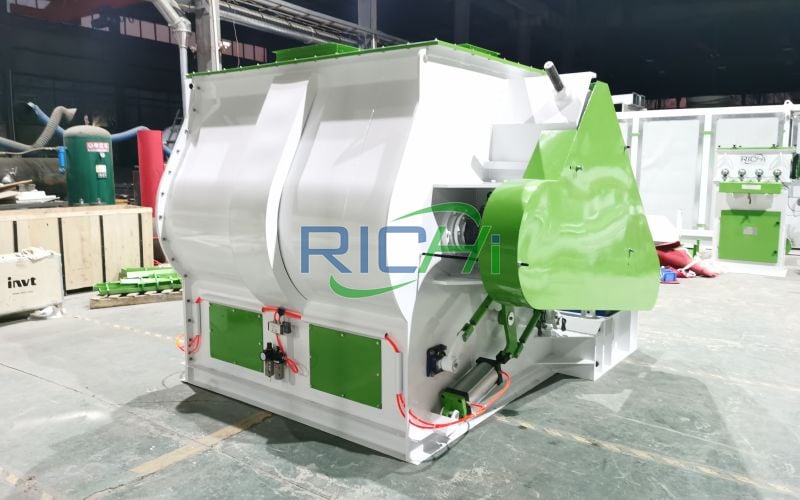
The twin shaft feed mixer for livestock feed in Paraguay was selected for a regional feed manufacturer serving beef cattle farms and livestock operations. The company purchases maize and other agricultural ingredients from local suppliers, processes grain in its existing grinding section, and prepares compound feed for customers with different feeding requirements.
Its immediate objective is to improve the consistency of powdered ingredients before they move to the next stage of production. Instead of replacing the complete feed processing line, the company plans to install one RICHI SLHSJ2.0A twin shaft paddle mixer alongside its existing equipment.
The project is a targeted production upgrade rather than a greenfield investment. The customer already has suitable raw-material storage, grain grinding equipment and downstream handling facilities, but needs a dedicated mixer to handle batches containing ground maize, soybean meal, wheat bran, rice bran and mineral ingredients.
Name:
Livestock Feed Mixer
Country:
Paraguay
Date:
2026
Capacity:
1,000 kg per batch
Model:
SLHSJ2.0A
Power:
18.5 kW
Effective volume:
2 m³
Construction material:
Carbon steel
With a rated mixing amount of 1,000 kg per batch, a 2 m³ effective volume and an 18.5 kW motor, the SLHSJ2.0A provides a practical starting point for this production requirement. The machine is intended for blending prepared ingredients, not grinding whole grain or replacing the other equipment in the plant.
Paraguay has a well-established agricultural and livestock sector. Grain production, soybean cultivation and cattle farming support a range of businesses involved in agricultural processing and animal nutrition. For a feed manufacturer supplying beef cattle operations, the challenge is to prepare consistent batches from ingredients that do not all behave in the same way.
Ground maize can form an important energy component of a concentrate or compound-feed formula. Soybean meal contributes protein, while wheat bran or rice bran may be incorporated according to ingredient availability, nutritional targets and the intended feeding system. Mineral sources and vitamin-mineral premixes must also be distributed correctly, even when their inclusion rates are much lower than those of the main ingredients.
The customer in this project is a medium-sized commercial feed processor serving several livestock customers rather than a single large integrated cattle operation. Some buyers require a concentrate for use alongside pasture or forage, while others may purchase a more complete formulated feed. The plant therefore needs to handle different recipes without relying on one fixed ingredient combination throughout the year.
Previously installed grinding and conveying equipment can still perform its intended functions. The gap is the mixing stage, where ingredient distribution needs to be controlled before the material moves forward. Adding a twin shaft paddle mixer gives the plant a defined batch operation, making it easier to record the ingredient weights, establish repeatable mixing conditions and investigate any variation identified during quality checks.
After considering the intended batch size and the existing process arrangement, the proposed configuration is the SLHSJ2.0A twin shaft paddle mixer. This model belongs to RICHI's SLHSJ series, which is designed for mixing powder, granular and other suitable materials across feed and several other processing industries.
| Specification | SLHSJ2.0A |
|---|---|
| Equipment type | Twin shaft paddle mixer |
| Quantity | 1 unit |
| Motor power | 18.5 kW |
| Rated mixing amount | 1,000 kg per batch |
| Effective volume | 2 m³ |
| Drive arrangement | Chain drive |
| Construction material | Carbon steel |
| Primary application | Prepared livestock feed ingredients and compound-feed mixtures |
The listed mixing amount is the model's rated batch quantity. It should not be interpreted as a guarantee that every formula can be loaded to exactly 1,000 kg under all operating conditions. Bulk density, particle size, ingredient flowability and the manufacturer's recommended working limits affect the practical batch load. These factors need to be checked when the customer's actual formulas are reviewed.
The carbon-steel configuration is suitable for many conventional dry feed-mixing applications. It is not automatically the right choice for every material or operating environment. If the process involves unusual corrosive ingredients, special hygiene requirements or regular liquid addition, the material specification and machine configuration should be reviewed before ordering.
The proposed application focuses on feed for beef cattle, with the exact formula adjusted to the feeding program of each customer. Paraguay's agricultural production provides a realistic setting for the use of maize and soybean-derived ingredients, while bran and mineral products can be sourced through the regional agricultural supply chain.
Ground maize is expected to be one of the main ingredients. It supplies dietary energy and is widely used in concentrate formulations. Soybean meal can provide additional protein, while wheat bran or rice bran may be included where the ingredient quality, availability and nutritional profile suit the formula. A mineral component may contain suitable calcium and phosphorus sources, salt and a premix selected for the target animals.
The following ingredient groups illustrate the proposed mixing duty. They are not a prescribed formula or a claim that every batch will contain every ingredient.
The proportions must be established by a qualified nutritionist according to animal age, production stage, forage supply and the intended feeding system. A concentrate fed alongside pasture does not necessarily have the same composition as a more complete ration. The mixer must therefore be selected for the real range of formulations rather than a single theoretical recipe.
The paddle mixer machine receives ingredients that have already been prepared and weighed. Its purpose is to redistribute those ingredients through the batch. It does not replace the hammer mill, and it should not be expected to reduce whole maize kernels or large fibrous materials to the required particle size.
During operation, the two shafts carry paddle elements that move material through the mixing chamber. The resulting material movement helps distribute the different components throughout the batch. The actual mixing result depends on the formula, particle-size distribution, loading level, mixing time and physical properties of the ingredients.
For the Paraguayan customer, the most important issue is consistency from one batch to the next. A formula containing a high proportion of maize meal behaves differently from a mineral-rich blend or a mixture with a different bran content. The production team needs an operating procedure that accommodates these differences while keeping the process straightforward for operators.
The twin shaft arrangement is intended to provide effective movement of the batch within the chamber. However, no mixer should be assumed to deliver a specific homogeneity result without testing the actual material. Commissioning should include trials using representative formulas and a suitable method for assessing the distribution of selected ingredients.
Buying a single mixer allows the customer to concentrate investment on the process stage that needs improvement. The existing grain grinder can continue to prepare the maize and other ingredients, while storage bins and conveying equipment can remain in service if their condition and capacity are suitable.
Before installation, the layout needs to be checked against the machine's inlet and discharge arrangements. The receiving hopper, weighing system and discharge conveyor must work together so that the mixer does not become a bottleneck between ingredient preparation and the next operation. Electrical supply, access for maintenance, dust management and the available headroom should also be reviewed.
The planned production sequence is simple enough for routine operation, but each step still needs to be controlled.
If the customer later adds a feed pellet mill or increases downstream capacity, the mixer can be assessed as part of the revised production balance. Any expansion should consider the time needed for weighing, loading, mixing and discharge, rather than comparing nominal mixer capacity with pellet-mill capacity alone.
There is no single mixing time that can be responsibly guaranteed for all livestock feed formulas. A blend dominated by ground maize and soybean meal may behave differently from one containing a higher proportion of bran, minerals or other ingredients. The plant should establish its operating conditions through commissioning tests using representative batches.
Particle size is one of the first variables to control. Large differences between ingredient sizes can encourage segregation during transfer or storage. Consistent grinding and appropriate screening help create a more manageable blend before it enters the mixer. Grinding too finely without a formulation or process reason is not necessarily beneficial, because it can affect handling, dust generation and the behavior of the finished feed.
Moisture also matters. The SLHSJ2.0A is being considered here for conventional prepared feed ingredients, primarily in dry blending. Materials that are damp, compacted or prone to sticking may discharge differently from free-flowing powders. If regular liquid addition or a particularly difficult material is involved, the required configuration should be confirmed with RICHI's technical team.
Batch loading should be kept consistent with the working limits of the machine. An overloaded chamber may restrict material movement, while an unsuitable low fill level can affect the mixing pattern. The correct operating range needs to be established from the equipment instructions and trials, not inferred from motor power alone.
Quality checks should also extend beyond visual inspection. A batch can look uniform while still showing variation in a low-inclusion ingredient. The plant should use an appropriate sampling method and a suitable homogeneity test to confirm the mixing procedure. The acceptance criteria must reflect the customer's quality system and the applicable feed-safety requirements.
For a livestock feed manufacturer, a mixer is not merely a vessel with a motor. It is the point at which separately prepared ingredients become a defined batch of feed. Poor control at this stage can undermine the work already completed by the weighing and grinding sections.
The SLHSJ series mixer machine offers a twin shaft paddle arrangement for customers who need to blend powders, granules and other suitable materials. The listed models cover different batch sizes, allowing the selection to reflect the scale of the operation. The SLHSJ2.0A, with a 1,000 kg rated mixing amount, is a possible choice where the production schedule and existing line layout support that batch size.
RICHI also supplies other mixer configurations for different process needs. The SLHJ series uses a single-shaft double-layer paddle arrangement, while the SLHY series uses a single-shaft double-ribbon arrangement for powder blending. These designs should not be treated as interchangeable solely because their nominal batch capacities appear similar. Material behavior, mixing objectives, discharge requirements and plant layout all influence the appropriate choice.
RICHI Machinery supplies individual machines as well as complete feed production lines. A customer purchasing one mixer can receive assistance with model selection and integration planning. Customers planning a larger project can also discuss a customized process covering raw-material receiving, grinding, batching, mixing, pelletizing, cooling, screening and packing. The final configuration should be based on actual production needs and equipment already available at the site.
For an ocean shipment from Qingdao Port in China, the Port of Montevideo in Uruguay can be evaluated as a possible seaport for cargo destined for landlocked Paraguay. The suitable route and final port arrangement must be confirmed with the freight forwarder according to the shipment schedule, available services and current transit arrangements.
The equipment's dimensions, packing method, weight and documentation should be confirmed before shipment planning. This helps the buyer and freight forwarder determine the appropriate cargo arrangement without assuming that every shipment will use the same route.
In this illustrative project scenario, the buyer's main concern is whether the new mixer can fit into the existing workflow without creating another handling problem. The proposed SLHSJ2.0A provides a defined batch size and a dedicated mixing stage, but the final decision should depend on technical confirmation and trials with the customer's own ingredients.
The most useful acceptance checks would include the actual batch weight, repeatability of the mixing cycle, discharge behavior and results from a suitable homogeneity test. The production team should also verify that the mixer can be loaded and emptied within the planned cycle and that the next process can receive the material without unnecessary waiting.
Illustrative project feedback: “The main point for us is to make batch preparation easier to control. We want to keep the equipment that still works well and improve the mixing stage without rebuilding the whole plant. The final assessment will depend on the mixing trials and how smoothly the new machine fits into daily production.”
This statement is an illustrative feedback example for the proposed scenario, not a verified quotation from an actual RICHI customer. No installation record or measured production result is being claimed.
A suitable mixer starts with a clear understanding of the ingredients, batch weight, required blending quality and equipment already installed at the plant. These details help determine whether a twin shaft paddle mixer or another mixing design is the better fit. They also make it easier to plan the inlet, discharge, weighing and conveying arrangements before equipment is ordered.
RICHI Machinery supplies mixing equipment for feed mills, farms and other industrial applications, as well as machinery for complete feed processing projects. The company has supplied equipment to customers in more than 100 countries. For a twin shaft feed mixer for livestock feed in Paraguay, the next step is to review the actual feed formulas, target batch size, existing machinery and downstream process. That information gives the technical team a practical basis for confirming the model and preparing an equipment integration plan.
Having the right mix of reliable, high-quality pellet machine and pelletizing systems and expert support is essential to your success. Watch how our end-to-end feed pellet plant solutions have helped our customers optimize their performance.
Our customized and future-proofed turnkey pellet plant solutions is designed with you at the core. From vision to reality and beyond, our team stays connected with yours. Giving you peace-of-mind with an expert at your side.
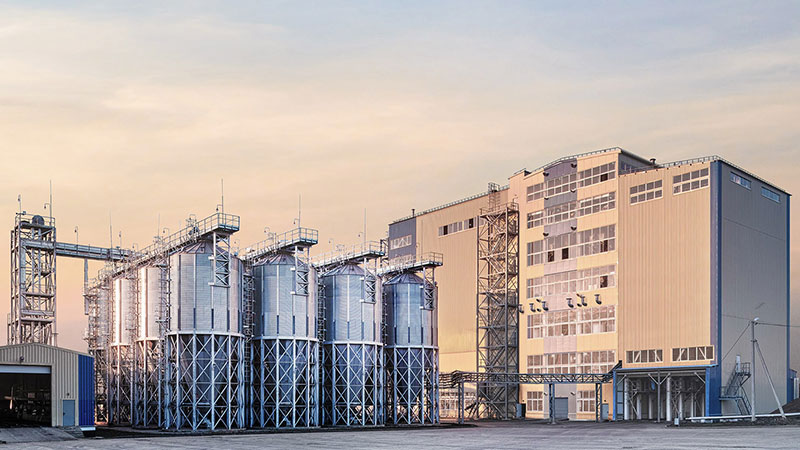
At RICHI, we go beyond project completion. With RICHI Servicee, we’re your dedicated partners in success. Count on us for expert guidance, minimal downtime, and optimized productivity. Choose RICHI for unmatched service and support.
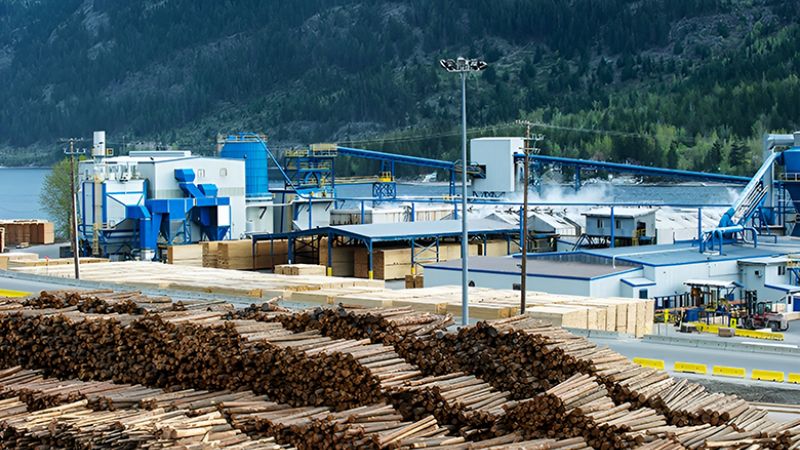


Meet global product demands and quality standards with industry-leading pellet plant design, engineering, equipment, and construction services for pellet processors.


Your Partner Beyond Project Completion
2000+ cases
RICHI is the leading designer, manufacturer and builder of pellet plants in the world, completing over 2000 projects in 140 countries across 6 continents.
Read More
Increase plant productivity, profitability, and safety by integrating high quality equipment into your pellet production line. Over the years, RICHI has become China's top pellet equipment manufacturer. At the same time, RICHI has established valuable partnerships with the world's leading component and raw material manufacturers to bring you the best there is in technology, automation, and efficiency in pelleting plant machinery.

For nearly 30 years, RICHI has been providing best-in-class pellet plant equipment and services to clients across a variety of industries, sizes, and needs. We pride ourselves on the knowledge and skill that each team member possesses – from our technical sales team to our process design engineers. You can count on RICHI Machinery to take your operation to the next level of innovation, quality, and success.
Need help with your pellet manufacturing plant project? Contact us today.
ANIMAL FEED
BIOMASS
WOOD
ORGANIC FERTILIZER
AQUA FEED
CAT LITTER
MUNICIPAL WASTE RECYCLING
SPECIAL PELLET PRODUCTION
RICHI Machinery continues to deliver world class pellet mill equipment, pellet plant engineering and project solutions that add value to our customers in the animal feed, wood waste, agriculture waste, organic fertilizer, cat litter and special pellet products industries. Throughout the years, we RICHI Machinery have built strong brand, becoming industry-leading pellet machine manufacturer. We value integrity, promise quality, and prioritize your success.
Learn MoreWith our expert team, we precisely implement your process engineering requirements in pellet mill and pelletizing plant systems. No matter which industry you’re in – we understand your needs and deliver solutions that meet the highest standards.
At RICHI, quality comes first. Our pellet making machine and related pellet line equipment undergo rigorous quality controls to ensure they meet the highest standards. Rely on products that are durable, safe, and efficient.
With decades of experience in pellet machine and pellet production line production, we have earned a reputation as a trusted partner in various industries. Our expertise allows us to cover a wide range of applications.
Not only do we offer premium pelleting equipment, but we are also experts at designing, building, installing, and maintaining facilities from the ground up. Our expertise is within pellt plant process design, discovering the most efficient, productive, and profitable way to handle your materials in an end-to-end cycle.
○ RICHI MACHINERY
Keeping in touch with us is an effective way to solve all your problems. If you have any needs or questions, please leave your contact information, then RICHI technical consultants will send design, quotation, videos to your mailbox. You can also contact us directly via WhatsApp: +86 13838389622
Copyright©2015-2026 by HENAN RICHI MACHINERY CO., LTD. All rights reserved.