
Trout Feed Extruder Machine in Finland for producing extruded rainbow trout feed. Discover RICHI's SPHS120×2 wet twin screw extruder, feed ingredients, pellet sizing, processing requirements and customized equipment solutions.
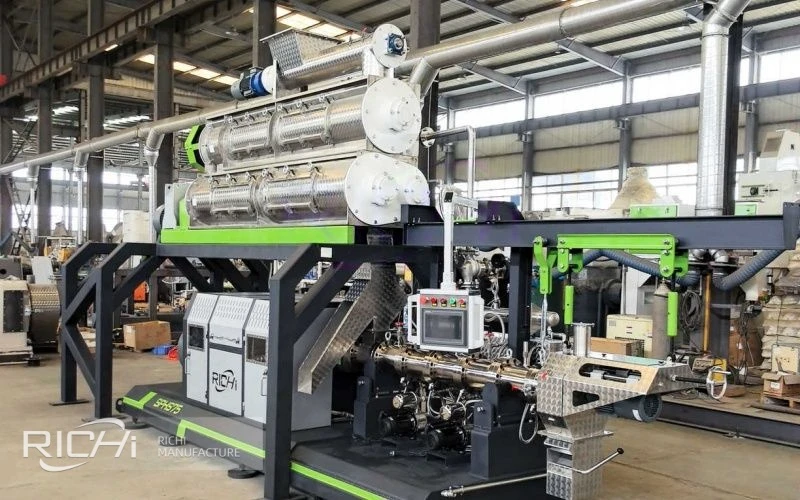
The Trout Feed Extruder Machine in Finland was selected for a commercial aquaculture feed manufacturer planning to expand its rainbow trout feed production capacity. The buyer already had ingredient preparation equipment and wanted to add one wet twin screw extruder rather than invest in an entirely new production line. The new machine would handle the extrusion stage for formulated trout feed used by fish farms.
RICHI proposed the SPHS120×2 twin screw wet extrusion machine, with a 90 kW main motor and a rated capacity of 1.5–2.0 T/H. The project focuses on sinking and floating-capable extruded feed formulations for different trout growth stages, with the final product characteristics determined by the recipe, die configuration and processing trials.
Name:
Trout Feed Extruder
Country:
Finland
Date:
2026
Capacity:
1.5–2.0 T/H
Model:
SPHS120×2
Main Motor Power:
90 kW
Extrusion method:
Wet twin screw extrusion
Feeder motor power:
1.5 kW
Rainbow trout is a major farmed fish species in Finland. According to the Natural Resources Institute Finland, national rainbow trout production reached approximately 15.8 million kilograms in 2024. This established production base makes Finland a suitable market for a project focused on commercial trout feed processing.
The proposed buyer is a regional aquatic feed manufacturer supplying independent fish farms and professional aquaculture operators. Its existing operation already handles bulk ingredients, grinding, weighing and powder mixing. The investment decision was therefore not about building a factory from the ground up.
Instead, the manufacturer wanted a dedicated extrusion machine that could work with its existing ingredient preparation system. Adding one machine allows the company to develop its trout feed range while retaining upstream equipment that remains suitable for the required throughput and formula specifications.
Trout feed is not a product that can be defined by pellet size alone. Fish size, feeding behavior, protein and fat requirements, water stability and the intended feeding system all affect the formulation. The extrusion equipment must be selected with those requirements in mind.
The SPHS120×2 was selected for this proposed project because its rated capacity suits a medium-scale commercial feed operation. A wet type fish feed extruder also provides processing flexibility for formulated aquatic feed mixtures containing protein ingredients, oils and starch-bearing materials.
| Specification | Selected configuration |
|---|---|
| Machine model | SPHS120×2 |
| Equipment quantity | 1 unit |
| Extrusion method | Wet twin screw extrusion |
| Main motor power | 90 kW |
| Screw diameter | 120 mm |
| Feeder motor power | 1.5 kW |
| Conditioner motor power | 11 kW |
| Differential conditioner motor power | 11 kW |
| Conditioner specification | DC500-244 |
| Differential conditioner specification | DC500×400-300 |
| Rated capacity | 1.5–2.0 T/H |
The capacity shown above is the manufacturer's rated range for the selected configuration. Actual output depends on the formulation, moisture content, die openings, pellet dimensions and operating conditions. The final production rate should be confirmed against the buyer's intended trout feed recipes.
The proposed raw material system combines marine protein ingredients, plant proteins, oils, starch-bearing materials and nutritional supplements. Fish meal made from suitable marine fish can provide concentrated protein and other nutrients. Plant protein ingredients, such as soybean protein, can be incorporated according to the nutritional target.
Finland's existing fish feed industry provides relevant context for this selection. Finnish feed producer Fennoaqua describes using fish meal from Baltic herring and sprat, plant protein ingredients and vegetable and fish oils in its fish feed products. These are credible ingredient options for a Finnish trout feed formulation, although each commercial recipe requires its own nutritional assessment.
For this project, the manufacturer could evaluate the following ingredient groups:
These ingredient groups are not a fixed recipe. The final proportions must be established by a qualified aquaculture nutritionist, taking into account the fish's growth stage, nutrient requirements, raw material quality and applicable feed regulations.
The new extruder is intended to support feed products for more than one growth stage. Fry and juvenile trout generally require smaller feed particles and a different nutrient profile from larger fish. Grower feed may require a different balance of protein and energy as fish biomass increases.
Rather than changing the entire production line for every product, the manufacturer can assess whether a common extrusion platform can accommodate several formulations and pellet sizes. The practical range depends on the machine configuration, die options, ingredient properties and product testing.
For initial planning, a product range might include approximately 1.5–2.5 mm pellets for smaller trout and 3–6 mm pellets for larger fish. These are proposed product targets, not guaranteed outputs from the machine. Final sizes should be selected in consultation with the feed nutritionist and confirmed during extrusion trials.
The company may also evaluate feed for other cold-water species, such as Arctic char, if there is a genuine customer requirement. However, rainbow trout remains the primary product for this project, so the initial equipment configuration should be based on the trout feed recipes rather than an unnecessarily broad product list.
Before the material reaches the extruder, the prepared ingredients must be ground where necessary, accurately weighed and mixed into a consistent blend. Particle size distribution matters because large or uneven particles can affect small pellet production, feeding consistency and the finished product's appearance.
The prepared mixture then enters the wet conditioning section. Moisture and heat are introduced under controlled conditions to prepare the ingredients for extrusion. The twin screws convey and process the conditioned mixture before forcing it through the die, where the product takes shape.
When the material exits the die, the pressure change can cause expansion depending on the formulation and operating conditions. A cutter determines pellet length. The resulting product may be designed to sink or float, but this behavior must be engineered through the combination of formulation, processing conditions and die configuration.
For trout feed, extrusion is only one part of product development. Pellet durability, water stability, nutrient retention and the intended feeding method must all be considered. The final feed also needs appropriate drying and cooling before it can be stored and transported.
The buyer is purchasing one extruder, not a complete fish feed production line. Existing upstream equipment can remain in service if its capacity, condition and process compatibility are confirmed. The new extrusion stage must still be coordinated with the equipment that supplies it and receives its output.
The belt dryer is particularly important because freshly extruded feed normally requires further moisture reduction before storage. The buyer's existing dryer should be checked for capacity and suitability. If it cannot handle the new product, the drying stage may need to be upgraded separately.
Before the equipment order is confirmed, the technical review should establish the target formulas, pellet sizes, expected operating schedule and available utilities. The existing grinder, mixer and downstream dryer should also be assessed to determine whether they can support the planned output.
RICHI's pre-sale support can cover equipment selection, process-flow review, layout coordination and discussion of the required auxiliary equipment. This helps the buyer understand the complete operating requirements even though the purchase is limited to a single machine.
Important checks include electrical supply, installation space, maintenance access, material transfer arrangements and the required drying capacity. The final configuration should be based on actual production needs rather than nominal motor power alone.
For a feed manufacturer working with several trout recipes, it is also useful to identify which product specifications will be used during acceptance testing. These may include pellet dimensions, moisture after drying, physical durability and water behavior. Agreed testing criteria make equipment commissioning more practical and objective.
The proposed project required more than a model recommendation. The buyer needed to understand how the extruder would fit into an existing factory, which upstream machines could be retained and what downstream equipment would be required to finish the product.
RICHI Machinery supplies individual extruders as well as complete aquatic feed processing lines. Depending on project requirements, its equipment range can cover grinding, mixing, feeding, conditioning, extrusion, drying, coating, cooling, screening and packing.
The company has supplied machinery to customers in more than 100 countries. Different markets use different raw materials and feed specifications, so the equipment arrangement should be adapted to the product, capacity and operating conditions of each project.
For this Finnish application, the focus is on selecting a suitable extrusion stage for rainbow trout feed and coordinating it with the existing production equipment. That approach allows the customer to make a targeted investment without automatically replacing machinery that may still be fit for purpose.
The proposed shipment would depart from Qingdao Port in China, with the Port of Helsinki as the intended destination port for Finland. The final shipping arrangement, route and schedule should be confirmed with the freight forwarder before dispatch.
Before shipment, the buyer should confirm the machine's packing dimensions, weight, electrical requirements and installation documentation. These details help the factory prepare the site and coordinate the equipment's arrival.
The main purpose of the investment is to add extrusion capacity for rainbow trout feed while keeping suitable existing equipment in operation. The SPHS120×2 fish feed extruder provides a proposed rated capacity of 1.5–2.0 T/H, but the actual rate must be verified using the intended formulas and pellet specifications.
During commissioning, the manufacturer should assess pellet size, moisture after drying, durability and feeding performance. Different recipes may require different settings, and a product that works well for larger trout may not be suitable for fry or juvenile fish without further adjustment.
No specific production result or customer testimonial is claimed for this proposed project. The practical value of the equipment will depend on the confirmed process configuration, successful trials and the manufacturer's ability to maintain consistent operating conditions.
A suitable trout feed extruder must match the formulation, pellet dimensions, required production rate and existing factory equipment. Choosing a machine without considering these factors can leave the production process unbalanced, even when its nominal capacity appears sufficient.
For a Trout Feed Extruder Machine in Finland, the proposed SPHS120×2 wet twin screw model offers a starting point for a 1.5–2.0 T/H production plan. RICHI Machinery can review the raw materials, target pellet sizes, site conditions and existing equipment to help determine whether this configuration meets the buyer's actual requirements.
Having the right mix of reliable, high-quality pellet machine and pelletizing systems and expert support is essential to your success. Watch how our end-to-end feed pellet plant solutions have helped our customers optimize their performance.
Our customized and future-proofed turnkey pellet plant solutions is designed with you at the core. From vision to reality and beyond, our team stays connected with yours. Giving you peace-of-mind with an expert at your side.

At RICHI, we go beyond project completion. With RICHI Servicee, we’re your dedicated partners in success. Count on us for expert guidance, minimal downtime, and optimized productivity. Choose RICHI for unmatched service and support.



Meet global product demands and quality standards with industry-leading pellet plant design, engineering, equipment, and construction services for pellet processors.


Your Partner Beyond Project Completion
2000+ cases
RICHI is the leading designer, manufacturer and builder of pellet plants in the world, completing over 2000 projects in 140 countries across 6 continents.
Read More
Increase plant productivity, profitability, and safety by integrating high quality equipment into your pellet production line. Over the years, RICHI has become China's top pellet equipment manufacturer. At the same time, RICHI has established valuable partnerships with the world's leading component and raw material manufacturers to bring you the best there is in technology, automation, and efficiency in pelleting plant machinery.

For nearly 30 years, RICHI has been providing best-in-class pellet plant equipment and services to clients across a variety of industries, sizes, and needs. We pride ourselves on the knowledge and skill that each team member possesses – from our technical sales team to our process design engineers. You can count on RICHI Machinery to take your operation to the next level of innovation, quality, and success.
Need help with your pellet manufacturing plant project? Contact us today.
ANIMAL FEED
BIOMASS
WOOD
ORGANIC FERTILIZER
AQUA FEED
CAT LITTER
MUNICIPAL WASTE RECYCLING
SPECIAL PELLET PRODUCTION
RICHI Machinery continues to deliver world class pellet mill equipment, pellet plant engineering and project solutions that add value to our customers in the animal feed, wood waste, agriculture waste, organic fertilizer, cat litter and special pellet products industries. Throughout the years, we RICHI Machinery have built strong brand, becoming industry-leading pellet machine manufacturer. We value integrity, promise quality, and prioritize your success.
Learn MoreWith our expert team, we precisely implement your process engineering requirements in pellet mill and pelletizing plant systems. No matter which industry you’re in – we understand your needs and deliver solutions that meet the highest standards.
At RICHI, quality comes first. Our pellet making machine and related pellet line equipment undergo rigorous quality controls to ensure they meet the highest standards. Rely on products that are durable, safe, and efficient.
With decades of experience in pellet machine and pellet production line production, we have earned a reputation as a trusted partner in various industries. Our expertise allows us to cover a wide range of applications.
Not only do we offer premium pelleting equipment, but we are also experts at designing, building, installing, and maintaining facilities from the ground up. Our expertise is within pellt plant process design, discovering the most efficient, productive, and profitable way to handle your materials in an end-to-end cycle.
○ RICHI MACHINERY
Keeping in touch with us is an effective way to solve all your problems. If you have any needs or questions, please leave your contact information, then RICHI technical consultants will send design, quotation, videos to your mailbox. You can also contact us directly via WhatsApp: +86 13838389622
Copyright©2015-2026 by HENAN RICHI MACHINERY CO., LTD. All rights reserved.