
The tofu cat litter granules making machine in Turkey was supplied for a Turkish pet-products manufacturer adding a plant-based litter product to an existing cat litter operation. The customer had already been selling mineral-based litter and working with local packaging and distribution channels, but wanted to test a biodegradable tofu litter formula without rebuilding the entire factory around a completely new production system. One MSZLH320 ring die cat litter pellet machine was therefore purchased as the main forming unit for the new production section.
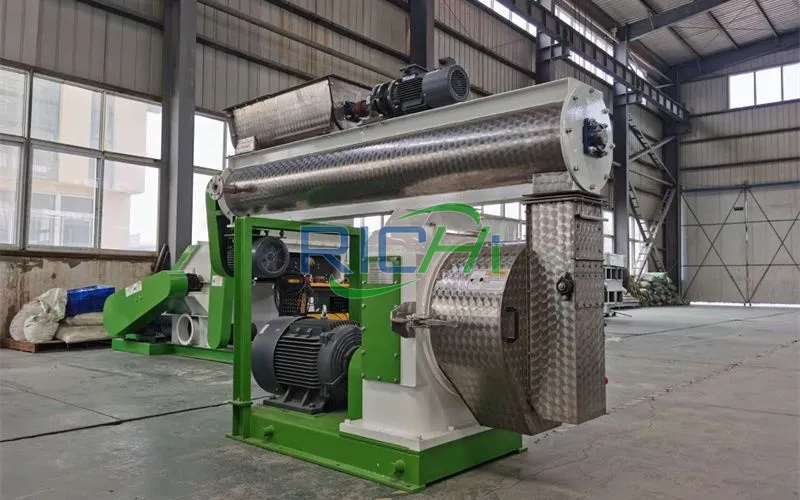
The tofu cat litter granules making machine in Turkey was supplied for a Turkish pet-products manufacturer adding a plant-based litter product to an existing cat litter operation. The customer had already been selling mineral-based litter and working with local packaging and distribution channels, but wanted to test a biodegradable tofu litter formula without rebuilding the entire factory around a completely new production system. One MSZLH320 ring die cat litter pellet machine was therefore purchased as the main forming unit for the new production section.
This was not a complete cat litter production line purchased from RICHI Machinery. The Turkish customer already had part of the material handling, weighing, mixing, cooling and packing equipment required for production. The missing piece was a reliable tofu cat litter pellet machine capable of continuously pressing a relatively light soybean-fiber and starch mixture into uniform 2.5 mm granules.
After reviewing the expected output, formulation, available workshop space and the capacity of the customer's existing downstream equipment, the MSZLH320 with a rated capacity of 3–4 t/h was selected.
Name:
tofu cat litter pelletizer
Country:
Turkey
Date:
2026
Capacity:
3–4 T/H
Model:
MSZLH320
Main Motor Power:
37 kW
Raw Materials:
soybean residue, corn starch
Pellet diameter:
2.5 mm
Turkey already has a mature mineral-processing sector and abundant bentonite resources, so conventional clumping clay litter is well established in the country. That strength also creates a practical problem for manufacturers trying to introduce another ordinary bentonite product: it can be difficult to make the product sufficiently different from what is already available.
The customer in this project was not entering the pet industry from zero. It was an established pet-products manufacturer supplying packaged cat litter through domestic distributors and private-label channels. Its existing business was centered on conventional mineral litter.
The company wanted a second product category aimed at buyers asking for lighter, plant-based and biodegradable alternatives. Instead of immediately investing in a large dedicated factory, management chose to make use of existing factory infrastructure and add a separate granulation section.
That decision shaped the equipment selection.
A very large tofu cat litter making machine would have created an imbalance with the existing mixer, cooler, screening equipment and packaging section. A very small machine, on the other hand, would not have provided enough production capacity for commercial distribution. The 3–4 t/h MSZLH320 offered a more practical middle ground.
The project therefore became an equipment-integration job rather than a conventional greenfield plant project.
One important detail in this tofu cat litter granules making machine in Turkey project was the condition of the soybean material.
Fresh tofu residue is not suitable for direct feeding into a ring die pellet machine. Fresh okara can contain a very high amount of water, while stable pelletizing requires a controlled material condition. Putting wet tofu residue directly into the granulator would result in unstable extrusion, poor pellet strength, die blockage and large fluctuations in output.
The Turkish customer therefore did not feed fresh wet okara into the machine.
The production formula was based mainly on commercially dried soybean fiber/by-product material combined with cereal starch and a small proportion of functional ingredients. Turkey has an established grain-processing and starch-consuming industrial base, making cereal-derived binders a practical component for local formulation.
The plant also retained flexibility to adjust part of the fiber input according to supplier availability rather than depending on a single wet tofu-processing source.
For the commissioning formula, the material composition was approximately:
The percentages were not treated as an unchangeable recipe. During production adjustment, the binder proportion could be moved slightly according to soybean fiber fineness, incoming moisture, starch characteristics and the required hardness of the finished litter.
That flexibility matters in a commercial plant. Tofu litter production is not simply a matter of copying one formula and expecting identical performance from every batch of raw material.
The target product was a 2.5 mm cylindrical tofu cat litter granule intended for household cat litter rather than fuel, fertilizer or feed.
Diameter was discussed before the die configuration was finalized. Extremely fine granules would have increased the risk of breakage and fines during cooling, screening, bagging and transport. A much larger diameter would have changed the texture and appearance of the customer's intended retail product.
The 2.5 mm specification provided a workable compromise between appearance, pellet integrity, absorption behavior and processing stability.
Length was controlled after extrusion rather than relying solely on the die opening. The cutting system was adjusted so that the product would not leave the pellet chamber as unnecessarily long strands. This was particularly important because the customer planned to package the litter in consumer-sized bags, where an excessively wide particle-size distribution would be visually obvious.
The objective of the tofu litter pelletizer was therefore not just to force material through a die. It had to create a repeatable physical form that could survive the remaining cooling, screening, conveying and packing stages.
After comparing the customer's planned production volume with the equipment already installed in the factory, RICHI Machinery configured one MSZLH320 ring die cat litter pellet machine.
| Parameter | Project Configuration |
|---|---|
| Machine Model | MSZLH320 |
| Main Motor Power | 37 kW |
| Feeder Power | 1.5 kW |
| Conditioner Power | 4 kW |
| Ring Die Inner Diameter | 320 mm |
| Available Pellet Diameter | 2–12 mm |
| Project Pellet Diameter | 2.5 mm |
| Rated Capacity | 3–4 t/h |
| Main Product | Plant-based tofu cat litter granules |
| Number of Machines | 1 unit |
The MSZLH320 sits well above a laboratory or very small startup machine but remains considerably more compact than the MSZLH420, MSZLH508 and larger industrial models.
That distinction was important here.
The customer was not asking for the maximum tonnage available from a cat litter granules making machine. The requirement was to fit one new forming machine into an operating factory without forcing unnecessary replacement of serviceable upstream and downstream equipment.
RICHI's larger MSZLH models remain available when production requirements increase. The series extends from the MSZLH250 at 1.0–1.5 t/h through the MSZLH768 at 38–40 t/h. In this case, however, installing a machine several times larger than the rest of the section would have provided no practical advantage.
The customer's existing equipment handles much of the preparation work.
Dried soybean material first needs to reach a sufficiently uniform particle condition. Oversized fibrous pieces or agglomerates are reduced before mixing. The starch and minor ingredients are then proportioned according to the working formulation and distributed throughout the soybean-based material.
This mixing step has a direct effect on granulation.
If the starch accumulates in one part of the batch while another part contains mainly dry fiber, the tofu cat litter pellet making machine receives material with constantly changing friction and binding behavior. The result can be unstable motor load, inconsistent granule strength and variations in surface quality.
Moisture is also checked before the mixture reaches the pelletizer. The target is not to make the material wet. Instead, enough moisture must be available for conditioning and binding without producing a soft mixture that sticks inside the machine.
For this reason, RICHI's commissioning work focuses on the actual behavior of the customer's formula rather than supplying only a theoretical moisture number.
The customer already had the infrastructure for preparation and downstream handling. RICHI engineers therefore reviewed the connection points between the existing system and the new machine, including feeding height, discharge position, electrical requirements and capacity balance.
This is often more important in a single-machine retrofit than adding unnecessary auxiliary equipment.
The conditioner on the MSZLH320 is one reason this machine differs from a simple biomass granulator.
Soybean fiber and starch do not behave like dry sawdust. For tofu litter, controlled conditioning helps prepare the mixture before it enters the pressing chamber. Heat, moisture and residence conditions can influence starch binding and the way the material responds when compressed through the ring die.
The MSZLH320 supplied for this project uses a 4 kW conditioner.
During commissioning, the operating settings are not determined from motor power alone. The technicians observe material flow, conditioning response, extrusion behavior, pellet surface, breakage and machine load together.
This is particularly relevant when a manufacturer changes ingredient suppliers. Two batches both described as "soybean fiber" may differ in particle size, residual oil, moisture, bulk density or fiber structure.
A stable tofu cat litter pellet production machine has to accommodate those practical variations within a reasonable processing window.
After conditioning, the prepared mixture enters the pelletizing chamber.
The rotating working system distributes material across the inner surface of the ring die. Under mechanical pressure, the mixture is forced through the selected die holes. Pressure, friction and the binding characteristics of the conditioned formula work together to form continuous strands.
The cutter controls the discharged length.
For the Turkish project, the machine was configured around the customer's 2.5 mm product rather than using a generic die intended for a completely different pellet application.
Die selection is one of the areas where equipment suppliers with only general pellet experience can underestimate cat litter requirements. Tofu litter is judged not only by whether a pellet can be formed. The producer also cares about appearance, dust generation, breakage, bulk density, absorption behavior and the amount of material returned from screening.
The ring die and working parameters therefore need to be selected around the formula and finished product, not merely around nominal tonnage.
For an established manufacturer, replacing usable equipment simply to purchase a "complete line" does not necessarily make engineering or financial sense.
The Turkish plant already had equipment that could continue performing several jobs satisfactorily. What it lacked was a dedicated high-capacity tofu cat litter granulator machine suitable for the new formulation.
RICHI Machinery therefore treated the project as an integration rather than trying to turn it into a larger equipment package.
Before the machine configuration was finalized, the existing production arrangement was reviewed against four practical points: the amount of material that could be supplied continuously, the available electrical load, downstream cooling and screening capacity, and the space available around the proposed pelletizer position.
This allowed the MSZLH320 to become the new forming core while much of the existing plant remained in service.
It also left room for future modification. If tofu litter volumes eventually exceed the capacity of this section, the customer can reconsider upstream preparation, cooling, screening and packing as a coordinated expansion rather than prematurely oversizing one part of the factory.
The MSZLH series is a ring die pelletizing platform rather than a machine limited to one rigid soybean recipe.
That was another consideration for this customer.
Commercial plant-based litter manufacturers frequently need to adjust formulas. Raw-material prices change. Supplier availability changes. Private-label buyers may request different granule hardness, color, fragrance, absorption or composition. A machine that works only with one narrowly defined recipe can quickly become a constraint.
With appropriate formulation, die and operating adjustments, the equipment can be applied to different plant-fiber cat litter materials, including soybean fiber, tofu residue after proper drying, corn-derived materials, cereal fiber, selected grass or plant powders, bamboo-based fiber and certain blended biodegradable litter formulations.
Mineral-containing blends can also be evaluated, but the formulation and wear conditions have to be considered separately. Bentonite is much more abrasive and mineral-rich than soybean fiber, so a manufacturer should not assume that a tofu formulation and a high-bentonite formulation require identical dies and operating parameters.
This ability to discuss the material first and the machine second was one of the reasons the customer selected RICHI Machinery.
The machine does not become useless if the factory later changes its product mix.
Soybean-derived and cereal-derived materials have applications beyond cat litter. Depending on the raw-material quality, formulation, sanitation requirements and intended market, the same general ring die pelletizing principle can be used for several other products.
Soybean-processing residues can be incorporated into certain organic fertilizer pellets after appropriate treatment and formulation. Clean agricultural plant fibers can also be blended into biomass-type pellets where their fuel properties and ash characteristics are acceptable.
Suitable agricultural ingredients may be used in feed pellet production as well, but feed is a separate application with much stricter requirements concerning ingredient safety, nutritional formulation, hygiene and regulatory compliance. Material that has been handled as cat litter feedstock should never automatically be regarded as feed-grade simply because the pellet machine is technically capable of processing agricultural ingredients.
For the Turkish customer, the purchased MSZLH320 remains dedicated to tofu cat litter production. The broader material capability simply gives the equipment more flexibility if the factory's product strategy changes later.
A commercial cat litter plant needs more than occasional pellet formation. The equipment must operate continuously enough to support mixing, cooling, screening and packing without becoming a bottleneck.
The ring die configuration provides a large effective working area and is suited to continuous commercial production. The feeding and conditioning systems help stabilize the material entering the pellet chamber, while replaceable ring dies allow the machine to be adapted for different pellet diameters.
The heavy transmission arrangement is also designed for the sustained mechanical load associated with dense extrusion.
For this project, another advantage was controllability. Instead of pushing the machine continuously at the top edge of its rated range, operators can adjust feeding according to actual material behavior and the capacity available downstream.
This matters with tofu litter because maximum instantaneous output is less useful than stable output with a manageable amount of broken granules and recycled fines.
The factory acceptance stage confirms mechanical operation, but that alone does not establish a tofu litter production recipe.
After installation, the more valuable work is process adjustment around the real material.
RICHI Machinery provided technical guidance covering feeding stability, conditioner operation, die selection, cutter adjustment, lubrication points, normal inspection routines and operating-load observation. Guidance was also provided for responding to common production changes such as increased fines, softer granules or fluctuations in machine current.
Operators need to understand what a change in the finished pellet is telling them.
For example, excessive powder after screening does not automatically mean that the ring die is defective. It can result from an overly dry mixture, insufficient binding, unsuitable particle distribution, incorrect conditioning, improper die parameters or rough downstream handling.
Likewise, reducing output is not always the right answer to a rising motor load. The cause may be a change in incoming moisture or a denser batch of fiber.
This troubleshooting logic formed an important part of the support supplied with the tofu cat litter granules making machine in Turkey.
The first production trials were evaluated on more than whether the pellets came out of the machine.
The customer checked the consistency of the 2.5 mm diameter, the proportion of fines after cooling and screening, pellet breakage during conveying, surface appearance and the stability of machine load over an extended run.
Another concern was the transition between batches.
Because plant-fiber raw materials are not perfectly uniform, operators needed settings that provided a reasonable operating window instead of a single "perfect" point that became unusable whenever the raw material changed slightly.
The final adjustment therefore favored stable commercial operation rather than chasing a short-term peak capacity figure.
That approach suited the customer's existing factory particularly well because the new pelletizer had to work as part of equipment supplied at different times rather than as one newly commissioned turnkey line.
The customer's comments after trial production focused on two details that had been major concerns before the purchase: feeding consistency and control of the finished granule.
The production team reported that the machine responded predictably when the soybean fiber-to-starch ratio was adjusted within the planned formulation range. Operators were also able to understand the relationship between conditioning, feed rate and granule quality after the commissioning period.
One point the customer particularly appreciated was that the equipment recommendation had not been based simply on selling a larger model. The 3–4 t/h MSZLH320 matched the existing plant better than an oversized pelletizer would have.
The customer's production staff summarized the experience this way:
"The useful part was not only getting the machine running. The technicians helped the operators understand what to change when the material changed. With plant fiber, that makes a real difference."
For a retrofit project, this type of feedback is more meaningful than a short maximum-capacity test. The machine has to become manageable equipment for the customer's own operators after commissioning personnel leave the site.
The MSZLH320 and its associated components were prepared for sea shipment after factory inspection and packing.
The equipment was shipped from Qingdao Port, China, to Ambarlı Port in the Istanbul area, Turkey. Ambarlı is one of Turkey's major container gateways and is particularly suitable for industrial cargo serving the Marmara region.
For heavy machinery shipments, RICHI Machinery prepares the packing arrangement according to the dimensions and characteristics of the equipment rather than treating a pellet machine like ordinary general merchandise. Key components are secured for ocean transport, while packing lists and installation documentation are prepared for the customer's receiving and installation work.
The project therefore covered more than manufacturing the granulator itself. Equipment layout communication, technical documentation, shipping coordination, installation guidance, commissioning support and operator instruction were all part of the delivery process.
Turkey is already a strong producer of mineral-based cat litter because of its bentonite resources. That does not mean every new manufacturer should compete only in the same material category.
Plant-based litter gives existing pet-product companies another route.
It is lighter than conventional clay-based products and can be positioned around renewable plant ingredients, biodegradability and low-dust product development. For manufacturers already serving pet shops, supermarkets, distributors, e-commerce sellers or private-label buyers, this creates the possibility of adding another material category without abandoning established bentonite products.
The opportunity is particularly relevant to manufacturers that already understand cat litter packaging and distribution but do not yet have their own tofu cat litter manufacturing machine.
The engineering challenge is different from clay litter production. Instead of primarily crushing, drying and grading mineral particles, tofu litter requires formulation, mixing, conditioning, extrusion, cooling and screening. That is why simply adapting a bentonite processing line is usually not enough.
A properly selected tofu cat litter pellet mill in Turkey becomes the central forming machine around which that plant-based process is built.
The current project is deliberately modest compared with RICHI's largest cat litter installations.
One MSZLH320 gives the customer a rated 3–4 t/h pelletizing platform. It does not lock the company into remaining at that scale permanently.
If future production requires more capacity, the expansion should be based on the actual bottleneck. The next investment may be additional raw-material preparation, another mixing system, a larger cooler, more screening capacity, automated packing or another pelletizing unit. It should not automatically be assumed that the pellet mill itself is the first component that needs replacement.
This staged approach is particularly useful for companies moving from traditional litter into plant-based products. Production can develop according to real orders and operating experience rather than assumptions made before the product reaches the market.
RICHI Machinery's cat litter pelletizing equipment has been exported to more than 80 countries, with applications covering the major pelletized litter categories found in the market.
Projects do not all arrive with neat, standardized raw materials.
Some customers have dried tofu residue. Others have soybean fiber, starch-rich agricultural by-products, wood fiber, sawdust, bamboo fiber, grass-based materials, paper fiber or formulas containing several components. Some factories start from one principal material, while others need to combine three, four or more ingredients to achieve the required absorption, strength, density and appearance.
For that reason, equipment selection cannot be reduced to the question, "How many tons per hour do you need?"
RICHI engineers also look at the material's moisture, particle size, bulk density, fiber characteristics, abrasiveness, binder behavior and intended pellet diameter. The required conditioning system, ring die specification and surrounding equipment can then be matched to those conditions.
Unusual raw materials are not automatically rejected simply because they are not part of a standard tofu litter recipe. Single-material and mixed-material formulations can both be evaluated through the same engineering process.
This is also why the MSZLH series covers such a broad capacity range—from the 1.0–1.5 t/h MSZLH250 to industrial machines reaching 38–40 t/h. The appropriate cat litter pellet making machine depends on what the factory actually needs to produce, not on choosing the largest model available.
The tofu cat litter granules making machine in Turkey requires detailed technical work even though the customer purchased only one new pelletizing machine.
The customer did not need RICHI Machinery to replace every piece of equipment in the factory. It needed one correctly selected machine to fill a very specific gap: converting a conditioned soybean-fiber and starch formulation into consistent 2.5 mm tofu litter granules at a commercial 3–4 t/h scale.
That meant the project had to begin with the existing factory, the available raw materials and the intended product—not with an equipment catalogue.
For another customer, the answer could be an MSZLH250. For a larger plant it might be an MSZLH420, MSZLH508 or one of the higher-capacity machines. A customer processing a different plant fiber may also need a different die, conditioning approach or preprocessing arrangement even when the required output is similar.
RICHI Machinery can evaluate these details before equipment selection. Customers planning a new tofu litter product, replacing an unstable pelletizer, adding a granulation section to an existing cat litter factory, or working with an unusual plant-based raw material can provide the raw-material composition, moisture, desired pellet size, expected hourly output and existing equipment arrangement for technical assessment.
The machine configuration is selected to work with the customer's material, fit the surrounding process and produce the cat litter granule required by the target market.
Having the right mix of reliable, high-quality pellet machine and pelletizing systems and expert support is essential to your success. Watch how our end-to-end feed pellet plant solutions have helped our customers optimize their performance.
Our customized and future-proofed turnkey pellet plant solutions is designed with you at the core. From vision to reality and beyond, our team stays connected with yours. Giving you peace-of-mind with an expert at your side.
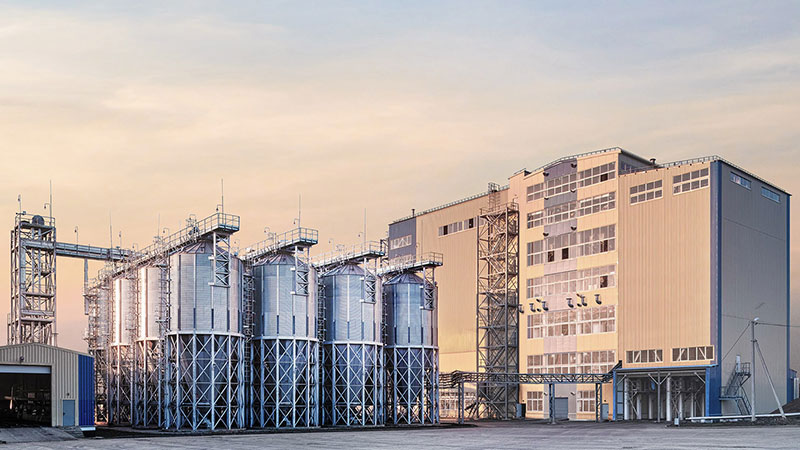
At RICHI, we go beyond project completion. With RICHI Servicee, we’re your dedicated partners in success. Count on us for expert guidance, minimal downtime, and optimized productivity. Choose RICHI for unmatched service and support.
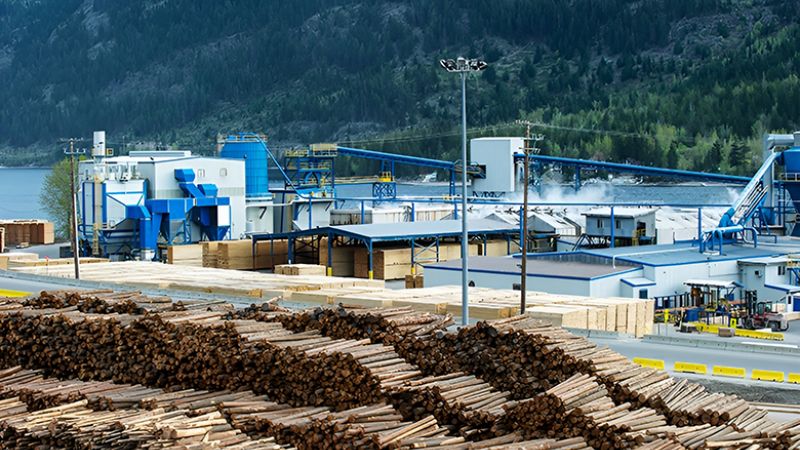


Meet global product demands and quality standards with industry-leading pellet plant design, engineering, equipment, and construction services for pellet processors.

Your Partner Beyond Project Completion
2000+ cases
RICHI is the leading designer, manufacturer and builder of pellet plants in the world, completing over 2000 projects in 140 countries across 6 continents.
Read More
Increase plant productivity, profitability, and safety by integrating high quality equipment into your pellet production line. Over the years, RICHI has become China's top pellet equipment manufacturer. At the same time, RICHI has established valuable partnerships with the world's leading component and raw material manufacturers to bring you the best there is in technology, automation, and efficiency in pelleting plant machinery.

For nearly 30 years, RICHI has been providing best-in-class pellet plant equipment and services to clients across a variety of industries, sizes, and needs. We pride ourselves on the knowledge and skill that each team member possesses – from our technical sales team to our process design engineers. You can count on RICHI Machinery to take your operation to the next level of innovation, quality, and success.
Need help with your pellet manufacturing plant project? Contact us today.
ANIMAL FEED
BIOMASS
WOOD
ORGANIC FERTILIZER
AQUA FEED
CAT LITTER
MUNICIPAL WASTE RECYCLING
SPECIAL PELLET PRODUCTION
RICHI Machinery continues to deliver world class pellet mill equipment, pellet plant engineering and project solutions that add value to our customers in the animal feed, wood waste, agriculture waste, organic fertilizer, cat litter and special pellet products industries. Throughout the years, we RICHI Machinery have built strong brand, becoming industry-leading pellet machine manufacturer. We value integrity, promise quality, and prioritize your success.
Learn MoreWith our expert team, we precisely implement your process engineering requirements in pellet mill and pelletizing plant systems. No matter which industry you’re in – we understand your needs and deliver solutions that meet the highest standards.
At RICHI, quality comes first. Our pellet making machine and related pellet line equipment undergo rigorous quality controls to ensure they meet the highest standards. Rely on products that are durable, safe, and efficient.
With decades of experience in pellet machine and pellet production line production, we have earned a reputation as a trusted partner in various industries. Our expertise allows us to cover a wide range of applications.
Not only do we offer premium pelleting equipment, but we are also experts at designing, building, installing, and maintaining facilities from the ground up. Our expertise is within pellt plant process design, discovering the most efficient, productive, and profitable way to handle your materials in an end-to-end cycle.
○ RICHI MACHINERY
Keeping in touch with us is an effective way to solve all your problems. If you have any needs or questions, please leave your contact information, then RICHI technical consultants will send design, quotation, videos to your mailbox. You can also contact us directly via WhatsApp: +86 13838389622
Copyright©2015-2026 by HENAN RICHI MACHINERY CO., LTD. All rights reserved.