
RICHI supplied an SFSP56×40 Timothy Hammer Mill in Canada for an Alberta horse farm, with 4 mm, 6 mm and 8 mm screens for controlled timothy hay grinding before wet ration mixing.
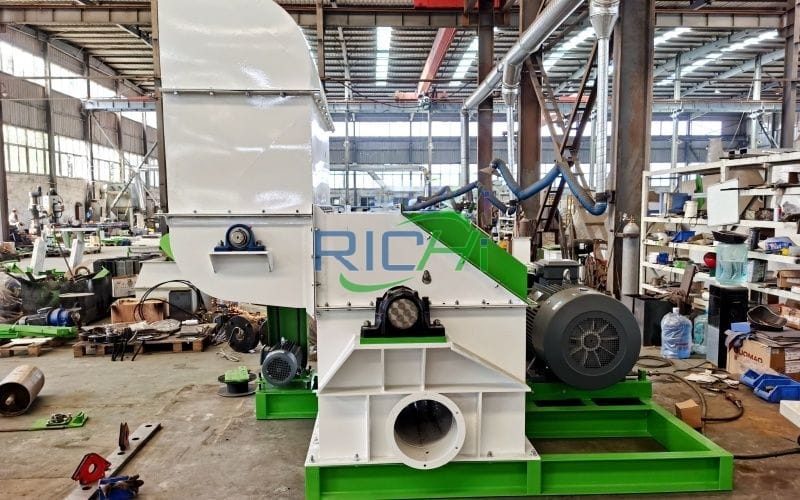
A horse farm in Alberta's Peace River region purchased a Timothy Hammer Mill in Canada to process part of its own baled timothy hay into a controlled-size forage meal for wet feeding. The farm keeps about 35 horses and grows timothy on approximately 80 hectares, so it already had a dependable forage supply. Its problem was not access to hay, but preparation: long baled hay could not be fed through the farm's existing mixer efficiently, and manually cutting forage before each batch was slow and inconsistent. The owner therefore wanted one grinder that could fit between the existing bale-opening step and mixer machine without investing in a complete animal feed production line.
After discussing bale condition, moisture, required particle size and daily operating volume, RICHI configured an SFSP56×40 hammer mill with a 37 kW main motor. The customer also ordered interchangeable 4 mm, 6 mm and 8 mm screens so the farm could establish the most suitable grinding condition with its own timothy rather than relying on one theoretical screen recommendation. For normal production, the 6 mm screen became the preferred configuration. The machine was exported from Qingdao, China, through the Port of Vancouver and then transported inland to Alberta.
Name:
Timothy Hammer Mill
Country:
Canada
Date:
2026
Capacity:
0.8-1T/H
Model:
SFSP56×40
Main Motor Power:
37 kW
Raw Materials:
Timothy hay
Final product size:
4 /6 / 8 mm
The customer was not planning to manufacture commercial compound feed or build an industrial forage pellet plant. Timothy hay was already grown, field-dried and baled on the farm, while a mixer was available for preparing the final ration. The missing operation was controlled size reduction. Long stems were difficult to meter consistently into the mixer, while improvised cutting produced a broad mixture of long pieces and fines. Buying a standalone SFSP hammer mill therefore addressed one specific bottleneck without forcing the farm to replace equipment that was still useful.
This purchasing logic also determined the required capacity. A farm keeping roughly 35 horses does not need to grind close to one tonne of hay every hour for many hours each day. The SFSP56×40 grass crusher machine provides reserve capacity, but in this installation it operates intermittently and prepares batches that can be stored temporarily for subsequent mixing. Machine selection was based not only on the number of horses, but also on the fibrous nature of timothy, the existing feeding arrangement, the desired screen options and the customer's preference for completing grinding work in short production periods.
The farm harvests its own timothy during the summer forage season and stores the bales under cover after field drying. Material intended for grinding is checked before entering the processing area because hammer-mill performance depends heavily on forage condition. Properly dried hay fractures much more predictably than damp forage, while excessive moisture can reduce throughput, encourage material buildup around the screen and create poor storage conditions after grinding.
For this project, the customer generally handles baled timothy at approximately 12% moisture. Before grinding, the bales are opened and the compacted forage is loosened so that long, compressed sections do not enter the hammer mill as uncontrolled masses. A magnetic separation point is arranged ahead of the grinder to reduce the risk from stray ferrous material associated with baling, handling or storage. The purpose of this preparation is not to make the hay extremely fine; it is to establish stable feeding so the selected screen can control the final particle distribution more effectively.
| Project Item | Configuration | Selection Basis |
|---|---|---|
| Equipment | Timothy hay hammer mill | Standalone replacement/addition for forage size reduction |
| Model | SFSP56×40 | Selected for the customer's fibrous forage grinding requirement |
| Main Motor | 37 kW | Matches the selected SFSP configuration |
| Available Screens | 4 mm, 6 mm, 8 mm | Allows on-site adjustment according to hay condition and required grind |
| Normal Production Screen | 6 mm | Chosen after comparing the customer's own timothy through different screens |
| Incoming Hay Moisture | Approximately 12% | Typical condition of the farm's stored timothy used for grinding |
| Application | Ground timothy for wet mixed horse ration | Single use scenario for this project |
| Export Route | Qingdao – Vancouver – Alberta | Sea freight followed by inland transport |
Actual hammer-mill output is not defined by motor power or screen diameter alone. Timothy variety, stem condition, moisture, feeding continuity, hammer condition and the percentage of material that must pass the selected screen all affect hourly production. A smaller screen normally increases resistance and can reduce throughput, but quoting an exact universal figure such as 0.8 T/H for every batch of timothy would give buyers a false level of certainty. For this reason, RICHI treats capacity as material-dependent and recommends testing representative forage when particle-size control is important.
The customer initially considered buying only a 6 mm screen, but RICHI recommended retaining more adjustment range because forage does not remain identical throughout the year. Different cuts, storage periods and stem conditions can change how timothy breaks inside the grinding chamber. The 8 mm screen provides a coarser option when less size reduction is required, while the 4 mm screen gives the farm a finer alternative for a different mixing requirement. The 6 mm screen sits between those two operating conditions and became the farm's normal choice after trials with its own hay.
Screen selection should not be interpreted as a medical prescription for horses. A hammer mill controls forage particle size; it does not treat equine asthma, allergies or other respiratory disease. Likewise, a 6 mm screen cannot guarantee “no dust.” Fine particles are inevitably generated during mechanical grinding, and the amount depends on hay condition, hammer speed, screen configuration, aspiration and material handling after the mill. Where a farm has animals with diagnosed respiratory conditions, ration form and forage management should be determined with an equine veterinarian or qualified nutrition professional. RICHI's role is to configure the grinding and dust-control equipment around the processing requirement.
Dust management was an important engineering consideration because grinding dry forage inevitably creates fines. The SFSP56×40 therefore does not simply discharge ground material into an open pile inside the feed room. The grinding section is connected to an aspiration and collection arrangement so that air movement and suspended fines can be managed instead of allowing dust to accumulate around the operator and equipment.
The customer uses a cyclone as part of material-air separation, with downstream filtration incorporated into the dust-control arrangement. The exact collection efficiency of a filtration system should be based on the selected filter, air volume, filter media and actual particle loading rather than described with an unsupported universal figure such as “99% dust capture.” RICHI sized the aspiration requirement around the hammer mill and the customer's layout, while the farm also adopted enclosed transfer wherever practical. The ground timothy is subsequently incorporated into a wet ration, which further changes the way the material is handled after grinding.
This machine has one defined production role. The customer grinds timothy hay so that it can be incorporated more consistently into the farm's own wet mixed forage ration. The SFSP56×40 is not being used in this project to manufacture timothy pellets, commercial rabbit feed, biomass fuel or packaged ground hay for several unrelated markets.
After grinding, the timothy passes to the farm's existing mixing operation, where the ration can be combined with the other ingredients selected by the farm's nutrition program and water can be added when a wet ration is required. Breaking long stems into a controlled range makes mechanical mixing more practical and reduces the tendency of long forage to wrap, bridge or distribute unevenly through small mixing equipment. The hammer mill therefore solves a physical preparation problem; formulation, nutrient balance and feeding decisions remain separate from the machine itself.
One of the most important lessons from this project concerns what happens before the grinding chamber. Timothy may appear soft compared with wood or crop stalks, but long hay can still feed poorly when compacted sections from a bale are introduced directly into a hammer mill. Fibrous material can bridge above the inlet, arrive in irregular surges and prevent the grinder from maintaining a stable load.
The customer therefore loosens the bales before controlled feeding. For the present operating volume, the existing arrangement is sufficient, but a dedicated bale breaker or forage feeding system can be added if the farm later wants more continuous operation. This is a more meaningful expansion path than simply installing a larger hammer mill: if the upstream bale-opening section cannot deliver forage uniformly, increasing grinding power alone will not solve the bottleneck.
Timothy is considerably different from abrasive mineral-bearing materials, but RICHI still avoids promising a fixed number of operating hours for hammers or screens. Wear depends on more than forage species. Soil contamination picked up during harvesting, stones or foreign matter, hammer configuration, rotor speed, screen opening and total processed tonnage can all influence component life.
The farm's maintenance routine therefore uses inspection rather than a predetermined claim such as “the hammers will last 300 hours.” Operators check hammer edges, screen condition, fasteners, rotor behavior and abnormal vibration as part of routine maintenance. When hammers have multiple usable working edges, they can be rotated or replaced according to their actual wear condition and the manufacturer's maintenance procedure. This approach gives the customer a more defensible maintenance schedule than assuming every load of clean-looking timothy creates identical wear.
At first glance, a 37 kW hammer mill can appear large for a farm with only 35 horses. The correct comparison, however, is not simply machine hourly capacity versus daily feed consumption. The owner did not want to run a tiny grinder continuously throughout the day. She wanted to process prepared forage in scheduled batches and then use the existing mixer for ration preparation.
The selected machine also provides enough grinding chamber capacity to handle fibrous material without forcing the farm to operate at the edge of a small grinder's capability. At the same time, RICHI did not design an industrial multi-ton-per-hour forage line around the project. There is no large dryer, pellet mill, cooler or automatic bagging section because none of those systems is required for the customer's actual use.
The SFSP56×40 crusher machine was exported from Qingdao, China, with Vancouver, British Columbia, used as the destination seaport before inland transport to Alberta. Because the Peace River region is far from Canada's west-coast container terminals, inland freight formed an important part of the logistics plan rather than being treated as a minor final-delivery step.
Before shipment, RICHI prepared the hammer mill, screen set and associated components for sea transport and supplied installation and electrical documentation. The customer had to prepare the equipment position, electrical connection, feeding interface and dust-collection connection before commissioning. Once the machine reached the farm, installation focused on correct anchoring, rotor inspection, screen installation, aspiration connection and no-load testing before timothy was introduced.
Screen selection is much more reliable when based on representative raw material than on forage name alone. Timothy from Alberta does not necessarily grind exactly like timothy grown under different harvesting, maturity and storage conditions. RICHI can therefore test customer-supplied material when a buyer needs to compare screen openings or evaluate whether the selected hammer mill is suitable for a particular hay condition.
For a test to be useful, the sample should represent the actual material entering production rather than unusually clean hand-selected stems. Buyers should also provide bale type, approximate moisture, required final use and upstream feeding method. RICHI can then evaluate grinding behavior, resulting particle distribution and equipment loading and use those observations to recommend a screen range. The purpose of testing is equipment selection and process verification, not making animal-health claims from the resulting particle size.
For Canadian horse farms, forage processors or feed operations evaluating a Timothy Hammer Mill in Canada, the first question should not be simply whether a machine can “grind hay.” Most hammer mills can reduce some form of dry forage; the real issue is whether the complete feeding, grinding, aspiration and discharge arrangement matches the physical condition of the timothy and the required downstream use.
The Timothy Hammer Mill in Canada gave this Peace River horse farm a dedicated way to reduce its own dry timothy before wet ration preparation without purchasing equipment it did not need. The SFSP56×40 with a 37 kW motor was supplied as the grinding unit, while 4 mm, 6 mm and 8 mm screens gave the customer flexibility to evaluate particle size with its own forage. In normal operation, the farm uses the 6 mm screen as its preferred configuration, supported by controlled bale opening and dust collection around the grinding section.
For buyers considering a similar standalone hammer mill, RICHI Machinery recommends sending the actual forage information before selecting a model: timothy or other hay type, bale dimensions, moisture range, approximate stem length after bale breaking, required particle size, tonnes to be processed per day, operating hours, existing feeding equipment and available electrical supply. If necessary, representative hay can be tested before the equipment configuration is finalized. This allows the hammer mill, screens, feeding method and aspiration system to be selected around the real material rather than around a generic hay-grinding capacity figure.
Having the right mix of reliable, high-quality pellet machine and pelletizing systems and expert support is essential to your success. Watch how our end-to-end feed pellet plant solutions have helped our customers optimize their performance.
Our customized and future-proofed turnkey pellet plant solutions is designed with you at the core. From vision to reality and beyond, our team stays connected with yours. Giving you peace-of-mind with an expert at your side.
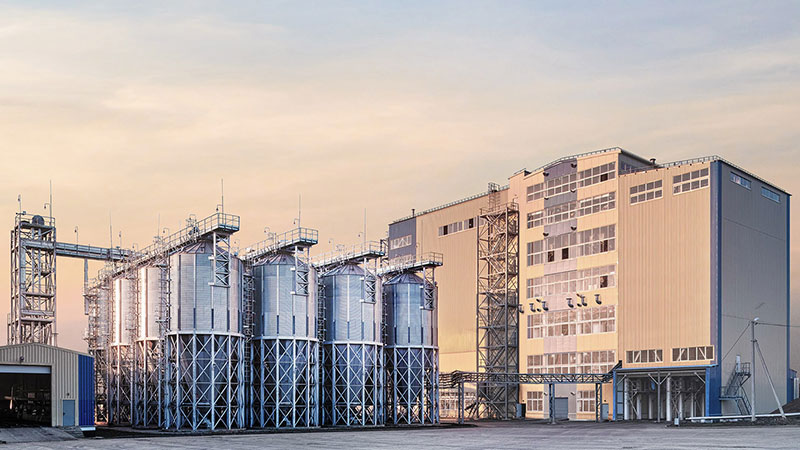
At RICHI, we go beyond project completion. With RICHI Servicee, we’re your dedicated partners in success. Count on us for expert guidance, minimal downtime, and optimized productivity. Choose RICHI for unmatched service and support.
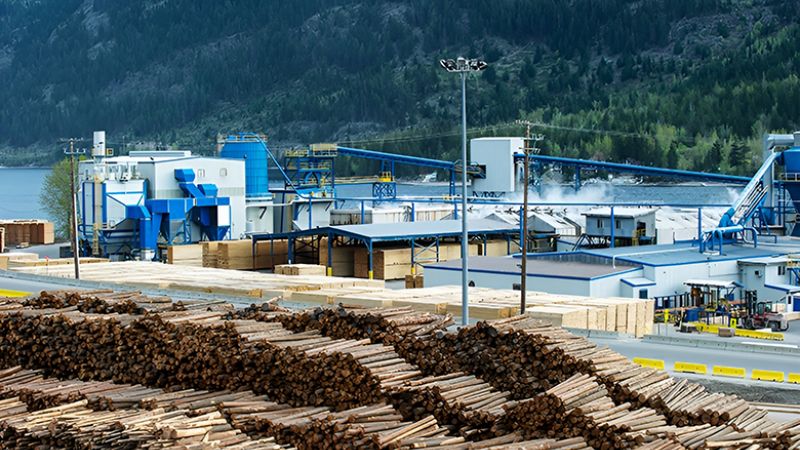


Meet global product demands and quality standards with industry-leading pellet plant design, engineering, equipment, and construction services for pellet processors.


Your Partner Beyond Project Completion
2000+ cases
RICHI is the leading designer, manufacturer and builder of pellet plants in the world, completing over 2000 projects in 140 countries across 6 continents.
Read More
Increase plant productivity, profitability, and safety by integrating high quality equipment into your pellet production line. Over the years, RICHI has become China's top pellet equipment manufacturer. At the same time, RICHI has established valuable partnerships with the world's leading component and raw material manufacturers to bring you the best there is in technology, automation, and efficiency in pelleting plant machinery.

For nearly 30 years, RICHI has been providing best-in-class pellet plant equipment and services to clients across a variety of industries, sizes, and needs. We pride ourselves on the knowledge and skill that each team member possesses – from our technical sales team to our process design engineers. You can count on RICHI Machinery to take your operation to the next level of innovation, quality, and success.
Need help with your pellet manufacturing plant project? Contact us today.
ANIMAL FEED
BIOMASS
WOOD
ORGANIC FERTILIZER
AQUA FEED
CAT LITTER
MUNICIPAL WASTE RECYCLING
SPECIAL PELLET PRODUCTION
RICHI Machinery continues to deliver world class pellet mill equipment, pellet plant engineering and project solutions that add value to our customers in the animal feed, wood waste, agriculture waste, organic fertilizer, cat litter and special pellet products industries. Throughout the years, we RICHI Machinery have built strong brand, becoming industry-leading pellet machine manufacturer. We value integrity, promise quality, and prioritize your success.
Learn MoreWith our expert team, we precisely implement your process engineering requirements in pellet mill and pelletizing plant systems. No matter which industry you’re in – we understand your needs and deliver solutions that meet the highest standards.
At RICHI, quality comes first. Our pellet making machine and related pellet line equipment undergo rigorous quality controls to ensure they meet the highest standards. Rely on products that are durable, safe, and efficient.
With decades of experience in pellet machine and pellet production line production, we have earned a reputation as a trusted partner in various industries. Our expertise allows us to cover a wide range of applications.
Not only do we offer premium pelleting equipment, but we are also experts at designing, building, installing, and maintaining facilities from the ground up. Our expertise is within pellt plant process design, discovering the most efficient, productive, and profitable way to handle your materials in an end-to-end cycle.
○ RICHI MACHINERY
Keeping in touch with us is an effective way to solve all your problems. If you have any needs or questions, please leave your contact information, then RICHI technical consultants will send design, quotation, videos to your mailbox. You can also contact us directly via WhatsApp: +86 13838389622
Copyright©2015-2026 by HENAN RICHI MACHINERY CO., LTD. All rights reserved.