
RICHI supplied a 3.5–4.5 T/H Sugar Beet Waste Dryer in Hungary to reduce pressed beet pulp from about 75% moisture to 10–12%, evaporating 2.5–3.2 T/H water.
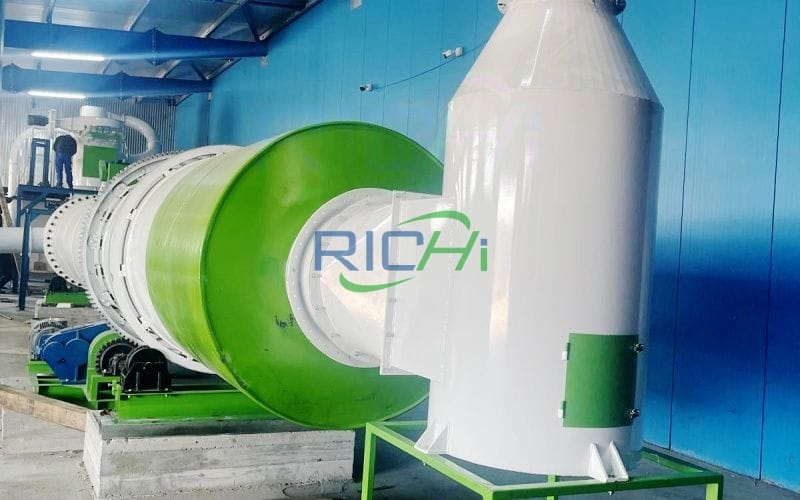
A feed by-product processor in Somogy County selected one RICHI Sugar Beet Waste Dryer in Hungary to add a dedicated drying stage for pressed sugar beet pulp. The facility is located near Kaposvár, where Hungary's sugar-processing industry provides a realistic regional source of beet pulp during the sugar campaign. The customer already had wet-material receiving, conveying, dry-product cooling and storage equipment, so the project required one rotary dryer rather than another complete feed-processing line.
The selected φ1.8×18 single-pass rotary dryer uses a 30 kW drum drive. For pressed beet pulp containing approximately 74–76% moisture, the project handles about 3.5–4.5 T/H of wet feed and removes approximately 2.5–3.2 T/H of water. Final product moisture is controlled at approximately 10–12%, giving about 1.0–1.3 T/H of dried beet pulp depending on the actual incoming dry matter. The finished material is sold as a dried fibrous feed ingredient for dairy cattle.
Name:
sugar beet pulp dryer
Country:
Hungary
Date:
2026
Capacity:
3.5–4.5 T/H
Model:
φ1.8×18
Drum Drive Power:
30 kW
Incoming Moisture:
74–76%
Final Moisture:
10–12%
Hungary still has an active sugar beet industry, but processing is highly concentrated. A dryer project based on sugar beet pulp therefore needs to be located around an actual beet-processing supply chain rather than placed in an arbitrary agricultural region.
The customer receives pressed pulp during the sugar campaign and dries part of the material for longer storage and wider distribution. Pressed pulp that is sold locally can remain wet or be ensiled, while the portion intended for dried-feed customers enters the rotary drying section.
This allows the processor to use the dryer only where moisture removal creates a real commercial advantage instead of drying every tonne produced during the campaign.
| Project Parameter | Specification |
|---|---|
| Equipment | Single-pass rotary sugar beet pulp dryer |
| Project Model | φ1.8×18 rotary drum dryer |
| Drum Diameter | Approximately 1.8 m |
| Drum Length | Approximately 18 m |
| Drum Drive Power | 30 kW |
| Wet Feed Capacity | Approximately 3.5–4.5 T/H |
| Incoming Moisture | Approximately 74–76% |
| Water Evaporation | Approximately 2.5–3.2 T/H |
| Dry Product Output | Approximately 1.0–1.3 T/H |
| Final Moisture | Approximately 10–12% |
| Main Product | Dried sugar beet pulp for dairy cattle feed |
The 30 kW figure is the mechanical drive power for rotating the drum. It is not the thermal duty of the drying system. Heat demand is determined separately from wet-feed rate, incoming moisture, required final moisture, air conditions and heat-source efficiency.
Pressed sugar beet pulp normally contains only about one-quarter dry matter, which means most of the incoming weight is water. This distinction is essential when selecting a dryer because wet-feed tonnes per hour cannot be treated as dried-product tonnes per hour.
For example, 4 T/H of pressed pulp at approximately 25% dry matter contains roughly 1 tonne of solids and 3 tonnes of water. If the final dried material contains about 11% moisture, those solids produce only around 1.1 tonnes of finished material. Close to 2.9 tonnes of water must be evaporated during the process.
This is why the project is specified using three separate capacities: wet feed, water evaporation and dry product output.
The customer does not select the φ1.8×18 dryer simply because the drum is 1.8 meters in diameter. The primary engineering calculation starts with how much water must be removed per hour.
At the lower end of the project range, approximately 3.5 T/H of pressed pulp generates close to 2.5 T/H of evaporation load. At the upper end, approximately 4.5 T/H requires roughly 3.2 T/H of water removal when inlet dry matter and final moisture remain within the project range.
If incoming pulp becomes wetter, the same dryer may need a lower wet-feed rate. Conversely, better mechanical pressing before drying can reduce thermal load because less water must be removed by evaporation.
Using heat to remove water is more energy-intensive than removing free water mechanically. The customer's operating strategy therefore starts with properly pressed beet pulp rather than very wet fresh pulp directly from extraction.
Incoming material is checked for moisture and physical condition before the dryer feed rate is set. Where mechanical pressing has produced lower dry matter than expected, operators reduce dryer throughput or improve upstream dewatering instead of forcing more wet material through the drum.
This distinction also explains why a dryer rated at 3.5–4.5 T/H wet feed should not be marketed as a universal 4 T/H machine regardless of incoming moisture.
The project does not rely on one fixed inlet-gas temperature or residence time for every tonne of beet pulp. Hot-air temperature, airflow and drum loading are adjusted according to incoming moisture and actual outlet condition.
The objective is to remove the required water without unnecessarily overheating the dried feed. Excessive thermal exposure can darken the product and alter feed quality, while insufficient drying leaves material with poor storage stability.
Operators therefore monitor feed moisture, outlet moisture, exhaust condition and product appearance together. Drum rotation controls material movement, but residence time is not treated as one universal value independent of feed rate and moisture.
The dried beet pulp is intended for storage and subsequent use as a commercial feed ingredient. Reducing moisture from roughly 75% to around 10–12% dramatically changes storage and transportation characteristics.
The lower moisture reduces the mass of water transported with the product and improves storage stability compared with unpreserved pressed pulp. The material still needs to be cooled before long-term storage or packaging because warm dried product can create condensation when placed into enclosed bins or bags too early.
The final moisture target is therefore linked to downstream storage and feed handling, not simply to achieving the lowest possible moisture number.
The customer's actual downstream product is dried sugar beet pulp for dairy cattle feeding. Beet pulp provides digestible fiber and energy but is not a nutritionally complete cattle ration by itself.
Dairy farms or compound-feed manufacturers combine the dried pulp with forage, protein ingredients, minerals and other ration components according to nutrition requirements. The dryer does not improve protein content or create additional nutrients; it primarily removes water and converts a highly perishable wet by-product into a more transportable and storable feed ingredient.
This project therefore avoids claims that drying automatically increases milk production, feed conversion or animal health.
Material leaving the rotary drum remains warm. The customer's existing downstream cooling equipment lowers product temperature before storage. This step is separate from drying and is important for preventing condensation in finished-product bins.
After cooling, the dried beet pulp can be stored as bulk material or directed to further size control and packaging according to customer requirements. Dust collection is provided around transfer points because dry beet pulp can generate fines during conveying.
The complete project route is pressed beet pulp receiving → moisture check → controlled feeding → φ1.8×18 rotary drying → cooling → finished-product storage and dispatch.
Sugar beet processing is seasonal, so the dryer does not necessarily operate at the same load throughout the year. During the beet campaign, wet pulp supply can be concentrated into a relatively short period, making wet-material buffering and drying schedules important.
The customer therefore sizes receiving and intermediate storage around expected daily pulp supply rather than the dryer capacity alone. If incoming wet pulp temporarily exceeds the 3.5–4.5 T/H dryer range, feedstock must be managed through planned storage, ensiling or adjusted operating hours rather than overloading the drum.
The Sugar Beet Waste Dryer in Hungary is prepared for export from Qingdao, China, in modular sections because the rotary drum is substantially larger than a standard single-machine crate. Rijeka in Croatia provides a practical northern Adriatic gateway for inland delivery toward southwestern Hungary.
Before shipment, RICHI reviews the drum foundation, support rollers, hot-air system, feed conveyor, exhaust and dust-control arrangement, electrical supply, cooling interface and available installation space. The 30 kW drum motor is only one part of the utility review; thermal energy and fan requirements must be sized separately.
This Sugar Beet Waste Dryer in Hungary project uses one φ1.8×18 single-pass rotary dryer with a 30 kW drum drive near Kaposvár. Pressed sugar beet pulp enters at approximately 74–76% moisture and a wet-feed rate of around 3.5–4.5 T/H. The system evaporates approximately 2.5–3.2 T/H of water and produces roughly 1.0–1.3 T/H of dried beet pulp at approximately 10–12% final moisture.
For another sugar or feed by-product processor evaluating a dryer, RICHI Machinery needs the wet-feed T/H, measured dry matter, target final moisture, operating hours, heat source and downstream cooling and storage configuration. Those figures determine the real evaporation load and dryer size far more reliably than selecting equipment from wet tonnage alone.
Having the right mix of reliable, high-quality pellet machine and pelletizing systems and expert support is essential to your success. Watch how our end-to-end feed pellet plant solutions have helped our customers optimize their performance.
Our customized and future-proofed turnkey pellet plant solutions is designed with you at the core. From vision to reality and beyond, our team stays connected with yours. Giving you peace-of-mind with an expert at your side.
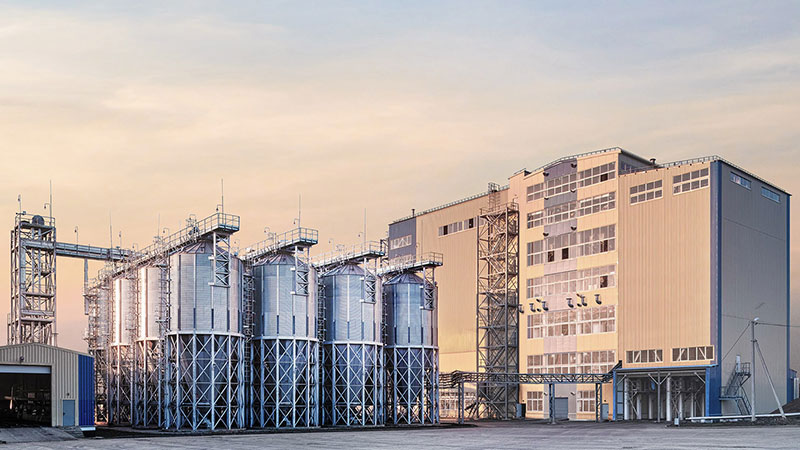
At RICHI, we go beyond project completion. With RICHI Servicee, we’re your dedicated partners in success. Count on us for expert guidance, minimal downtime, and optimized productivity. Choose RICHI for unmatched service and support.
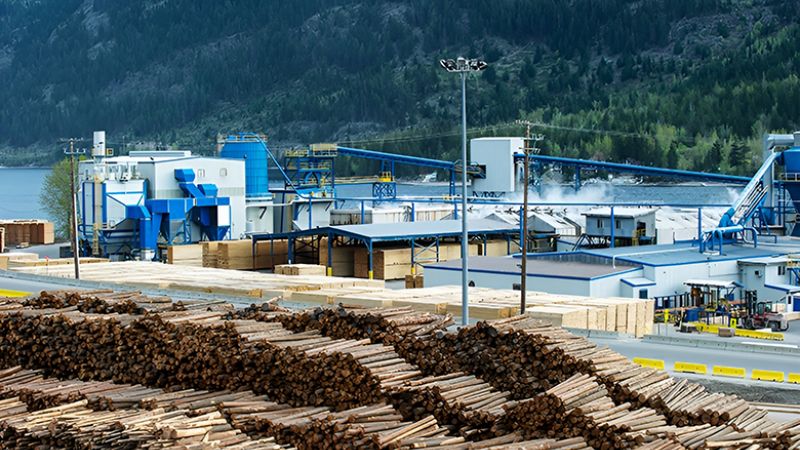


Meet global product demands and quality standards with industry-leading pellet plant design, engineering, equipment, and construction services for pellet processors.


Your Partner Beyond Project Completion
2000+ cases
RICHI is the leading designer, manufacturer and builder of pellet plants in the world, completing over 2000 projects in 140 countries across 6 continents.
Read More
Increase plant productivity, profitability, and safety by integrating high quality equipment into your pellet production line. Over the years, RICHI has become China's top pellet equipment manufacturer. At the same time, RICHI has established valuable partnerships with the world's leading component and raw material manufacturers to bring you the best there is in technology, automation, and efficiency in pelleting plant machinery.

For nearly 30 years, RICHI has been providing best-in-class pellet plant equipment and services to clients across a variety of industries, sizes, and needs. We pride ourselves on the knowledge and skill that each team member possesses – from our technical sales team to our process design engineers. You can count on RICHI Machinery to take your operation to the next level of innovation, quality, and success.
Need help with your pellet manufacturing plant project? Contact us today.
ANIMAL FEED
BIOMASS
WOOD
ORGANIC FERTILIZER
AQUA FEED
CAT LITTER
MUNICIPAL WASTE RECYCLING
SPECIAL PELLET PRODUCTION
RICHI Machinery continues to deliver world class pellet mill equipment, pellet plant engineering and project solutions that add value to our customers in the animal feed, wood waste, agriculture waste, organic fertilizer, cat litter and special pellet products industries. Throughout the years, we RICHI Machinery have built strong brand, becoming industry-leading pellet machine manufacturer. We value integrity, promise quality, and prioritize your success.
Learn MoreWith our expert team, we precisely implement your process engineering requirements in pellet mill and pelletizing plant systems. No matter which industry you’re in – we understand your needs and deliver solutions that meet the highest standards.
At RICHI, quality comes first. Our pellet making machine and related pellet line equipment undergo rigorous quality controls to ensure they meet the highest standards. Rely on products that are durable, safe, and efficient.
With decades of experience in pellet machine and pellet production line production, we have earned a reputation as a trusted partner in various industries. Our expertise allows us to cover a wide range of applications.
Not only do we offer premium pelleting equipment, but we are also experts at designing, building, installing, and maintaining facilities from the ground up. Our expertise is within pellt plant process design, discovering the most efficient, productive, and profitable way to handle your materials in an end-to-end cycle.
○ RICHI MACHINERY
Keeping in touch with us is an effective way to solve all your problems. If you have any needs or questions, please leave your contact information, then RICHI technical consultants will send design, quotation, videos to your mailbox. You can also contact us directly via WhatsApp: +86 13838389622
Copyright©2015-2026 by HENAN RICHI MACHINERY CO., LTD. All rights reserved.