
4–6 T/H Sugar Beet Pulp Rotary Dryer in Estonia with 2–3 T/H water evaporation capacity, drying wet beet pulp to 12–14% moisture for a horse bedding processor.
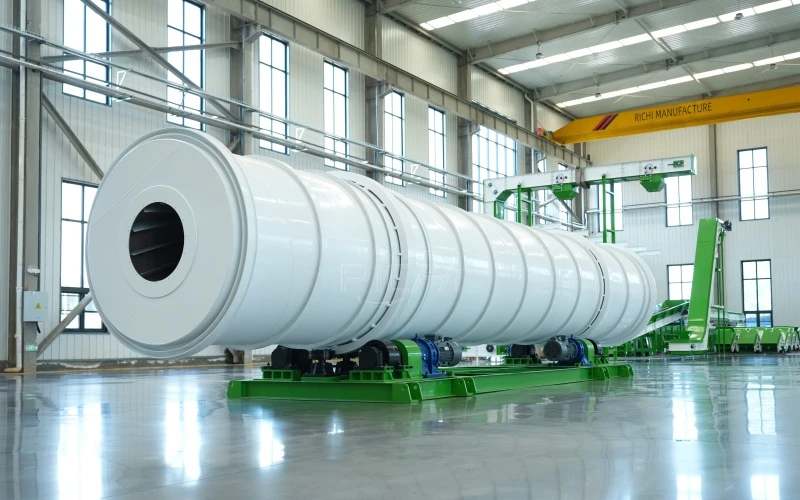
An agricultural by-product processor in the Tartu region purchased a Sugar Beet Pulp Rotary Dryer in Estonia to add a dedicated drying stage for wet beet pulp used in its horse bedding business. The company already handled peat-based bedding materials and had receiving, screening, blending, cooling and compression-baling equipment at the site. What it lacked was a stable way to process wet sugar beet pulp arriving from regional suppliers. Depending on the incoming moisture and operating condition, the selected rotary dryer handles approximately 4–6 T/H of wet beet pulp and evaporates about 2–3 T/H of water, reducing the material to approximately 12–14% moisture before downstream handling.
The customer selected a φ1.8×20 m single-pass rotary dryer with a 30 kW drum drive rather than purchasing another complete bedding production line. This allowed the existing handling and packaging equipment to remain in service while the new drying section solved the main moisture-control bottleneck. After drying and cooling, the beet pulp is combined with prepared peat according to the customer's bedding formulation and compressed into transportable bales. The project therefore has one clearly defined role for the RICHI equipment: converting high-moisture sugar beet pulp into a stable dried ingredient suitable for the customer's existing horse bedding process.
Name:
Single-pass rotary dryer
Country:
Estonia
Date:
2026
Capacity:
4–6 T/H
Model:
φ1.8×20
Main Motor Power:
30 kW
Final Moisture:
12–14%
Application:
Beet pulp ingredient for horse bedding
Wet sugar beet pulp is very different from the dry fibrous materials normally handled in a bedding plant. Fresh or pressed pulp contains a large amount of water and cannot simply be blended into a dry bedding product. High moisture increases transport weight, creates poor storage conditions and makes it difficult to maintain a repeatable final blend. For the Estonian customer, this meant that the availability of beet pulp was not the limiting factor; moisture removal was.
The company wanted to use beet pulp as one fibrous component of a compressed horse bedding product, while retaining locally sourced peat as the other major component. Rather than attempting to dry the finished blend, the process separates the two operations. Wet beet pulp is dried under conditions selected for the pulp itself, then cooled before entering the customer's existing blending section. This gives the operator much better control over final moisture and avoids forcing two physically different materials through the same drying condition.
The customer sources beet pulp through regional agricultural and sugar-processing supply channels in the Baltic area. Incoming condition varies between shipments, so the dryer is not operated against one fixed feed-moisture assumption. Wet beet pulp must first be checked for moisture, foreign material and consistency because all three affect dryer loading and evaporation demand. Large compacted masses are loosened before controlled feeding so that the dryer receives a more even material bed.
For engineering purposes, dryer capacity is always considered together with incoming and outgoing moisture. A statement such as “6 T/H dryer” is incomplete unless the water load is known. In this project, the φ1.8×20 rotary dryer is configured for approximately 4–6 T/H wet-feed capacity under the specified operating envelope, with approximately 2–3 T/H water evaporation capacity. The target discharged beet pulp is controlled at approximately 12–14% moisture. Actual dry-product output therefore changes with the incoming moisture rather than remaining identical for every shipment.
| Project Parameter | Configuration | Project Basis |
|---|---|---|
| Equipment | Single-pass rotary dryer | Dedicated sugar beet pulp drying |
| Model | φ1.8×20 | 1.8 m drum diameter, 20 m drum length |
| Wet Feed Capacity | 4–6 T/H | Varies with incoming pulp moisture and feed consistency |
| Water Evaporation Capacity | 2–3 T/H | Operating range for the selected drying configuration |
| Final Beet Pulp Moisture | 12–14% | Target before cooling and bedding-material blending |
| Drum Drive Power | 30 kW | Main rotary drum drive |
| Drum Speed | 3–10 rpm adjustable range | Adjusted according to material residence requirement |
| Heat Source | Biomass-fired hot-air system | Configured around locally available solid biomass fuel |
| Application | Beet pulp ingredient for horse bedding | Single application in this project |
| Destination Port | Port of Tallinn | Sea shipment from Qingdao, China |
The 4–6 T/H figure refers specifically to wet material entering the dryer, not to 4–6 T/H of finished dry beet pulp. This distinction is important for any customer comparing rotary dryer quotations. If incoming pulp becomes wetter, more of the dryer's thermal capacity is consumed evaporating water and dry-product throughput falls. If the pulp has already been mechanically dewatered more effectively, the same drying system can process more solids within its evaporation limit. RICHI therefore sizes a sugar beet pulp drying system from both tonnes per hour and moisture balance rather than quoting capacity independently of feed condition.
Wet beet pulp can arrive as cohesive fibrous masses rather than a freely flowing granular material. Stable drying consequently starts with controlled feeding. Once the pulp enters the rotating drum, the internal lifting arrangement repeatedly raises and disperses the material through the hot-air stream. This increases contact between the wet pulp and drying medium while the drum rotation advances the material toward discharge.
Residence time, drum speed, feeding rate and heat input are coordinated rather than adjusted independently. If wet feed suddenly rises while heat input remains unchanged, outlet moisture can increase. If feed is reduced too aggressively without corresponding thermal adjustment, the material can be exposed to unnecessarily severe drying conditions. The Estonian installation therefore uses variable operating control so the dryer can respond to the moisture variation typical of agricultural by-products instead of relying on a single fixed setting throughout the season.
Sugar beet pulp requires more careful thermal control than inert mineral material. The temperature of the drying gas is not the same as the actual temperature of the wet solids inside the drum, particularly near the inlet where evaporation absorbs substantial heat. For this reason, quoting only a high inlet-gas temperature can be misleading when evaluating whether the process is safe for beet pulp.
The project uses an adjustable hot-air system and monitors both drying conditions and discharged material moisture. The operator's objective is not to maximize temperature; it is to supply enough thermal energy to remove the required water without scorching the fibrous solids or creating unstable outlet quality. RICHI therefore configures the burner, airflow and drum operation around the customer's real incoming moisture range and evaporation requirement. This is especially important when the same supplier's pulp changes condition during different parts of the processing season.
Dried beet pulp leaves the thermal section above the temperature preferred for immediate compression packaging. The customer therefore retains a cooling stage between drying and final bedding preparation. Material is cooled toward near-ambient handling temperature before it is blended and compressed, which reduces the risk of trapping excess heat inside dense bales and gives the packaging section a more stable product condition.
Cooling is particularly relevant in a compressed bedding application because bulk fibrous material occupies substantial volume. Once compressed, heat dissipates more slowly than it does from a loose material bed. The process sequence therefore keeps drying, cooling, blending and baling as separate controlled operations instead of moving hot material directly from the dryer into a finished package.
The dried beet pulp is not being produced as livestock feed in this installation. Its downstream use is the customer's horse bedding product. After the pulp reaches the required moisture and is cooled, it enters the existing blending system together with prepared peat. The customer can adjust the formulation according to physical characteristics such as bulk density, moisture, absorbency and compression behavior rather than depending on one permanently fixed ratio.
This distinction also affects dryer design. RICHI did not size the system as a feed dryer based on nutritional preservation targets or as a pellet-line dryer based on subsequent pellet-mill moisture. The required endpoint is instead a dry, manageable fibrous ingredient that can be blended, conveyed and compressed reliably in the customer's bedding facility. Keeping the equipment selection tied to the actual end use avoids unnecessary process sections and reduces the chance of overengineering the project.
One important engineering decision was to keep peat preparation separate from beet pulp drying. The two materials can have substantially different incoming moisture, particle behavior, density and drying response. Feeding a highly variable peat/beet-pulp mixture into one drum would make the evaporation load harder to predict and could create uneven discharge moisture between the two fractions.
Instead, the customer prepares the peat through its existing material-handling route while the new RICHI dryer concentrates on wet beet pulp. The streams meet only after the beet pulp has reached its controlled endpoint and passed through cooling. For a processor that already owns part of the bedding-production infrastructure, this modular arrangement is easier to control and leaves each material free to receive the preprocessing it actually needs.
The most useful figure for this Sugar Beet Pulp Rotary Dryer in Estonia is not just the 4–6 T/H wet-feed range. The 2–3 T/H evaporation range explains why production changes when incoming pulp moisture changes. For example, two batches may both weigh five tonnes before drying but contain very different quantities of dry solids. The wetter batch requires more thermal energy and more evaporation capacity to reach the same 12–14% final moisture.
This is why RICHI asks dryer buyers for incoming moisture, target moisture and required finished-product tonnage before final equipment sizing. A customer who needs 5 T/H of dry finished product requires a substantially different system from one who needs to feed 5 T/H of wet material into a dryer. For agricultural residues, confusing these two capacity definitions is one of the easiest ways to undersize a drying section.
Estonia's operating environment also matters. Outdoor temperature and humidity vary significantly between summer and winter, and wet agricultural by-products can behave differently after transport and storage. The customer therefore needed enough operating adjustment to maintain final moisture rather than assuming identical conditions throughout the year.
The system uses controlled feeding, adjustable drum operation and coordinated hot-air supply to accommodate normal feed variation. Moisture checks at receiving and discharge give operators a practical basis for adjustment. The objective is a repeatable 12–14% endpoint, not an artificially precise single moisture number that would be unrealistic for a fibrous agricultural by-product.
The thermal system was configured around solid biomass fuel available to the customer, including suitable wood-based fuel from regional supply channels. Fuel choice matters because the dryer requires a stable heat supply during continuous evaporation. The combustion section must therefore be sized together with the maximum expected water-removal load rather than simply matched to the drum's physical dimensions.
RICHI also reviewed hot-air delivery and exhaust handling as part of the dryer configuration. Drying fibrous agricultural material carries fine particles into the exhaust stream, so gas velocity and downstream collection need to be considered during system design. The objective is to maintain effective heat and mass transfer without unnecessarily increasing entrainment losses from the drum.
Because the customer already had downstream material handling and compression-baling capability, the installation work concentrated on the interfaces around the new dryer. The receiving and feeding section had to supply wet beet pulp evenly; the discharge had to connect to cooling; and the cooled material then had to enter the existing blending and baling arrangement without creating a new bottleneck.
This integration work is particularly important when a customer buys one machine rather than an entire RICHI line. A correctly sized rotary dryer can still perform poorly if the upstream feeder delivers material in large surges or if downstream equipment cannot remove the dried product fast enough. Before manufacturing, RICHI therefore reviews the customer's available equipment, elevations, conveying direction, operating capacity and available installation space so the standalone machine functions as part of the actual plant rather than as an isolated unit.
The final bedding material has relatively low loose bulk density, making volume reduction important for distribution across Estonia and neighboring Baltic markets. The customer's existing compression equipment forms compact bales after the dried beet pulp has been cooled and blended with the prepared bedding material. This lowers transport volume and makes storage at equestrian facilities more practical than shipping the product loose.
Drying is central to that packaging step. If the beet pulp enters the blend with unstable moisture, bale weight, compression behavior and storage condition become more difficult to control. By holding the dried pulp around the 12–14% target range before cooling and blending, the customer gains a much more predictable material for the downstream baling process.
The φ1.8×20 rotary dryer and its project components were prepared for export from Qingdao, China, and shipped by sea to the Port of Tallinn. From Tallinn, the equipment was moved by road to the customer's facility in the Tartu region. Because a 20 m drying drum is very different logistically from a compact standalone biomass pellet mill or mixer machine, transport planning had to consider component dimensions, loading method and inland handling before dispatch.
RICHI supplied the equipment arrangement and installation information required for site preparation before arrival. Commissioning focused on drum alignment and rotation, feeding stability, hot-air operation, exhaust performance and moisture adjustment. Test production then established operating settings around the customer's actual beet pulp rather than assuming that nominal design conditions would exactly match every incoming batch.
The principal result was control over a raw material that had previously been difficult to incorporate consistently into the customer's bedding process. The new drying section gives the processor a defined 4–6 T/H wet-feed operating range and approximately 2–3 T/H water-removal capability, with dried beet pulp targeted at 12–14% moisture. This provides a much clearer production basis for downstream cooling, blending and compression than purchasing wet pulp and attempting to compensate for moisture elsewhere in the process.
The project also leaves room for expansion. If bedding sales increase beyond the present drying capacity, RICHI can evaluate whether the next constraint is evaporation capacity, wet-material feeding, cooling, blending or baling before recommending another machine. Expansion therefore follows the actual bottleneck rather than automatically duplicating every piece of equipment in the facility.
The Sugar Beet Pulp Rotary Dryer in Estonia provides the Tartu processor with a dedicated 4–6 T/H wet-material drying stage for its horse bedding operation. The φ1.8×20 single-pass drum is configured around approximately 2–3 T/H of water evaporation and a final beet pulp moisture target of 12–14%. By drying the beet pulp separately and blending it only after cooling, the customer can manage two very different bedding ingredients without forcing them through the same thermal process.
For a similar project, RICHI needs more than a requested dryer capacity to select the correct equipment. Send us the raw material, incoming moisture range, required final moisture, wet feed volume per hour, required dry output per hour, daily operating hours, available fuel, existing upstream and downstream equipment, and site conditions. RICHI Machinery can then calculate the water balance and determine the appropriate drum size, evaporation capacity, feeding system, heat source and dust-control configuration for the actual material.
Having the right mix of reliable, high-quality pellet machine and pelletizing systems and expert support is essential to your success. Watch how our end-to-end feed pellet plant solutions have helped our customers optimize their performance.
Our customized and future-proofed turnkey pellet plant solutions is designed with you at the core. From vision to reality and beyond, our team stays connected with yours. Giving you peace-of-mind with an expert at your side.
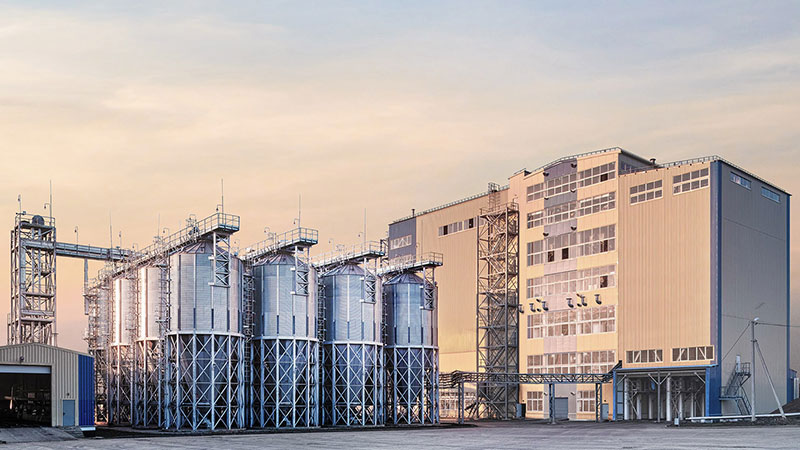
At RICHI, we go beyond project completion. With RICHI Servicee, we’re your dedicated partners in success. Count on us for expert guidance, minimal downtime, and optimized productivity. Choose RICHI for unmatched service and support.
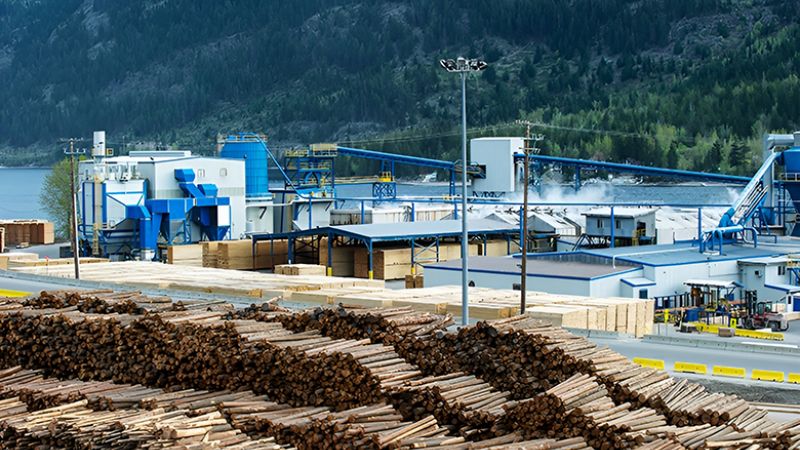


Meet global product demands and quality standards with industry-leading pellet plant design, engineering, equipment, and construction services for pellet processors.


Your Partner Beyond Project Completion
2000+ cases
RICHI is the leading designer, manufacturer and builder of pellet plants in the world, completing over 2000 projects in 140 countries across 6 continents.
Read More
Increase plant productivity, profitability, and safety by integrating high quality equipment into your pellet production line. Over the years, RICHI has become China's top pellet equipment manufacturer. At the same time, RICHI has established valuable partnerships with the world's leading component and raw material manufacturers to bring you the best there is in technology, automation, and efficiency in pelleting plant machinery.

For nearly 30 years, RICHI has been providing best-in-class pellet plant equipment and services to clients across a variety of industries, sizes, and needs. We pride ourselves on the knowledge and skill that each team member possesses – from our technical sales team to our process design engineers. You can count on RICHI Machinery to take your operation to the next level of innovation, quality, and success.
Need help with your pellet manufacturing plant project? Contact us today.
ANIMAL FEED
BIOMASS
WOOD
ORGANIC FERTILIZER
AQUA FEED
CAT LITTER
MUNICIPAL WASTE RECYCLING
SPECIAL PELLET PRODUCTION
RICHI Machinery continues to deliver world class pellet mill equipment, pellet plant engineering and project solutions that add value to our customers in the animal feed, wood waste, agriculture waste, organic fertilizer, cat litter and special pellet products industries. Throughout the years, we RICHI Machinery have built strong brand, becoming industry-leading pellet machine manufacturer. We value integrity, promise quality, and prioritize your success.
Learn MoreWith our expert team, we precisely implement your process engineering requirements in pellet mill and pelletizing plant systems. No matter which industry you’re in – we understand your needs and deliver solutions that meet the highest standards.
At RICHI, quality comes first. Our pellet making machine and related pellet line equipment undergo rigorous quality controls to ensure they meet the highest standards. Rely on products that are durable, safe, and efficient.
With decades of experience in pellet machine and pellet production line production, we have earned a reputation as a trusted partner in various industries. Our expertise allows us to cover a wide range of applications.
Not only do we offer premium pelleting equipment, but we are also experts at designing, building, installing, and maintaining facilities from the ground up. Our expertise is within pellt plant process design, discovering the most efficient, productive, and profitable way to handle your materials in an end-to-end cycle.
○ RICHI MACHINERY
Keeping in touch with us is an effective way to solve all your problems. If you have any needs or questions, please leave your contact information, then RICHI technical consultants will send design, quotation, videos to your mailbox. You can also contact us directly via WhatsApp: +86 13838389622
Copyright©2015-2026 by HENAN RICHI MACHINERY CO., LTD. All rights reserved.