
A Romanian feed-ingredient processor uses a φ1.8×20 rotary dryer to reduce moisture in pressed sugar beet pulp, with a 2.5–3.5 T/H water evaporation basis and flexible campaign operation.
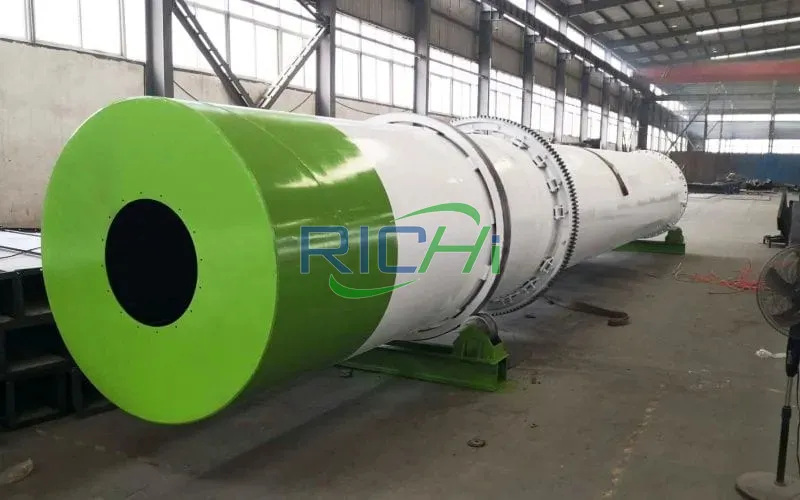
An agricultural feed-ingredient processor in eastern Romania installed a φ1.8×20 Sugar Beet Processing Dryer in Romania to convert high-moisture pressed beet pulp into a more stable material for storage, transport and downstream feed manufacturing. The facility handles seasonal sugar-industry by-products and already had wet-material receiving, conveying and finished-product handling capacity, so the investment focused on the thermal drying stage rather than another complete processing line.
The selected single-pass rotary dryer uses a 1.8 m diameter drum, 20 m effective length and 30 kW main drive. Its design is evaluated primarily by water evaporation rather than one fixed wet-feed tonnage, because pressed beet pulp can arrive with substantially different moisture depending on extraction and mechanical pressing efficiency. For this project, approximately 2.5–3.5 T/H of water evaporation provides the main sizing basis.
Name:
Sugar Beet Dryer
Country:
Romania
Date:
2026
Capacity:
3–5 T/H
Model:
φ1.8×20
Power:
30 kW
Raw materials:
Pressed sugar beet pulp
Target Moisture:
10–12%
The material entering the machine is the fibrous pulp remaining after sugar extraction, not harvested beet roots.
This distinction is important because whole sugar beet processing involves washing, slicing, diffusion and juice extraction before the pulp by-product becomes available. The rotary dryer operates much later in that chain.
Pressed beet pulp still contains a large quantity of water even after mechanical dewatering. Its dry matter can represent only a fraction of the incoming mass, so transporting or storing the material wet is less efficient than handling a stabilized dried product.
The customer therefore uses thermal drying to remove the water that cannot be economically eliminated by mechanical pressing alone.
The facility operates as an agricultural by-product processor rather than as another complete sugar refinery. Wet pressed beet pulp is received during the beet campaign through contracted processing channels in eastern Romania.
This customer profile gives the dryer a clear commercial role. The plant takes a wet, seasonally available feed material and converts it into a product that can be stored for longer periods and shipped more economically to feed manufacturers and livestock operations.
The business does not depend on producing sugar itself. Its value is created after extraction by controlling moisture and handling of the pulp fraction.
This also keeps the equipment project within the correct boundary: one dryer has been added to an established by-product handling operation.
| Project Parameter | Configuration |
|---|---|
| Equipment | Single-pass rotary feed-material dryer |
| Model | φ1.8×20 |
| Quantity | 1 unit |
| Drum Diameter | 1.8 m |
| Drum Length | 20 m |
| Number of Passes | 1 |
| Main Drive Power | 30 kW |
| Rotational Speed Range | Approximately 3–10 rpm |
| Reference Water Evaporation | Approximately 2.5–3.5 T/H |
| Typical Wet Beet Pulp Basis | Approximately 3–5 T/H for high-moisture pressed pulp, depending on inlet condition |
| Main Material | Pressed sugar beet pulp |
| Secondary Duty | Compatible wet feed by-products after material testing |
| Target Dried Beet Pulp Moisture | Typically around 10–12% for stable feed-ingredient handling |
The wet-feed figure cannot be separated from inlet moisture. A dryer removing 3 T/H of water can accept much more material at 55% moisture than at 75% moisture.
For this reason, water evaporation provides a more useful design parameter than stating that the dryer always processes exactly 5 T/H or 7 T/H.
Pressed beet pulp commonly carries a large amount of residual water. If the incoming material is around one-quarter dry matter, approximately three-quarters of every tonne entering the dryer is water.
To produce a dried material near 10–12% moisture, most of that water has to leave through the drying system.
Under a 2.5–3.5 T/H evaporation basis, high-moisture pressed pulp generally corresponds to roughly 3–5 T/H of wet input. If better mechanical pressing raises incoming dry matter, wet throughput can increase because less water has to be removed from each tonne.
This makes upstream pressing one of the most important factors affecting dryer economics.
A more efficient press can often increase usable dryer capacity without any change to the drum itself.
Removing water mechanically normally requires much less thermal energy than evaporating the same amount of water.
The plant therefore does not send unnecessarily wet pulp directly to the rotary drum when additional pressing can be performed economically.
A practical route is:
The rotary dryer therefore performs thermal moisture reduction rather than replacing every dewatering stage.
Pressed beet pulp can form wet clumps and does not flow like grain.
Feeding the drum in large surges creates alternating periods of excessive thermal load and insufficient material. The discharge moisture then becomes more difficult to control even if burner capacity is adequate.
The wet-material hopper and feeder are therefore sized to create a relatively continuous flow.
Operators monitor incoming moisture together with feed rate. When wetter pulp arrives, throughput may need to decrease so the same dryer can maintain the required discharge condition.
A dryer should not be forced to maintain maximum wet tonnage while incoming water content is increasing.
The plant aims to bring dried beet pulp into a moisture condition suitable for commercial feed-ingredient storage and transport.
A target around 10–12% provides a practical basis for this application, although the final specification should follow the customer's storage period and downstream buyer requirements.
Drying significantly below the necessary level does not automatically improve product quality. Excessive drying consumes additional thermal energy and can increase brittleness and dust.
Leaving too much residual moisture can create the opposite problem by reducing storage stability and increasing the risk of heating, caking or microbial deterioration.
The operating target is therefore a controlled moisture window rather than the lowest achievable number.
Rotary drying systems can use hot inlet gas at temperatures far above the temperature reached by the feed material itself.
Publishing only an inlet-gas figure can therefore be misleading.
The thermal setting has to be coordinated with feed rate, incoming moisture, airflow, drum speed and discharge condition. Operators are interested in whether the material is drying uniformly without scorching or unnecessary heat exposure, not simply whether the burner reaches a particular temperature.
The control system therefore follows process behavior rather than using one permanent temperature for every batch of beet pulp.
The Sugar Beet Processing Dryer in Romania has to work with a raw material that changes throughout the processing campaign.
Pulp leaving one press setting may contain more water than material produced later in the season. Fibre structure can also vary with beet condition and extraction performance.
The plant responds by adjusting wet-feed rate, drum speed and thermal input within the operating window established during commissioning.
This flexibility is more useful than defining one theoretical production number and expecting every incoming truckload to behave identically.
The customer also evaluates wet distillers grains as a secondary feed-material duty during periods when beet pulp volume is lower.
These materials should not be treated as mechanically identical.
Wet distillers grains contain more protein and oil than beet pulp and can be stickier during drying. Excessive thermal exposure can also reduce feed value, particularly through heat damage to sensitive amino acids.
The plant therefore uses separate operating settings when distillers grains are processed.
Feed rate, hot-gas conditions, drum speed and discharge moisture are established from the actual wet material rather than copied directly from the beet-pulp campaign.
Running beet pulp and wet distillers grains through the same drum is possible when the dryer, feeding system and cleaning arrangement are suitable, but that does not mean they should automatically be mixed wet before drying.
Separate campaign drying gives the operator better control over each material's moisture and thermal behavior.
Dried materials can then be blended later if a feed manufacturer has established an appropriate formula.
This approach also makes nutritional quality easier to control because the processor can analyze each dried ingredient individually.
A fixed wet blend is only justified when actual material testing and downstream formulation demonstrate a reason to use it.
Beet pulp should not be marketed as a high-protein substitute for soybean meal.
Its feeding value comes mainly from digestible fibre and useful energy characteristics. Protein content is relatively low compared with soybean meal or distillers grains.
This makes dried beet pulp well suited to many ruminant feeding programs, particularly when incorporated with adequate protein, minerals and structural forage.
The drying machine improves storage and physical handling. It does not alter beet pulp into a protein concentrate.
Distillers grains contain considerably more protein than beet pulp and can contribute both protein and energy to animal-feed formulations.
They still cannot be treated as nutritionally identical to soybean meal.
Amino-acid profile, fibre, oil, phosphorus and heat damage all have to be considered when a feed manufacturer establishes an inclusion rate.
The customer's dryer therefore supplies physical moisture control. Nutritionists determine how the finished ingredient is used.
Romania has an established freshwater aquaculture sector, including common carp production, so feed manufacturers can evaluate locally available agricultural by-products for suitable aquatic formulations.
That does not make dried beet pulp a direct soybean-meal replacement.
Aquafeed formulation has to consider species, life stage, digestible protein, amino acids, energy, fibre, pellet characteristics and water stability.
Where beet pulp or distillers grains are evaluated for aquaculture, inclusion should be established through nutritional formulation and feed trials rather than by assigning one permanent 60/40 mixture.
Wet distillers grains can adhere more readily to steel surfaces than pressed beet pulp.
The internal flight arrangement therefore has to lift and redistribute material without creating large stagnant deposits.
Cleaning access is also important when the drum changes from one feed material to another.
Instead of assuming that one coating permanently eliminates sticking, operators monitor internal buildup, material residence and discharge behavior.
Any scraper, liner or surface treatment should be selected only after actual material testing establishes that it is required.
The 30 kW figure in the equipment specification refers to mechanical drum drive power.
Thermal drying requires much more energy than drum rotation.
Project evaluation therefore separates electrical demand from thermal demand. Electrical load includes the drum drive, feeders, fans, conveyors and separation equipment, while the furnace or burner supplies the heat required to evaporate water.
This distinction is essential when comparing dryer operating costs.
A buyer cannot estimate total energy consumption by looking only at the 30 kW motor.
Natural gas is one practical thermal option in Romania where an adequate connection is available.
Agricultural biomass can also be considered through a properly designed hot-gas furnace. In an agricultural region, sunflower husks or other qualified clean biomass may be commercially attractive when supply and ash management are suitable.
Gas combustion and solid-biomass combustion require different fuel-handling and furnace arrangements, so they should not be described simply as the same burner switching between two fuels.
If the plant wants fuel flexibility, the thermal section has to be engineered around both combustion systems and the required hot-gas quality.
If sunflower husks are used as thermal fuel, they require dry storage and controlled metering to the biomass furnace.
Bulk density, particle condition and ash behavior all influence combustion stability.
The fuel should remain separate from the animal-feed material path.
A dedicated conveyor, combustion chamber, ash-removal arrangement and appropriate air control prevent the fuel system from interfering with feed-product hygiene.
The economic decision should compare delivered biomass cost, gas price, labor, ash handling and furnace efficiency rather than assuming agricultural residue is automatically free energy.
Drying performance depends on both temperature and air volume.
Too little airflow reduces the system's ability to remove evaporated moisture from the drum. Excessive velocity can entrain fine beet-pulp particles into the exhaust stream.
The separation system therefore works together with the main fan to recover carried solids before exhaust air reaches final dust-control equipment.
Fan selection, cyclone or separator sizing and duct resistance are part of dryer capacity even though they are not included in the 30 kW drum-drive figure.
Wet pulp creates relatively little airborne dust at receiving, but dried pulp is much lighter and can generate fines at discharge, conveying and storage points.
The customer therefore encloses dry transfer points where practical and provides aspiration around areas where fine material is released.
This helps recover saleable product and keeps organic dust from accumulating around motors, bearings and structural surfaces.
Routine cleaning remains necessary because dried agricultural feed dust should not be allowed to build up inside the processing area.
Material leaving the drum should not be transferred directly into a large closed storage volume while it is still hot.
Warm product can create local condensation as temperatures equalize, particularly when outside air conditions change.
The dried material therefore passes through an appropriate cooling or tempering stage before extended storage or packing.
Temperature and moisture are checked together. A product can meet the moisture target and still be unsuitable for immediate sealed storage if it remains excessively warm.
Sugar beet pulp is not generated uniformly throughout the entire year.
The dryer therefore operates more intensively during the processing campaign and can run fewer hours when wet-pulp supply decreases.
This makes seasonal storage planning important. Wet material cannot simply wait for long periods before drying because deterioration begins much faster than in the stabilized dried product.
The wet hopper is therefore a short-term process buffer rather than a seasonal warehouse.
Dried product provides the customer with much greater flexibility to supply feed buyers after the beet campaign has finished.
If the press supplies material irregularly, the rotary dryer cannot maintain stable operation simply by increasing burner output.
The customer therefore evaluates three capacities together:
Increasing dry-matter content before the drum reduces thermal load and can raise the tonnes of wet pulp processed per hour.
For many beet-pulp projects, improving pressing efficiency is therefore worth evaluating before purchasing a larger dryer.
A 20 m rotary dryer requires adequate planning around the complete drying area.
The site review includes:
The drum itself is only one part of a reliable drying module.
The drying equipment is prepared for ocean transport from Qingdao to Constanța before inland movement to the Romanian installation site.
Large drum sections, supports, drive components, fans and associated equipment require transport planning according to actual shipment dimensions rather than treating the dryer as a standard small containerized machine.
Foundation and utility preparation can proceed while the cargo is in transit using the confirmed installation drawings and interface dimensions.
Final sailing, terminal handling and inland transport depend on the confirmed logistics arrangement rather than one fixed transit duration.
If wet beet-pulp volume grows, the first expansion question is not simply whether another drum is needed.
The customer should first compare wet-feed moisture, press performance, annual campaign hours and actual evaporation load.
Improving upstream dewatering may create additional usable throughput from the installed dryer. A larger feeder or cooler may become necessary if those sections are restricting operation.
Only when the evaporation requirement regularly exceeds the installed 2.5–3.5 T/H capability does parallel or larger drying capacity become the logical next step.
A Sugar Beet Processing Dryer in Romania should be sized from moisture balance rather than wet tonnes alone. RICHI Machinery would first review incoming pressed-pulp moisture, required dried moisture, hourly wet volume, annual campaign tonnage, press performance, available thermal fuel, operating hours, secondary materials, storage arrangement and downstream cooling capacity.
Those values determine the real water-evaporation requirement and whether a φ1.8×20 single-pass rotary dryer provides enough capacity. They also show where mechanical pressing, feeding, airflow or cooling improvements may reduce energy demand before the project moves to a larger drying system.
Having the right mix of reliable, high-quality pellet machine and pelletizing systems and expert support is essential to your success. Watch how our end-to-end feed pellet plant solutions have helped our customers optimize their performance.
Our customized and future-proofed turnkey pellet plant solutions is designed with you at the core. From vision to reality and beyond, our team stays connected with yours. Giving you peace-of-mind with an expert at your side.
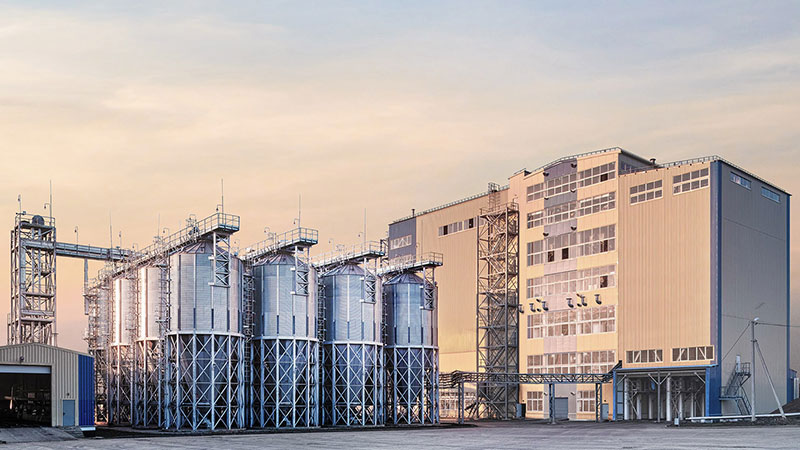
At RICHI, we go beyond project completion. With RICHI Servicee, we’re your dedicated partners in success. Count on us for expert guidance, minimal downtime, and optimized productivity. Choose RICHI for unmatched service and support.
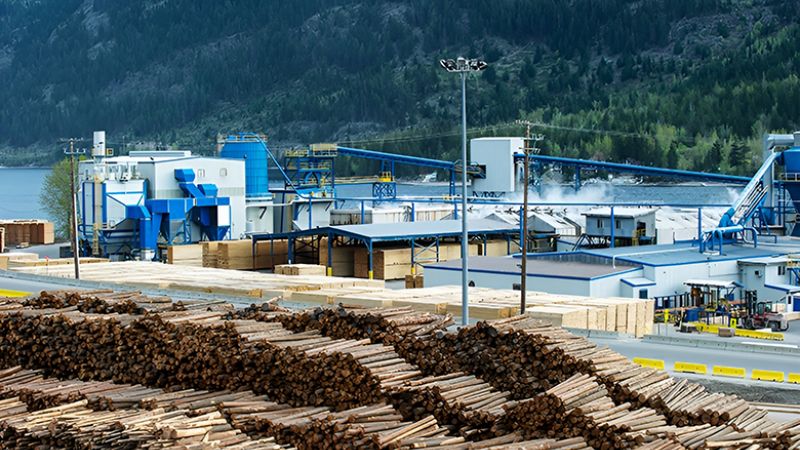


Meet global product demands and quality standards with industry-leading pellet plant design, engineering, equipment, and construction services for pellet processors.


Your Partner Beyond Project Completion
2000+ cases
RICHI is the leading designer, manufacturer and builder of pellet plants in the world, completing over 2000 projects in 140 countries across 6 continents.
Read More
Increase plant productivity, profitability, and safety by integrating high quality equipment into your pellet production line. Over the years, RICHI has become China's top pellet equipment manufacturer. At the same time, RICHI has established valuable partnerships with the world's leading component and raw material manufacturers to bring you the best there is in technology, automation, and efficiency in pelleting plant machinery.

For nearly 30 years, RICHI has been providing best-in-class pellet plant equipment and services to clients across a variety of industries, sizes, and needs. We pride ourselves on the knowledge and skill that each team member possesses – from our technical sales team to our process design engineers. You can count on RICHI Machinery to take your operation to the next level of innovation, quality, and success.
Need help with your pellet manufacturing plant project? Contact us today.
ANIMAL FEED
BIOMASS
WOOD
ORGANIC FERTILIZER
AQUA FEED
CAT LITTER
MUNICIPAL WASTE RECYCLING
SPECIAL PELLET PRODUCTION
RICHI Machinery continues to deliver world class pellet mill equipment, pellet plant engineering and project solutions that add value to our customers in the animal feed, wood waste, agriculture waste, organic fertilizer, cat litter and special pellet products industries. Throughout the years, we RICHI Machinery have built strong brand, becoming industry-leading pellet machine manufacturer. We value integrity, promise quality, and prioritize your success.
Learn MoreWith our expert team, we precisely implement your process engineering requirements in pellet mill and pelletizing plant systems. No matter which industry you’re in – we understand your needs and deliver solutions that meet the highest standards.
At RICHI, quality comes first. Our pellet making machine and related pellet line equipment undergo rigorous quality controls to ensure they meet the highest standards. Rely on products that are durable, safe, and efficient.
With decades of experience in pellet machine and pellet production line production, we have earned a reputation as a trusted partner in various industries. Our expertise allows us to cover a wide range of applications.
Not only do we offer premium pelleting equipment, but we are also experts at designing, building, installing, and maintaining facilities from the ground up. Our expertise is within pellt plant process design, discovering the most efficient, productive, and profitable way to handle your materials in an end-to-end cycle.
○ RICHI MACHINERY
Keeping in touch with us is an effective way to solve all your problems. If you have any needs or questions, please leave your contact information, then RICHI technical consultants will send design, quotation, videos to your mailbox. You can also contact us directly via WhatsApp: +86 13838389622
Copyright©2015-2026 by HENAN RICHI MACHINERY CO., LTD. All rights reserved.