
Discover a straw bale shredder in Uruguay for processing baled wheat and barley straw into 20–30 mm material for cattle feed preparation and livestock bedding. Explore the RICHI YPPK-2600, its technical features and single-machine investment advantages.
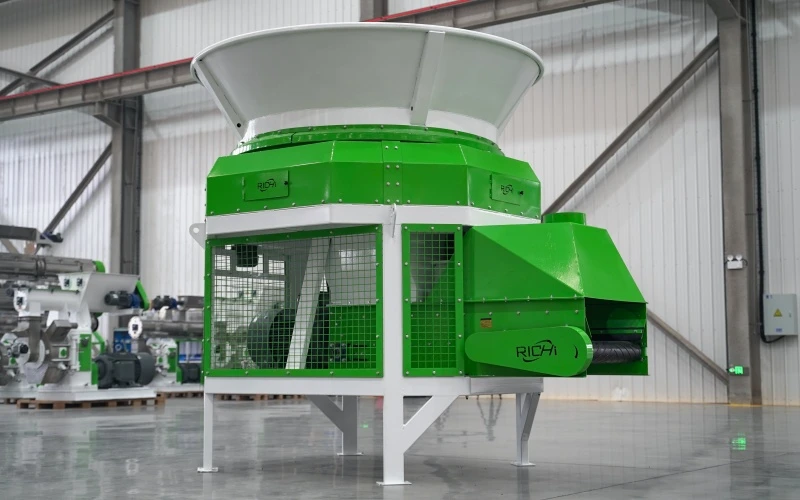
A straw bale shredder in Uruguay was selected for an agricultural raw-material processor supplying roughage to cattle farms and dairy operations. The business handles large round bales of wheat and barley straw collected from grain-growing areas and needs a more reliable way to prepare this material before it enters the next processing stage.
Rather than purchasing a complete straw processing line, the customer chose one RICHI YPPK-2600 disc-type bale shredder to work with the existing material-handling equipment.
The main reason for purchasing this machine was straightforward: intact straw bales were difficult to feed consistently into the customer's existing equipment, and manual dismantling created unnecessary handling work.
Name:
Straw bale shredder
Country:
Uruguay
Date:
2026
Capacity:
Flexible
Model:
YPPK-2600
Power:
55 kW
Equipment weight:
2.2 tonnes
Final product size:
20–30 mm
The new straw bale shredder is intended to open and coarsely shred the compressed bales into approximately 20–30 mm material. This gives the operator a more manageable feedstock for subsequent mixing, ration preparation or bedding distribution, depending on the final application. The project covers one machine, not a complete feed manufacturing plant.
Uruguay has a well-established cattle sector, with beef production and dairy farming forming important parts of its agricultural economy. Grain production also creates opportunities for collecting cereal straw after harvest. Although straw is not nutritionally equivalent to high-quality pasture or alfalfa, it can have a useful role in livestock operations when handled and used appropriately.
The customer in this project is a regional roughage processor serving commercial cattle farms and dairy producers. Its raw-material supply comes from nearby grain farms and agricultural contractors who bale crop residues after harvesting wheat and barley. Instead of leaving all the straw in the field or selling it only in intact bales, the processor wants to offer a prepared material that is easier for customers to handle and incorporate into their own operations.
The business already has facilities for unloading, storing and moving agricultural bales. What it lacks is a dedicated machine capable of accepting large, compressed bales and reducing them to a more manageable size. A conventional hammer mill is not necessarily the best first step when whole bales are still tightly compressed. The material must first be opened and coarsely shredded before any finer grinding is considered.
This is why a disc-type bale shredder was selected as a separate machine. It addresses the specific bottleneck at the raw-material preparation stage without requiring the customer to replace the existing equipment or invest in every downstream process at once.
The planned raw materials are baled wheat straw and barley straw collected from grain farms. Wheat straw is the principal material, while barley straw provides a secondary feedstock when it is available and meets the processor's purchasing specifications. This combination gives the customer some flexibility in sourcing seasonal crop residues without assuming that every bale has identical physical characteristics.
After grain harvest, cereal straw is typically collected, dried in the field as conditions permit, and compressed into bales for storage and sale. For this project, the intended material consists mainly of dry, mechanically baled cereal straw rather than freshly cut, wet green forage. Some variation in stalk length, bale density, moisture and the amount of leaves or broken material is expected between suppliers.
The planning assumption is that incoming bales will generally be around 1,200–1,500 mm in diameter, with moisture often targeted at approximately 12–16% for the dry-straw handling scenario. These are project planning assumptions, not verified measurements from a specific customer's warehouse. The actual bale dimensions and moisture should be checked before the machine is ordered and again when each new batch arrives. The selected machine's maximum stated processing diameter is 1,800 mm, so bales exceeding that limit would require a different handling arrangement or prior size reduction.
Raw-material inspection also matters for equipment life. Straw bales should be checked for stones, wire, foreign objects, excessive soil contamination and signs of mold. Twine or net wrap must be handled according to the machine's operating and safety procedures. Removing unsuitable contaminants before feeding helps reduce avoidable damage, downtime and contamination of the finished material.
For the expected bale size and the customer's initial processing requirements, the selected configuration is one RICHI YPPK-2600. This model is designed for coarse shredding of large-diameter baled and loose agricultural residues, including straw and alfalfa. The purpose is to break apart compressed material and produce a coarser, more uniform output suitable for downstream handling.
| Technical Item | Selected Specification |
|---|---|
| Equipment name | Straw bale shredder |
| Manufacturer | RICHI Machinery |
| Model | YPPK-2600 |
| Main motor power | 55 kW |
| Maximum processing diameter | 1,800 mm |
| Hammer quantity | 36 |
| Overall dimensions | 3,800 × 2,600 × 2,650 mm |
| Equipment weight | 2.2 tonnes |
| Typical target output size | Approximately 20–30 mm |
| Purchase quantity | One unit |
| Primary materials | Baled wheat straw and barley straw |
The YPPK-2600 Bale Breaker Machine was chosen rather than the larger YPPK-2800 because the planned bale diameter remains below the 1,800 mm limit of the smaller model. The 55 kW main drive and 36 hammers provide the specified mechanical configuration for this application. If the customer's future supply shifts toward larger bales approaching or exceeding 1,800 mm, the YPPK-2800, with its 90 kW motor and 2,050 mm maximum processing diameter, could be evaluated as an alternative.
A guaranteed hourly throughput has not been assigned to this project because the supplied specifications do not state a rated capacity in tonnes per hour. Actual output depends on bale density, straw variety, moisture, feeding rate, the condition of the material and the downstream size requirement. RICHI should confirm the expected throughput against the customer's actual straw samples and operating target rather than provide an unsupported production figure.
Whole straw bales are compact and difficult to meter directly into many downstream processing machines. Their compressed structure can cause irregular feeding, while long stalks may bridge over an inlet or move unevenly through a receiving hopper. These problems become more noticeable when a processor handles bales from multiple farms with different densities and tying methods.
The straw bale shredder creates a dedicated coarse-shredding stage. The operator positions suitable bales at the feed section, and the feeding mechanism guides the material toward the shredding area. The rotating hammers then break apart the compacted straw. Under suitable operating conditions, the target output is approximately 20–30 mm, although the actual particle distribution depends on the material and machine setup.
That reduction in size makes the straw easier to convey, blend or distribute. It also provides a more practical feedstock for subsequent processing equipment that cannot accept whole bales. The shredder is not a fine grinder, however. If the final product requires a much smaller particle size, a separate hammer mill or other suitable grinding machine may still be needed.
For the Uruguayan processor, this separation of duties is important. The bale shredder deals with the bulky raw material, while existing or future equipment can handle the next stage. The customer can therefore address the immediate handling problem without purchasing a larger integrated system before its actual processing demand is established.
The main planned outlet is coarse straw for livestock operations. In cattle and dairy farming, cereal straw can be used as a roughage component or as a bedding material, depending on its quality and the customer's requirements. These are different applications and should not be treated as interchangeable. Straw intended for a ration must be assessed by a nutritionist or feed specialist, while bedding material is evaluated more for absorbency, cleanliness, handling and suitability for the housing system.
For feed preparation, reducing long straw to a manageable size can make it easier to weigh, mix and combine with other ration ingredients. The shredded material may be considered for selected cattle rations where straw is appropriate as a fiber source. Its inclusion rate must be based on the animal's nutritional needs, the quality of the other feed ingredients and the feeding system. The shredder itself does not improve the nutritional value of straw simply by reducing its size.
For bedding, coarse shredded straw can be easier to spread than intact bales. Dairy farms and other cattle operations may use it in suitable housing areas where the material, moisture conditions and manure-management system are compatible. The required particle size and distribution may differ from those used for feed preparation, so the processor should confirm the target with each customer.
The processor may also evaluate other clean cereal straws when supply conditions change. Wheat and barley straw are the main materials for this project, but the YPPK series can also be used for suitable alfalfa bales and other agricultural residues. Each material should be assessed separately because fiber structure, moisture, bale compression and stalk length can affect feeding and shredding performance.
Straw bale processing places different demands on a machine from ordinary loose-material grinding. A bale may be tightly compressed, with stalks arranged in different directions. The feeding mechanism must engage the material effectively and guide it into the working area without relying on an operator to dismantle the entire bale by hand.
The YPPK series bale crusher machine uses a feeding arrangement based on an external chain and rotary cutting action. The design is intended to grip and draw material into the shredding zone, helping reduce dead areas where bulky straw might otherwise accumulate. A damping plate inside the crushing area improves material engagement and supports the shredding process.
The machine uses a heavy-duty housing and reinforced transmission chain to withstand repeated loads associated with agricultural residues. The hammer material is specified as No. 65 manganese steel, heat-treated to provide the required hardness. Tungsten-carbide hardfacing on the hammer heads is intended to improve wear resistance in demanding service.
These design details matter when the machine is processing a steady supply of bales over a long working period. Straw can contain abrasive dust and soil, and wear rates depend on how clean the raw material is and how many hours the equipment operates. Durable components can help manage maintenance costs, but regular inspection and timely replacement remain necessary.
The customer is purchasing one bale shredder, but the machine can be configured with auxiliary equipment where the site layout requires it. For this project, a feeding chain conveyor, discharge belt conveyor and dust-control system are potential options to review before the final layout is approved.
A feeding chain conveyor can help move bales toward the machine in a controlled manner, particularly when the operator needs to maintain a regular supply. A discharge belt conveyor can transfer shredded straw to a collection point or the next processing stage, reducing manual handling. Whether either conveyor is necessary depends on the customer's existing material-handling arrangements.
Dust control deserves attention because dry straw generates airborne particles during feeding and shredding. The appropriate arrangement depends on the building, ventilation, collection point and operating conditions. Dust extraction should be designed with the material's combustible-dust characteristics in mind, alongside housekeeping, ignition-source control and the relevant local safety requirements. A dust collector should not be selected solely by appearance or nominal fan power; its capacity and protection measures need to suit the installation.
The plant layout should also leave sufficient clearance for bale handling, inspection, routine cleaning and hammer replacement. The machine's dimensions are only part of the space requirement: the operator needs a safe area for loading and maintenance as well.
The customer's investment decision was based on a specific operational bottleneck rather than a plan to establish an entirely new factory. Existing facilities already provide the basic functions of bale receiving, storage and movement. The missing step is the mechanical opening and coarse shredding of the compressed straw.
Purchasing a single straw bale shredder keeps the initial project focused. It allows the processor to begin preparing straw for its existing customers, measure actual daily demand and determine whether a separate grinding or mixing stage is justified later. This approach also avoids paying for equipment that may remain underused while the customer is still developing the market for processed straw.
Another consideration is raw-material variability. Straw supply changes with harvest conditions, farm practices and seasonal availability. A dedicated bale shredder gives the operator a defined place to manage bulky residues before deciding how each batch should be used. If demand increases, conveyors or downstream equipment can be considered based on measured throughput rather than estimates alone.
For a single-machine purchase, careful preparation is just as important as the equipment specification. RICHI can review the planned bale dimensions, the condition of the straw, the intended output size and the available space before finalizing the configuration. This information helps establish whether the YPPK-2600 is suitable or whether the larger model should be considered.
The installation review should cover the foundation or supporting surface, electrical supply, bale-loading arrangement, discharge location and maintenance access. The customer should also confirm how the machine will be lifted and positioned, where operators will stand during feeding and how the shredded material will be removed safely.
Before the first production run, the operating team should inspect the machine, check mechanical connections and follow the manufacturer's startup procedure. Initial feeding should be controlled rather than immediately loading the machine at the highest possible rate. Operators can then observe how the particular straw behaves and adjust the feeding arrangement within the recommended operating limits.
RICHI can also provide guidance on routine inspection, hammer wear, chain maintenance and safe shutdown. These practices are particularly relevant for agricultural processors because incoming materials vary in cleanliness and physical condition. A consistent maintenance routine helps the customer identify abnormal wear or feeding problems before they lead to longer downtime.
The planned shipping port in Uruguay is the Port of Montevideo, with the machine dispatched from Qingdao Port in China. The final sailing schedule, transit arrangements and port handling details should be confirmed with the freight forwarder before shipment.
Before dispatch, the receiving site should prepare a clear route for unloading and positioning the equipment. The installation area should be ready, the required electrical connection should be checked and any optional conveyor interfaces should be agreed in advance. Completing these preparations reduces the chance of avoidable delays after the machine reaches Uruguay.
The most meaningful evaluation of this straw bale shredder will come from the customer's actual operating experience. The key questions are whether the machine handles the expected bale sizes, whether it produces material within the required 20–30 mm target range and whether the feeding process is manageable with the available labor and handling equipment.
No verified customer quotation or commissioning report has been provided for this project profile, so an invented testimonial is not presented as a real customer statement. After startup, the operator's feedback can be documented against specific observations: feeding consistency, ease of removing shredded material, access to wear parts, dust levels and the maintenance work required during normal operation.
Recording these points is useful not only for the buyer but also for future customers evaluating a straw bale shredder. A short, evidence-based operating report is more valuable than a general claim that the machine performs well, especially when it includes the raw-material type, approximate bale dimensions, operating hours and observed output characteristics.
This straw bale shredder in Uruguay is designed around the needs of a roughage processor that wants to turn compressed cereal straw into a more manageable raw material. The selected RICHI YPPK-2600 has a 55 kW main motor, a maximum processing diameter of 1,800 mm and 36 hammers, with a target coarse output size of approximately 20–30 mm.
Its role is specific: to open and shred baled wheat and barley straw before further handling or use. It is not a complete feed production line, and it does not replace the need for nutritional assessment when the material is intended for cattle rations. For bedding applications, the final material should likewise meet the customer's cleanliness and handling requirements.
For agricultural businesses facing a similar problem, the first step is to confirm bale diameter, moisture, material condition and the required output size. RICHI Machinery can then help assess the appropriate model, review auxiliary conveying and dust-control needs, and plan how the machine will fit into the existing operation. A properly matched single-machine investment can address a practical processing bottleneck while leaving room for future expansion when demand justifies it.
Having the right mix of reliable, high-quality pellet machine and pelletizing systems and expert support is essential to your success. Watch how our end-to-end feed pellet plant solutions have helped our customers optimize their performance.
Our customized and future-proofed turnkey pellet plant solutions is designed with you at the core. From vision to reality and beyond, our team stays connected with yours. Giving you peace-of-mind with an expert at your side.

At RICHI, we go beyond project completion. With RICHI Servicee, we’re your dedicated partners in success. Count on us for expert guidance, minimal downtime, and optimized productivity. Choose RICHI for unmatched service and support.



Meet global product demands and quality standards with industry-leading pellet plant design, engineering, equipment, and construction services for pellet processors.


Your Partner Beyond Project Completion
2000+ cases
RICHI is the leading designer, manufacturer and builder of pellet plants in the world, completing over 2000 projects in 140 countries across 6 continents.
Read More
Increase plant productivity, profitability, and safety by integrating high quality equipment into your pellet production line. Over the years, RICHI has become China's top pellet equipment manufacturer. At the same time, RICHI has established valuable partnerships with the world's leading component and raw material manufacturers to bring you the best there is in technology, automation, and efficiency in pelleting plant machinery.

For nearly 30 years, RICHI has been providing best-in-class pellet plant equipment and services to clients across a variety of industries, sizes, and needs. We pride ourselves on the knowledge and skill that each team member possesses – from our technical sales team to our process design engineers. You can count on RICHI Machinery to take your operation to the next level of innovation, quality, and success.
Need help with your pellet manufacturing plant project? Contact us today.
ANIMAL FEED
BIOMASS
WOOD
ORGANIC FERTILIZER
AQUA FEED
CAT LITTER
MUNICIPAL WASTE RECYCLING
SPECIAL PELLET PRODUCTION
RICHI Machinery continues to deliver world class pellet mill equipment, pellet plant engineering and project solutions that add value to our customers in the animal feed, wood waste, agriculture waste, organic fertilizer, cat litter and special pellet products industries. Throughout the years, we RICHI Machinery have built strong brand, becoming industry-leading pellet machine manufacturer. We value integrity, promise quality, and prioritize your success.
Learn MoreWith our expert team, we precisely implement your process engineering requirements in pellet mill and pelletizing plant systems. No matter which industry you’re in – we understand your needs and deliver solutions that meet the highest standards.
At RICHI, quality comes first. Our pellet making machine and related pellet line equipment undergo rigorous quality controls to ensure they meet the highest standards. Rely on products that are durable, safe, and efficient.
With decades of experience in pellet machine and pellet production line production, we have earned a reputation as a trusted partner in various industries. Our expertise allows us to cover a wide range of applications.
Not only do we offer premium pelleting equipment, but we are also experts at designing, building, installing, and maintaining facilities from the ground up. Our expertise is within pellt plant process design, discovering the most efficient, productive, and profitable way to handle your materials in an end-to-end cycle.
○ RICHI MACHINERY
Keeping in touch with us is an effective way to solve all your problems. If you have any needs or questions, please leave your contact information, then RICHI technical consultants will send design, quotation, videos to your mailbox. You can also contact us directly via WhatsApp: +86 13838389622
Copyright©2015-2026 by HENAN RICHI MACHINERY CO., LTD. All rights reserved.