
Shrimp juvenile feed crumbler in the United Arab Emirates for producing 0.3–1.2 mm shrimp feed crumbles. Explore the RICHI SSLG25*170X three-roll crumbler for existing aquafeed production lines.
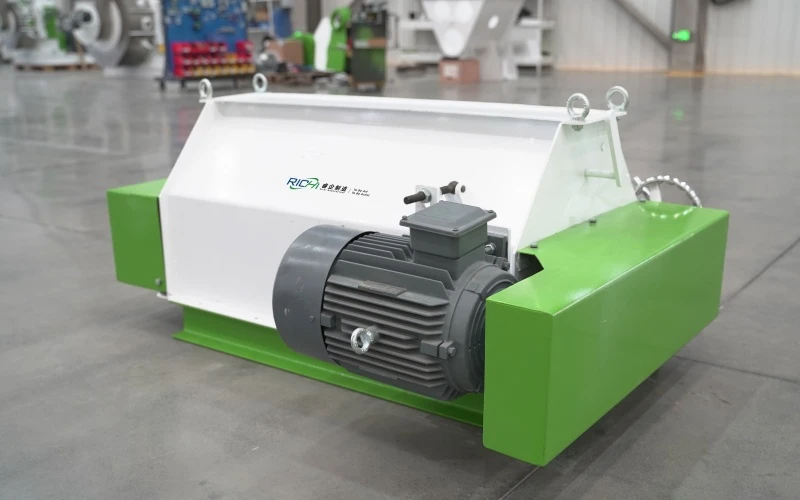
Shrimp juvenile feed crumbler in the United Arab Emirates was selected for a commercial aquafeed manufacturer seeking a practical way to produce smaller feed particles without replacing its existing pellet production equipment. The customer serves shrimp farming operations that require different feed sizes at different growth stages.
Its current production setup can manufacture sinking shrimp feed pellets, but the available product range does not adequately cover the smaller crumble grades needed for selected juvenile feeding programs. Rather than purchasing a complete new production line, the customer decided to add one RICHI SSLG25*170X three-roll shrimp feed crumbler.
Name:
shrimp feed pellet crumbler
Country:
United Arab Emirates
Date:
2026
Capacity:
Flexible
Model:
SSLG25*170X
Power:
18.5 + 1.1 kW
Roll arrangement:
Three rolls
Target crumble size:
0.3–1.2mm
The project focuses on processing finished sinking shrimp feed pellets measuring approximately 1.2–1.5 mm into smaller crumbles within a target range of 0.3–1.2 mm. The new machine is intended to work as a separate downstream unit, using pellets produced by the customer's existing line.
With three rolls and a finer tooth arrangement designed specifically for shrimp feed, the SSLG25*170X provides a dedicated size-reduction option for juvenile feed products. The investment allows the manufacturer to explore additional feed grades while keeping its existing raw-material handling, mixing, conditioning and pelleting equipment in service.
The customer is a commercial aquafeed producer supplying shrimp farms and related aquaculture businesses in the United Arab Emirates. Its business depends not only on producing feed efficiently, but also on offering physical feed formats that suit different farming requirements. A pellet suitable for larger shrimp is not automatically appropriate for every juvenile feeding stage.
Shrimp aquaculture has an established commercial presence in the UAE, although the country's hot climate and water-management requirements make production conditions different from those in many traditional shrimp-farming regions. Commercial farms and developing land-based aquaculture projects need reliable feed supplies, and feed manufacturers must be prepared to serve specific customer requirements rather than rely on a single standard pellet size. The UAE has also pursued land-based shrimp aquaculture projects, including projects associated with Jebel Ali.
For this customer, the immediate issue is the lack of a convenient process for producing small shrimp feed crumbles from its existing pellet output. Buying a complete juvenile shrimp feed line would require additional investment in equipment that the factory already owns. The more targeted solution is to retain the existing pellet mill and install a specialized crumbler for the selected products.
This approach also allows the factory to keep its regular sinking shrimp feed production schedule. Only the batches intended for juvenile crumble feed need to pass through the new machine. The customer can therefore introduce a new product format without automatically routing all conventional pellets through an additional processing stage.
The selected model is the RICHI SSLG25*170X three-roll shrimp feed pellet crumbler machine. The X configuration is designed for shrimp feed and uses finer crushing teeth than the standard crumbler configuration for ordinary livestock and poultry feed. This is an important distinction for a project where the finished product needs to be substantially smaller than the incoming pellets.
| Parameter | Selected Specification |
|---|---|
| Equipment type | Three-roll shrimp feed pellet crumbler |
| Model | SSLG25*170X |
| Drive power | 18.5 + 1.1 kW |
| Roll diameter | 25 cm |
| Roll length | 170 cm |
| Roll arrangement | Three rolls |
| Incoming material | Finished sinking shrimp feed pellets, approximately 1.2–1.5 mm |
| Target crumble size | 0.3–1.2 mm |
| Purchase quantity | One machine |
The selected machine is larger in roll length than the SSLG25*140X model, making it a distinct configuration for this project. However, the supplied specifications do not include a rated hourly capacity for either model. A firm throughput figure should therefore be confirmed with RICHI based on pellet hardness, diameter, formula characteristics, operating settings and the required percentage of acceptable crumbles.
Before the order is finalized, the customer should provide representative samples of its existing pellets and confirm the intended product grades. This allows the equipment selection to be reviewed against the actual feed rather than relying only on nominal particle sizes. The factory should also confirm installation height, feeding and discharge arrangements, electrical connections and maintenance access.
The incoming material is already-finished sinking shrimp feed. A representative formula may include fishmeal, soybean meal, wheat flour or another suitable starch source, oils, vitamin and mineral premixes, and other ingredients selected by the feed formulator. The exact formula depends on the shrimp species, growth stage, nutritional targets and manufacturing practice. The crumbler does not require a universal recipe; it is selected according to the physical properties of the pellets that need to be processed.
For this project, the assumed incoming pellet diameter is approximately 1.2–1.5 mm. The machine breaks these pellets into smaller fragments, targeting a finished crumble range of 0.3–1.2 mm. The output is still formulated shrimp feed, not a newly ground raw-material meal.
That distinction matters because the machine's task is mechanical size reduction. It does not independently improve the nutritional value of the feed or replace the formulation, mixing, conditioning and pelleting stages. The main benefit is the ability to convert selected pellet batches into a smaller physical format for an additional product grade.
Not every fragment leaving the crumbler will necessarily fall within the target range. Some material may remain oversized, while some may become finer than required. For this reason, the factory should evaluate the output with suitable sieves and establish acceptable proportions for each size fraction. A screening stage may be needed to separate the desired crumbles from oversize material and excessive fines.
Feed particle size must be matched to the intended animal and feeding stage. Juvenile shrimp may require smaller particles than those supplied in conventional grow-out pellets, but there is no single particle size that suits every shrimp species, body size or production system. The target range of 0.3–1.2 mm in this project is therefore a product-development specification to be verified by the customer's nutrition and production teams.
For the manufacturer, the new crumbler creates a way to offer a small-particle product alongside its regular sinking pellets. This may help serve farms that prefer smaller feed particles for particular stages of juvenile development. The actual feeding recommendation should still be based on the farm's stocking conditions, animal size, feeding behavior and technical guidance.
Physical consistency is as important as the nominal size. If the crumble contains too many large fragments, the feed may not meet the intended grade. If excessive fines are generated, handling becomes more difficult and small particles may disperse rapidly in water. Both outcomes can affect product acceptance and feeding management.
Water stability should also be evaluated after crumbling. The original pellet may have been formulated and processed to achieve a particular level of durability, but breaking it into smaller pieces changes the exposed surface area and the way particles behave in water. The customer should therefore assess the finished crumble for particle distribution, durability and suitability for the intended feeding conditions before approving it for commercial supply.
RICHI's crumbler range includes double-roll and three-roll configurations. The double-roll models are intended for conventional livestock and poultry feed crumbling, while the X-type three-roll models are specifically designed for shrimp feed and can produce crumbles in the 0.3–1.2 mm range.
The three-roll arrangement is useful for this project because it supports more uniform feeding through the crumbling process. The finer crushing teeth are also relevant when the required product is much smaller than a conventional poultry or pig feed crumble. Rather than selecting a general-purpose machine and assuming it will meet the same requirements, the customer can start with a model intended for shrimp feed.
The SSLG25*170X also provides a defined mechanical processing stage that can be integrated into the existing plant. The factory can direct selected pellet batches to the crumbler while leaving conventional feed products on their normal route. This helps limit unnecessary handling and gives production staff greater flexibility when scheduling different feed grades.
The final performance still depends on the incoming material and operating conditions. Pellet hardness, moisture, binder characteristics and formula composition can all affect how pellets fracture. Representative trials and particle-size testing are therefore essential for confirming the operating procedure and determining the actual acceptable output rate.
The existing shrimp feed production line remains responsible for raw-material receiving, ingredient preparation, batching, mixing, conditioning and pellet production. The SSLG25*170X is added downstream as a separate machine for batches that require further size reduction.
Depending on the factory layout, finished pellets can be transferred to the crumbler by a conveyor or another suitable feeding arrangement. After crumbling, the material may pass through a screening unit before being sent to the appropriate packing or storage point. The exact layout should be confirmed during engineering review rather than assumed from the machine model alone.
This configuration gives the customer a straightforward way to trial new juvenile feed grades. Conventional pellets can continue to be produced for larger shrimp, while selected batches can be crumbled to smaller sizes. If demand changes, the factory can adjust the proportion of production assigned to each grade without replacing the main pellet mill.
Before installation, the customer should check the available floor space, feeding and discharge elevations, electrical supply, access for inspection and the handling route for different product grades. Dust control and cleaning arrangements should also be considered where appropriate. The machine should be positioned so that operators can inspect the rolls and carry out routine maintenance without disrupting adjacent equipment.
The target range of 0.3–1.2 mm needs to be translated into a practical quality specification. A nominal range alone does not show how much of the output falls within the desired grade. The customer should establish the acceptable proportion of target-size crumbles, the maximum permitted oversize fraction and the limit for excessive fines.
During commissioning, representative incoming pellets should be processed and samples collected from the discharge. Sieving can then be used to measure the size distribution. If the result does not meet the target, the operating settings and incoming pellet characteristics should be reviewed with the technical team.
It is also important to distinguish the total amount of material processed from the amount that meets the finished-product specification. For example, a batch may pass through the machine successfully but still require screening or reprocessing before it can be released as juvenile feed. The factory should therefore record both throughput and acceptable-product yield during trials.
Since no rated capacity is provided in the supplied model specifications, the project's hourly output should be confirmed through technical consultation or representative testing. This avoids building the production schedule around an unsupported capacity assumption.
The crumbler is a mechanical size-reduction machine, so the condition of its rolls and crushing teeth has a direct influence on the finished product. Regular inspection should cover the roll surfaces, drive components, feeding consistency and discharge area. Changes in particle distribution, unusual noise or abnormal vibration should prompt an inspection before the machine continues operating.
Cleaning is particularly important when the factory handles multiple shrimp feed formulas. Ingredient carryover can affect product identity and quality, so a documented cleaning and changeover procedure should be established. The procedure should follow the plant's feed safety requirements and the manufacturer's maintenance instructions.
A dedicated crumbler can also simplify maintenance planning because it is a separate unit rather than an integral part of the pellet mill. Operators can inspect and service the machine as a distinct work area. The expected service life of rolls and wear parts will depend on the materials processed, operating hours and maintenance practices; it should be assessed from actual operating conditions rather than assumed in advance.
For this project, equipment selection should begin with the customer's actual pellets and target crumble specification. RICHI can review the incoming pellet size, discuss the required output range, confirm the SSLG25*170X configuration and help assess the proposed installation arrangement.
Technical preparation can also cover the machine's electrical requirements, feeding and discharge connections, access for roll maintenance and the screening arrangement needed to meet the finished-product specification. These details are particularly important when a standalone machine is added to an existing line with limited space and an established material flow.
During initial operation, the customer should record the particle-size distribution, acceptable output, amount of oversize material, fines generation and any changes needed to the operating procedure. These results provide a practical basis for deciding whether the machine meets the intended requirement and for standardizing subsequent batches.
For manufacturers planning similar upgrades, a useful first step is to share a sample or specification of the existing pellets, the required crumble size and the expected operating schedule. This information helps the equipment supplier evaluate the application before the purchase is finalized.
The equipment is planned for sea shipment from Qingdao Port in China to Jebel Ali Port in Dubai, a major UAE port handling container and general cargo. The final shipping arrangement should be confirmed with the freight forwarder based on the cargo dimensions, delivery schedule and receiving location.
Before dispatch, the customer should confirm the receiving area's dimensions, unloading arrangements, electrical requirements and installation access. The production team should also prepare the feeding and discharge connections so that the crumbler can be integrated into the existing workflow after arrival.
RICHI can provide the relevant equipment documentation and installation information to support preparation before shipment. Confirming these practical details in advance helps reduce avoidable delays during installation and initial commissioning.
For this type of investment, the most useful feedback comes from the factory's actual operating results. The production team should assess whether the SSLG25*170X can process the selected pellets into the required juvenile crumble grade, whether the target-size fraction is consistent and whether excessive fines can be kept within the agreed limit.
The customer should also evaluate how the new machine fits into the existing production schedule. If selected batches can be processed without disrupting conventional pellet production, the factory gains an additional product option while retaining its established manufacturing process.
Acceptance should be based on measurable results, including particle-size distribution, product yield, ease of operation, cleaning requirements and maintenance access. Any direct customer quotation published after the project should reflect feedback actually received from the buyer rather than a fabricated testimonial.
The shrimp juvenile feed crumbler in the United Arab Emirates project is designed around a specific production need: adding a small-particle shrimp feed grade without purchasing a complete new production line. One RICHI SSLG25*170X three-roll shrimp feed crumbler is selected to process approximately 1.2–1.5 mm finished sinking pellets into a target crumble range of 0.3–1.2 mm.
With an 18.5 + 1.1 kW drive configuration, 25 cm roll diameter, 170 cm roll length and three-roll arrangement, the selected model is intended for shrimp-specific crumbling. Its performance must be verified using the customer's actual pellets, with particular attention to particle distribution, acceptable-product yield and the amount of fines generated.
The value of this investment lies in adding a dedicated processing step rather than replacing equipment that already performs its job. For aquafeed manufacturers considering a similar upgrade, RICHI Machinery can help review the application, confirm the model configuration and prepare for installation and commissioning. The next step is to define the incoming pellet characteristics, target crumble specification and required production schedule so that the machine can be evaluated against the factory's actual needs.
Having the right mix of reliable, high-quality pellet machine and pelletizing systems and expert support is essential to your success. Watch how our end-to-end feed pellet plant solutions have helped our customers optimize their performance.
Our customized and future-proofed turnkey pellet plant solutions is designed with you at the core. From vision to reality and beyond, our team stays connected with yours. Giving you peace-of-mind with an expert at your side.

At RICHI, we go beyond project completion. With RICHI Servicee, we’re your dedicated partners in success. Count on us for expert guidance, minimal downtime, and optimized productivity. Choose RICHI for unmatched service and support.



Meet global product demands and quality standards with industry-leading pellet plant design, engineering, equipment, and construction services for pellet processors.


Your Partner Beyond Project Completion
2000+ cases
RICHI is the leading designer, manufacturer and builder of pellet plants in the world, completing over 2000 projects in 140 countries across 6 continents.
Read More
Increase plant productivity, profitability, and safety by integrating high quality equipment into your pellet production line. Over the years, RICHI has become China's top pellet equipment manufacturer. At the same time, RICHI has established valuable partnerships with the world's leading component and raw material manufacturers to bring you the best there is in technology, automation, and efficiency in pelleting plant machinery.

For nearly 30 years, RICHI has been providing best-in-class pellet plant equipment and services to clients across a variety of industries, sizes, and needs. We pride ourselves on the knowledge and skill that each team member possesses – from our technical sales team to our process design engineers. You can count on RICHI Machinery to take your operation to the next level of innovation, quality, and success.
Need help with your pellet manufacturing plant project? Contact us today.
ANIMAL FEED
BIOMASS
WOOD
ORGANIC FERTILIZER
AQUA FEED
CAT LITTER
MUNICIPAL WASTE RECYCLING
SPECIAL PELLET PRODUCTION
RICHI Machinery continues to deliver world class pellet mill equipment, pellet plant engineering and project solutions that add value to our customers in the animal feed, wood waste, agriculture waste, organic fertilizer, cat litter and special pellet products industries. Throughout the years, we RICHI Machinery have built strong brand, becoming industry-leading pellet machine manufacturer. We value integrity, promise quality, and prioritize your success.
Learn MoreWith our expert team, we precisely implement your process engineering requirements in pellet mill and pelletizing plant systems. No matter which industry you’re in – we understand your needs and deliver solutions that meet the highest standards.
At RICHI, quality comes first. Our pellet making machine and related pellet line equipment undergo rigorous quality controls to ensure they meet the highest standards. Rely on products that are durable, safe, and efficient.
With decades of experience in pellet machine and pellet production line production, we have earned a reputation as a trusted partner in various industries. Our expertise allows us to cover a wide range of applications.
Not only do we offer premium pelleting equipment, but we are also experts at designing, building, installing, and maintaining facilities from the ground up. Our expertise is within pellt plant process design, discovering the most efficient, productive, and profitable way to handle your materials in an end-to-end cycle.
○ RICHI MACHINERY
Keeping in touch with us is an effective way to solve all your problems. If you have any needs or questions, please leave your contact information, then RICHI technical consultants will send design, quotation, videos to your mailbox. You can also contact us directly via WhatsApp: +86 13838389622
Copyright©2015-2026 by HENAN RICHI MACHINERY CO., LTD. All rights reserved.