
Shrimp feed crumble unit in Saudi Arabia for producing 0.3–1.2 mm shrimp feed crumbles. Discover the RICHI SSLG25*140X three-roll crumbler, designed for uniform feeding, controlled size reduction and integration with existing shrimp feed production lines.
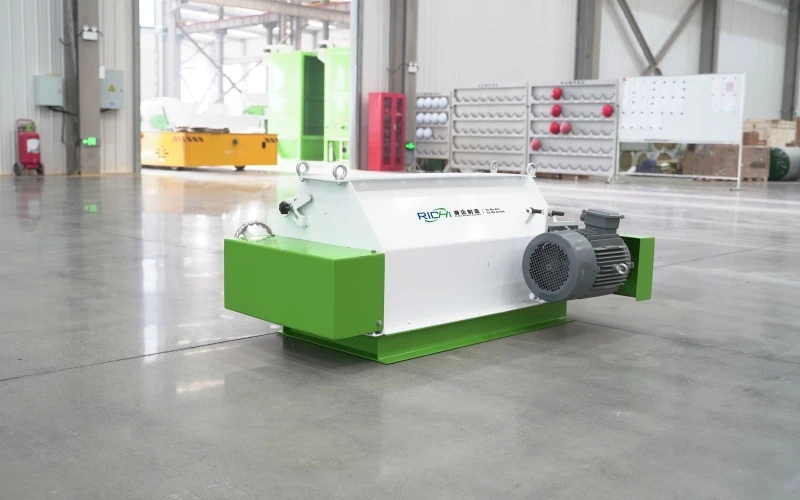
Shrimp feed crumble unit in Saudi Arabia was selected for a commercial aquafeed producer looking to add smaller feed grades to its existing shrimp feed range. The customer already operates a sinking shrimp feed production line, but its current process is primarily arranged around conventional pellets for larger shrimp.
As demand develops for nursery and early-growth feed, the factory needs a reliable way to turn selected finished pellets into smaller, more manageable particles without investing in an entirely new production line. The project therefore involves purchasing one RICHI SSLG25*140X three-roll shrimp feed crumbler as an additional processing machine.
Name:
shrimp feed crumbler
Country:
Saudi Arabia
Date:
2026
Capacity:
Flexible
Model:
SSLG25*140X
Power:
11 + 1.1 kW
Number of rolls:
3
Final product size:
0.3–1.2mm
The new unit is intended to reduce approximately 1.5–2.0 mm shrimp feed pellets into crumbles in the 0.3–1.2 mm range, with the final size distribution adjusted to the customer's product requirements. The equipment uses three rolls and a finer crushing-tooth arrangement specifically designed for shrimp feed.
Its purpose is not to manufacture feed from raw ingredients or replace the shrimp feed pellet machine, but to add a dedicated size-reduction stage after pellet production. This approach allows the Saudi Arabian feed manufacturer to expand its product range while making use of its existing mixing, conditioning, pelleting and material-handling facilities.
The customer in this project is a commercial aquafeed manufacturer serving shrimp farms and aquaculture businesses. Its existing production operation is designed to manufacture sinking shrimp pellets from formulated ingredients. The company wants to supply a broader range of feed sizes, particularly for younger shrimp that require smaller particles than those used in later growth stages.
Saudi Arabia has invested in aquaculture development, including marine shrimp farming along its Red Sea coast. In this market, feed selection needs to account for the species being cultured, shrimp size, feeding behavior, water conditions and the farm's production system. Feed suppliers must therefore consider more than the total tonnage of pellets produced. The ability to supply different particle sizes can also be commercially important.
For the customer, the immediate challenge is a gap between its existing pellet sizes and the smaller particles required for selected nursery feeding programs. Producing these smaller grades directly on the existing line may require adjustments to the process, additional screening or a dedicated crumbling stage. Purchasing another complete shrimp feed production line would involve substantially more equipment than the current requirement justifies.
A standalone shrimp feed crumbler offers a more targeted solution. The existing pellet mill continues producing the base pellets, while the new machine processes selected batches into smaller crumbles. The factory can introduce the new feed grade without replacing its core production equipment or changing every stage of the manufacturing process.
The selected machine is the RICHI SSLG25*140X, a three-roll pellet crumbler designed specifically for shrimp feed. The X-type configuration uses finer crushing teeth than a conventional livestock and poultry feed crumbler, allowing the machine to produce smaller shrimp feed crumbles. This distinction matters because shrimp feed requires a controlled particle size suitable for the intended feeding stage.
| Parameter | Project Configuration |
|---|---|
| Equipment | Three-roll shrimp feed crumbler |
| Model | SSLG25*140X |
| Drive power | 11 + 1.1 kW |
| Roll diameter | 25 cm |
| Roll length | 140 cm |
| Number of rolls | 3 |
| Incoming material | Selected finished sinking shrimp feed pellets, approximately 1.5–2.0 mm |
| Target crumble size | 0.3–1.2 mm |
| Purchase quantity | 1 unit |
The 11 + 1.1 kW drive configuration is taken from the supplied model specifications. The source specifications do not provide a rated hourly capacity for this particular machine. Therefore, no unsupported tonnes-per-hour figure is assigned to the project. Actual throughput should be confirmed with RICHI based on the incoming pellet diameter, pellet hardness, binder and formula characteristics, required particle-size distribution and acceptable fines content.
Before finalizing the order, the manufacturer and customer should also confirm the connection points, feeding height, discharge arrangement, installation space and compatibility with the existing conveyor or elevator. These checks are important when a single machine is being inserted into an operating production line rather than installed as part of a new factory.
The incoming material is assumed to be a sinking shrimp feed pellet manufactured by the customer's existing production line. A representative product may contain fishmeal, soybean meal, wheat flour or other suitable starch sources, oil, mineral and vitamin premixes, and other ingredients selected for the intended shrimp species and growth stage. The exact formula belongs to the feed manufacturer and should not be inferred from the crumbler specifications.
The project uses approximately 1.5–2.0 mm finished pellets as the starting material. These are not raw ingredients waiting to be ground. They have already passed through formulation, mixing, conditioning and pelleting. The crumbler performs a secondary mechanical operation, breaking the pellets into smaller pieces while retaining the formulated feed as the basis of the final product.
The intended output range is 0.3–1.2 mm. This range covers multiple small particle grades, rather than one uniform particle size. The actual grade selected for each product should correspond to the shrimp's feeding stage and the customer's product specification. Very young shrimp and larger juveniles do not necessarily require the same particle distribution.
Because the machine breaks existing pellets rather than grinding raw materials into powder, the characteristics of the incoming pellets affect the result. Pellet hardness, moisture, binder properties, diameter and mechanical strength can all influence how the material fractures. Trial processing is therefore valuable before a commercial specification is fixed.
RICHI offers both double-roll and three-roll pellet crumbler configurations. The double-roll SSLG series is intended for ordinary livestock and poultry feed crumbling, while the X-type three-roll configuration is designed specifically for shrimp feed and its finer particle requirements.
Compared with a conventional double-roll machine, the three-roll arrangement supports more uniform feeding through the crumbling process. The structure remains relatively straightforward, and the roll-based mechanism allows finished pellets to be broken down without introducing a separate fine-grinding stage for every batch.
For the Saudi Arabian project, the finer crushing teeth are particularly relevant. Shrimp feed crumbles must be suitable for the intended animals and feeding conditions. Oversized fragments may be unsuitable for the target grade, while excessive fines can affect handling, feeding behavior and water quality. The objective is not simply to break pellets apart, but to produce a usable particle distribution.
The three-roll shrimp feed crumbler provides a dedicated mechanical step between pellet production and final product handling. Depending on the existing factory arrangement, the process may also include screening to separate acceptable crumbles from oversized pieces and excessive fines. Any oversize return or fines-management procedure should be designed around the manufacturer's quality requirements and the customer's feed safety procedures.
The main commercial reason for this investment is to expand the factory's range of small-particle shrimp feed. Depending on the shrimp species, production system and formulation, smaller crumbles may be used in selected nursery or early-growth feeding programs. The appropriate particle size should be determined by the feed formulation team and the farm's feeding requirements rather than applied as a universal specification.
For a commercial shrimp feed manufacturer, a dedicated crumble grade can help bridge the gap between very fine starter feeds and conventional pellets. It also gives the factory another product format to offer existing customers. Instead of requiring every farm to purchase the same pellet size, the manufacturer can develop a more differentiated product range around the needs of its target customers.
The crumbler does not determine the nutritional quality of the feed. Protein level, amino acid balance, lipid content, mineral composition, water stability and other formulation parameters remain dependent on the original feed formula and its manufacturing process. The machine changes the physical size of the finished product; it does not independently improve its nutrient profile.
Water stability deserves particular attention in shrimp aquaculture. Smaller particles can behave differently in water from intact pellets, and excessive fines may disperse more readily. The factory should test the finished crumbles for particle distribution, durability, handling losses and suitability for the intended feeding system before commercial release.
The customer's existing production line remains responsible for receiving raw materials, grinding ingredients where necessary, batching, mixing, conditioning and producing finished shrimp feed pellets. The SSLG25*140X is added as a separate downstream operation for selected products.
Depending on the plant layout, finished pellets can be diverted to the crumbler when a smaller feed grade is required. The resulting crumbles may then pass through a screening stage before being transferred to the appropriate packing or storage equipment. The final arrangement depends on whether the customer plans to produce small-particle feed in dedicated batches or process a portion of its existing output.
This single-machine approach gives the customer flexibility in scheduling production. Conventional pellets can continue to be manufactured for larger shrimp, while selected batches can be processed into smaller crumbles. The plant does not need to route every tonne of feed through the crumbler, which can help avoid unnecessary handling and additional wear.
Before installation, the layout should account for the machine's feeding and discharge elevations, access for roll inspection, electrical connections, operator clearance and the method used to separate different feed grades. If the crumbler is installed on an existing line, the material transfer arrangement should prevent unnecessary pellet damage before the intended crumbling stage.
For shrimp feed, the nominal target of 0.3–1.2 mm is only the starting point for product control. A commercial specification should define the acceptable proportion of material in each size fraction and the maximum permissible amount of fines. Those limits will depend on the intended feed grade and the customer's quality standards.
Incoming pellets should be checked for consistency before crumbling trials begin. If the pellets vary significantly in diameter, hardness or moisture, the resulting crumbles may also vary. Using a representative batch helps the customer determine whether the selected machine and operating settings can meet the required specification.
After processing, samples should be collected from the discharge and evaluated using suitable sieves. This helps distinguish the main crumble fraction from oversized fragments and fine material. The operator can then review the results with the technical team and establish the most appropriate operating procedure for each product grade.
Material testing also helps the customer make a realistic production plan. Since the supplied specifications do not state the hourly capacity of the SSLG25*140X, a throughput target should be established through manufacturer confirmation or representative trials. The factory should evaluate both the quantity processed and the proportion of material that meets the final particle-size specification.
A pellet crumbler operates under repeated mechanical contact with finished feed pellets. The condition of the rolls and their teeth can influence crumbling performance, so inspection and maintenance are important parts of routine production.
The three-roll arrangement is designed to provide controlled feeding and size reduction. Operators should nevertheless check the roll surfaces, feeding consistency, drive components and discharge area according to the manufacturer's maintenance instructions. Abnormal noise, vibration or a change in the particle distribution should be investigated rather than ignored.
Because the machine is dedicated to shrimp feed, cleaning and product changeover also require attention. Different formulas may contain different ingredient combinations, and carryover between batches can affect product identity and quality. Cleaning procedures should be established according to the plant's feed safety system, especially when switching between products with different formulations or customer specifications.
Routine inspection is generally easier to plan when the pellet crumbler machine is installed as an accessible standalone unit. The customer can include it in the maintenance schedule without taking the entire shrimp feed production line apart. The expected service life of wear components, however, depends on operating conditions and should not be stated as a fixed period without supporting data.
The customer's priority is a machine that addresses a specific product requirement: converting selected sinking shrimp feed pellets into smaller crumbles. The SSLG25*140X was selected because it is the shrimp-specific X-type model in the supplied range and has a three-roll arrangement intended for finer feed crumbling.
The choice also reflects the value of matching equipment to the material rather than selecting a general-purpose machine based on motor power alone. A conventional livestock feed crumbler may be appropriate for larger poultry or pig feed crumbles, but shrimp feed requires closer attention to fine particle size and the distribution of the finished material.
RICHI's role can include reviewing the customer's incoming pellet samples, confirming the model selection, checking the installation arrangement and discussing the target particle distribution before shipment. Technical support should also cover the operating procedure, maintenance requirements and the checks needed during initial commissioning.
These steps help the customer assess the investment on practical criteria. The most important results are whether the machine handles the actual pellets, whether the final crumbles meet the intended specification, and whether the unit can be integrated into the existing operation without creating unnecessary handling or maintenance problems.
The equipment is planned for sea shipment from Qingdao Port in China to Saudi Arabia. Jeddah Islamic Port is a relevant destination for a project serving the western side of the country, although the final port and shipping route should be confirmed with the freight forwarder according to the customer's location and the available service.
Before dispatch, the customer should confirm the unloading arrangements, installation access, electrical requirements and space available for maintenance. The existing plant layout should also be reviewed to ensure that the crumbler can receive finished pellets and discharge processed crumbles without interfering with other equipment.
RICHI Machinery can coordinate the equipment documentation and provide installation-related information for the customer's preparation. Advance confirmation of the electrical connection, lifting arrangements and material-transfer points helps the receiving team prepare for installation and commissioning.
For this type of project, useful customer feedback should focus on the results that matter to the production team. The first concern is whether the SSLG25*140X can produce the required small-particle grade from the factory's existing shrimp pellets. The second is whether the acceptable crumble fraction can be obtained consistently without generating an excessive amount of fines.
During initial operation, the production team should compare the incoming pellet samples with the discharged crumbles and record the size distribution, material losses, feeding behavior and any adjustments required. The findings can then be used to establish a repeatable procedure for future batches.
The customer should also evaluate how easily the machine fits into the existing workflow. If the unit can process selected batches without disrupting conventional pellet production, it will be easier to schedule nursery-feed orders alongside the factory's regular product range. These observations provide a meaningful basis for acceptance and future production planning.
Any published customer quotation should be based on feedback actually obtained from the buyer after installation or operation. Where commissioning records or a confirmed customer statement are not available, technical acceptance findings are more reliable than inventing a testimonial.
This shrimp feed crumble unit in Saudi Arabia project demonstrates a focused equipment investment for a commercial aquafeed manufacturer. Instead of replacing its existing shrimp feed production line, the customer adds one SSLG25*140X three-roll shrimp feed crumbler to produce smaller feed grades from selected finished pellets.
With an 11 + 1.1 kW drive configuration, three 25 cm diameter rolls and a 140 cm roll length, the machine is designed for shrimp-specific crumbling. Its target output range of 0.3–1.2 mm supports the customer's plan to develop smaller particle grades, subject to product testing and confirmation of the final size distribution.
The investment is most effective when the equipment is selected around real pellet characteristics and a clearly defined product specification. RICHI Machinery can assist with model confirmation, material trials, layout review and commissioning preparation so that the customer can assess the machine against its actual production requirements.
For shrimp feed manufacturers considering a similar upgrade, the next step is to provide the existing pellet diameter, formulation characteristics, desired crumble size and expected production schedule. These details allow the equipment configuration and operating expectations to be reviewed before the purchase is finalized.
Having the right mix of reliable, high-quality pellet machine and pelletizing systems and expert support is essential to your success. Watch how our end-to-end feed pellet plant solutions have helped our customers optimize their performance.
Our customized and future-proofed turnkey pellet plant solutions is designed with you at the core. From vision to reality and beyond, our team stays connected with yours. Giving you peace-of-mind with an expert at your side.

At RICHI, we go beyond project completion. With RICHI Servicee, we’re your dedicated partners in success. Count on us for expert guidance, minimal downtime, and optimized productivity. Choose RICHI for unmatched service and support.



Meet global product demands and quality standards with industry-leading pellet plant design, engineering, equipment, and construction services for pellet processors.


Your Partner Beyond Project Completion
2000+ cases
RICHI is the leading designer, manufacturer and builder of pellet plants in the world, completing over 2000 projects in 140 countries across 6 continents.
Read More
Increase plant productivity, profitability, and safety by integrating high quality equipment into your pellet production line. Over the years, RICHI has become China's top pellet equipment manufacturer. At the same time, RICHI has established valuable partnerships with the world's leading component and raw material manufacturers to bring you the best there is in technology, automation, and efficiency in pelleting plant machinery.

For nearly 30 years, RICHI has been providing best-in-class pellet plant equipment and services to clients across a variety of industries, sizes, and needs. We pride ourselves on the knowledge and skill that each team member possesses – from our technical sales team to our process design engineers. You can count on RICHI Machinery to take your operation to the next level of innovation, quality, and success.
Need help with your pellet manufacturing plant project? Contact us today.
ANIMAL FEED
BIOMASS
WOOD
ORGANIC FERTILIZER
AQUA FEED
CAT LITTER
MUNICIPAL WASTE RECYCLING
SPECIAL PELLET PRODUCTION
RICHI Machinery continues to deliver world class pellet mill equipment, pellet plant engineering and project solutions that add value to our customers in the animal feed, wood waste, agriculture waste, organic fertilizer, cat litter and special pellet products industries. Throughout the years, we RICHI Machinery have built strong brand, becoming industry-leading pellet machine manufacturer. We value integrity, promise quality, and prioritize your success.
Learn MoreWith our expert team, we precisely implement your process engineering requirements in pellet mill and pelletizing plant systems. No matter which industry you’re in – we understand your needs and deliver solutions that meet the highest standards.
At RICHI, quality comes first. Our pellet making machine and related pellet line equipment undergo rigorous quality controls to ensure they meet the highest standards. Rely on products that are durable, safe, and efficient.
With decades of experience in pellet machine and pellet production line production, we have earned a reputation as a trusted partner in various industries. Our expertise allows us to cover a wide range of applications.
Not only do we offer premium pelleting equipment, but we are also experts at designing, building, installing, and maintaining facilities from the ground up. Our expertise is within pellt plant process design, discovering the most efficient, productive, and profitable way to handle your materials in an end-to-end cycle.
○ RICHI MACHINERY
Keeping in touch with us is an effective way to solve all your problems. If you have any needs or questions, please leave your contact information, then RICHI technical consultants will send design, quotation, videos to your mailbox. You can also contact us directly via WhatsApp: +86 13838389622
Copyright©2015-2026 by HENAN RICHI MACHINERY CO., LTD. All rights reserved.