
Assess a sewage sludge belt dryer in Poland for 400–500 kg/h wet cake, with steam integration, sludge trials, exhaust treatment and disposal planning.
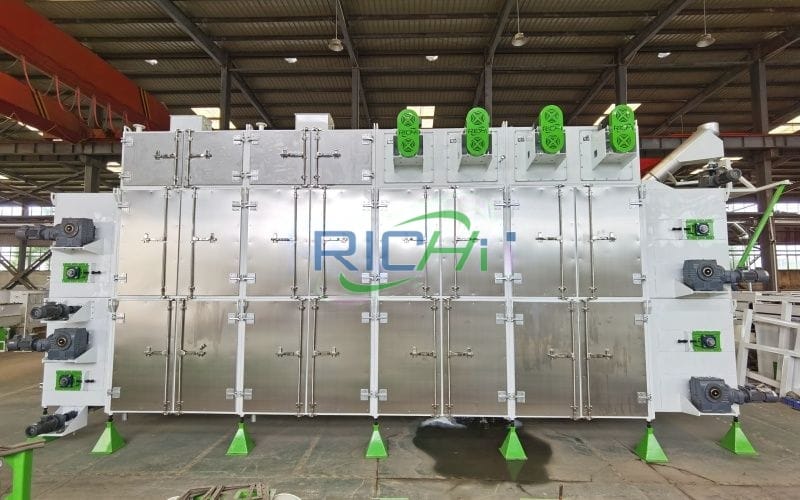
A sewage sludge belt dryer in Poland must fit the treatment plant’s dewatering equipment, available heat and disposal contract. This application design considers a municipal wastewater treatment plant near Kraków, where centrifuges produce sticky, digested sludge cake containing 75–80% moisture. The procurement objective is to reduce the weight sent off site while keeping the existing digestion and dewatering systems.
The proposed addition is one steam-heated belt dryer with the necessary feeding, exhaust and discharge connections. A design intake of 400–500 kg/h suits a smaller sludge treatment duty. At 500 kg/h, operating for 16 hours on 250 days gives an annual wet-cake intake of 2,000 tonnes. All moisture figures below are on a wet basis.
Name:
Sewage Sludge Dryer
Country:
Poland
Date:
2026
Capacity:
8 tonnes per day
Model:
QHG-1000
Main Motor Power:
70+2.2*3+1.5 kW
belt width:
1.2 m
drying area:
43 m²
Wet sludge intake, evaporated water and dried product are different quantities. At the calculation point of 78% inlet moisture and 22% outlet moisture, every 500 kg of cake contains 110 kg of dry solids. Preserving those solids gives approximately 141 kg of dried material and requires removal of 359 kg of water.
| Design item | Calculation basis |
|---|---|
| Wet sludge feed | 500 kg/h |
| Inlet / outlet moisture | 78% / 22% |
| Dry solids retained | 110 kg/h |
| Calculated dried discharge | Approximately 141 kg/h |
| Required water evaporation | Approximately 359 kg/h |
| Annual operating hours | 4,000 hours |
| Calculated annual dried material | Approximately 564 tonnes |
These calculations assume negligible solids loss. At 80% inlet moisture and the same feed rate and discharge target, evaporation rises to approximately 372 kg/h. The equipment assessment therefore needs to cover wetter cake, rather than relying on one favourable sample.
Each scheduled production day handles 8 tonnes of wet cake. A buffer between the centrifuges and dryer must accommodate intermittent dewatering output, while level controls prevent surges onto the belt. Storage and bypass arrangements should allow centrifuge operation to continue during planned dryer cleaning. This interface matters because wastewater treatment must remain available when the drying equipment stops.
The QHG-1000 steam-heated belt dryer is the candidate platform for this assessment. Its general configuration includes five mesh-belt layers, a 1.2 m belt width and 43 m² of drying area. The listed electrical configuration is three 2.2 kW motors plus one 1.5 kW motor, totalling 8.1 kW. Feeding, exhaust treatment and other project auxiliaries require separate load calculations.
Drying area alone does not establish sewage sludge capacity. Selection depends on measured evaporation, airflow resistance, belt release and cleaning performance with representative sludge. Material compatibility, seals and accessible cleaning points also need review for sludge service. The proposed wet-feed rate remains a design target until trials establish the operating envelope.
Centrifuge cake can form dense lumps that restrict airflow. A metering screw and sludge-specific forming head can distribute strands across the belt, increasing exposed surface and leaving air passages. This is wet-cake preparation, not a separate commercial pellet production process.
The forming arrangement must be tested against the cake’s consistency and polymer conditioning. Some sludge may need dried-material backmixing to pass through its sticky phase; other cake may spread adequately without it. Backmixing increases internal circulating load and must be included in equipment sizing.
Strand diameter, bed depth and belt speed are established together during trials. Prescribing a universal strand size or residence time would overlook changes in solids content, ash and stickiness. The practical objective is a permeable bed that dries evenly and releases reliably.
The site scenario includes a biogas-fired boiler supporting digester heating. A steam-heated sludge dryer could use this infrastructure, provided the boiler has sufficient spare capacity during winter. Steam already committed to digestion is unavailable for drying.
The utility review covers pressure at the dryer connection, sustained flow, steam quality, control valves, traps and condensate return. Steam consumption must come from the heat balance and material trials. Fan electricity, boiler operation, maintenance and any competing use for biogas remain operating costs.
A temperature-controlled heat exchanger supplies drying air without injecting steam into the sludge. Feed regulation and belt speed should respond to measured discharge moisture, with laboratory checks used to verify the control readings.
Warm, humid exhaust creates a separate treatment duty. Enclosure under controlled negative pressure helps contain emissions, but an existing biofilter cannot automatically accept the additional airflow, heat and ammonia load. Exhaust cooling, condensation or scrubbing may be needed before biological treatment. Collected liquids return through an agreed treatment connection.
Dried sludge also requires controlled discharge and suitable storage. Cooling, dust capture, housekeeping and protection against overheating are part of the integration assessment. Fire and explosion protection must follow the material assessment and applicable requirements; a low drying temperature alone does not eliminate these risks.
The 20–25% outlet-moisture range is a proposed target for evaluating transfer to an authorised thermal-treatment or co-processing facility. The receiving operator must accept the material’s moisture, calorific value, ash, contaminants and handling characteristics. Drying does not guarantee acceptance or a positive selling price.
Agricultural use requires a separate assessment of treatment, pathogens, metals, soil conditions and application requirements. Lower moisture alone does not establish suitability. For this Polish sludge drying project, the commercial evaluation therefore follows an agreed receiving route rather than assuming fertiliser sales.
The acceptance plan should record wet-feed mass, inlet and outlet moisture, operating hours, steam draw, electrical consumption and recovered dried material over sustained operation. Checks across the discharged material help identify wet pockets. Cleaning trials should establish access, wash-water demand, drainage and restart procedures.
The staffing plan needs supervision across both operating shifts, together with time for sampling, inspection and cleaning. Maintenance and laboratory support remain separate responsibilities. The quotation should distinguish the dryer from the wet-cake feeder, exhaust treatment, discharge cooling and site works, so the operator can compare the installed scope and operating duties.
Site installation needs confirmed support loads, maintenance clearance, lifting access and electrical interfaces. Qingdao–Gdańsk followed by road transport is a possible shipping arrangement; packing and container requirements depend on the final assembly dimensions.
At the calculation point, drying reduces outbound material from 2,000 to approximately 564 tonnes annually. This is a calculated mass reduction, not an equivalent saving in transport costs. Actual value depends on haulage contracts, receiving fees and the full operating cost.
To evaluate a sewage sludge belt dryer in Poland, send RICHI Machinery representative cake data, daily sludge tonnage, seasonal moisture results, available steam conditions, the receiving facility’s specification and a site layout. These inputs support a material trial, an evaporation-based selection and a quotation defining the dryer and its required interfaces.
Having the right mix of reliable, high-quality pellet machine and pelletizing systems and expert support is essential to your success. Watch how our end-to-end feed pellet plant solutions have helped our customers optimize their performance.
Our customized and future-proofed turnkey pellet plant solutions is designed with you at the core. From vision to reality and beyond, our team stays connected with yours. Giving you peace-of-mind with an expert at your side.
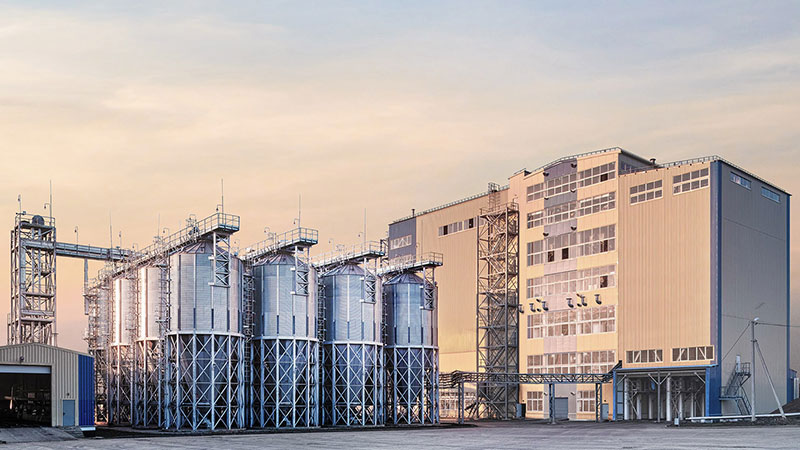
At RICHI, we go beyond project completion. With RICHI Servicee, we’re your dedicated partners in success. Count on us for expert guidance, minimal downtime, and optimized productivity. Choose RICHI for unmatched service and support.
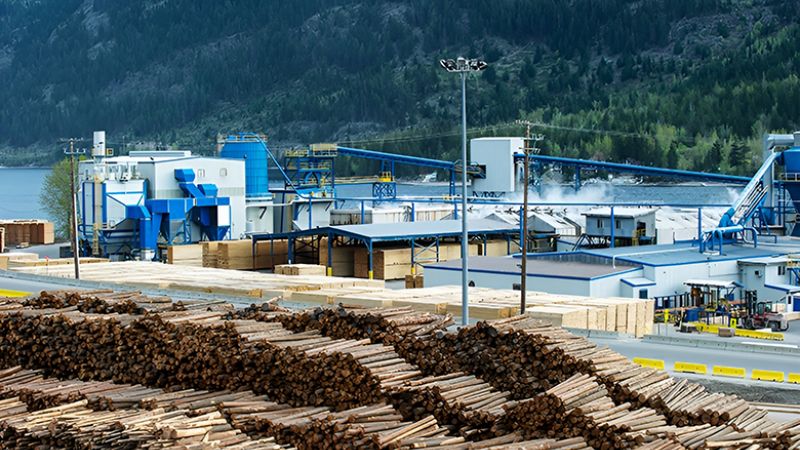


Meet global product demands and quality standards with industry-leading pellet plant design, engineering, equipment, and construction services for pellet processors.

Your Partner Beyond Project Completion
2000+ cases
RICHI is the leading designer, manufacturer and builder of pellet plants in the world, completing over 2000 projects in 140 countries across 6 continents.
Read More
Increase plant productivity, profitability, and safety by integrating high quality equipment into your pellet production line. Over the years, RICHI has become China's top pellet equipment manufacturer. At the same time, RICHI has established valuable partnerships with the world's leading component and raw material manufacturers to bring you the best there is in technology, automation, and efficiency in pelleting plant machinery.

For nearly 30 years, RICHI has been providing best-in-class pellet plant equipment and services to clients across a variety of industries, sizes, and needs. We pride ourselves on the knowledge and skill that each team member possesses – from our technical sales team to our process design engineers. You can count on RICHI Machinery to take your operation to the next level of innovation, quality, and success.
Need help with your pellet manufacturing plant project? Contact us today.
ANIMAL FEED
BIOMASS
WOOD
ORGANIC FERTILIZER
AQUA FEED
CAT LITTER
MUNICIPAL WASTE RECYCLING
SPECIAL PELLET PRODUCTION
RICHI Machinery continues to deliver world class pellet mill equipment, pellet plant engineering and project solutions that add value to our customers in the animal feed, wood waste, agriculture waste, organic fertilizer, cat litter and special pellet products industries. Throughout the years, we RICHI Machinery have built strong brand, becoming industry-leading pellet machine manufacturer. We value integrity, promise quality, and prioritize your success.
Learn MoreWith our expert team, we precisely implement your process engineering requirements in pellet mill and pelletizing plant systems. No matter which industry you’re in – we understand your needs and deliver solutions that meet the highest standards.
At RICHI, quality comes first. Our pellet making machine and related pellet line equipment undergo rigorous quality controls to ensure they meet the highest standards. Rely on products that are durable, safe, and efficient.
With decades of experience in pellet machine and pellet production line production, we have earned a reputation as a trusted partner in various industries. Our expertise allows us to cover a wide range of applications.
Not only do we offer premium pelleting equipment, but we are also experts at designing, building, installing, and maintaining facilities from the ground up. Our expertise is within pellt plant process design, discovering the most efficient, productive, and profitable way to handle your materials in an end-to-end cycle.
○ RICHI MACHINERY
Keeping in touch with us is an effective way to solve all your problems. If you have any needs or questions, please leave your contact information, then RICHI technical consultants will send design, quotation, videos to your mailbox. You can also contact us directly via WhatsApp: +86 13838389622
Copyright©2015-2026 by HENAN RICHI MACHINERY CO., LTD. All rights reserved.