
Round hay bale pellet mill for large farm in Oman, featuring a CZLH350 ring die grass feed pellet machine for alfalfa hay and barley-based cattle feed. Explore machine specifications, forage preparation and RICHI Machinery's single-machine solution.
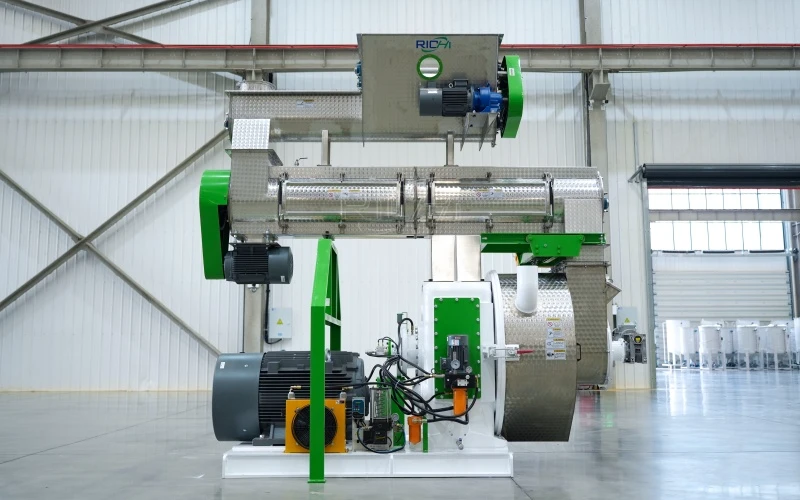
The round hay bale pellet mill for large farm in Oman is planned for a commercial dairy farm that wants to process part of its purchased forage into compact feed pellets without replacing its existing feed-preparation system.
The farm handles round bales of dry alfalfa hay and already has equipment for opening bales, chopping forage, grinding ingredients and mixing feed. Its immediate requirement is one ring die grass feed pellet machine to turn a prepared alfalfa-based mixture into a more uniform product for selected groups of cattle.
The proposed installation uses a CZLH350 grass feed pellet mill with a reference production capacity of 1.0–1.2 T/H. The initial formula is planned at 80% alfalfa hay, 12% barley and 8% wheat bran, with a target pellet diameter of 6 mm.
The intention is to make a forage-rich supplementary feed for dairy cattle, not to replace every component of the farm's total mixed ration. By adding one pellet mill to its current operation, the farm can test a defined product, control its own production batches and avoid duplicating machinery that is already available on site.
Name:
ring die grass feed pellet machine
Country:
Oman
Date:
2026
Capacity:
1.0–1.2 T/H
Model:
CZLH350
Main Motor Power:
37 kW
Raw Materials:
Alfalfa-based forage
Pellet diameter:
6mm
Livestock production in Oman operates in an environment where water availability, high temperatures and the cost of feed procurement influence day-to-day farm management. Commercial dairy operations need reliable access to forage and concentrate ingredients, while also managing storage conditions and the nutritional consistency of the feed delivered to different cattle groups.
Alfalfa hay is a practical raw material for a forage-pelleting project because it provides fiber and protein and can be purchased in a dried, baled form. Round bales are convenient for bulk handling, but their size makes them unsuitable for direct feeding into a ring die pellet mill.
They must first be opened, reduced in size and ground to a controlled particle range. A farm that already performs these operations has a different investment requirement from a customer starting a new feed factory from an empty site.
The farm in this project wants to use pelleting for a specific operational reason: it needs a consistent, compact feed product that can be weighed, stored and incorporated into a planned feeding program.
Loose ground forage can be useful in many rations, but its bulk density, handling characteristics and tendency to separate from other ingredients may complicate some storage and batching arrangements. Properly manufactured pellets provide another way to handle a defined forage blend.
The project is not based on the assumption that all dairy cattle should receive pelleted forage instead of long hay. Physically effective fiber remains important to rumination and normal digestive function. The farm will continue to use its existing feeding methods where appropriate, while the new grass feed pellet machine serves a separate product stream.
Oman has an established livestock sector and a growing domestic animal-feed manufacturing base. Government agricultural data tracks dairy production and livestock activity, while the Ministry of Agriculture, Fisheries and Water Resources has also reported investment in animal-feed manufacturing. These developments provide a relevant commercial context for farms assessing whether to prepare more of their feed requirements in-house.
For a farm in Oman, the economics of forage pelleting depend on the delivered price and quality of alfalfa hay, the cost of concentrate ingredients, the amount of feed required each day and the existing machinery available for preparation. Dry forage may be sourced from domestic production where suitable or purchased through established feed supply channels. The customer needs to confirm its own suppliers, bale specifications and landed costs rather than assume that a particular origin or price will remain constant.
Water and land constraints can make purchased forage important for some commercial operations. In that setting, a pellet mill is most useful when the farm receives sufficient quantities of consistent dry material and has a defined use for the finished pellets.
A large farm with established storage, handling and feed-mixing facilities may be able to justify a single machine more readily than a small operation that would need to buy all the supporting equipment as well.
RICHI Machinery supplies ring die feed pellet mills and complete feed-processing equipment for different forage and agricultural material applications. A project such as this one is approached through the raw material, target product and existing process rather than by selecting the largest available machine. The CZLH350 is considered here because its reference capacity fits a moderate, dedicated forage-pellet stream within a larger farm operation.
The main raw material is dry alfalfa hay packed in large round bales. The farm receives the bales from commercial forage suppliers and stores them in a covered area to reduce exposure to rain, ground moisture and contamination. The bales are inspected before processing, with attention to mold, foreign objects, unusual odors and changes in color that could indicate poor storage conditions.
The round bales are not fed directly into the CZLH350. A bale breaker or bale-opening machine first loosens the compacted hay. A forage chopper then reduces the material to shorter lengths, and a hammer mill or other suitable grinder prepares the particles for mixing and pelleting.
The farm's existing preparation equipment is retained for this purpose. If the current grinding system cannot handle the required throughput or produce a suitable particle distribution, that issue needs to be resolved before the alfalfa pellet machine is commissioned.
For the initial product, the proposed formula contains 80% ground alfalfa hay, 12% barley and 8% wheat bran by weight. Alfalfa supplies the main forage fraction; barley contributes energy and starch; and wheat bran contributes additional fiber and other nutrients. The mixture is intended to remain forage-rich rather than becoming a grain-dominant concentrate pellet.
The formula is a starting design for equipment planning, not a complete nutritional recommendation. A dairy nutritionist should review the final proportions against forage analysis, the cattle's production stage, the rest of the ration and the desired daily intake. The ingredients should be weighed consistently, and the farm should keep batch records so that changes in the quality of purchased hay can be identified.
The planning assumption is that the alfalfa hay arrives at approximately 10–13% moisture. This range must be verified by checking actual deliveries. If a batch is excessively wet, poorly stored or visibly moldy, it should not be processed simply to maintain production. A pellet mill is not a substitute for a dryer, and the feed-preparation team must keep moisture and storage hygiene under control.
The farm plans to purchase one CZLH350 ring die grass feed pellet machine. The model is listed with a 37 kW main motor and a reference capacity of 1.0–1.2 T/H for grass and straw feed pelleting. It is equipped with an arch-breaking feeder, a forced feeder and a conditioner, making it suitable for a dedicated forage-feed pelleting application when the upstream preparation and operating conditions are correctly matched.
The stated capacity is a reference from the supplied model specifications, not a guaranteed rate for every formula. Actual throughput depends on the alfalfa's fiber characteristics, grinding quality, moisture, concentrate inclusion, die configuration and operating settings. A forage-rich mixture may behave differently from a grain-based feed, so the farm should confirm the expected output using its own ingredients.
The 6 mm pellet diameter is selected for this project's planned product. The final diameter and die configuration should be confirmed with the farm's feed specialist and RICHI's technical team. Pellet size alone does not determine nutritional suitability, and a 6 mm product should not automatically be assumed appropriate for every cattle group.
The CZLH350 offers a way to add a defined pelleting stage without automatically investing in the higher-capacity CZLH420 or larger models. The choice is based on the planned production requirement, the existing preparation system and the farm's intention to manufacture a portion of its forage feed internally. If the actual demand later increases, the farm can assess its production records before considering a larger machine or additional capacity.
The farm already has a feed-preparation area with equipment for bale opening, forage grinding, ingredient weighing and mixing. The missing stage is the equipment required to compact the prepared mixture into pellets. Buying a complete feed line would duplicate some of the machinery that is already in service and increase the scope of the investment beyond the customer's immediate requirement.
A single round hay bale pellet mill allows the farm to retain its existing equipment and concentrate expenditure on the pelleting process. The new machine still needs suitable connections to the mixer discharge, transfer conveyors, finished-pellet collection and downstream cooling or screening arrangements. Those interfaces must be checked before the order is finalized, but they do not necessarily require a new independent production building.
The single-machine approach also gives the farm a manageable way to evaluate its own forage-pellet product. It can begin with one formula and a defined operating schedule, then record ingredient use, actual throughput, pellet durability and the amount of fines generated. Those records can support later decisions about whether to increase operating hours or introduce a second formula.
This is particularly relevant when forage prices, delivery quality and concentrate costs vary over time. The machine should be sized around a realistic production plan rather than an assumption that maximum rated capacity will always provide the best return. The value of the investment depends on how consistently the farm can supply suitable material and use the pellets it produces.
After the round bales have been opened, chopped and ground, the prepared alfalfa is blended with barley and wheat bran according to the approved formula. Particle size matters at this stage. Oversized stems can interfere with even feeding and pellet formation, while excessive grinding can change the physical characteristics of the forage. The grinding specification should therefore be established through a review of both pelleting performance and nutritional requirements.
The mixed material is fed into the conditioner before entering the pelleting chamber. Conditioning settings depend on the formula, moisture and required pellet characteristics. Steam may be used if the final system configuration calls for it, but the required steam supply, pressure and consumption must be confirmed during engineering. These values cannot be calculated from the motor-power table alone.
The forced feeder helps deliver the prepared mixture into the pelleting chamber at a controlled rate. Inside the ring die, rollers press the material through the die holes to form cylindrical pellets.
Die-hole diameter, effective compression, material moisture and operating settings all influence the finished product. A die configuration suitable for a grain-heavy formula should not automatically be used for a fibrous alfalfa blend without technical review.
After pelleting, the product needs adequate cooling before it is transferred to storage. Cooling helps the pellets stabilize and reduces the risk of condensation when warm product enters bags, bins or bulk storage. Screening may be required to remove fines, and the farm should check the finished pellets for moisture, durability, diameter consistency and storage suitability.
Because this order covers one pellet mill rather than a complete line, the existing downstream equipment must be checked against the machine's expected discharge rate. If the farm does not have adequate cooling or screening capacity, those requirements should be addressed as part of the integration plan. A pellet mill alone does not automatically deliver a finished product ready for long-term storage.
The initial product is a 6 mm alfalfa-based pellet containing barley and wheat bran. It is intended for use as a forage-rich feed component in selected dairy cattle feeding programs. Compared with loose ground forage, properly made pellets can be easier to meter, store and blend with other ingredients, helping the farm manage a defined portion of its feed preparation more consistently.
The product should not be described as a complete dairy ration unless its formulation has been specifically designed and validated for that purpose. In this project, the pellets are planned as one component of the farm's wider feeding program. The quantity offered to each group of cattle must be set by the farm's nutritionist according to milk production, lactation stage, forage availability, body condition and the other ingredients in the ration.
The same pellet mill may be capable of processing other suitable forage mixtures, but each new product requires its own formula and process review. For example, a mixture containing Rhodes grass hay or another suitable dry grass may behave differently from an alfalfa-dominant blend.
Cereal straw can also have a different fiber structure and nutritional value. These materials should not be substituted in the existing formula without reviewing digestibility, particle size, nutrient balance and the intended feeding application.
Different cattle groups have different nutritional requirements. Lactating cows, dry cows and replacement heifers should not automatically receive the same formula just because the same machine can manufacture each product. If the farm decides to develop a second feed, the recipe and finished-product specification should be approved separately.
The CZLH350 combines a ring die pelleting system with an arch-breaking feeder, forced feeder and conditioner. These components are relevant to forage-based production because fibrous material can bridge in hoppers or flow less evenly than free-moving grain meal. The arch-breaking feeder helps maintain material movement, while the forced feeder supports controlled feeding into the pelleting chamber.
The ring die is a key working component and must be selected for the intended product. Die-hole diameter and compression characteristics influence pellet formation, throughput and durability. RICHI Machinery should review the final formula, target diameter and expected raw-material condition before the die configuration is confirmed.
Routine maintenance should be considered during layout planning rather than after the machine is installed. The operator needs sufficient access for inspection, lubrication, cleaning and servicing of the die and rollers. Adequate clearance also makes it easier to inspect the feeder, check for unusual vibration and keep the work area clean during product changes.
The electrical supply needs to be confirmed against the farm's actual installation. Motor ratings alone do not establish the required cable sizes, starting arrangement or electrical protection. Voltage, frequency, control requirements and the relationship between the pellet mill and existing upstream machinery should be included in the final technical review.
For this type of single-machine project, the selection process starts with the material and the existing process. RICHI Machinery can review photographs of the round hay bales, the bale-opening equipment, the grinder, the mixer and the intended installation area. The technical team can then assess whether the CZLH350 is a reasonable match for the planned production volume and the physical characteristics of the prepared material.
The layout review should establish how the existing mixer discharges material, whether a buffer hopper is needed and how the prepared mixture will reach the pellet mill. If the conveyor height, discharge direction or available space does not match the machine arrangement, those details should be resolved before shipment rather than left to be improvised during installation.
RICHI can provide equipment drawings, connection information and guidance on the feeder, conditioner and die configuration. The farm can use this information to prepare the foundation or supporting structure, electrical connection and maintenance access. These checks are especially useful when the new machine is being fitted into an operating feed-preparation area rather than installed as part of a completely new factory.
A representative sample of the actual ground alfalfa and concentrate mixture can also help the engineering discussion. Material testing may help identify whether the blend feeds evenly and whether particle size, moisture or conditioning needs adjustment. Final operating settings should be confirmed during commissioning rather than copied from an unrelated formula.
The equipment supplier's role is to provide the appropriate machinery and technical guidance for integration. The farm remains responsible for ingredient acceptance, storage hygiene, nutritional formulation and the suitability of the finished feed for its cattle. Clear coordination between the feed specialist, the farm's operators and the equipment supplier helps ensure that the machine is used within the intended process.
The planned shipment will depart from Qingdao Port in China and arrive at Sohar Port in Oman. Sohar is an established commercial port with international shipping connections and facilities serving containerized and other cargo. It is a practical destination to consider for industrial equipment intended for an Omani agricultural operation.
The final shipping arrangement depends on the packed dimensions, shipment terms and vessel schedule. Before dispatch, the customer should confirm the unloading arrangements, temporary storage conditions and the space available for moving the equipment into the installation area.
Installation preparation should include a check of the foundation or floor loading, electrical supply, cable routing, working clearances and connections to the existing material-handling equipment. The machine should only be energized after installation inspections and the manufacturer's safety procedures have been completed.
The most useful measure of success is not the main motor rating alone. The farm needs to establish whether the prepared alfalfa blend feeds consistently, whether the CZLH350 can achieve a commercially useful production rate and whether the finished pellets meet the required product specification.
During commissioning, the operators should record the actual formula, ingredient moisture, grinding conditions, conditioning settings, die configuration and measured throughput. They should also inspect pellet durability, fines generation and product condition after cooling. These records provide a sound basis for comparing production batches and identifying the source of changes in performance.
Alfalfa quality deserves particular attention. A bale with more coarse stems, a different leaf-to-stem ratio or a different moisture level may behave differently from the material used during the first trial. Keeping the same ingredient percentages does not guarantee identical pellet quality when the raw materials change.
Feedback should be collected after the machine has operated under normal farm conditions. The most useful points include the ease of integrating the pellet mill with the existing preparation equipment, operator access, consistency of the finished pellets and the practicality of routine maintenance. Any published customer quotation or numerical performance claim should be supported by the farm's actual acceptance records rather than assumed in advance.
The round hay bale pellet mill for large farm in Oman is planned as a focused addition to an existing dairy-feed preparation operation. The raw material is clearly defined: dry round-baled alfalfa hay, supplemented with barley and wheat bran, prepared and pelleted into a 6 mm forage-rich product.
The CZLH350 provides a reference capacity of 1.0–1.2 T/H, a 37 kW main motor, a 350 mm ring die and the feeder and conditioning components specified for grass feed pelleting. Actual output depends on the formula, preparation quality, die configuration and operating conditions, so performance should be confirmed with the farm's own ingredients.
For commercial farms considering a round hay bale pellet mill, alfalfa pellet mill or grass feed pellet machine, the first step is to identify the intended product and review the equipment already available.
RICHI Machinery can help assess the raw material, target pellet size, machine configuration and installation interfaces so that the selected equipment addresses a specific processing need without unnecessarily duplicating existing machinery.
For a farm that regularly handles dry alfalfa bales and wants to manufacture a defined portion of its forage feed internally, a properly selected ring die pellet mill can be a practical investment. The best outcome comes from matching the machine to the material, confirming the process around it and evaluating the finished product against the farm's operating and nutritional requirements.
Having the right mix of reliable, high-quality pellet machine and pelletizing systems and expert support is essential to your success. Watch how our end-to-end feed pellet plant solutions have helped our customers optimize their performance.
Our customized and future-proofed turnkey pellet plant solutions is designed with you at the core. From vision to reality and beyond, our team stays connected with yours. Giving you peace-of-mind with an expert at your side.

At RICHI, we go beyond project completion. With RICHI Servicee, we’re your dedicated partners in success. Count on us for expert guidance, minimal downtime, and optimized productivity. Choose RICHI for unmatched service and support.



Meet global product demands and quality standards with industry-leading pellet plant design, engineering, equipment, and construction services for pellet processors.


Your Partner Beyond Project Completion
2000+ cases
RICHI is the leading designer, manufacturer and builder of pellet plants in the world, completing over 2000 projects in 140 countries across 6 continents.
Read More
Increase plant productivity, profitability, and safety by integrating high quality equipment into your pellet production line. Over the years, RICHI has become China's top pellet equipment manufacturer. At the same time, RICHI has established valuable partnerships with the world's leading component and raw material manufacturers to bring you the best there is in technology, automation, and efficiency in pelleting plant machinery.

For nearly 30 years, RICHI has been providing best-in-class pellet plant equipment and services to clients across a variety of industries, sizes, and needs. We pride ourselves on the knowledge and skill that each team member possesses – from our technical sales team to our process design engineers. You can count on RICHI Machinery to take your operation to the next level of innovation, quality, and success.
Need help with your pellet manufacturing plant project? Contact us today.
ANIMAL FEED
BIOMASS
WOOD
ORGANIC FERTILIZER
AQUA FEED
CAT LITTER
MUNICIPAL WASTE RECYCLING
SPECIAL PELLET PRODUCTION
RICHI Machinery continues to deliver world class pellet mill equipment, pellet plant engineering and project solutions that add value to our customers in the animal feed, wood waste, agriculture waste, organic fertilizer, cat litter and special pellet products industries. Throughout the years, we RICHI Machinery have built strong brand, becoming industry-leading pellet machine manufacturer. We value integrity, promise quality, and prioritize your success.
Learn MoreWith our expert team, we precisely implement your process engineering requirements in pellet mill and pelletizing plant systems. No matter which industry you’re in – we understand your needs and deliver solutions that meet the highest standards.
At RICHI, quality comes first. Our pellet making machine and related pellet line equipment undergo rigorous quality controls to ensure they meet the highest standards. Rely on products that are durable, safe, and efficient.
With decades of experience in pellet machine and pellet production line production, we have earned a reputation as a trusted partner in various industries. Our expertise allows us to cover a wide range of applications.
Not only do we offer premium pelleting equipment, but we are also experts at designing, building, installing, and maintaining facilities from the ground up. Our expertise is within pellt plant process design, discovering the most efficient, productive, and profitable way to handle your materials in an end-to-end cycle.
○ RICHI MACHINERY
Keeping in touch with us is an effective way to solve all your problems. If you have any needs or questions, please leave your contact information, then RICHI technical consultants will send design, quotation, videos to your mailbox. You can also contact us directly via WhatsApp: +86 13838389622
Copyright©2015-2026 by HENAN RICHI MACHINERY CO., LTD. All rights reserved.