
A Czech premix manufacturer selected DCS-50FB stainless steel auger-fed bagging equipment for accurate 20–25 kg filling, cleaner formula changeovers and controlled powder packaging.
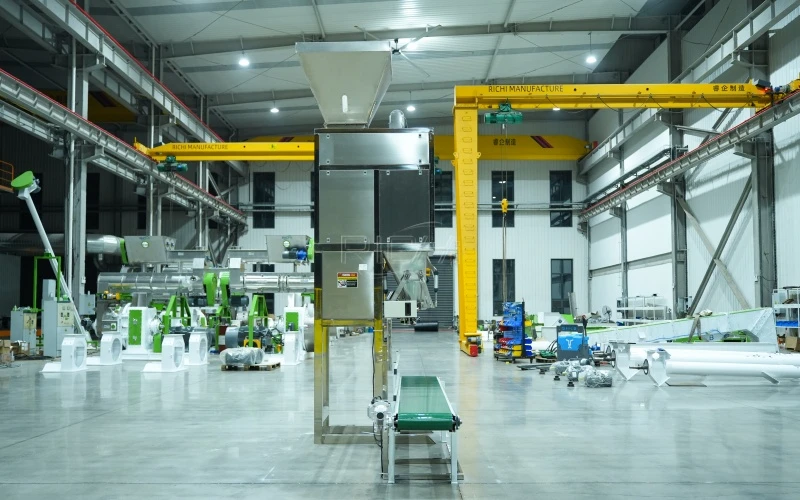
A premix manufacturer in central Czechia selected DCS-50FB Premix Feed Bagging Equipment in Czech Republic for the final weighing and packing stage of its vitamin-mineral premix operation. The company produces powder premixes for pig, poultry and cattle feed and required a machine suited to fine, mineral-containing materials rather than pellets or ordinary coarse mash.
The packaging section had become increasingly difficult to manage with a mild-steel auger filler. Fine mineral-containing powder remained around product-contact areas, cleaning between formulas required more attention, and corrosion on exposed surfaces created an unnecessary feed-safety concern. The customer therefore concentrated its investment on one stainless steel bagging machine while retaining the upstream premix production equipment that was already suitable for the factory.
The selected DCS-50FB combines screw feeding, electronic weighing and configurable bag sealing. For this plant, the main packaging formats are 20 kg and 25 kg lined bags, with production organized around different premix formulas rather than one continuous bulk product.
Name:
Premix powder bagging equipment
Country:
Czech Republic
Date:
2026
Capacity:
6–8 bags/min
Model:
DCS-50FB
Bag Sizes:
20 kg and 25 kg
Application:
Feed premix powder
Material Configuration:
Stainless steel
Premix occupies a very different position from finished compound feed. A relatively small bag can contain concentrated vitamins, trace minerals, amino acids, carriers and other ingredients that will later be dosed into a much larger quantity of animal feed.
This makes several packaging details particularly important.
The plant therefore selected the packaging machine from the physical behavior and hygiene requirements of the premix rather than simply matching the nominal tonnes per hour of the upstream mixer.
| Project Parameter | Configuration |
|---|---|
| Equipment | Premix powder bagging equipment |
| Model | DCS-50FB |
| Main Application | Feed premix powder |
| Material Configuration | Stainless steel |
| Feeding Method | Auger feeding |
| Packaging Speed | 6–8 bags/min under suitable conditions |
| Installed Power | 1.5 + 0.55 + 0.37 kW |
| Static Weighing Accuracy | ±0.1% |
| Dynamic Weighing Accuracy | ±0.2% |
| Compressed Air Requirement | 0.4–0.6 MPa, approximately 1.5 m³/h |
| Main Project Bag Sizes | 20 kg and 25 kg |
| Bag Closing | Heat sealing, sewing or combined sealing according to bag structure |
The 6–8 bags/min value is a packaging-machine reference rather than a guarantee that every premix formula, bag type and sealing arrangement will run at the same speed. Powder flowability, bulk density, target bag weight, required weighing tolerance, operator handling and downstream sealing all influence actual production.
Premix does not behave like a free-flowing feed pellet. Fine powders can aerate during transfer, compact during storage and bridge above a discharge opening. Different carriers and mineral concentrations can also alter bulk density from one formula to another.
The DCS-50FB uses an auger to meter powder toward the weighing system. This gives the machine positive control over material delivery instead of depending entirely on gravity.
The screw speed can be coordinated with the weighing cycle so that the system feeds quickly during the main filling stage and controls the final portion more carefully as the target weight is approached.
This is particularly useful where one plant packages several premixes with different flow characteristics. A poultry mineral premix containing a high proportion of dense mineral ingredients may behave differently from a vitamin-rich product using a lighter carrier.
The operator therefore calibrates the bagging cycle with the actual premix rather than assuming one feeder setting will suit every formula.
The decision to use stainless steel was driven by both material compatibility and cleanability.
Mineral premixes can contain ingredients such as copper compounds, zinc compounds, manganese compounds, calcium salts and other inorganic components. Their effect on equipment depends on chemical form, moisture, concentration and the cleaning environment, so not every mineral powder should be described as equally corrosive.
For a premix plant, however, stainless steel provides a more suitable product-contact environment than unprotected mild steel when repeated exposure to mineral-containing powders and cleaning is expected.
The second advantage is cleaning. Smooth stainless product-contact surfaces are easier to inspect and clean between production campaigns. That matters when the same machine packages feeds intended for different species or different inclusion programs.
The customer therefore treats stainless construction primarily as a feed-hygiene and material-compatibility decision rather than simply as a way to make the machine last longer.
A weighing machine cannot correct poor segregation upstream. Premix left inside the finished-product bin, connecting chute or auger can enter the next formula unless the complete product path is included in the changeover procedure.
The Czech plant therefore considers the entire section from the finished-premix discharge to the bag clamp.
Areas that require routine attention include:
The cleaning method depends on the formula sequence and the plant's feed-safety program. The objective is not simply to make stainless surfaces look clean, but to control carryover to the level required by the products being manufactured.
For this customer, Premix Feed Bagging Equipment in Czech Republic is used for several species-specific product groups instead of one continuous formula. Pig, poultry and cattle premixes can contain different active components and different inclusion levels, so packaging flexibility has to include changeover management as well as bag weight.
The plant schedules compatible products together where practical and cleans the packaging route between campaigns according to its documented hygiene procedure.
This approach also affects daily capacity. A machine capable of filling 6–8 bags per minute during stable production will not package at that rate for every minute of a shift because product changeovers, inspections, cleaning, bag replenishment and sealing adjustments also require time.
For production planning, the customer therefore separates instantaneous filling speed from effective shift output.
The DCS-50FB Automatic Packing Machine is specified at ±0.1% static accuracy and ±0.2% dynamic accuracy.
Static accuracy relates to the weighing system under controlled weighing conditions. Dynamic accuracy reflects the practical filling cycle while product is moving through the machine.
For a 25 kg bag, a ±0.2% dynamic specification corresponds to a nominal tolerance of approximately ±50 g. For a 20 kg bag, the same percentage corresponds to approximately ±40 g.
Actual bag-to-bag results still depend on calibration, material flow, auger cut-off behavior, scale condition and vibration around the machine.
The factory therefore verifies weighing performance with its actual premix and maintains calibration checks rather than treating the catalogue tolerance as a permanent result regardless of operating condition.
At six 25 kg bags per minute, the filling stage represents approximately 9 T/H of packaged product. At eight bags per minute, the theoretical figure reaches approximately 12 T/H.
For 20 kg bags, the corresponding theoretical range is approximately 7–10 T/H.
These calculations describe the filling station during steady operation. They do not mean that the complete premix factory produces 12 T/H continuously.
The mixer, finished-product bins, formula-change schedule, bag handling, sealing, palletizing and warehouse logistics determine the practical plant output. For a manufacturer producing several thousand tonnes of premix annually, the machine can therefore operate in concentrated packaging campaigns rather than continuously throughout every production shift.
The customer mainly uses 20 kg and 25 kg bags for commercial premix distribution.
Where the packaging structure includes an inner thermoplastic liner, heat sealing can provide a moisture barrier around the product. The outer bag can then be sewn or otherwise closed according to its construction and transport requirement.
This is useful for premixes containing moisture-sensitive vitamins or hygroscopic ingredients, but the sealing temperature and dwell time cannot be defined by the bagging machine alone.
Film composition, liner thickness and bag supplier specifications determine the correct sealing condition. Operators therefore establish the heat-sealing setting from the actual packaging material and verify seal integrity during production.
The DCS series can be configured for thermoplastic sealing, sewing or a combined closing arrangement, allowing the packaging section to follow the selected bag rather than forcing one closure method onto every product.
Premix powder can contain a substantial fine fraction. When material enters an empty bag, displaced air can carry dust back toward the operator and surrounding equipment.
The packaging area therefore needs an appropriate dust-control interface around the filling point and nearby transfer positions.
Containing powder has several practical benefits. It keeps more saleable product inside the process, reduces deposits around weighing components, makes cleaning easier and improves the working environment.
Dust extraction still has to be balanced carefully. Excessive airflow at the filling point can remove lightweight product and disturb weighing. The aspiration arrangement is therefore designed around containment rather than simply applying the highest possible suction.
Stainless steel does not eliminate mechanical wear.
Mineral-rich premixes may contain abrasive particles that gradually wear auger flights, particularly at sections exposed to repeated contact with dense powders. Wear rate depends on formulation, throughput, particle hardness and operating hours.
The plant therefore inspects auger clearance and flight condition as part of preventive maintenance. A worn auger can alter feed consistency and make fine control near the target weight more difficult.
Maintenance is based on physical inspection and weighing performance rather than a promise that the screw must last for one fixed tonnage.
This distinction is important: corrosion resistance and abrasion resistance are different equipment considerations.
The DCS-50FB was installed below the customer's finished-premix holding section. Because this is a standalone equipment project, the critical engineering work is at the interfaces rather than in designing another complete feed factory.
The installation review includes:
The machine uses compressed air in the 0.4–0.6 MPa range, so the plant's pneumatic system must be able to supply stable pressure and approximately 1.5 m³/h for the packaging equipment.
For a Czech installation, the electrical configuration is matched to the site's three-phase industrial supply before shipment rather than assumed from another export project.
Premix is a relatively high-value product, so a few additional bags per minute are not useful if the filling system repeatedly overshoots the target weight or creates unacceptable variation.
Commissioning therefore focuses on stable material flow and repeatable weighing first.
A practical procedure uses certified or verified weighing references to check the scale and then runs the actual premix through the system. Operators can adjust screw-feed behavior and filling control while monitoring a sequence of finished bags on an independent check scale.
When the formula changes significantly in bulk density or flowability, the plant can verify the settings again instead of assuming the previous product's parameters remain suitable.
A machine can be manufactured from suitable materials and still become a cross-contamination risk if operators cannot reach the surfaces where powder accumulates.
The DCS-50FB installation therefore leaves practical access around the hopper, auger assembly and filling area. Cleaning tools and procedures are selected so that residual premix can be removed without introducing another contamination problem.
Where wet cleaning is permitted by the plant procedure, equipment must be adequately dried before feed production resumes. In many powder-premix operations, controlled dry cleaning or vacuum removal is preferred for routine changeovers because unnecessary moisture can create caking and hygiene problems.
The applicable EU feed-hygiene framework requires feed equipment to permit adequate cleaning and to minimize contamination and cross-contamination, making cleanability a production requirement rather than a cosmetic feature.
The DCS-50FB was prepared for sea transport from Qingdao to Hamburg, followed by inland movement to the Czech customer.
Hamburg is an established overseas gateway for Czech trade and has extensive direct rail connections with Czech inland terminals. This makes it a practical routing option for containerized feed-processing equipment destined for central Czechia.
The customer can prepare the bagging position while the equipment is in transit using machine dimensions, electrical information, compressed-air requirements and upstream/downstream interface data.
Final ocean, terminal and inland schedules depend on the confirmed transport arrangement, so no fixed sailing or customs-clearance duration is treated as part of the machine specification.
The value of the DCS-50FB in this plant comes from matching several requirements at the same time: fine-powder feeding, stainless product-contact construction, controlled weighing, flexible bag closure and access for formula changeovers.
A gravity-fed pellet bagger could offer high output for free-flowing pellets but would not address the same powder-handling problem. A belt-fed machine may suit other feed materials but introduces a different cleaning and dust-control arrangement.
The auger-fed DCS-50FB is therefore selected for the physical characteristics of premix, not simply because stainless steel is a more expensive material.
Premix Feed Bagging Equipment in Czech Republic should be selected from the real powder and packaging specification. Two premixes with the same 25 kg bag weight can still require different feeding settings because bulk density, mineral content, carrier system and flowability are different.
For another premix manufacturer, RICHI Machinery would first review product type, bulk density, powder flowability, mineral composition, target bag weight, required bags per minute, weighing tolerance, bag construction, sealing method, formula-change frequency, dust-control arrangement, finished-bin interface, available headroom, electrical supply and compressed-air conditions.
These details determine whether the DCS-50FB is the appropriate bagging configuration and how the filling, weighing and sealing section should connect with the customer's existing premix factory.
Having the right mix of reliable, high-quality pellet machine and pelletizing systems and expert support is essential to your success. Watch how our end-to-end feed pellet plant solutions have helped our customers optimize their performance.
Our customized and future-proofed turnkey pellet plant solutions is designed with you at the core. From vision to reality and beyond, our team stays connected with yours. Giving you peace-of-mind with an expert at your side.
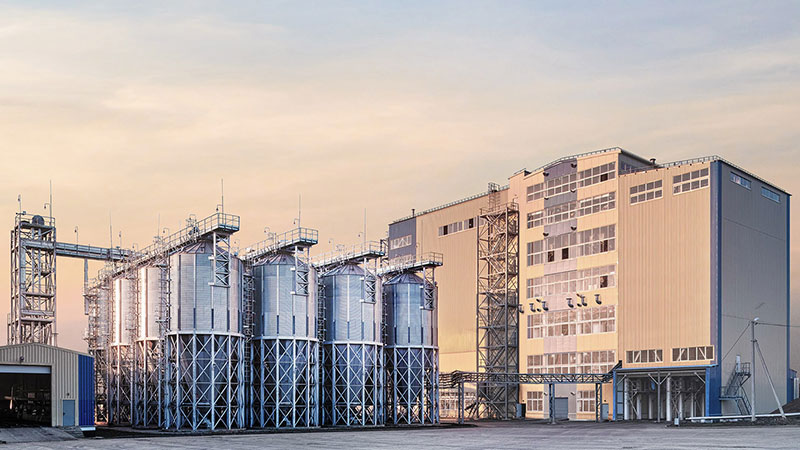
At RICHI, we go beyond project completion. With RICHI Servicee, we’re your dedicated partners in success. Count on us for expert guidance, minimal downtime, and optimized productivity. Choose RICHI for unmatched service and support.
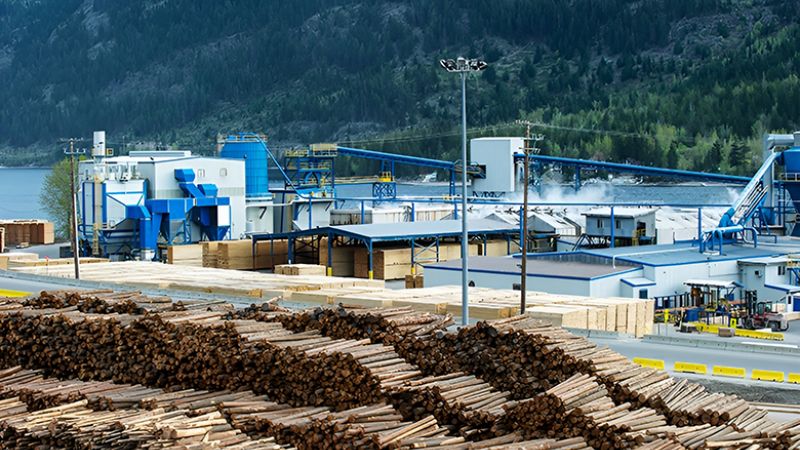


Meet global product demands and quality standards with industry-leading pellet plant design, engineering, equipment, and construction services for pellet processors.


Your Partner Beyond Project Completion
2000+ cases
RICHI is the leading designer, manufacturer and builder of pellet plants in the world, completing over 2000 projects in 140 countries across 6 continents.
Read More
Increase plant productivity, profitability, and safety by integrating high quality equipment into your pellet production line. Over the years, RICHI has become China's top pellet equipment manufacturer. At the same time, RICHI has established valuable partnerships with the world's leading component and raw material manufacturers to bring you the best there is in technology, automation, and efficiency in pelleting plant machinery.

For nearly 30 years, RICHI has been providing best-in-class pellet plant equipment and services to clients across a variety of industries, sizes, and needs. We pride ourselves on the knowledge and skill that each team member possesses – from our technical sales team to our process design engineers. You can count on RICHI Machinery to take your operation to the next level of innovation, quality, and success.
Need help with your pellet manufacturing plant project? Contact us today.
ANIMAL FEED
BIOMASS
WOOD
ORGANIC FERTILIZER
AQUA FEED
CAT LITTER
MUNICIPAL WASTE RECYCLING
SPECIAL PELLET PRODUCTION
RICHI Machinery continues to deliver world class pellet mill equipment, pellet plant engineering and project solutions that add value to our customers in the animal feed, wood waste, agriculture waste, organic fertilizer, cat litter and special pellet products industries. Throughout the years, we RICHI Machinery have built strong brand, becoming industry-leading pellet machine manufacturer. We value integrity, promise quality, and prioritize your success.
Learn MoreWith our expert team, we precisely implement your process engineering requirements in pellet mill and pelletizing plant systems. No matter which industry you’re in – we understand your needs and deliver solutions that meet the highest standards.
At RICHI, quality comes first. Our pellet making machine and related pellet line equipment undergo rigorous quality controls to ensure they meet the highest standards. Rely on products that are durable, safe, and efficient.
With decades of experience in pellet machine and pellet production line production, we have earned a reputation as a trusted partner in various industries. Our expertise allows us to cover a wide range of applications.
Not only do we offer premium pelleting equipment, but we are also experts at designing, building, installing, and maintaining facilities from the ground up. Our expertise is within pellt plant process design, discovering the most efficient, productive, and profitable way to handle your materials in an end-to-end cycle.
○ RICHI MACHINERY
Keeping in touch with us is an effective way to solve all your problems. If you have any needs or questions, please leave your contact information, then RICHI technical consultants will send design, quotation, videos to your mailbox. You can also contact us directly via WhatsApp: +86 13838389622
Copyright©2015-2026 by HENAN RICHI MACHINERY CO., LTD. All rights reserved.