
Discover a poultry feed granule breaker in Zambia for converting 3–4 mm poultry feed pellets into smaller broiler feed crumbles. Explore the SSLG201403 three-roll crumbler, technical features, and production line integration.
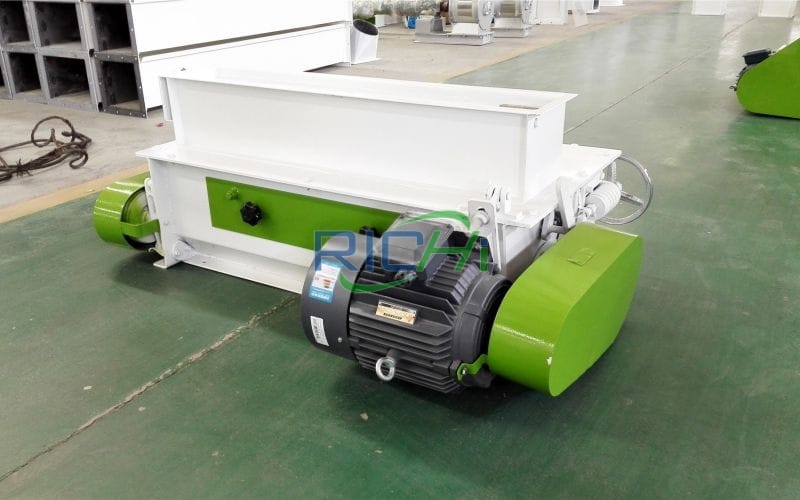
A poultry feed granule breaker in Zambia was selected by a medium-sized poultry feed manufacturer seeking to expand its product range without replacing its existing pellet production line. The company supplied compound feed to independent poultry farmers, commercial broiler operations, and agricultural distributors.
Its existing equipment could produce conventional poultry feed pellets, but demand for smaller feed particles for young broilers had increased. Rather than install another complete feed production line, the manufacturer purchased one RICHI SSLG20*140*3 three-roll pellet crumbler to process finished pellets into crumbles.
The project focused on converting approximately 3–4 mm poultry feed pellets into a more manageable crumble product for young broilers, with a target finished size of around 1.5–3 mm depending on the feeding stage and formulation.
The new machine was planned as an additional processing unit between the existing pellet cooler and the downstream screening and conveying section. This arrangement allowed the plant to retain its established grinding, batching, mixing, conditioning, pelleting, and cooling equipment while introducing greater flexibility in finished feed size.
Name:
Poultry feed granule breaker
Country:
Zambia
Date:
2026
Capacity:
Flexible
Model:
SSLG20*140*3
Power:
11 + 1.1 kW
Incoming material:
3–4mm poultry pellets
Final product size:
1.5–3mm
Zambia has an established poultry sector supported by commercial farms, independent producers, hatchery-linked operations, and feed suppliers. Maize is an important ingredient in many local poultry feed formulations, while soybean meal and other protein sources contribute to the nutritional requirements of broilers. The precise formula varies according to ingredient prices, availability, target growth performance, and the age of the birds.
The customer in this project served poultry producers that purchased feed in different forms. Older broilers generally require larger particles than newly placed chicks, while young birds benefit from feed that is easy to pick up and consume. Depending on the production program, a feed manufacturer may supply mash, pellets, or crumbles to meet different customer requirements.
The plant already had a working pellet production system. Its challenge was not a shortage of pellet-making capacity but the limited flexibility of its finished-product section. When customers requested crumble feed, the manufacturer needed a reliable way to reduce the size of cooled pellets without changing the entire production process.
Breaking pellets manually or relying on improvised crushing equipment would make it difficult to maintain a consistent product specification. Excessive breakage could generate too many fines, while insufficient breakage could leave large particles that did not meet the intended feeding requirement. A dedicated poultry feed pellet crumbler offered a more controlled alternative.
The purchase was therefore a targeted investment. One machine could support a new product category while keeping the existing pellet line in service. The plant could continue producing conventional pellets when required and direct suitable batches through the crumbler when a customer ordered crumble feed.
For this application, the selected model was the RICHI SSLG20*140*3 three-roll pellet crumbler machine. The model belongs to the standard livestock and poultry feed crumbler range rather than the specialized X-type machine designed for shrimp feed. Its three-roll arrangement was selected to support more even feeding and controlled size reduction of poultry pellets.
| Project specification | Details |
|---|---|
| Core keyword | Poultry feed granule breaker in Zambia |
| Equipment type | Three-roll poultry feed pellet crumbler |
| Selected model | SSLG20*140*3 |
| Roller arrangement | Three rollers |
| Roller diameter | 20 cm |
| Roller length | 140 cm |
| Listed drive power | 11 + 1.1 kW |
| Incoming material | Approximately 3–4 mm cooled poultry feed pellets |
| Representative target product | Approximately 1.5–3 mm poultry feed crumbles, subject to testing |
| Purchase scope | One standalone crumbler |
| Shipping origin | Qingdao Port, China |
| Regional destination port | Port of Dar es Salaam, Tanzania |
The supplied specifications list the roller dimensions and drive power but do not provide a rated throughput for this model. Actual capacity must be confirmed against the customer's pellet diameter, pellet hardness, formulation, target crumble size, and required proportion of acceptable product. The production rate should not be estimated from motor power alone.
The SSLG20*140*3 was chosen because the project required a dedicated poultry feed crumbler for standard compound feed pellets, rather than a machine intended for fine shrimp-feed crumbling. Before final installation, the customer would need to confirm the expected hourly throughput and the required crumble-size distribution with RICHI's technical team.
The feed manufacturer primarily handled compound poultry feed formulated around maize and soybean meal, with additional protein sources, oils, minerals, vitamins, and other ingredients according to the nutritional specification. The exact ingredient proportions were determined by the feed formulation rather than by the crumbler itself.
After grinding, batching, mixing, conditioning, and pelleting, the feed passed through the existing cooling section. For crumble production, cooled pellets were then directed to the three-roll crumbler. This sequence helps avoid processing pellets while they are excessively hot and mechanically vulnerable immediately after pelleting.
The representative incoming product was a 3–4 mm pellet. The intended crumble product was approximately 1.5–3 mm, with the final specification adjusted to the age of the broilers and the customer's feed formulation. Smaller starter particles may be appropriate for younger birds, while larger crumbles can be used for later feeding stages. These ranges are practical design targets, not a guarantee that every pellet will break into one uniform size.
In operation, the rollers apply controlled mechanical force to the pellets, breaking them into smaller pieces. The resulting material can then be screened to separate oversized particles and excessive fines. Oversized material may be returned for further processing if the plant's process design permits it, while fines can be handled according to the feed mill's quality-control procedure.
The objective is not simply to make the pellets smaller. The plant needs a suitable balance between crumble size, particle uniformity, fines generation, and handling performance. A well-controlled crumbler can help the feed manufacturer supply a more consistent product while retaining the nutritional formulation established upstream.
RICHI offers both two-roll and three-roll crumbler configurations for different feed-processing requirements. The double-roll series provides a straightforward solution for conventional livestock and poultry feed crumbling. The three-roll series offers a different roller arrangement intended to improve feeding uniformity and support controlled pellet breakage.
For this project, the SSLG20*140*3 was selected to suit the plant's intention to add a dedicated crumble product to an established poultry feed operation. The decision was based on the product requirement and the proposed production arrangement, rather than on the assumption that a three-roll machine is automatically the best choice for every feed mill.
The three-roll configuration can help distribute the breaking action more evenly when the incoming pellets are fed and presented correctly. However, the final result still depends on roller adjustment, pellet properties, feeding stability, and the required particle-size distribution. Equipment selection should be validated against actual samples whenever possible.
The machine's structure is designed for straightforward operation. For a feed mill that needs to switch between regular pellets and crumble orders, ease of adjustment and access for inspection are important practical considerations. Operators need to monitor the roller condition, material flow, and product quality without introducing unnecessary interruptions into the rest of the line.
The customer purchased the crumbler as a standalone machine, not as part of a new turnkey poultry feed plant. The existing equipment continued to perform raw-material grinding, ingredient dosing, mixing, conditioning, pelleting, and cooling. The crumbler was added to the downstream process so the plant could produce crumble feed when required.
The planned arrangement placed the machine after pellet cooling and before final screening and conveying. This gave the plant a defined route for crumble orders while preserving the existing route for standard pellet orders. The precise connection points would be confirmed against the actual site layout, material-transfer equipment, and available installation space.
Before commissioning, the manufacturer needed to check whether the cooling section could supply pellets at the required rate, whether the crumbler could process them at the agreed operating conditions, and whether downstream screening and conveying could accept the resulting material. The slowest stage in this sequence would determine the practical output of the complete crumble-processing section.
Electrical coordination was also important. The listed drive power for the SSLG20*140*3 is 11 + 1.1 kW. The installation plan must account for the supplied motor arrangement, control requirements, electrical protection, and any auxiliary equipment included in the final package. The listed machine power should not be confused with the total electricity demand of the wider feed production line.
RICHI's technical support for this type of project can include model-selection guidance, equipment interface information, installation recommendations, and advice on operating adjustments. Providing the existing line layout and representative pellet samples before shipment helps the technical team assess the application more accurately and reduces the risk of avoidable changes during installation.
For broiler feed, particle size affects how easily birds pick up feed and how the product behaves during transport and storage. A crumbler must therefore be selected and adjusted according to the intended feed grade rather than operated at one setting for every product.
The plant's quality-control checks should begin with the incoming pellets. Diameter, hardness, moisture condition, and the amount of fines already present can all affect the final result. Pellets that are unusually hard or fragile may behave differently under the same roller setting, even when their nominal diameter is identical.
After crumbling, representative samples should be screened or measured to determine the proportions of acceptable crumbles, oversized particles, and fines. This gives the operator a practical basis for adjusting the machine. If the product contains too many large pieces, the roller setting and feeding conditions may need attention. If fines increase excessively, the operator should check whether the pellets are too brittle, the breaking action is too aggressive, or the incoming material has inconsistent properties.
Quality checks should also extend beyond particle size. The feed mill needs to maintain the nutritional formula, avoid cross-contamination during product changes, and ensure that the finished product remains suitable for packaging and distribution. The crumbler changes physical form; it does not replace formulation control or the broader feed-safety system.
The machine is planned for sea shipment from Qingdao Port in China, with the Port of Dar es Salaam in Tanzania serving as the regional maritime gateway for this landlocked destination. Dar es Salaam is an established import gateway for cargo serving Zambia and other countries in the region.
Before dispatch, the equipment package should be checked against the order documentation, including the model, roller dimensions, motor specifications, supplied accessories, and packing list. Clear identification of the machine and its components makes arrival inspection and installation preparation more straightforward.
The importer should confirm the applicable customs, transport, and machinery-import documentation for the actual shipment. The final shipping arrangement, delivery schedule, and any inland transport arrangements should be confirmed with the freight forwarder rather than assumed from the port name alone.
The main consideration in the project's operating review was whether the new crumbler could provide a reliable route for crumble orders without disrupting the plant's regular pellet production. The feed mill wanted to retain its existing production workflow while giving sales and production staff more flexibility in the physical form of the finished feed.
The operating team focused on practical indicators: steady pellet feeding, manageable fines generation, repeatable crumble sizing, and smooth transfer into the downstream screening section. These checks were more useful than evaluating the machine only by its installed motor power or the nominal size of its rollers.
The project's intended benefit was a simpler way to accommodate broiler starter and other crumble-feed orders using the plant's existing pellet production assets. Actual performance would be assessed through trial runs using the customer's own pellets, with the working settings established from the resulting product samples.
For a feed mill in Zambia, this type of targeted equipment purchase can be more practical than commissioning an entirely separate line when the existing upstream machinery has sufficient capacity. The investment remains focused on the process stage that needs additional capability.
The poultry feed granule breaker in Zambia project illustrates how a standalone crumbler can extend the product range of an existing feed mill. The manufacturer selected the SSLG20*140*3 three-roll model to convert cooled poultry pellets into smaller crumbles for young broilers, while retaining its current grinding, mixing, pelleting, and cooling equipment.
The selected machine has three rollers, a roller diameter of 20 cm, a roller length of 140 cm, and a listed drive power of 11 + 1.1 kW. Its final operating capacity must be confirmed against the incoming pellet specifications and the required finished-product distribution. The intended crumble size of approximately 1.5–3 mm is a project target that should be validated through material testing and commissioning.
For poultry feed manufacturers considering a similar upgrade, the most useful starting information includes the existing pellet diameter, target crumble size, required throughput, feed formulation, pellet hardness, and current line layout. These details help determine whether a double-roll or three-roll crumbler is appropriate and how the machine should be connected to the existing process.
RICHI Machinery can assist with model selection, technical coordination, installation planning, and operating guidance for poultry feed pellet crumbling applications. Feed mills considering a new crumble product can submit representative pellet samples and production requirements to discuss a suitable configuration before committing to the equipment purchase.
Having the right mix of reliable, high-quality pellet machine and pelletizing systems and expert support is essential to your success. Watch how our end-to-end feed pellet plant solutions have helped our customers optimize their performance.
Our customized and future-proofed turnkey pellet plant solutions is designed with you at the core. From vision to reality and beyond, our team stays connected with yours. Giving you peace-of-mind with an expert at your side.

At RICHI, we go beyond project completion. With RICHI Servicee, we’re your dedicated partners in success. Count on us for expert guidance, minimal downtime, and optimized productivity. Choose RICHI for unmatched service and support.



Meet global product demands and quality standards with industry-leading pellet plant design, engineering, equipment, and construction services for pellet processors.


Your Partner Beyond Project Completion
2000+ cases
RICHI is the leading designer, manufacturer and builder of pellet plants in the world, completing over 2000 projects in 140 countries across 6 continents.
Read More
Increase plant productivity, profitability, and safety by integrating high quality equipment into your pellet production line. Over the years, RICHI has become China's top pellet equipment manufacturer. At the same time, RICHI has established valuable partnerships with the world's leading component and raw material manufacturers to bring you the best there is in technology, automation, and efficiency in pelleting plant machinery.

For nearly 30 years, RICHI has been providing best-in-class pellet plant equipment and services to clients across a variety of industries, sizes, and needs. We pride ourselves on the knowledge and skill that each team member possesses – from our technical sales team to our process design engineers. You can count on RICHI Machinery to take your operation to the next level of innovation, quality, and success.
Need help with your pellet manufacturing plant project? Contact us today.
ANIMAL FEED
BIOMASS
WOOD
ORGANIC FERTILIZER
AQUA FEED
CAT LITTER
MUNICIPAL WASTE RECYCLING
SPECIAL PELLET PRODUCTION
RICHI Machinery continues to deliver world class pellet mill equipment, pellet plant engineering and project solutions that add value to our customers in the animal feed, wood waste, agriculture waste, organic fertilizer, cat litter and special pellet products industries. Throughout the years, we RICHI Machinery have built strong brand, becoming industry-leading pellet machine manufacturer. We value integrity, promise quality, and prioritize your success.
Learn MoreWith our expert team, we precisely implement your process engineering requirements in pellet mill and pelletizing plant systems. No matter which industry you’re in – we understand your needs and deliver solutions that meet the highest standards.
At RICHI, quality comes first. Our pellet making machine and related pellet line equipment undergo rigorous quality controls to ensure they meet the highest standards. Rely on products that are durable, safe, and efficient.
With decades of experience in pellet machine and pellet production line production, we have earned a reputation as a trusted partner in various industries. Our expertise allows us to cover a wide range of applications.
Not only do we offer premium pelleting equipment, but we are also experts at designing, building, installing, and maintaining facilities from the ground up. Our expertise is within pellt plant process design, discovering the most efficient, productive, and profitable way to handle your materials in an end-to-end cycle.
○ RICHI MACHINERY
Keeping in touch with us is an effective way to solve all your problems. If you have any needs or questions, please leave your contact information, then RICHI technical consultants will send design, quotation, videos to your mailbox. You can also contact us directly via WhatsApp: +86 13838389622
Copyright©2015-2026 by HENAN RICHI MACHINERY CO., LTD. All rights reserved.