
For this feed cooperative near Herning in western Denmark, the bottleneck was not pellet production. The existing feed mill could already manufacture the required pig feeds, and much of the cooperative’s high-volume farm supply continued to move through bulk delivery. The problem was the smaller but commercially important bagged-feed section, where an aging weighing and filling machine was becoming increasingly difficult to keep stable.
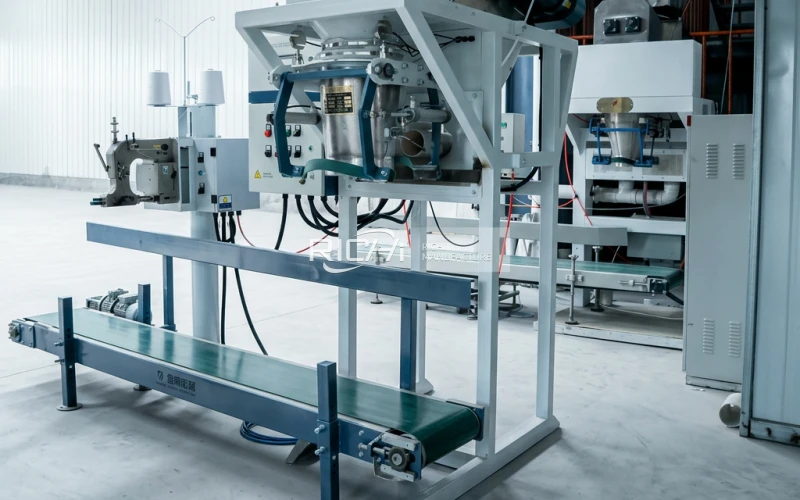
For this feed cooperative near Herning in western Denmark, the bottleneck was not pellet production. The existing feed mill could already manufacture the required pig feeds, and much of the cooperative’s high-volume farm supply continued to move through bulk delivery. The problem was the smaller but commercially important bagged-feed section, where an aging weighing and filling machine was becoming increasingly difficult to keep stable.
The cooperative therefore purchased one RICHI DCS-50K pig feed packing machine in Denmark as a direct replacement for the old bagging unit. Existing finished-feed bins, conveyors, bag sewing equipment and pallet handling were retained. The project focused on one job: improving weighing repeatability for dry pig feed pellets packed mainly in 25 kg bags, while preserving the simple semi-automatic workflow already familiar to the operators.
Name:
Pig Feed Packing Machine
Country:
Denmark
Date:
2026
Capacity:
5–6 bags/min
Model:
DCS-50K
Feeding Method:
Gravity feeding
Main product:
pelleted pig feed
Main Project Bag Size:
25 kg
Large commercial pig farms in Denmark commonly receive substantial volumes of compound feed in bulk, so only part of the cooperative’s production requires small-sack packaging.
The customer uses the DCS-50K Automatic Packing Machine for the portion of production that genuinely requires bags. This includes smaller orders, selected piglet and sow feeds, feed supplied to customers without suitable bulk silos, trial formulations and other orders where 25 kg packaging is more practical than tanker delivery.
The packing machine therefore only needs to handle the cooperative’s actual bagged-feed volume rather than its entire annual feed tonnage.
The previous semi-automatic machine had remained in service for many years. Its mechanical components and weighing system increasingly required adjustment, and spare-part availability was becoming less convenient.
The cooperative did not need another pellet mill, mixer or complete packaging line. Operators were comfortable with manually placing empty bags and transferring filled bags toward the existing sewing section.
A standalone weighing and filling replacement therefore offered a targeted investment.
| Project Parameter | Specification |
|---|---|
| Equipment | Pig feed packing machine |
| Model | DCS-50K |
| Feeding Method | Gravity feeding |
| Bagging Range | 10–50 kg |
| Main Project Bag Size | 25 kg |
| Reference Dynamic Accuracy | ±0.2% |
| Reference Filling Speed | Up to approximately 5–6 bags/min under suitable operating conditions |
| Main Material | Dry pelleted pig feed |
| Bag Closing | Existing sewing system retained |
The DCS-50K is configured for dry, free-flowing pig feed pellets and integrated with the cooperative’s existing finished-feed and bag-closing equipment.
Gravity feeding is particularly practical when the product flows freely from the finished-product bin.
The cooperative’s pig feed pellets are dry and sufficiently free flowing to descend into the weighing hopper without requiring an auger to force them forward. That keeps the filling arrangement comparatively simple and avoids adding mechanical feeding components where they are not required.
If the same customer were packaging a sticky mash, high-fat powder or other poorly flowing product, the feeding method would need to be reviewed rather than assuming the DCS-50K gravity configuration is always the correct choice.
The packing machine receives finished feed after pelleting, cooling and screening.
Excessive fines can change flow behavior and increase dust around the filling point. Pellets that are still warm can also create storage problems after packaging.
The customer therefore treats packing as the final part of a complete feed-manufacturing process. The DCS-50K measures and fills qualified finished feed; it does not correct weak pellets, excessive moisture or poor cooling produced upstream.
The same packing section handles feed intended for different production stages, including piglet, grower, finisher and sow feeding programs.
Pellet diameter and formulation can change between products, but all materials selected for this gravity-fed machine share one important physical characteristic: they remain sufficiently dry and free flowing for stable weighing and discharge.
The packer therefore does not need a separate mechanical configuration merely because the nutritional formula changes.
Typical pig feeds in Denmark can use locally available cereal ingredients such as barley and wheat together with protein meals, oilseed products, minerals, vitamins and other approved feed ingredients.
The exact proportion changes by pig category, ingredient price and nutritional specification.
The cooperative therefore does not use one rigid formula such as 45% barley, 25% wheat and 18% soybean meal for every bagged pig-feed product.
The cooperative primarily uses 25 kg sacks in this packing section.
That size is practical for lower-volume farm orders and dealer-style distribution while remaining compatible with the existing sewing and conveyor equipment.
The DCS-50K can operate over a broader nominal filling range, so another bag size can be configured when a confirmed customer order requires it.
The machine can support weights up to 50 kg, but the cooperative does not use 50 kg as the normal choice for larger Danish pig farms simply because they consume more feed.
Larger farms are precisely the customers most likely to justify bulk handling.
Where heavier bags are used, the cooperative also considers manual-handling and palletizing arrangements rather than viewing bag weight only as a packing-machine setting.
The DCS-50K has a reference dynamic accuracy of ±0.2% under the specified machine conditions.
That should be understood as an equipment-performance reference, not as a statement that every 25 kg sack will always fall within exactly the same number of grams under every production condition.
Feed flow, vibration, load-cell condition, filling speed, coarse/fine feed settings and calibration all affect practical weighing performance.
A nominal accuracy figure should not be converted into an unsupported claim that every 25 kg bag will consistently remain within only 10–20 g of target.
Actual performance depends on production conditions and the statistical method used to evaluate the filled bags.
The cooperative therefore uses the manufacturer’s reference accuracy together with routine check weighing to monitor practical filling performance.
The cooperative is responsible for making sure feed is packaged, labelled and marketed according to the rules applying to its products.
Danish Veterinary and Food Administration guidance specifically requires feed presentation not to mislead customers about characteristics including quantity, and net quantity forms part of feed labelling information.
The DCS-50K helps control filling weight, but legal compliance depends on the complete weighing, verification and documentation system used by the operator.
The tolerable negative errors used within the EU harmonised prepackage regime should not simply be treated as the machine-accuracy specification for a 25 kg pig-feed bag.
The harmonised e-mark prepackage regime has its own scope and testing requirements; it is not interchangeable with the ±0.2% machine-accuracy figure.
For commercial filling equipment, applicable metrology requirements and the installed weighing system must be evaluated separately.
Operators periodically remove filled sacks and compare them on an appropriate reference scale.
The purpose is not to adjust the filling machine after every bag. It is to identify drift before a large production batch is affected.
The cooperative records checks by product and packing run, giving the maintenance team useful information if the weight distribution begins to change.
When the target bag weight changes, recipe selection, target-weight setup, test filling and verification depend on the actual control system and operator procedure.
The team therefore follows a standard changeover check rather than applying one fixed calibration time to every switch between bag formats.
This is another important capacity distinction.
The DCS-50K can reach approximately 5–6 filling cycles per minute under suitable conditions, but a semi-automatic packaging line also includes bag placement, discharge, sewing and downstream handling.
If those activities cannot maintain the same pace, complete-line output will be lower.
The customer deliberately retained its existing sewing equipment because the bag-closing quality was satisfactory.
After replacing the old filler, the cooperative checked whether operators and the sewing conveyor could keep up with the higher filling rate.
The achievable packaging output therefore depends on the balance between filling, manual bag handling, sewing and downstream conveying.
The customer uses suitable sewn feed sacks for the selected product range.
However, the important regulatory issue is not whether Danish farmers simply “prefer paper bags.”
Danish feed guidance generally requires feed to be marketed in closed packaging or containers unless a specific exception applies; the closure should provide the required integrity for the marketed product.
The final bag and sewing arrangement are therefore selected from feed protection and regulatory requirements as well as customer preference.
The DCS-50K was not installed as an isolated machine in the middle of a warehouse.
The existing feed bin above the packing area already provided gravity head and product buffering.
The retrofit therefore focused on matching the new packer inlet, discharge height, conveyor position and maintenance clearance to the old plant layout.
A replacement machine from another manufacturer rarely has exactly the same footprint as equipment installed decades earlier.
The maintenance team used the confirmed RICHI installation drawing to prepare the support points instead of assuming the previous anchor-bolt pattern could simply be reused.
Pneumatic bag clamps and actuators require stable, clean compressed air.
Water, oil contamination or unstable pressure can affect cylinder response and eventually cause unreliable bag handling.
The cooperative already had a central compressed-air system, so the project required only confirmation that pressure and air quality met the final machine requirement.
The facility uses industrial three-phase electrical service at 50 Hz.
The exact machine electrical configuration was confirmed before manufacturing and documented for installation.
Final electrical design is based on the customer’s actual site conditions rather than national voltage information alone.
Instead of switching repeatedly among piglet, grower and sow feeds during start-up, operators selected one dry, consistently flowing pellet product.
They checked filling stages, bag clamping, gross and fine feed response, discharge and check weight before introducing other products.
This made it easier to distinguish machine adjustments from changes in pellet flow behavior.
Overfilling and underfilling are not the same commercial problem.
Consistent overfill creates product giveaway. Underfill can create customer and compliance problems.
The objective is therefore not simply to set every 25 kg bag substantially above 25 kg to guarantee that none are light. A stable filler allows the target to be controlled more closely without unnecessary safety margin.
Giveaway cannot be calculated by multiplying a nominal weighing deviation by the cooperative’s complete annual feed output, because only part of that production is packed in bags and individual filling errors are not all identical overfills.
The cooperative instead evaluates giveaway from actual bagged volume and measured average net weight.
A mill producing 40,000 tonnes annually could require only a modest bagging machine if nearly all feed is delivered in bulk.
Another mill with lower overall production could need a faster packing system if most products are sold in bags.
RICHI therefore asks for bags per hour and percentage of output packaged, not just annual feed-mill capacity.
An animal feed bagging machine is frequently purchased as a retrofit rather than as part of a completely new feed plant.
Where finished-product bins, conveyors and sealing equipment already work reliably, replacing only the weighing filler can reduce installation complexity.
A 25kg feed packing machine must be selected from more than nominal bag weight. Pellet flowability, required bags per minute, bag material, operator involvement and downstream closing speed all affect the appropriate configuration.
A gravity-fed pellet feed bagging machine is particularly suitable for dry, screened pellets that flow consistently.
Mash feed or oily specialty products may require belt, screw or other controlled feeding arrangements.
Buyers searching for an automatic feed weighing packing machine should distinguish automatic weighing from fully automatic bag handling.
The DCS-50K controls weighing and filling, while this Danish customer continues to use operator-assisted bag placement and its existing closing equipment.
A livestock feed packing machine in Denmark must fit an industry where bulk feed and bagged feed can coexist within the same business.
The right packing capacity is therefore determined by the actual packaged product portfolio rather than the feed mill’s total annual output.
For feed pellets, consistent product flow makes accurate weighing easier, but the packing section still needs routine verification. Load cells, pneumatic components and bag clamps remain working parts that should be inspected according to condition.
The DCS-50K was prepared for export from Qingdao and routed into Denmark through the Port of Aarhus before road delivery to the cooperative near Herning.
Port of Aarhus handles a large share of Denmark’s container traffic and provides regular container connections suitable for imported industrial machinery destined for western Denmark.
Actual ocean transit, customs processing and landed cost depend on the final carrier schedule, shipping route and import arrangement.
“We did not need to rebuild the packing department. Our conveyor and sewing machine were still useful; the weighing filler was the part we no longer trusted to remain stable. With the new machine, our operators check the bag weights regularly and can see whether the process is holding its target instead of compensating for an old machine by adding more feed to every sack.”
This pig feed packing machine in Denmark project uses one RICHI DCS-50K gravity-fed weighing and filling machine as a standalone replacement at a feed cooperative near Herning.
The cooperative produces several pig-feed formulations and supplies member farms through a combination of bulk delivery and bagged products. The DCS-50K handles the bagged portion rather than the plant’s complete annual feed output. Dry screened pig feed pellets are transferred from an existing finished-product bin into the weighing system, filled mainly into 25 kg bags and then moved to the cooperative’s retained sewing and handling equipment.
The machine provides a 10–50 kg packing range, approximately ±0.2% reference dynamic accuracy and filling capability of up to around 5–6 bags per minute under suitable conditions. Actual complete-line output depends on bag placement, feed flow, sewing speed and downstream handling, so the filler’s maximum cycle rate is not automatically the final packaged production rate.
For another customer comparing a pig feed packing machine in Denmark, animal feed bagging machine, 25kg feed packing machine, pellet feed bagging machine, automatic feed weighing packing machine, livestock feed packing machine, feed pellet weighing machine or DCS-50K feed bagger, RICHI Machinery would first review the percentage of total feed sold in bags, pellet or mash form, bulk density, bag weights, required bags per hour, bag material, sealing method, available compressed air, finished-bin arrangement and existing conveyor and palletizing equipment.
For a retrofit project like this one, the best packing machine is not necessarily the fastest model. It is the machine whose weighing method, filling speed and bag-handling arrangement fit the part of the existing feed mill that the customer actually needs to replace.
Having the right mix of reliable, high-quality pellet machine and pelletizing systems and expert support is essential to your success. Watch how our end-to-end feed pellet plant solutions have helped our customers optimize their performance.
Our customized and future-proofed turnkey pellet plant solutions is designed with you at the core. From vision to reality and beyond, our team stays connected with yours. Giving you peace-of-mind with an expert at your side.
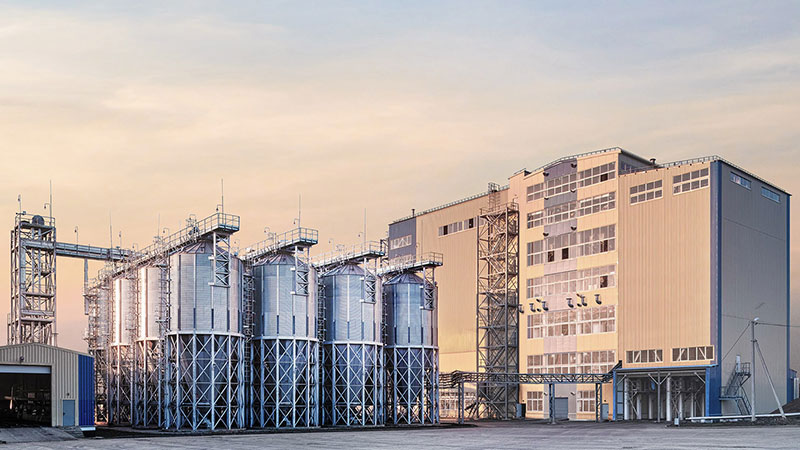
At RICHI, we go beyond project completion. With RICHI Servicee, we’re your dedicated partners in success. Count on us for expert guidance, minimal downtime, and optimized productivity. Choose RICHI for unmatched service and support.
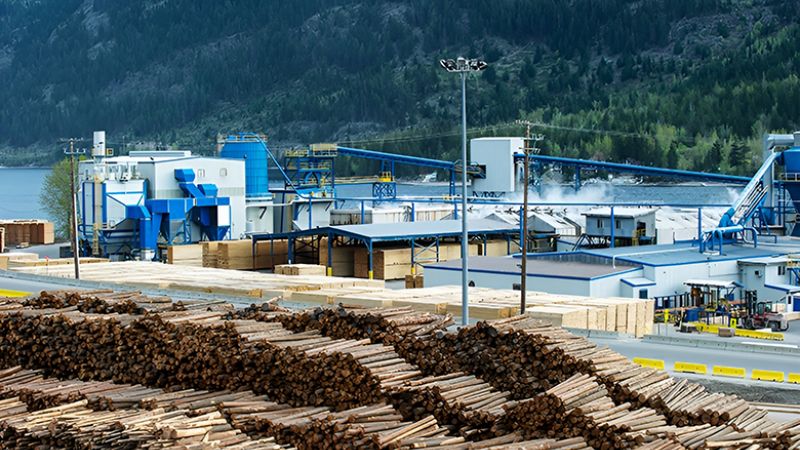


Meet global product demands and quality standards with industry-leading pellet plant design, engineering, equipment, and construction services for pellet processors.


Your Partner Beyond Project Completion
2000+ cases
RICHI is the leading designer, manufacturer and builder of pellet plants in the world, completing over 2000 projects in 140 countries across 6 continents.
Read More
Increase plant productivity, profitability, and safety by integrating high quality equipment into your pellet production line. Over the years, RICHI has become China's top pellet equipment manufacturer. At the same time, RICHI has established valuable partnerships with the world's leading component and raw material manufacturers to bring you the best there is in technology, automation, and efficiency in pelleting plant machinery.

For nearly 30 years, RICHI has been providing best-in-class pellet plant equipment and services to clients across a variety of industries, sizes, and needs. We pride ourselves on the knowledge and skill that each team member possesses – from our technical sales team to our process design engineers. You can count on RICHI Machinery to take your operation to the next level of innovation, quality, and success.
Need help with your pellet manufacturing plant project? Contact us today.
ANIMAL FEED
BIOMASS
WOOD
ORGANIC FERTILIZER
AQUA FEED
CAT LITTER
MUNICIPAL WASTE RECYCLING
SPECIAL PELLET PRODUCTION
RICHI Machinery continues to deliver world class pellet mill equipment, pellet plant engineering and project solutions that add value to our customers in the animal feed, wood waste, agriculture waste, organic fertilizer, cat litter and special pellet products industries. Throughout the years, we RICHI Machinery have built strong brand, becoming industry-leading pellet machine manufacturer. We value integrity, promise quality, and prioritize your success.
Learn MoreWith our expert team, we precisely implement your process engineering requirements in pellet mill and pelletizing plant systems. No matter which industry you’re in – we understand your needs and deliver solutions that meet the highest standards.
At RICHI, quality comes first. Our pellet making machine and related pellet line equipment undergo rigorous quality controls to ensure they meet the highest standards. Rely on products that are durable, safe, and efficient.
With decades of experience in pellet machine and pellet production line production, we have earned a reputation as a trusted partner in various industries. Our expertise allows us to cover a wide range of applications.
Not only do we offer premium pelleting equipment, but we are also experts at designing, building, installing, and maintaining facilities from the ground up. Our expertise is within pellt plant process design, discovering the most efficient, productive, and profitable way to handle your materials in an end-to-end cycle.
○ RICHI MACHINERY
Keeping in touch with us is an effective way to solve all your problems. If you have any needs or questions, please leave your contact information, then RICHI technical consultants will send design, quotation, videos to your mailbox. You can also contact us directly via WhatsApp: +86 13838389622
Copyright©2015-2026 by HENAN RICHI MACHINERY CO., LTD. All rights reserved.