
A County Cork pig feed mill uses one DCS-50K gravity-fed automatic weighing bagger for fast 20–25 kg packing of dry pig feed pellets.
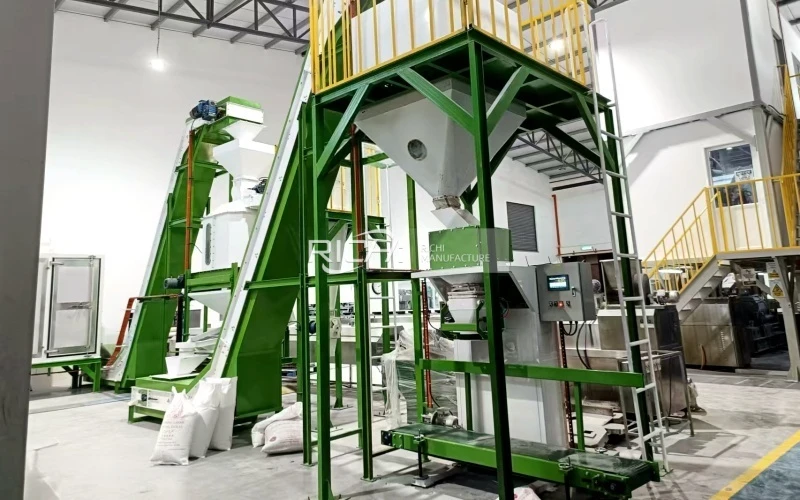
A commercial feed mill in County Cork selected one DCS-50K Pig Feed Automatic Bagger in Ireland after its manual filling and weighing station became a bottleneck for bagged pig-feed orders. The factory produces roughly 30,000 T/A of compound feed and supplies pig farms across southern Ireland, with part of its production delivered in bulk and selected piglet, grower, finisher and sow feeds packed into bags.
The customer already had finished-feed bins, a sewing machine, conveyors and pallet-handling space, so the project focused on one automatic weighing and filling machine rather than a complete packaging line. The DCS-50K uses gravity feeding for dry pellets and offers a reference speed of 5–6 bags/min, giving the mill a much more suitable packing rate without adding automatic bag placement or robotic palletizing.
Name:
Automatic weighing and filling machine
Country:
Ireland
Date:
2026
Capacity:
5–6 bags/min
Model:
DCS-50K
Power:
0.55 + 0.37 kW
Suitable Material:
Dry free-flowing pellets
Bag Sizes:
20 kg and 25 kg
The existing packing station depended on an operator opening a manual gate, estimating the bag fill and then moving each sack to a separate platform scale for correction. That workflow could function at low volume, but repeated weighing and manual adjustment became increasingly difficult as bagged orders grew. The mill therefore targeted the filling and weighing stage while continuing to use serviceable downstream equipment.
| Project Parameter | Configuration |
|---|---|
| Equipment | Automatic weighing and filling machine for pig feed pellets |
| Model | DCS-50K |
| Quantity | 1 unit |
| Suitable Material | Dry free-flowing pellets |
| Feeding Method | Gravity feeding |
| Packaging Range | 10–50 kg/bag |
| Main Project Bag Sizes | 20 kg and 25 kg |
| Occasional Bag Size | 40 kg where required |
| Reference Filling Speed | 5–6 bags/min under suitable conditions |
| Static Accuracy | ±0.1% |
| Dynamic Accuracy | ±0.2% |
| Installed Power | 0.55 + 0.37 kW |
| Compressed Air | 0.4–0.6 MPa, approximately 1.5 m³/h |
| Bag Closing | Customer's sewing equipment |
| Installation Type | Standalone packing-section upgrade |
The 5–6 bags/min specification describes the filling machine under suitable pellet-flow conditions. Complete packing output also depends on operator bag placement, finished-bin discharge, bag removal, sewing speed and pallet handling. The DCS-50K therefore automates weighing and filling, but it should not be described as a fully robotic bagging line unless automatic bag supply and downstream handling are also installed.
The Pig Feed Automatic Bagger in Ireland receives qualified finished feed after pelleting, cooling and screening. The project mainly handles piglet, grower, finisher and sow pellets in the approximate 3–5 mm range. Although formulation and pellet diameter differ between products, they share the characteristic that matters most to this machine: they are dry enough and free flowing enough for controlled gravity feeding.
Dry screened pellets can move from the finished-feed bin into the weighing section without a belt or screw forcing material forward. This makes gravity feeding a practical choice for the County Cork project and avoids unnecessary mechanical contact with the pellets. The same model would not automatically be selected for sticky mash, oily powder or another product that bridges severely above the filling system.
The DCS-50W Automatic Packing Machine also uses gravity feeding but has a reference filling rate of only about 2–3 bags/min. That can suit smaller bagging operations, but the Irish customer's growing bagged-feed volume requires more cycle capacity. The DCS-50K increases the reference rate to 5–6 bags/min while keeping the same basic gravity-feed principle, making it a more proportionate upgrade without moving to a more complex feeding system.
The DCS-50P is useful when one machine must handle both pellets and less predictable powder-type materials, but that versatility is not the main requirement here. The County Cork packing station is dedicated mainly to dry pig-feed pellets, so adding a belt feeder would introduce another drive and moving material-contact surface without solving an actual flow problem. Machine selection follows product behaviour rather than model ranking.
Auger-fed packing equipment can provide positive metering for premixes and other powders, but the customer does not need that feeding principle for its normal pellet campaigns. Passing pellets through an unnecessary screw adds mechanical contact and complexity, while gravity already provides adequate flow. If the factory later develops a substantial powder-feed business, that product should be evaluated separately rather than forced through this pellet configuration.
At 5 bags/min, a 25 kg bag format corresponds mathematically to about 7.5 T/H of filling flow; at 6 bags/min, the figure rises to about 9 T/H. These values are theoretical scale throughput rather than guaranteed packaged tonnes for a full shift. Operator movement, sewing and pallet handling can reduce usable output, so the customer evaluates the entire packing station before setting the production schedule.
A tonne of feed requires 50 bags at 20 kg but only 40 bags at 25 kg, so smaller bags increase the number of filling cycles required for the same mass. At 5–6 bags/min, the theoretical flow for 20 kg bags is about 6–7 T/H. This means piglet-feed campaigns can consume more bagging time even when their total tonnes are lower than grower or finisher production packed mainly in 25 kg sacks.
The DCS-50K can operate within a 10–50 kg range, so 40 kg pig-feed bags can be configured when customers request them. The scale itself may have enough capacity, but a heavier filled bag places more demand on manual removal, conveyor transfer and pallet stacking. The mill therefore treats larger bags as a handling decision as well as a weighing decision instead of assuming higher kilograms per bag automatically improve the packing operation.
A commercial Irish pig-feed manufacturer can supply larger farms through bulk delivery while using bags for smaller orders, specialty feeds, dealers or customers without suitable bulk silos. This means total factory tonnage should not be divided by 25 kg to calculate required bag counts. The DCS-50K is selected from the peak bagged portion of production, not from the assumption that all 30,000 annual tonnes pass through one bagging spout.
If the complete 30,000 T/A were packed into 25 kg sacks, the mill would need about 1.2 million bags each year, creating a much larger packaging operation than one operator-assisted DCS-50K station. The actual project makes more sense when bulk and bagged dispatch coexist. During peak bagging campaigns, the 5–6 bags/min scale provides substantial reserve without pretending that one filling machine handles the factory's entire annual production.
The DCS-50K is specified at ±0.1% static accuracy and ±0.2% dynamic accuracy. At a 25 kg target, ±0.2% corresponds mathematically to about ±50 g; at 20 kg, it corresponds to about ±40 g. These are reference equipment figures rather than a promise for every individual bag because calibration, pellet flow, vibration and gate cut-off behaviour all influence practical production results.
Automatic weighing does not eliminate quality-control checks. The mill periodically verifies representative filled bags using an appropriate independent scale and reviews whether average pack weight remains around the intended target. If results begin to drift, operators inspect calibration, gate movement, load-cell condition and pellet flow before increasing the set point and giving away unnecessary feed in every sack.
A small systematic overfill can accumulate when thousands of bags are produced, but it would be misleading to claim that the customer had been giving away hundreds of tonnes without verified weighing records. The practical objective is stable filling around the declared bag weight while avoiding both underweight packs and excessive safety margins. Real savings should be calculated from measured bag data rather than estimated retrospectively.
The mill can use barley, wheat, soybean meal, rapeseed products, grain by-products, minerals, vitamins and amino acids according to pig stage and ingredient economics. Those nutritional decisions occur upstream. Once properly manufactured feed reaches the packing bin as a dry, free-flowing pellet, the DCS-50K mainly responds to physical characteristics such as bulk density, fines level, pellet integrity and bag weight.
Barley and wheat are well-established cereal ingredients in Irish livestock feeding, while imported protein meals can complement locally available grains and by-products. The customer does not use a permanent percentage recipe merely because those materials are common in the region. Ingredient proportions differ across piglet, grower, finisher and sow feeds, but the packing machine can serve all of them when the finished physical form remains suitable.
The packer receives feed only after cooling and screening, so excessive fines or damaged pellets indicate an upstream issue rather than a filling-machine problem. A high fines fraction can alter bulk density, increase dust and affect how material approaches the weighing cut-off. The customer therefore monitors pellet quality together with bagging performance instead of assuming that every variation in filling behaviour should be corrected through scale settings.
Warm pellets can continue releasing heat and moisture after they enter a closed sack, increasing the risk of condensation or poor storage stability. The customer therefore checks cooling before finished feed is released to the bagging section. The DCS-50K measures and fills qualified product; it does not compensate for insufficient cooling or high finished-feed moisture produced earlier in the manufacturing process.
Gravity packing depends on stable product supply above the weighing machine. If the finished-feed bin repeatedly runs nearly empty or its outlet restricts pellet flow, filling cycles can become slower even though the scale itself is working correctly. The project therefore checks outlet geometry, available head height and bin refill control so the DCS-50K receives a predictable material flow throughout each bagging campaign.
The DCS-50K requires compressed air at approximately 0.4–0.6 MPa with reference consumption around 1.5 m³/h. The customer therefore verifies pressure stability, moisture control and total compressor demand before operation. Where the same air system serves bag clamps, valves or other packaging equipment, compressor sizing is based on simultaneous consumption rather than the scale's requirement alone.
The DCS-50K uses a power configuration of approximately 0.55 + 0.37 kW, which is minor compared with hammer mills or pellet mills. Even so, the packing position still needs correct protection, grounding and controls, while the sewing machine and conveyors add separate loads. Site voltage and frequency are confirmed against the customer's plant supply rather than assumed from a generic European installation.
Filled bags leave the DCS-50K and move toward the customer's sewing station, so replacing the weighing filler does not require replacing serviceable closing equipment. The interface still needs to be checked for bag height, conveyor level and sewing speed. If filled bags accumulate between the scale and sewer, the downstream equipment rather than the DCS-50K becomes the practical packaging bottleneck.
The customer's normal pig-feed bags are compatible with seam closing, allowing the existing sewing equipment to remain useful. This does not mean every Irish feed bag should use the same closure. Paper construction, liners, moisture protection and distribution requirements determine whether sewing, heat sealing or a combined method is appropriate. The filling scale is selected independently from the final bag-closing choice.
An operator positions the empty sack, the DCS-50K controls filling and weighing, and the full bag then moves toward sewing and pallet handling. This arrangement removes manual judgement from the weighing stage without introducing the cost and maintenance of automatic bag magazines and robotic palletizers. For the bagged share of a 30,000 T/A mill, this intermediate level of automation can be more practical than a completely automatic line.
The Pig Feed Automatic Bagger in Ireland can reduce manual weighing and adjustment work, but exact labour savings depend on how the customer's bag placement, sewing, conveying and palletizing are organized. It would be unreliable to promise that one filler always replaces three employees. The stronger engineering case is that automatic weighing removes repetitive manual correction and lets labour be allocated around the remaining handling tasks.
Load-cell weighing works best when the machine is supported on a stable structure and isolated from unnecessary vibration. A nearby conveyor, grinder or other rotating machine can disturb weight readings if mechanical forces transfer into the scale. The County Cork retrofit therefore checks structural support, inlet connections and surrounding equipment before final positioning rather than selecting the location only from available floor area.
Even screened pellets generate some fines during conveying and filling, so dust can accumulate around the bag clamp, weighing components and floor area. The customer includes regular cleaning in the packing routine while avoiding practices that could damage load cells or electrical parts. Persistent increases in dust also trigger a check of pellet breakage and upstream screening instead of being treated only as a housekeeping issue.
The DCS-50K can be prepared for export from Qingdao and shipped into the Cork region before short-distance inland transport to the customer's facility. For a mill located in County Cork, this route offers a practical geographic connection without unnecessary movement across Ireland. Final vessel routing, customs handling and trucking still depend on the actual shipment, so the case does not assign fixed transit or clearance periods.
If bagged-feed orders continue growing, the mill should measure the whole packaging cycle before buying another filler. Sewing, manual bag supply, pallet stacking or warehouse movement may reach their limits while the DCS-50K still has available weighing capacity. Automation should therefore move to the stage that actually restricts bags per hour, rather than assuming a second packing scale is always the next logical investment.
The customer's dry pellet product does not justify changing feeding principle merely to obtain more automation. If future volume regularly exceeds the usable 5–6 bags/min range, the mill can evaluate a higher-capacity packing configuration together with automatic bag placement or pallet handling. The decision should be based on peak bagged tonnage, bag size, working hours and downstream speed rather than total annual feed production alone.
A Pig Feed Automatic Bagger in Ireland should be selected from the portion of production actually packed into bags. For another pig feed mill, RICHI Machinery would review pellet or mash form, bag weights, peak bags/min, bulk density, fines, finished-bin layout, operator involvement, closing method, conveyor capacity, compressed air, electrical supply and available L × W × H around the packing station.
Those details determine whether a gravity-fed DCS-50K provides enough capacity or whether another feeding and automation arrangement is more appropriate. A dry pellet mill with existing sewing equipment has a very different requirement from a factory packing powders, sticky feeds or very high daily bag counts, so the best bagger should follow the actual product and workflow rather than the annual tonnage headline.
Having the right mix of reliable, high-quality pellet machine and pelletizing systems and expert support is essential to your success. Watch how our end-to-end feed pellet plant solutions have helped our customers optimize their performance.
Our customized and future-proofed turnkey pellet plant solutions is designed with you at the core. From vision to reality and beyond, our team stays connected with yours. Giving you peace-of-mind with an expert at your side.
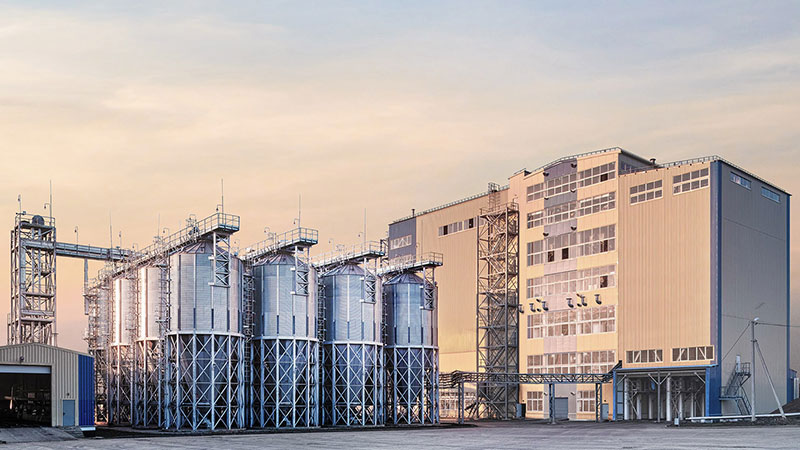
At RICHI, we go beyond project completion. With RICHI Servicee, we’re your dedicated partners in success. Count on us for expert guidance, minimal downtime, and optimized productivity. Choose RICHI for unmatched service and support.
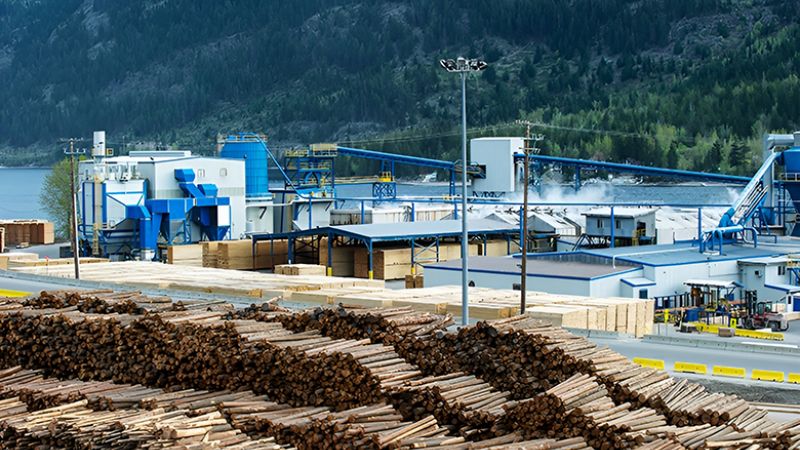


Meet global product demands and quality standards with industry-leading pellet plant design, engineering, equipment, and construction services for pellet processors.


Your Partner Beyond Project Completion
2000+ cases
RICHI is the leading designer, manufacturer and builder of pellet plants in the world, completing over 2000 projects in 140 countries across 6 continents.
Read More
Increase plant productivity, profitability, and safety by integrating high quality equipment into your pellet production line. Over the years, RICHI has become China's top pellet equipment manufacturer. At the same time, RICHI has established valuable partnerships with the world's leading component and raw material manufacturers to bring you the best there is in technology, automation, and efficiency in pelleting plant machinery.

For nearly 30 years, RICHI has been providing best-in-class pellet plant equipment and services to clients across a variety of industries, sizes, and needs. We pride ourselves on the knowledge and skill that each team member possesses – from our technical sales team to our process design engineers. You can count on RICHI Machinery to take your operation to the next level of innovation, quality, and success.
Need help with your pellet manufacturing plant project? Contact us today.
ANIMAL FEED
BIOMASS
WOOD
ORGANIC FERTILIZER
AQUA FEED
CAT LITTER
MUNICIPAL WASTE RECYCLING
SPECIAL PELLET PRODUCTION
RICHI Machinery continues to deliver world class pellet mill equipment, pellet plant engineering and project solutions that add value to our customers in the animal feed, wood waste, agriculture waste, organic fertilizer, cat litter and special pellet products industries. Throughout the years, we RICHI Machinery have built strong brand, becoming industry-leading pellet machine manufacturer. We value integrity, promise quality, and prioritize your success.
Learn MoreWith our expert team, we precisely implement your process engineering requirements in pellet mill and pelletizing plant systems. No matter which industry you’re in – we understand your needs and deliver solutions that meet the highest standards.
At RICHI, quality comes first. Our pellet making machine and related pellet line equipment undergo rigorous quality controls to ensure they meet the highest standards. Rely on products that are durable, safe, and efficient.
With decades of experience in pellet machine and pellet production line production, we have earned a reputation as a trusted partner in various industries. Our expertise allows us to cover a wide range of applications.
Not only do we offer premium pelleting equipment, but we are also experts at designing, building, installing, and maintaining facilities from the ground up. Our expertise is within pellt plant process design, discovering the most efficient, productive, and profitable way to handle your materials in an end-to-end cycle.
○ RICHI MACHINERY
Keeping in touch with us is an effective way to solve all your problems. If you have any needs or questions, please leave your contact information, then RICHI technical consultants will send design, quotation, videos to your mailbox. You can also contact us directly via WhatsApp: +86 13838389622
Copyright©2015-2026 by HENAN RICHI MACHINERY CO., LTD. All rights reserved.