
A Guadalajara pet food producer uses one SWFL90 micronizer to prepare selected dry ingredients at about 80–100 μm for rehydratable senior dog and cat food powders.
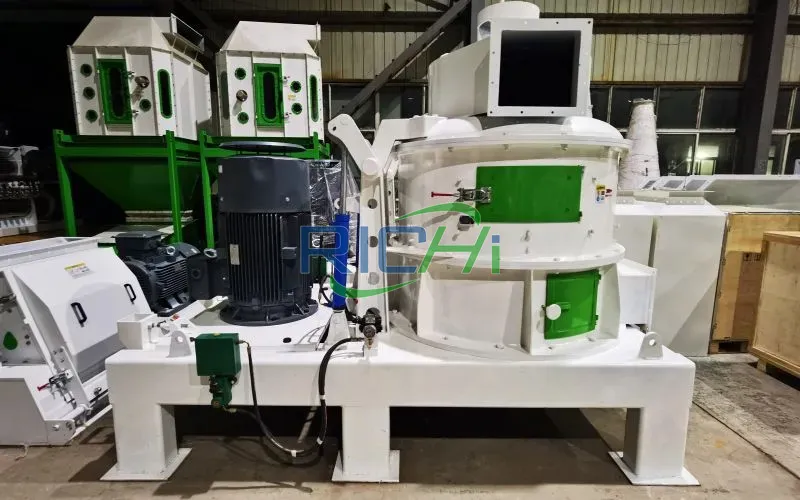
A specialty pet food manufacturer in Guadalajara selected one SWFL90 Pet Food Micronizer Machine in Mexico to develop a dry powder product that can be rehydrated into a soft meal for senior dogs and cats. The factory already produced premium pet food and had conventional grinding, batching and mixing equipment, so the investment focused on ultrafine size reduction rather than another complete processing line.
The SWFL90 uses a 90 kW main motor, 7.5 kW classifier drive and 1.5 kW feeder, with a nominal fineness range of about 80–200 mesh. For this project, the working target is around 80–100 μm for selected dry ingredients. At such a demanding fineness, practical planning is closer to about 0.8–1.0 T/H, with final capacity confirmed from material tests and classifier settings.
Name:
ultrafine grinder for pet food ingredients
Country:
Mexico
Date:
2026
Capacity:
0.8–1.0 T/H
Model:
SWFL90
Main Power:
90 kW
Raw Materials:
Pre-ground dry ingredients
Final product size:
75–180 μm
The plant could already reduce grains and protein ingredients to conventional feed-powder sizes, but the new product needed a much finer and more controlled particle distribution. The SWFL90 was added after primary grinding so it receives prepared material instead of whole grains or coarse meal. This keeps the 90 kW machine focused on ultrafine reduction and classification, where it provides more value than using it as the first crushing stage.
| Project Parameter | Configuration |
|---|---|
| Equipment | Air-classified ultrafine grinder for pet food ingredients |
| Model | SWFL90 |
| Quantity | 1 unit |
| Main Motor Power | 90 kW |
| Classifier Wheel Power | 7.5 kW |
| Feeder Power | 1.5 kW |
| Nominal Fineness Range | Approximately 80–200 mesh |
| Approximate Particle Range | About 75–180 μm, depending on classification setting and test method |
| Project Working Target | Approximately 80–100 μm for selected dry ingredients |
| Reference Capacity | 1–2 T/H under stated reference conditions |
| Fine-Setting Planning Range | Approximately 0.8–1.0 T/H for demanding micron duty |
| Incoming Material | Pre-ground dry ingredients, generally around sub-millimeter to 1–2 mm class |
| Main Application | Micronized dry ingredients for rehydratable pet food powder |
| Installation Type | Standalone ultrafine grinding upgrade |
The 1–2 T/H value should not be read as a guarantee at the finest setting. Capacity falls as the required cut point becomes finer or the material becomes harder, more fibrous, oilier or more abrasive. For the 80–100 μm duty in this project, the plant therefore plans production from the lower fine-grinding range and confirms the final rate with representative ingredients before setting daily output targets.
Chicken meal, rice-based ingredients, starches and other dry components can enter the ultrafine route when their physical condition suits the grinder. Liquid chicken fat, fish oil and other added lipids do not pass through the micronizer because high surface fat can smear, reduce classification efficiency and increase internal buildup. Those liquids are introduced later during formulation and mixing according to the pet food recipe.
The factory does not depend on a permanent blend such as 30% chicken meal, 25% rice and fixed percentages of starch, fibre and fat. Senior dog and cat products have different nutritional requirements, and ingredient analysis can vary between suppliers. The nutrition team defines protein, fat, fibre, minerals, vitamins and energy first, while the grinding team decides which dry components need micron reduction for texture and mixing performance.
Chicken meal can be useful in pet food, but its ash, hardness and residual fat vary with processing quality. Mineral-rich batches can increase wear, while higher surface fat can reduce free flow and make ultrafine grinding more difficult. The plant therefore checks moisture, ash, fat and particle condition before deciding how aggressively to micronize a batch, rather than assuming every poultry-protein meal will run at the same capacity.
Rice-based ingredients and starches create a different grinding duty from animal protein meals, yet hardness and moisture still influence throughput. A material that fractures readily may reach the required micron range with less recirculation, while a dense ingredient can remain longer in the classifier circuit. The plant therefore stores product-specific settings instead of using one feeder rate for every dry ingredient.
Fine fibre can contribute nutritional and functional value to pet food, but highly fibrous ingredients are harder to micronize than starch-rich materials. Beet pulp or similar fibre ingredients can lower throughput, increase recirculation and broaden particle distribution at higher inclusion. The customer therefore evaluates whether each fibre fraction needs ultrafine grinding or can enter later at a suitable prepared size.
The SWFL90 Ultrafine Pulverizer is more efficient when incoming material has already been reduced to a relatively uniform fine feed. For an 80–100 μm target, the plant prepares dry ingredients in the sub-millimeter to roughly 1 mm class where practical, while less demanding campaigns can accept somewhat coarser pre-ground material. Feeding large flakes or coarse granules would increase recirculation and reduce the useful output of the micronizing stage.
The Pet Food Micronizer Machine in Mexico does not control fineness with one small screen alone. Ground material moves with process air toward a classifier wheel, where fine particles leave the circuit and coarser particles remain for more grinding. This classification principle lets the operator adjust the cut point, but fineness must still be balanced against airflow, feeder rate and practical tonnes per hour.
Increasing classifier speed can generally push the cut point finer, but the result also depends on airflow, material density, feed rate and the condition of the grinding chamber. One fixed value such as 2,900 rpm should not be copied across every ingredient or formula. The operator establishes a working window from particle-size testing and motor behavior, then stores those settings for repeat production of the same dry ingredient.
The project target of 80–100 μm sits near the fine end of the SWFL90 operating range, roughly around the 150–180 mesh class depending on the sieve standard. Mesh and micron values are not perfectly interchangeable across every standard, so quality documents should state the actual particle-size method rather than rely only on a mesh label. This avoids confusion between suppliers and laboratories.
For a narrow ultrafine specification, particle-size analysis by laser diffraction can provide more useful distribution data than relying only on manual sieve checks. The customer needs to know not just one passing percentage but how much material remains above the intended cut and how much becomes excessively fine. The analyzer is a quality-control choice for the plant, not a standard part of the SWFL90 machine package.
Reducing dry ingredients to around 80–100 μm can help create a smoother mouthfeel after water is added, but texture also depends on starch hydration, protein functionality, fat, fibre, water ratio and mixing time. The micronizer therefore supports the physical product target without guaranteeing one puree texture by itself. The factory verifies the finished powder through controlled reconstitution tests using the actual commercial formula.
A very fine powder can still be nutritionally inadequate if the formula is poorly balanced. Protein quality, amino acids, essential fatty acids, minerals, vitamins, energy density and species-specific needs remain the responsibility of formulation and quality control. The SWFL90 performs particle-size reduction only, so the plant separates texture engineering from any claim that the finished food is complete and balanced.
Dogs and cats cannot be treated as one identical nutrition market simply because both products use the same micronizer. Cats have distinct requirements for nutrients such as taurine and certain amino acids, while dog formulas follow their own nutritional targets. The factory can use the same ultrafine grinding platform for suitable dry ingredients, but batching, premix addition and finished-product release remain species-specific.
Vitamin and mineral premixes are already fine, concentrated materials and normally do not need another high-energy grinding pass. Sending them through the SWFL90 can increase dust, residue and cross-contact without useful size reduction. The customer therefore micronizes the dry macro ingredients that need it, then adds premixes through controlled batching so dosage accuracy and formula segregation remain easier to manage.
As particle size moves toward the micron range, the powder becomes easier to suspend in air and more difficult to contain at transfer points. The grinding section therefore needs enclosed conveying, suitable product collection, filtration and disciplined housekeeping. Airflow is part of the classification process as well as dust management, so the fan, cyclone and filter must be sized as one circuit rather than treated as unrelated accessories.
Micronized starch, rice powder and protein meal can form combustible dust clouds under unfavorable conditions. The plant therefore considers grounding, dust containment, temperature monitoring, ignition control and suitable explosion-protection measures based on its risk assessment. The exact arrangement depends on ingredients, airflow and building layout, so one protection package should not be claimed for every pet food application.
A plant producing dog and cat foods, specialty powders and conventional products has to manage residue in the feeder, grinding chamber, classifier, cyclone and conveying path. Fine powder can remain on surfaces even when the machine appears empty. The customer therefore plans compatible production sequences and validates cleanout under its ingredient and allergen-control program instead of assuming that a short idle period clears the circuit.
Ultrafine grinding increases the number of particle impacts and can accelerate wear when ingredients contain hard mineral material. It is not credible to promise that hammers will last exactly 500 or 600 hours for every pet food formula. The factory inspects wear components against processed tonnes, vibration, product fineness and classifier performance, then establishes a maintenance interval from its own ingredient mix and operating pattern.
The SWFL90 includes a 90 kW main grinding drive, 7.5 kW classifier motor and 1.5 kW feeder before fans, airlocks, conveying and dust filtration are counted. Site planning therefore checks transformer capacity, motor starting, protection, cable sizing and simultaneous demand for the complete micronizing section. Mexico uses 60 Hz power, but the actual plant voltage must be confirmed before motor and control configuration is finalized.
Process air carries fine particles through the classifier and into the collection system, so insufficient airflow can increase recirculation while excessive airflow can disturb separation and raise filter loading. The customer therefore commissions the grinder, classifier, fan, cyclone and filter together. A dust collector used with a conventional hammer mill is not automatically suitable for an ultrafine classification circuit.
The factory manufactures about 6,000 tonnes of pet food annually, but the micronized senior product is only one part of that portfolio. A fine-setting output around 0.8–1.0 T/H can supply roughly 4–6 tonnes in a five- to six-hour production window before allowing for cleaning and product transitions. This makes the SWFL90 more realistic than sizing the machine from the factory's total annual tonnage.
The SWFL90 can be shipped from Qingdao to Manzanillo and then moved inland to the Guadalajara area. Manzanillo is a major Mexican container gateway with strong links into Jalisco and the central industrial region, making the route suitable for machinery imports. The project does not rely on fixed claims for sea transit, customs days or landed-cost percentages because those depend on vessel service, tariff treatment and terminal conditions.
The retrofit review covers machine support, inlet height, product collection, duct routing, fan location, filter access, electrical service and maintenance clearance. High-speed classification equipment also needs careful alignment and a stable structure, but the correct foundation is determined from confirmed machine loads and local civil design. A generic slab thickness or machine weight should not be copied into every SWFL90 installation.
Particle size is only one release parameter for the dry powder product. The customer also controls moisture, microbiological status, nutrient composition, bulk density and reconstitution behavior according to its finished-food specification. Mexico regulates products for animal consumption, so the manufacturer keeps formulation, manufacturing and quality documentation aligned with the product it intends to sell.
If sales of the rehydratable product grow, the plant should first check operating hours, classifier loading, pre-grinding capacity, mixing, dust collection and packaging before adding another micronizer. A larger SWFL model becomes useful when prepared dry material regularly waits ahead of the installed machine and downstream equipment can accept more fine powder without creating storage or cleaning problems.
A Pet Food Micronizer Machine in Mexico should be selected from the ingredients that truly need ultrafine reduction, not from the total tonnes of pet food sold by the factory. RICHI Machinery would review ingredient hardness, fat and fibre, incoming particle size, target micron distribution, required T/H, operating hours, air-handling capacity, product-contact requirements and available L × W × H before confirming the SWFL model.
For a Guadalajara producer targeting an 80–100 μm powder, the SWFL90 can provide an appropriate starting scale when primary grinding is already available and the daily micronized volume is moderate. The final selection still depends on representative material testing because chicken meal, rice, fibre ingredients and starches can produce very different throughput and wear at the same nominal micron target.
Having the right mix of reliable, high-quality pellet machine and pelletizing systems and expert support is essential to your success. Watch how our end-to-end feed pellet plant solutions have helped our customers optimize their performance.
Our customized and future-proofed turnkey pellet plant solutions is designed with you at the core. From vision to reality and beyond, our team stays connected with yours. Giving you peace-of-mind with an expert at your side.
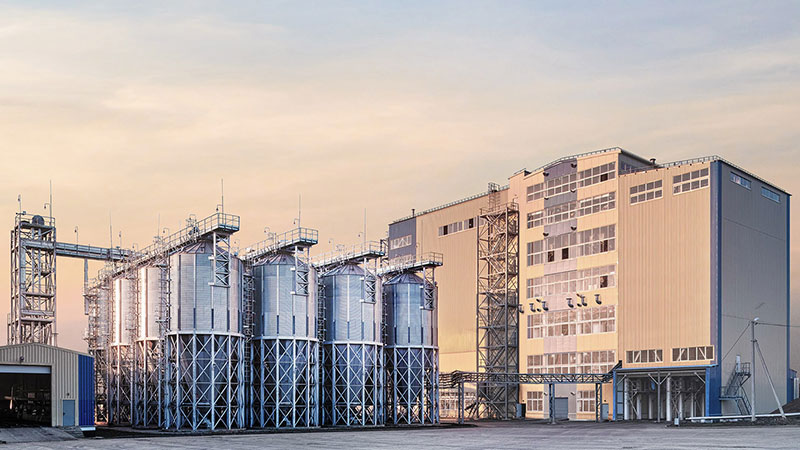
At RICHI, we go beyond project completion. With RICHI Servicee, we’re your dedicated partners in success. Count on us for expert guidance, minimal downtime, and optimized productivity. Choose RICHI for unmatched service and support.
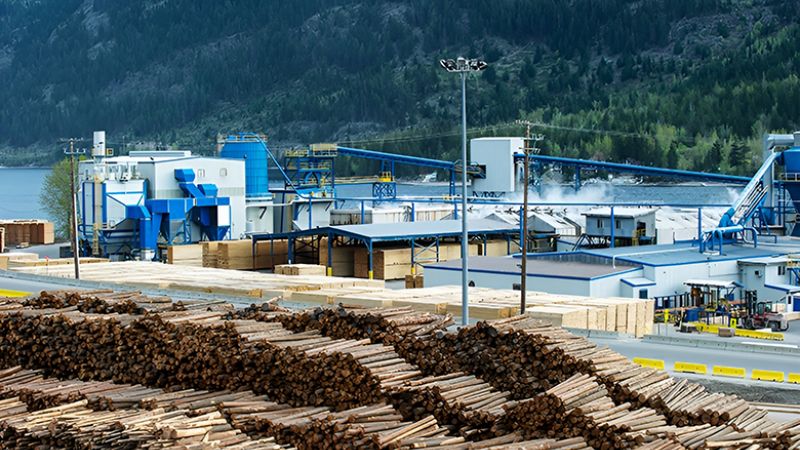


Meet global product demands and quality standards with industry-leading pellet plant design, engineering, equipment, and construction services for pellet processors.

Your Partner Beyond Project Completion
2000+ cases
RICHI is the leading designer, manufacturer and builder of pellet plants in the world, completing over 2000 projects in 140 countries across 6 continents.
Read More
Increase plant productivity, profitability, and safety by integrating high quality equipment into your pellet production line. Over the years, RICHI has become China's top pellet equipment manufacturer. At the same time, RICHI has established valuable partnerships with the world's leading component and raw material manufacturers to bring you the best there is in technology, automation, and efficiency in pelleting plant machinery.

For nearly 30 years, RICHI has been providing best-in-class pellet plant equipment and services to clients across a variety of industries, sizes, and needs. We pride ourselves on the knowledge and skill that each team member possesses – from our technical sales team to our process design engineers. You can count on RICHI Machinery to take your operation to the next level of innovation, quality, and success.
Need help with your pellet manufacturing plant project? Contact us today.
ANIMAL FEED
BIOMASS
WOOD
ORGANIC FERTILIZER
AQUA FEED
CAT LITTER
MUNICIPAL WASTE RECYCLING
SPECIAL PELLET PRODUCTION
RICHI Machinery continues to deliver world class pellet mill equipment, pellet plant engineering and project solutions that add value to our customers in the animal feed, wood waste, agriculture waste, organic fertilizer, cat litter and special pellet products industries. Throughout the years, we RICHI Machinery have built strong brand, becoming industry-leading pellet machine manufacturer. We value integrity, promise quality, and prioritize your success.
Learn MoreWith our expert team, we precisely implement your process engineering requirements in pellet mill and pelletizing plant systems. No matter which industry you’re in – we understand your needs and deliver solutions that meet the highest standards.
At RICHI, quality comes first. Our pellet making machine and related pellet line equipment undergo rigorous quality controls to ensure they meet the highest standards. Rely on products that are durable, safe, and efficient.
With decades of experience in pellet machine and pellet production line production, we have earned a reputation as a trusted partner in various industries. Our expertise allows us to cover a wide range of applications.
Not only do we offer premium pelleting equipment, but we are also experts at designing, building, installing, and maintaining facilities from the ground up. Our expertise is within pellt plant process design, discovering the most efficient, productive, and profitable way to handle your materials in an end-to-end cycle.
○ RICHI MACHINERY
Keeping in touch with us is an effective way to solve all your problems. If you have any needs or questions, please leave your contact information, then RICHI technical consultants will send design, quotation, videos to your mailbox. You can also contact us directly via WhatsApp: +86 13838389622
Copyright©2015-2026 by HENAN RICHI MACHINERY CO., LTD. All rights reserved.