
The Lower Saxony manufacturer did not need a dryer simply because its kibble contained fresh meat. The real engineering problem was controlling moisture after extrusion without creating large differences between the surface and the center of the kibble. Its existing drying section had limited flexibility over residence time, bed depth, and airflow distribution, which became more noticeable as the company introduced denser, meat-rich dog and cat food formulas.
The Lower Saxony manufacturer did not need a dryer simply because its kibble contained fresh meat. The real engineering problem was controlling moisture after extrusion without creating large differences between the surface and the center of the kibble. Its existing drying section had limited flexibility over residence time, bed depth, and airflow distribution, which became more noticeable as the company introduced denser, meat-rich dog and cat food formulas.
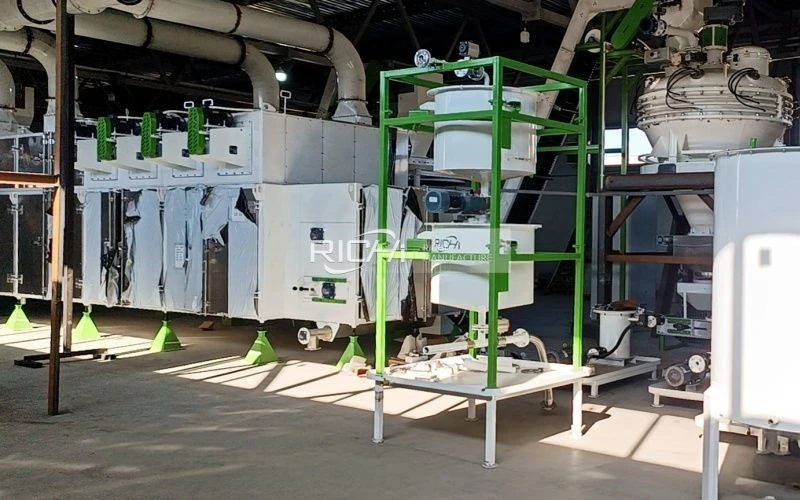
The customer therefore installed one DHG-1000 pet food extrusion mesh belt dryer in Germany as a replacement for the existing drying stage serving a premium kibble line. The five-layer dryer provides approximately 43 m² of effective drying area and is configured around roughly 0.8–1.2 T/H of extruded pet food, depending on kibble size, inlet moisture, target moisture, bed depth, and drying conditions. The customer retained its extrusion, cooling, coating, and packing systems rather than rebuilding the complete pet food plant.
Name:
premium kibble dryer
Country:
Germany
Date:
2026
Capacity:
0.8–1.2 T/H
Model:
DHG-1000
Final Moisture:
8–10%
Number of Layers:
5
Drying Area:
43 m²
The customer is a dry pet food manufacturer in Lower Saxony producing dog and cat kibble for the German and neighboring European markets. The plant already had grinding, batching, mixing, extrusion, coating, and packaging equipment. Drying was the section that provided the least flexibility when new formulations were introduced.
The problem was not that conventional pet food dryers are inherently unsuitable for premium kibble. Commercial dry pet food can be successfully produced with several dryer designs. The issue was whether the existing unit could deliver the temperature, airflow, residence time, and product handling required by this manufacturer's particular recipes.
Fresh-meat-rich formulations can leave the extruder with different moisture distribution and structural characteristics from simpler cereal-rich recipes. Kibble diameter, expansion, bulk density, and porosity also change how quickly water migrates from the center of the particle to the surface.
The customer wanted more control over this drying curve rather than simply increasing air temperature.
The main products are extruded dry dog and cat foods containing animal proteins together with starch-bearing ingredients, vegetable components, fats, minerals, and vitamins.
Typical formulations may contain fresh poultry or fish, dried animal-protein ingredients, peas, potato-derived ingredients, cereal or other starch sources, fats, and micronutrients. The exact formulation changes by product and is not fixed at one permanent percentage.
This matters because dryer selection cannot be based only on annual pet food output.
A small porous dog kibble may dry more rapidly than a dense cat kibble even when both enter the dryer at the same nominal moisture. Likewise, a formula containing more fresh meat may behave differently from another recipe with greater dry-protein inclusion.
For this reason, RICHI evaluated the belt dryer machine around the actual extruded products rather than assigning one universal temperature to all premium pet food.
| Project Parameter | Configuration |
|---|---|
| Equipment | Pet food extrusion mesh belt dryer |
| Model | DHG-1000 |
| Quantity | 1 unit |
| Drying Structure | Multi-layer mesh belt |
| Number of Layers | 5 |
| Drying Area | Approximately 43 m² |
| Project Capacity | Approximately 0.8–1.2 T/H, product dependent |
| Typical Product | Extruded dog and cat kibble |
| Target Final Moisture | Typically around 8–10%, according to product specification |
| Main Heat Source for This Project | Electric heating |
The customer selected the electrically heated version because the production area did not have a steam or thermal-oil system available for this dryer. Electric heating also simplified integration into the existing building, although electrical operating cost had to be evaluated carefully because energy prices in Germany can materially affect drying economics.
The main advantage of the multi-layer configuration in this project was residence time within a relatively compact footprint.
Kibble enters the upper section and travels progressively through the dryer on several mesh belts. Air passes through the product bed while the belt speed determines how long the kibble remains inside the drying chamber.
Instead of forcing most moisture removal into one short high-intensity zone, the process can distribute drying over a longer period.
This is useful for kibble because water has to migrate from inside the particle as drying progresses. If the surface dries much faster than the core, the plant may obtain a product that appears dry at discharge while still showing excessive internal moisture variation.
Adjustable belt speed, bed thickness, airflow, and air temperature give the operator more ways to correct that problem.
The DHG-1000 can operate with comparatively moderate drying-air conditions, but the German customer does not use exactly 90°C for every product.
Actual air temperature depends on kibble dimensions, input moisture, bulk density, porosity, required throughput, and target final moisture.
Some products may operate effectively within an 80–100°C drying-air range. Others require a different profile or changes in residence time.
The operator therefore adjusts belt speed together with air conditions rather than treating temperature as the only control variable.
A lower temperature with insufficient residence time will not necessarily dry the kibble adequately. A higher temperature with poorly distributed airflow will not automatically improve uniformity.
This distinction became important during commissioning.
The temperature of circulating drying air should not be interpreted as the temperature reached throughout every kibble particle. Evaporative cooling, product moisture, air velocity, bed depth, and residence time all influence the actual product temperature.
For this reason, the plant evaluates the process through product measurements rather than quoting only the dryer setpoint.
Operators check discharge moisture, product temperature, appearance, density, and moisture distribution across samples taken from the dryer width.
This provides a much stronger indication of drying performance than simply stating that the dryer runs at a particular number of degrees Celsius.
Extruded kibble enters the dryer after substantial water has been introduced during mixing, conditioning, preconditioning, or extrusion.
For one of the customer's main products, post-extrusion moisture can fall in the low-to-mid twenties by percentage, while finished dry kibble is typically brought to around 8–10% according to the product specification.
The difference represents water that the dryer must remove.
That calculation matters more than finished-product tonnage alone.
A dryer producing 1 T/H of finished kibble from 24% inlet moisture carries a different evaporation load from the same machine processing product entering at 18%. Capacity therefore changes when upstream extrusion conditions change, even if the target finished output appears identical.
The customer uses controlled spreading across the mesh belt so that kibble does not accumulate in thick ridges or leave large areas of the belt uncovered.
Bed depth directly affects airflow resistance and the amount of product being dried per square meter.
A thicker layer may increase the mass loaded onto the belt but can make moisture removal less uniform. A very thin layer improves air contact but sacrifices effective throughput.
During commissioning, the plant tests product depth together with belt speed instead of adopting a permanent 20 mm setting for every dog and cat food.
Smaller kibble, larger kibble, and products with different expansion characteristics require different operating windows.
Extruded kibble can become relatively fragile before final drying and cooling.
The mesh-belt arrangement supports the product during most of its residence in the dryer rather than continuously agitating it. Transfers between layers still need to be designed carefully because excessive drop height can generate fines or chipped pieces.
For this customer, reducing unnecessary mechanical handling was useful because finished appearance forms part of its premium product positioning.
Maintaining shape also reduces fines entering downstream coating and packaging, where excessive broken material can affect both appearance and coating distribution.
The customer wanted controlled thermal processing, particularly because some nutrients and fats can be sensitive to excessive heat exposure.
However, the dryer is not marketed as a machine that automatically preserves a fixed percentage of vitamins.
Actual nutrient retention depends on the entire manufacturing process: raw-material storage, grinding, preconditioning, extrusion temperature, residence time, drying conditions, coating, and storage all contribute.
Many vitamins and palatability-sensitive components can also be added or compensated for according to formulation and processing requirements.
The dryer therefore gives the plant better control over one thermal stage. It does not independently guarantee 94% vitamin retention or a fixed improvement over every other dryer design.
The German customer also monitors heat-induced process contaminants as part of product development, but it does not use a simple rule that acrylamide appears only above one exact temperature.
Acrylamide formation is influenced by temperature, heating time, moisture, reducing sugars, and amino-acid composition, particularly asparagine.
Extrusion itself is already a high-temperature processing stage, so controlling the dryer cannot erase reactions that may have occurred earlier.
Using a well-controlled drying profile can reduce unnecessary additional thermal exposure, but the finished product needs to be evaluated as a complete process rather than assuming that a 90°C air setpoint guarantees a particular acrylamide concentration.
Processed pet food containing materials of animal origin is subject to European animal-by-product requirements. Depending on the specific raw materials and production route, processed pet food must meet applicable heat-treatment or equivalent authorized processing requirements.
The dryer is therefore not considered an isolated food-safety step.
The customer validates the complete process, including treatment of animal-origin ingredients and the extrusion stage, while maintaining controls to prevent contamination after processing.
This distinction is especially relevant for a plant producing meat-containing dog and cat food. Selecting a lower dryer temperature cannot be allowed to compromise the validated hygienic process upstream.
Recirculating part of the heated air can reduce unnecessary energy loss, but a dryer cannot simply recycle all air indefinitely.
Moisture removed from kibble enters the drying air. If humidity becomes too high, the air loses its ability to pick up additional water and drying efficiency falls.
The DHG-1000 therefore balances recirculated hot air with controlled exhaust and fresh-air replacement.
The customer monitors the process so enough moist air is discharged to maintain effective drying while avoiding unnecessary loss of heated air.
This balance is one of the factors that determines actual electrical consumption per tonne.
Dryer energy demand is strongly influenced by the kilograms of water removed per hour.
The manufacturer therefore records electricity consumption together with inlet and outlet moisture rather than publishing one permanent kWh/t figure for every kibble.
A batch entering wetter, running at higher throughput, or requiring longer residence time naturally changes the energy balance.
The customer also evaluates fan consumption, heaters, exhaust settings, insulation condition, and production interruptions.
This gives management a more meaningful cost-per-tonne figure than comparing one nominal heater rating with another dryer.
The DHG-1000 sits directly after the extrusion section.
Extruded kibble is distributed across the upper mesh belt and dried through the five-layer system. After reaching the required moisture specification, the product leaves the dryer and proceeds to downstream cooling.
Depending on the recipe, fats and palatability enhancers are applied in the coating section under controlled conditions. The product is then cooled or stabilized as required before storage and packaging.
This process arrangement allows the customer to upgrade drying without replacing an extrusion line that was already producing acceptable kibble structure.
The company as a whole produces considerably more pet food than one DHG-1000 can dry.
This dryer was not selected for the entire factory.
It serves one premium extrusion line whose practical requirement is approximately 0.8–1.2 T/H depending on product. Other production continues through separate existing equipment.
The individual dryer therefore only needs to match the output and evaporation load of the extrusion line feeding it.
The dryer was sized according to the extrusion rate of the line feeding it, not the company's total annual sales.
The DHG-1000 was shipped from Qingdao Port in China to the Port of Hamburg in Germany.
Hamburg is Germany's largest seaport and continues to handle several million TEU of container traffic annually, making it a logical gateway for machinery destined for Lower Saxony.
Before shipment, RICHI supplied machine dimensions, electrical requirements, foundation and installation drawings, ducting information, and guidance for connecting the dryer to the existing production line.
The final transit period was determined by the actual carrier schedule rather than treated as a fixed 30–35-day delivery guarantee.
Initial testing used the customer's actual extruded kibble.
RICHI engineers and plant operators adjusted product depth, belt speed, airflow, and temperature while sampling moisture from different parts of the dryer discharge.
The objective was to find a stable operating window in which the center of the kibble reached the required moisture without excessive surface drying.
Once the primary dog food and cat food products had been tested, the plant stored separate operating references for each one.
This reduced the need for operators to rebuild settings from scratch whenever production changed from a larger dog kibble to a denser small-diameter cat food.
Fine kibble particles can accumulate on mesh surfaces and around airflow passages, so cleaning is part of routine dryer operation.
The customer checks belt cleanliness, tension, tracking, fan condition, heater performance, ducting, filters, and product-distribution components.
Cleaning frequency is based on actual production rather than a universal weekly schedule.
Products that generate more fines may require more frequent attention. A well-maintained belt and clear airflow path are important because gradual blockage can change pressure distribution and create uneven drying long before the machine stops completely.
“The biggest advantage is control. We can change residence time and airflow when we move from one kibble to another instead of forcing every product through the same drying condition. Our extrusion line already produced the structure we wanted; what we needed was a dryer that let us finish the product more consistently. Once we developed the drying curves for our main recipes, changeovers became much easier for the operators.”
The production team also found that monitoring moisture across several discharge points was more useful than relying on one sample from the center of the belt.
This helped identify product-distribution or airflow problems before they became a full-batch quality issue.
Germany has one of Europe's largest pet markets and a substantial commercial market for prepared dog and cat food. In 2025, German retail sales of prepared pet food remained around €4.3 billion through traditional retail channels alone, with dry dog and cat food representing established product categories.
Manufacturers serving this market compete on product consistency and differentiation across established dry dog and cat food categories.
For the Lower Saxony customer, the DHG-1000 is not justified by a claim that every premium product must be belt-dried. It is justified because the five-layer configuration matches the specific extrusion rate, available space, product-handling requirements, and drying flexibility required by this line.
This pet food extrusion mesh belt dryer in Germany project upgrades the drying stage of one premium extrusion line while retaining the customer's existing production equipment.
The DHG-1000 provides approximately 43 m² of five-layer drying area and a practical capacity around 0.8–1.2 T/H for the customer's premium extruded kibble line. Actual output is determined by inlet moisture, kibble dimensions, target moisture, bed depth, airflow, and residence time.
For another pet food project, RICHI Machinery would first need the extrusion output, kibble diameter and thickness, bulk density, moisture at dryer inlet, required final moisture, available heat source, factory electrical conditions, floor-space limitations, and the number of recipes produced on the same line.
Product safety requirements also need to be considered together with the upstream extrusion and animal-origin ingredient treatment process. Drying conditions should be optimized without weakening the validated hygienic controls required for processed pet food.
The objective is not simply to use the lowest possible drying temperature. It is to remove the required amount of water uniformly, protect kibble structure, control energy consumption, and deliver a finished product that remains within specification from the first bag of a production run to the last.
Having the right mix of reliable, high-quality pellet machine and pelletizing systems and expert support is essential to your success. Watch how our end-to-end feed pellet plant solutions have helped our customers optimize their performance.
Our customized and future-proofed turnkey pellet plant solutions is designed with you at the core. From vision to reality and beyond, our team stays connected with yours. Giving you peace-of-mind with an expert at your side.
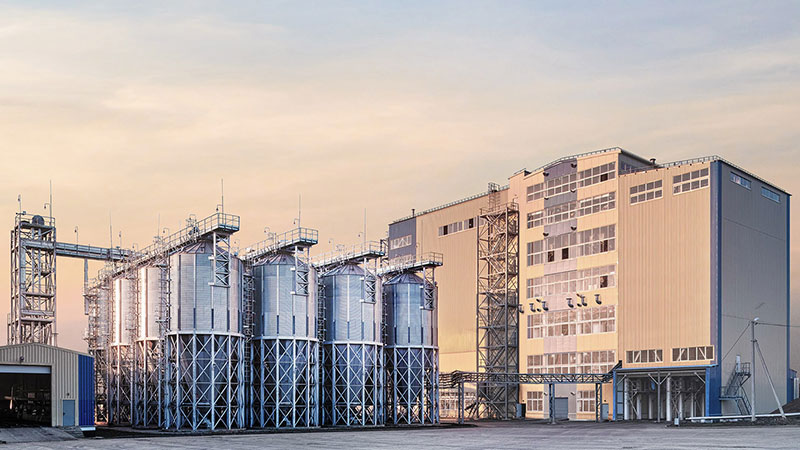
At RICHI, we go beyond project completion. With RICHI Servicee, we’re your dedicated partners in success. Count on us for expert guidance, minimal downtime, and optimized productivity. Choose RICHI for unmatched service and support.
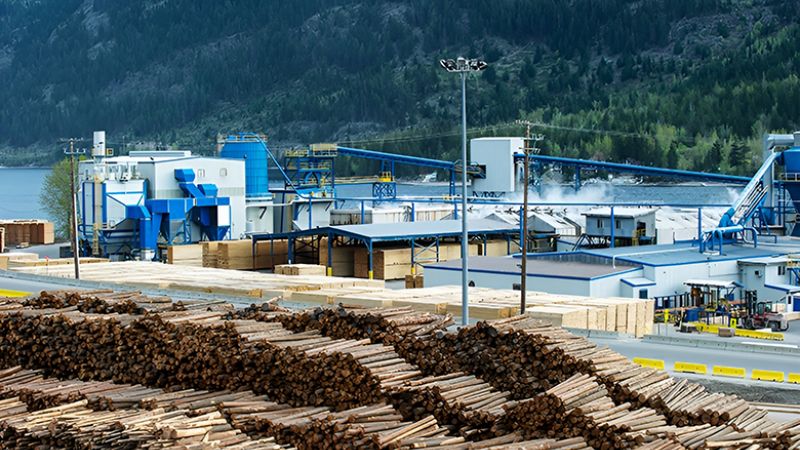


Meet global product demands and quality standards with industry-leading pellet plant design, engineering, equipment, and construction services for pellet processors.

Your Partner Beyond Project Completion
2000+ cases
RICHI is the leading designer, manufacturer and builder of pellet plants in the world, completing over 2000 projects in 140 countries across 6 continents.
Read More
Increase plant productivity, profitability, and safety by integrating high quality equipment into your pellet production line. Over the years, RICHI has become China's top pellet equipment manufacturer. At the same time, RICHI has established valuable partnerships with the world's leading component and raw material manufacturers to bring you the best there is in technology, automation, and efficiency in pelleting plant machinery.

For nearly 30 years, RICHI has been providing best-in-class pellet plant equipment and services to clients across a variety of industries, sizes, and needs. We pride ourselves on the knowledge and skill that each team member possesses – from our technical sales team to our process design engineers. You can count on RICHI Machinery to take your operation to the next level of innovation, quality, and success.
Need help with your pellet manufacturing plant project? Contact us today.
ANIMAL FEED
BIOMASS
WOOD
ORGANIC FERTILIZER
AQUA FEED
CAT LITTER
MUNICIPAL WASTE RECYCLING
SPECIAL PELLET PRODUCTION
RICHI Machinery continues to deliver world class pellet mill equipment, pellet plant engineering and project solutions that add value to our customers in the animal feed, wood waste, agriculture waste, organic fertilizer, cat litter and special pellet products industries. Throughout the years, we RICHI Machinery have built strong brand, becoming industry-leading pellet machine manufacturer. We value integrity, promise quality, and prioritize your success.
Learn MoreWith our expert team, we precisely implement your process engineering requirements in pellet mill and pelletizing plant systems. No matter which industry you’re in – we understand your needs and deliver solutions that meet the highest standards.
At RICHI, quality comes first. Our pellet making machine and related pellet line equipment undergo rigorous quality controls to ensure they meet the highest standards. Rely on products that are durable, safe, and efficient.
With decades of experience in pellet machine and pellet production line production, we have earned a reputation as a trusted partner in various industries. Our expertise allows us to cover a wide range of applications.
Not only do we offer premium pelleting equipment, but we are also experts at designing, building, installing, and maintaining facilities from the ground up. Our expertise is within pellt plant process design, discovering the most efficient, productive, and profitable way to handle your materials in an end-to-end cycle.
○ RICHI MACHINERY
Keeping in touch with us is an effective way to solve all your problems. If you have any needs or questions, please leave your contact information, then RICHI technical consultants will send design, quotation, videos to your mailbox. You can also contact us directly via WhatsApp: +86 13838389622
Copyright©2015-2026 by HENAN RICHI MACHINERY CO., LTD. All rights reserved.