
An Austrian feed mill selected DCS-50K gravity-fed pellet feed bagging equipment to match a 6–7 T/H pelleting section and integrate with existing conveying and bag-closing equipment.
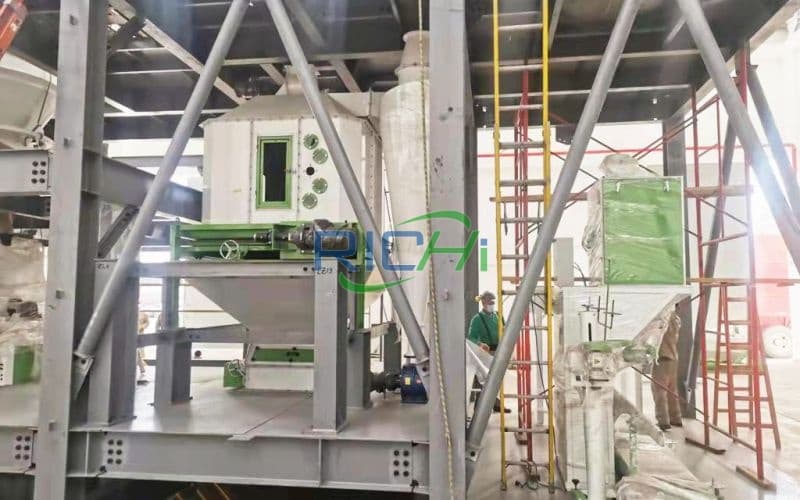
A medium-scale feed mill in Lower Austria selected DCS-50K Pellet Feed Bagging Equipment in Austria after the packing section became the limiting stage behind a 6–7 T/H pellet production system. The mill produces dry pig and poultry feed pellets and already had a usable discharge conveyor, bag-closing equipment and downstream handling arrangement, so the project focused on increasing weighing and filling capacity rather than rebuilding the whole finished-feed section.
The selected DCS-50K uses gravity feeding and provides a reference packaging speed of 5–6 bags per minute for suitable free-flowing pellets. With 25 kg bags, this corresponds to approximately 7.5–9 T/H during steady filling, giving the packing station enough capacity to work with the existing pellet line while retaining a practical margin for bag handling, sealing, calibration and routine production interruptions.
Name:
Pellet feed weighing and bagging machine
Country:
Austria
Date:
2026
Capacity:
5–6 bags/min
Model:
DCS-50K
Power:
0.55 + 0.37 kW
Material:
Dry animal feed pellets
Bag Sizes:
20 kg, 25 kg
The feed mill did not need more pelletizing capacity. The problem appeared after qualified pellets reached the finished-product section.
The existing packing equipment could fill only a few bags per minute. When finished pellets accumulated faster than they could be weighed and bagged, upstream production eventually had to slow down.
This type of mismatch is easy to overlook because every individual machine may still be operating normally. The pellet mill produces at its expected rate, the cooler performs correctly and the screener separates fines, but the line still loses usable production time because the last packaging stage cannot clear finished material quickly enough.
The Austrian customer therefore evaluated bagging capacity against actual pellet output before making another investment in the pelletizing section.
| Project Parameter | Configuration |
|---|---|
| Equipment | Pellet feed weighing and bagging machine |
| Model | DCS-50K |
| Material | Dry animal feed pellets |
| Feeding Method | Gravity feeding |
| Packaging Speed | 5–6 bags/min under suitable conditions |
| Installed Power | 0.55 + 0.37 kW |
| Static Weighing Accuracy | ±0.1% |
| Dynamic Weighing Accuracy | ±0.2% |
| Compressed Air Requirement | 0.4–0.6 MPa, approximately 1.5 m³/h |
| Main Project Bag Sizes | 20 kg, 25 kg and selected larger feed bags |
| Bag Closing Options | Sewing, thermoplastic sealing or combined closing according to bag construction |
| Installation Type | Standalone packing upgrade connected to existing finished-feed handling equipment |
The speed figure describes the weighing and filling machine under suitable pellet and bagging conditions. Effective shift output also depends on how quickly empty bags are presented, how filled bags leave the machine, whether sewing or another closing step is required and how downstream pallet handling is organized.
For a 25 kg bag, the throughput calculation is straightforward.
At 5 bags per minute, the DCS-50K fills 125 kg per minute, equivalent to approximately 7.5 T/H. At 6 bags per minute, the theoretical steady filling rate reaches approximately 9 T/H.
The upstream pellet section produces approximately 6–7 T/H, so the bagging machine does not need to operate continuously at its highest reference speed to keep pace.
This margin is useful because a real packaging line does not run every minute without interruption. Operators need time for bag replenishment, product changes, scale checks, sewing adjustments and routine cleaning.
The objective is therefore not to achieve the highest possible number of bags per minute. It is to prevent the packaging stage from repeatedly becoming slower than the pellet production section.
The customer's main products are dry feed pellets rather than premix powder or sticky mash.
That physical condition makes gravity feeding suitable. Pellets can move from the finished-product hopper toward the weighing section without requiring an auger to push fine powder or a belt to meter difficult material.
The simpler material path also reduces the number of moving components in contact with the pellets.
Gravity feeding is not automatically suitable for every feed product. Pellet surface oil, excessive fines, irregular broken material and moisture pickup can all alter flow through the hopper and filling gate.
The DCS-50K is therefore selected because the Austrian plant packages relatively dry, free-flowing pellets, not simply because gravity feeding has the lowest mechanical complexity.
When Pellet Feed Bagging Equipment in Austria is integrated into an existing mill, hourly capacity is only one part of the engineering check.
The installation also needs to match:
An automatic packing machine with enough theoretical capacity can still create problems if the filled bag exits at the wrong height or if the product hopper cannot deliver material consistently.
One reason the project remained a single-machine upgrade is that the feed mill already had downstream handling equipment that could continue operating.
The bag discharge height and conveyor position are checked before installation so the filled bag can move away from the scale without unnecessary manual lifting or a large transfer drop.
Conveyor speed also matters. If bags leave the filler faster than the downstream conveyor and sewing section can clear them, the new bagging machine merely transfers the bottleneck to the next stage.
The complete packaging rhythm therefore includes filling, discharge, conveying, closing and final transfer rather than treating the weighing machine as an isolated unit.
The feed mill uses more than one commercial bag format. Pig and poultry customers can require different package sizes depending on distribution channel and farm size.
Bag weight changes the relationship between bags per minute and tonnes per hour.
At the same machine cycle rate, heavier bags represent a higher theoretical mass flow. However, a larger target weight can also alter the filling cycle and operator handling time, so production planning should not assume that one bags-per-minute figure applies identically to every package.
The customer therefore calibrates each regular bag format and records the relevant operating settings rather than treating 20 kg, 25 kg and larger bags as one identical packaging job.
The DCS-50K is specified at ±0.1% static weighing accuracy and ±0.2% dynamic weighing accuracy.
Dynamic accuracy is particularly important because bags are filled while material is actually moving through the machine.
At a 25 kg target, ±0.2% corresponds to approximately ±50 g. That is the appropriate equipment-level reference for planning rather than claiming that every production bag will remain within an unsupported ±15 g or ±25 g result.
Actual repeatability depends on scale calibration, pellet flow, filling-gate response, vibration, bag positioning and machine condition.
The mill therefore uses routine check weighing to verify performance during production.
Two feed products with the same pellet diameter do not necessarily behave identically inside a bagging hopper.
Differences in pellet length, bulk density, surface fat, durability and fines can alter the way material flows through the gravity gate.
A harder pig pellet may fall cleanly and stop rapidly at the end of a weighing cycle. A poultry product containing more fines can behave differently near the target weight.
The weighing system therefore needs to be checked when the plant moves between noticeably different products.
The customer does not assume that a setting established for one 4 mm pellet will automatically provide the same filling behavior for every pellet produced by the feed mill.
The DCS-50K is a packing machine, not a pellet screener.
If excessive fines arrive from the cooling or conveying section, they enter the bag together with qualified pellets unless they are separated upstream.
This affects both commercial appearance and material flow. A mixture containing a high proportion of powder does not move through a gravity-fed system in exactly the same way as clean pellets.
The feed mill therefore keeps the screening stage ahead of finished-product storage in proper operating condition and monitors pellet breakage during conveying.
Improving the bagger cannot compensate for weak pellets or excessive mechanical damage earlier in the process.
Feed pellets can break when they repeatedly fall through excessive vertical distances.
The layout therefore considers the distance from the finished-product hopper through the weighing section and into the bag.
The objective is to maintain reliable gravity flow without creating unnecessary impact points that increase fines.
This is particularly relevant in a retrofit because the customer is working with an established building and existing bins. A machine should not simply be placed wherever floor space is available if doing so creates an awkward product path.
The DCS series can be configured around sewing, thermoplastic sealing or a combined arrangement.
For ordinary paper or woven feed bags, sewing may be sufficient where that matches the customer's packaging specification. Bags with an appropriate thermoplastic liner can use heat sealing when a stronger moisture barrier is required.
The closing method should follow the actual bag structure and distribution conditions rather than the destination country alone.
The plant therefore does not treat heat sealing as automatically mandatory for every feed exported outside Austria.
Where heat sealing is used, temperature and dwell time must be established from the liner material supplied by the bag manufacturer. One fixed temperature is not suitable for every film structure.
The DCS-50K requires compressed air in the range of 0.4–0.6 MPa, with a reference consumption of approximately 1.5 m³/h.
The packaging section therefore needs a stable air supply together with appropriate filtration and moisture control.
Low or unstable air pressure can affect pneumatic functions such as bag clamping or gate operation. Installing a faster weighing machine does not solve anything if the pneumatic system cannot respond consistently.
The air connection is checked as part of site preparation rather than after the machine has already been positioned.
The DCS-50K uses a power configuration of 0.55 + 0.37 kW, so its electrical demand is modest compared with major feed-process equipment such as hammer mills, pellet mills and coolers.
That does not mean electrical integration should be ignored.
The customer's electrician still checks voltage, frequency, control protection, cable routing, grounding and the connections of any associated conveyor or bag-closing equipment.
Keeping the packaging controls electrically stable is especially important because weighing accuracy depends on reliable sensing and repeatable machine operation.
A digital weighing system requires periodic verification.
Before routine packaging, the plant checks the scale against suitable reference weights and then verifies filled bags with the actual pellet product.
Check weighing is repeated when required by the plant's quality procedure or when operators observe an unusual weight trend.
A gradual change in bag weight can come from calibration drift, mechanical interference, pellet-flow changes or a problem with the filling gate.
The correct response is to identify the cause rather than simply changing the target weight to compensate.
The DCS-50K gives the customer enough speed to remove the packaging constraint without requiring the machine to operate permanently at maximum cycle rate.
This creates room to prioritize stable weighing.
If pellets are arriving irregularly from the finished-product bin or a new product flows differently, slowing the filling sequence temporarily may produce a more consistent result than forcing the machine to maintain six bags per minute.
For this feed mill, eliminating the bottleneck means maintaining enough reliable packaging capacity to support the 6–7 T/H pellet line, not maximizing one isolated speed figure.
The DCS-50K has a relatively simple gravity-fed material path, but several components still require routine inspection.
Wear parts are replaced according to actual condition rather than a fixed number of bags. Bag material, operating frequency and adjustment all influence service life.
The DCS-50K was prepared for ocean shipment from Qingdao to Koper, followed by inland transport to the customer's feed mill in Lower Austria.
For this standalone equipment project, shipment preparation centers on the bagging machine and the components specified for its installation rather than a large multi-container feed-line package.
Before delivery, the customer can prepare the machine position using dimensional information, inlet and outlet elevations, electrical data, compressed-air requirements and maintenance clearances.
Ocean schedules, customs procedures and inland delivery time depend on the confirmed shipment arrangement and are therefore coordinated against the actual cargo plan.
If pellet production increases again, the customer should first determine which part of the finished-product section reaches its limit.
The DCS-50K may still have enough filling capacity while the sewing machine, conveyor or pallet-handling operation becomes restrictive. In another situation, higher pellet output may eventually require a faster weighing system or parallel bagging position.
The decision should therefore come from measured production rates at each stage.
Adding another bagging machine is useful only when finished-product storage, bag closing, conveying and warehouse handling can support the additional flow.
Pellet Feed Bagging Equipment in Austria should be selected from the actual pellet flow and packaging format rather than annual feed tonnage alone. A feed mill producing 7 T/H of dry pellets into 25 kg bags has a very different packaging requirement from a plant selling most of its output in bulk or filling high-oil pellets that do not flow freely.
For another Austrian feed mill, RICHI Machinery would first review pellet type, bulk density, pellet diameter, fines level, target bag weights, required bags per minute, current pellet-line output, finished-bin arrangement, conveyor height, bag-closing method, pallet handling, compressed-air supply and available installation space.
Those details determine whether the gravity-fed DCS-50K has enough usable capacity and whether it can connect directly to the existing packaging section without forcing unnecessary changes to equipment that is still performing its job.
Having the right mix of reliable, high-quality pellet machine and pelletizing systems and expert support is essential to your success. Watch how our end-to-end feed pellet plant solutions have helped our customers optimize their performance.
Our customized and future-proofed turnkey pellet plant solutions is designed with you at the core. From vision to reality and beyond, our team stays connected with yours. Giving you peace-of-mind with an expert at your side.
At RICHI, we go beyond project completion. With RICHI Servicee, we’re your dedicated partners in success. Count on us for expert guidance, minimal downtime, and optimized productivity. Choose RICHI for unmatched service and support.


Meet global product demands and quality standards with industry-leading pellet plant design, engineering, equipment, and construction services for pellet processors.


Your Partner Beyond Project Completion
2000+ cases
RICHI is the leading designer, manufacturer and builder of pellet plants in the world, completing over 2000 projects in 140 countries across 6 continents.
Read More
Increase plant productivity, profitability, and safety by integrating high quality equipment into your pellet production line. Over the years, RICHI has become China's top pellet equipment manufacturer. At the same time, RICHI has established valuable partnerships with the world's leading component and raw material manufacturers to bring you the best there is in technology, automation, and efficiency in pelleting plant machinery.

For nearly 30 years, RICHI has been providing best-in-class pellet plant equipment and services to clients across a variety of industries, sizes, and needs. We pride ourselves on the knowledge and skill that each team member possesses – from our technical sales team to our process design engineers. You can count on RICHI Machinery to take your operation to the next level of innovation, quality, and success.
Need help with your pellet manufacturing plant project? Contact us today.
ANIMAL FEED
BIOMASS
WOOD
ORGANIC FERTILIZER
AQUA FEED
CAT LITTER
MUNICIPAL WASTE RECYCLING
SPECIAL PELLET PRODUCTION
RICHI Machinery continues to deliver world class pellet mill equipment, pellet plant engineering and project solutions that add value to our customers in the animal feed, wood waste, agriculture waste, organic fertilizer, cat litter and special pellet products industries. Throughout the years, we RICHI Machinery have built strong brand, becoming industry-leading pellet machine manufacturer. We value integrity, promise quality, and prioritize your success.
Learn MoreWith our expert team, we precisely implement your process engineering requirements in pellet mill and pelletizing plant systems. No matter which industry you’re in – we understand your needs and deliver solutions that meet the highest standards.
At RICHI, quality comes first. Our pellet making machine and related pellet line equipment undergo rigorous quality controls to ensure they meet the highest standards. Rely on products that are durable, safe, and efficient.
With decades of experience in pellet machine and pellet production line production, we have earned a reputation as a trusted partner in various industries. Our expertise allows us to cover a wide range of applications.
Not only do we offer premium pelleting equipment, but we are also experts at designing, building, installing, and maintaining facilities from the ground up. Our expertise is within pellt plant process design, discovering the most efficient, productive, and profitable way to handle your materials in an end-to-end cycle.
○ RICHI MACHINERY
Keeping in touch with us is an effective way to solve all your problems. If you have any needs or questions, please leave your contact information, then RICHI technical consultants will send design, quotation, videos to your mailbox. You can also contact us directly via WhatsApp: +86 13838389622
Copyright©2015-2026 by HENAN RICHI MACHINERY CO., LTD. All rights reserved.