
Paper Mill Extruder in Germany: two MZLH420 presses for traceable paper fibre, 10 mm bedding pellets, controlled feeding and product testing.
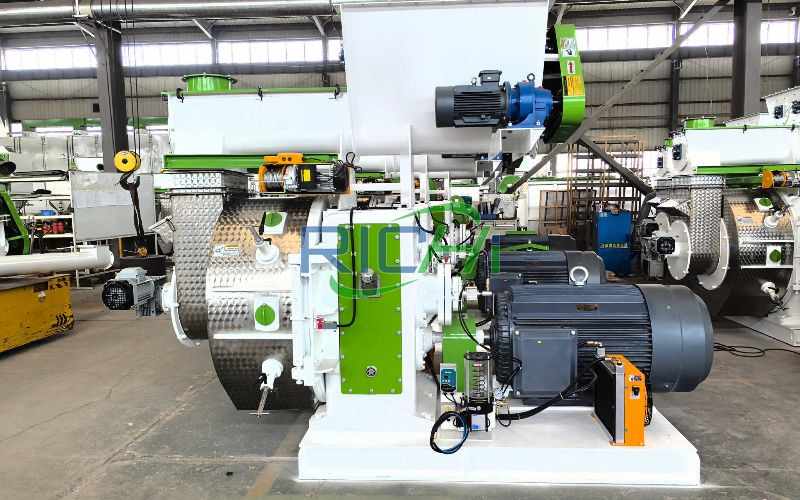
The paper mill’s proposed bedding business needs its own material supply and production schedule. The layout keeps the main fibre-recycling operation running while a separate dry-paper stream passes through preparation, a buffer bin and two independently fed pellet presses.
This illustrative application of a paper mill extruder in Germany concerns a paper and board producer in North Rhine-Westphalia. It wants to evaluate bagged paper bedding for stable operators and distributors. The purchase centres on two MZLH420 ring die presses, with existing dry shredding and handling equipment assessed for reuse.
Name:
Paper Pellet Extruder
Country:
Germany
Date:
2026
Capacity:
1,600–2,000 kg/hour
Model:
MZLH420
Main Motor Power:
90 kW
Pellet diameter:
10 mm
Pellet length:
10–20 mm
The candidate material is segregated, unprinted and uncoated manufacturing trim with a known source and composition. Each lot needs traceability and assessment for the intended bedding use. These controls apply before size reduction, when unwanted material remains easier to identify.
Mixed sorting rejects containing tape, plastic films, unidentified coatings or other contamination stay outside the bedding specification. Wet pulper rejects and sludge are separate material streams. Pressing cannot turn an unsuitable mixture into an acceptable animal-contact product.
The mill’s quality team establishes chemical, hygiene and foreign-material acceptance criteria with the product buyer. Paper colour or an apparently clean surface provides insufficient evidence. The commercial assessment also considers the material’s existing recycling value and the cost of preparing it for bedding.
The dry shredder machine opens the accepted paper. Trials determine whether secondary milling is needed to remove long strips and reach a provisional fragment size below 5 mm. Fluffy paper can bridge a hopper, so the trial includes the buffer bin and feeder.
The initial moisture window is 12–14% on a wet basis. Operators check moisture across the lot and record any controlled water addition before pressing. Feed preparation must distribute moisture evenly; alternating dry fluff and damp lumps makes machine settings difficult to repeat.
In the MZLH420 paper pellet machine, rollers force prepared fibre through ring die channels to form pellets. The equipment performs mechanical densification. Die geometry, moisture and feed rate are selected together using representative paper.
Weighed feeder trials establish mass flow over a defined period. With fluffy paper, hopper level provides a volume indication; the actual weight delivered can vary between lots. Feed settings are therefore checked against measured delivery and press load. Any water-dosing and mixing equipment needed for moisture distribution is identified separately in the scope.
The proposed arrangement allows the operator to commission one press before bringing both into production. Each unit has its own feeding controls. Their combined output still depends on shared cooling, screening and packing capacity.
| Parameter | Specification or application basis |
|---|---|
| Equipment quantity | Two MZLH420 ring die pellet presses |
| Main motor | 90 kW per press |
| Arch-breaking feeder | 3 kW per press |
| Forced feeder | 1.5 kW per press |
| Combined listed motor power | 94.5 kW per press; 189 kW for both, excluding auxiliaries |
| Ring die inner diameter | 420 mm |
| Published biomass output reference | 1,000–1,200 kg/hour per press; not a paper performance guarantee |
| Paper application target | 800–1,000 kg/hour per press of accepted cooled pellets, subject to trials |
| Combined application target | 1,600–2,000 kg/hour |
| Finished pellet dimensions | 10 mm diameter; target length 10–20 mm |
| Electrical design basis | 400 V, three-phase, 50 Hz; verify mill connection |
The 10 mm die determines diameter, while the cutter sets length. A diameter change requires another die. Compression is established from bedding tests, with no fixed ratio assumed from a fuel-pellet application.
Two units provide separate operating and trial schedules. A larger single press would require a different assessment of feed preparation, starting demand and maintenance arrangements. The decision rests on usable capacity and the mill’s operating plan.
The proposed sales format is a 15 kg bag. Product approval follows cooling, screening and a representative transport test. The buyer examines pellet breakage, loose fines and dust released during bag emptying.
Absorbency testing records water uptake per unit of dry material, wetting time and the structure formed as pellets break down. A handling assessment checks whether the wetted material can form a manageable bedding layer and be removed during routine cleaning.
Pellet durability and wet breakdown are assessed together. A pellet that survives delivery still needs to wet and separate as the product instructions require. Diameter alone cannot establish absorbency, comfort or suitability for horses.
The development programme includes controlled user evaluation with appropriate equine expertise. Hygiene, material suitability and dust performance require evidence before commercial claims are made. Frictional heat is not treated as a validated sterilisation process.
User evaluation also records the quantity needed to establish the bed and the material removed during cleaning. These observations support product instructions and a realistic cost comparison with the stable’s current bedding, without assuming that equal bag weights give equal service.
The planning basis uses 800 kg/hour of accepted finished pellets from each press. Together, that is 1,600 kg/hour. Seven productive hours on 250 operating days give 2,800 tonnes annually, with startup, cleaning and maintenance outside those productive hours.
This is the bedding product budget. Required incoming paper is established from measured trial yield, including preparation losses, removed fines and moisture changes. The mill must confirm enough qualifying paper and buyer demand to support the schedule.
Commissioning records saleable tonnes and measured electricity per tonne alongside pellet dimensions and bedding-test results. The 189 kW motor total describes installed motor ratings, not actual energy consumption or the full department load.
The layout review covers feed distribution, discharge heights, cooler loading, screen return and bagging access. Equipment drawings establish foundation loads, lifting points and die-removal space before installation work starts.
The electrical review checks transformer capacity, simultaneous loads, motor starting and interlocks. Paper-dust extraction and fire and explosion protection follow the site’s material and process risk assessment. The quotation identifies the required documentation and responsibilities.
Staff planning allows one press operator and two positions across packing and pallet handling, with mechanical handling aids and shared mill maintenance support. Training covers feed changes, blocked-flow response, safe isolation and restart.
Transport planning can assess Qingdao to Hamburg, followed by inland delivery to North Rhine-Westphalia. Packing dimensions, unloading arrangements, spare dies and roller shells, and commissioning assistance are defined in the supply scope.
An enquiry for a paper mill extruder in Germany should include the paper specification and representative samples, available dry tonnes, preparation equipment and required bedding tests. RICHI Machinery can then assess the die and feeding arrangement against the buyer’s product requirements and the mill’s available utilities.
Having the right mix of reliable, high-quality pellet machine and pelletizing systems and expert support is essential to your success. Watch how our end-to-end feed pellet plant solutions have helped our customers optimize their performance.
Our customized and future-proofed turnkey pellet plant solutions is designed with you at the core. From vision to reality and beyond, our team stays connected with yours. Giving you peace-of-mind with an expert at your side.

At RICHI, we go beyond project completion. With RICHI Servicee, we’re your dedicated partners in success. Count on us for expert guidance, minimal downtime, and optimized productivity. Choose RICHI for unmatched service and support.



Meet global product demands and quality standards with industry-leading pellet plant design, engineering, equipment, and construction services for pellet processors.


Your Partner Beyond Project Completion
2000+ cases
RICHI is the leading designer, manufacturer and builder of pellet plants in the world, completing over 2000 projects in 140 countries across 6 continents.
Read More
Increase plant productivity, profitability, and safety by integrating high quality equipment into your pellet production line. Over the years, RICHI has become China's top pellet equipment manufacturer. At the same time, RICHI has established valuable partnerships with the world's leading component and raw material manufacturers to bring you the best there is in technology, automation, and efficiency in pelleting plant machinery.

For nearly 30 years, RICHI has been providing best-in-class pellet plant equipment and services to clients across a variety of industries, sizes, and needs. We pride ourselves on the knowledge and skill that each team member possesses – from our technical sales team to our process design engineers. You can count on RICHI Machinery to take your operation to the next level of innovation, quality, and success.
Need help with your pellet manufacturing plant project? Contact us today.
ANIMAL FEED
BIOMASS
WOOD
ORGANIC FERTILIZER
AQUA FEED
CAT LITTER
MUNICIPAL WASTE RECYCLING
SPECIAL PELLET PRODUCTION
RICHI Machinery continues to deliver world class pellet mill equipment, pellet plant engineering and project solutions that add value to our customers in the animal feed, wood waste, agriculture waste, organic fertilizer, cat litter and special pellet products industries. Throughout the years, we RICHI Machinery have built strong brand, becoming industry-leading pellet machine manufacturer. We value integrity, promise quality, and prioritize your success.
Learn MoreWith our expert team, we precisely implement your process engineering requirements in pellet mill and pelletizing plant systems. No matter which industry you’re in – we understand your needs and deliver solutions that meet the highest standards.
At RICHI, quality comes first. Our pellet making machine and related pellet line equipment undergo rigorous quality controls to ensure they meet the highest standards. Rely on products that are durable, safe, and efficient.
With decades of experience in pellet machine and pellet production line production, we have earned a reputation as a trusted partner in various industries. Our expertise allows us to cover a wide range of applications.
Not only do we offer premium pelleting equipment, but we are also experts at designing, building, installing, and maintaining facilities from the ground up. Our expertise is within pellt plant process design, discovering the most efficient, productive, and profitable way to handle your materials in an end-to-end cycle.
○ RICHI MACHINERY
Keeping in touch with us is an effective way to solve all your problems. If you have any needs or questions, please leave your contact information, then RICHI technical consultants will send design, quotation, videos to your mailbox. You can also contact us directly via WhatsApp: +86 13838389622
Copyright©2015-2026 by HENAN RICHI MACHINERY CO., LTD. All rights reserved.