
The Kenyan customer was not trying to build a new biomass plant from scratch. What they needed was a machine capable of accepting bulky, irregular wood waste that their existing grinders could not handle efficiently. Whole pallets, broken crates, packaging timber, discarded boards, and selected construction wood were accumulating faster than workers could dismantle them, while exposed nails made manual preparation both slow and difficult to standardize.
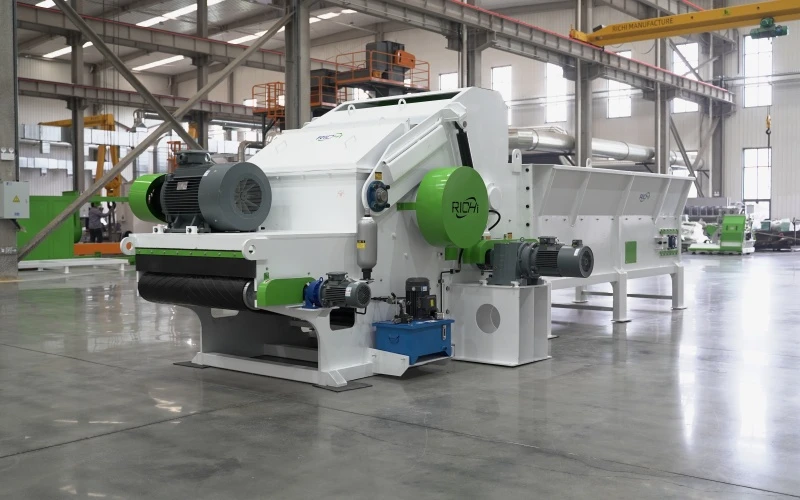
The Kenyan customer was not trying to build a new biomass plant from scratch. What they needed was a machine capable of accepting bulky, irregular wood waste that their existing grinders could not handle efficiently. Whole pallets, broken crates, packaging timber, discarded boards, and selected construction wood were accumulating faster than workers could dismantle them, while exposed nails made manual preparation both slow and difficult to standardize.
The company therefore added one RIBPC1250×500A Pallet Crusher Machine in Kenya to the front end of its existing wood recycling operation in Nairobi. Instead of producing finished sawdust directly, the crusher reduces suitable waste wood into manageable coarse chips. Those chips can then be separated from liberated metal and routed to the customer’s existing downstream equipment for biomass fuel preparation or further size reduction according to the final product.
Name:
Pallet Crusher
Country:
Kenya
Date:
6 T/H
Capacity:
Flexible
Model:
RIBPC1250×500A
Main Motor Power:
160 kW
Raw Materials:
Coarse recycled wood chips
Final product size:
20–40 mm
The customer had already been processing clean sawmill residues and smaller wood offcuts with conventional crushing equipment. Those machines worked reasonably well when the incoming material had already been reduced to chips or short sections.
Discarded pallets created a different problem.
A standard pallet is too large and awkward to feed directly into a conventional fine hammer mill. Nails, screws, corner blocks, thick deck boards, and irregular broken sections also make manual dismantling slow. Even after workers removed the easiest boards, the remaining pieces could still be too long for the existing grinder.
The new pallet crusher was therefore positioned as the primary size-reduction machine. Its value comes from accepting larger waste wood and converting it into a form that downstream equipment can handle more consistently.
Nairobi receives significant quantities of palletized goods through manufacturing, warehousing, retail distribution, construction supply, and logistics activities. Kenya also has an active construction sector that generates timber offcuts and reusable or recyclable wood waste. A 2024 University of Nairobi study specifically examined construction timber waste management in Nairobi and surrounding affordable-housing projects, confirming that timber waste recovery is a real local resource-management issue.
The customer sources most of its wood waste through commercial collection agreements rather than depending on one factory. Feedstock arrives from warehouses, industrial estates, logistics companies, furniture workshops, and selected construction contractors.
This diversified supply is important because pallet availability can fluctuate. By accepting several compatible categories of clean waste wood, the processor can keep the crusher utilized even when one source temporarily declines.
The customer does not treat all discarded wood as equivalent.
Clean untreated pallets and packaging timber are the preferred materials. Furniture parts and construction wood are inspected before processing because some items may contain paint, preservatives, laminates, plastics, glass, masonry, upholstery, electrical fittings, or other contaminants.
Treated or chemically contaminated timber is segregated according to the intended downstream use and local waste-management requirements rather than automatically mixed with biomass fuel material.
This is particularly important if the final chips are destined for combustion or pellet production. A crusher can physically reduce contaminated timber, but mechanical crushability does not mean that the resulting material is appropriate fuel.
| Project Parameter | Configuration |
|---|---|
| Equipment | Pallet crusher machine |
| Model | RIBPC1250×500A |
| Quantity | 1 unit |
| Feed Opening | Approximately 1250 × 500 mm |
| Main Motor Power | 160 kW |
| Feeding System Power | 11 + 7.5 kW |
| Hydraulic Pump Power | 2.2 kW |
| Discharge Conveyor Power | 1.5 kW |
| Hammer Quantity | 28 |
| Reference Capacity | Around 6 T/H under suitable pallet and waste-wood conditions |
| Main Output | Coarse recycled wood chips for downstream processing |
The customer selected this model because its opening and feeding system are better suited to bulky pallet sections than a conventional fine-grinding machine.
The approximately 6 T/H figure is treated as a project reference rather than an absolute capacity for every feedstock. A stack of dry softwood pallets, dense hardwood blocks, mixed broken furniture timber, and construction offcuts can differ substantially in bulk density and crushing resistance.
One of the main reasons the customer stopped relying on manual pallet dismantling was the amount of embedded metal.
The RIBPC series crusher machine is designed for tough waste-wood applications where nails and small fasteners may remain in pallets. Heavy-duty crushing components reduce the need to remove every nail by hand before feeding.
That does not mean metal can be ignored.
Large steel pieces, brackets, tools, heavy bolts, stones, and other inappropriate objects should still be removed before crushing whenever possible. After crushing, liberated nails and ferrous fragments are separated from the wood stream using magnetic separation before the material is sent to downstream processing.
This metal-removal stage is particularly important if the chips will later enter a hammer mill or pellet mill. Allowing loose nails to continue into high-speed downstream equipment would create unnecessary wear and safety risk.
The target output is around 20–40 mm as a practical coarse-crushing range for this stage.
However, the Pallet Crusher Machine in Kenya is not expected to produce every particle within one narrow 20–40 mm specification. Waste wood has irregular grain direction, thickness, density, and shape, so coarse-crushing output naturally contains a distribution of particle sizes.
If the material will later be used for biomass pellet production, a secondary hammer mill reduces the clean wood chips to the finer particle size required by the wood pellet mill.
If it will enter a particleboard process, additional screening, refining, drying, and classification are required according to board-layer specifications.
MDF production requires an even more specialized fiber-preparation process. Coarse pallet chips cannot be described as ready-made MDF fiber simply because the initial wood has been crushed.
The Kenyan processor concentrates on two principal outlets.
The first is biomass-fuel preparation. Suitable clean wood chips are either supplied for appropriately designed industrial biomass systems or further ground and dried before pelletization.
The second is recycled wood furnish for wood-based panel processors or related industrial users, where the chips undergo further refinement before entering board production.
The company does not market one coarse chip simultaneously as ready-to-use pellet feedstock, MDF fiber, compost, boiler fuel, and finished particleboard raw material. Each downstream application requires its own preparation specification.
This narrower market positioning also makes quality control easier because the operator knows which wood grades must be kept separate.
Incoming waste wood is first unloaded into a receiving area where unsuitable materials are removed. Large foreign objects and visibly treated or contaminated pieces are separated before crushing.
Compatible pallets and boards are then fed to the RIBPC1250×500A. The feeding mechanism controls the rate at which bulky material enters the crushing chamber rather than relying on operators to push irregular timber manually.
After size reduction, the coarse chips leave through the discharge conveyor.
Ferrous separation follows the crusher so that nails released from pallet boards can be removed before downstream size reduction. The cleaned chip stream is then directed according to its intended market: further grinding for pellet feedstock, screening and refining for industrial wood recycling, or storage as an intermediate product.
Pallet waste is difficult to feed evenly because individual pieces vary in width, thickness, orientation, and stiffness.
If oversized material enters the crushing chamber too aggressively, motor load can rise sharply. If feeding is too slow, the crusher operates below its useful capacity.
The hydraulic-assisted feeding arrangement gives the operator better control over this relationship.
During commissioning, the customer's team was trained to watch main-motor load and material behavior together. A pallet entering slowly does not necessarily indicate insufficient machine power; it may simply need a different orientation or controlled feeding pressure.
This prevents operators from trying to solve every irregular feed condition by forcing material into the chamber.
The customer tracks wear according to material type rather than assuming that hammer life can be predicted from operating hours alone.
Clean dry softwood pallets are relatively different from dirty construction timber containing sand and mineral contamination. Nails also contribute to impact wear, while pieces carrying cement residue or grit can increase abrasion considerably.
The maintenance team therefore inspects hammer condition, screens, bearings, fasteners, hydraulic components, conveyor condition, and chamber liners according to actual operating behavior.
Changes in vibration, noise, current draw, chip size, or throughput can indicate that the machine should be inspected before a component fails.
The largest labor improvement came from removing most manual dismantling work.
Previously, employees used hand tools to separate pallet boards and remove accessible fasteners before smaller pieces could enter the grinder. That work was slow and physically repetitive.
With the new crusher, compatible pallets can enter the primary crushing stage with far less dismantling.
Workers are still required in receiving and sorting because the machine cannot decide whether a painted board, steel bracket, upholstered furniture component, or chemically treated timber is appropriate for the final product.
Automation therefore moved labor from repetitive dismantling toward material inspection and process control rather than removing people from the recycling operation completely.
The customer is a medium-sized recycler, not a national pallet-processing network.
A 6 T/H project target already represents substantial daily capacity. At five net crushing hours, it corresponds to roughly 30 tonnes of material before allowance for changes in feedstock and interruptions.
The company does not need to accumulate enough pallets to run the crusher at nominal capacity around the clock.
Instead, material is collected and stored, then processed in campaigns according to incoming volume and downstream orders. This helps balance the crusher with the magnetic separation, secondary grinding, storage, and dispatch equipment already present at the site.
Selecting a much larger machine would have shifted the bottleneck downstream without creating additional saleable product.
Wood recycling generates dust and fines, particularly when dry pallets and broken boards are crushed.
The customer therefore avoided treating dust extraction as an optional accessory.
Transfer points are enclosed where practical, accumulated dust is removed regularly, and downstream fine grinding uses appropriate dust collection. The operating area is also kept clear of unnecessary ignition sources.
Fire-risk management is particularly important once the material becomes finer. Coarse pallet crushing itself creates less airborne fine dust than secondary hammer milling, but all wood-processing stages need good housekeeping.
The RIBPC1250×500A Pallet Shredder was shipped from Qingdao Port to the Port of Mombasa.
This route fits the project well. Kenya Ports Authority describes Mombasa as a major East and Central African gateway with container and multipurpose cargo terminals, while Nairobi is directly linked to Mombasa through inland container and rail services.
For this biomass pellet project, final inland delivery was arranged to the customer's Nairobi facility after import handling.
The route was not described with one permanent transit-time figure because ocean schedules, container availability, customs procedures, and inland transport conditions can change.
A pallet crusher occupies more operational space than its steel frame alone suggests.
The customer needed room for incoming pallet storage, controlled feeding, maintenance access, discharge conveying, metal separation, chip storage, and vehicle movement around the recycling yard.
RICHI therefore reviewed the equipment orientation together with the customer's existing material flow.
The final layout minimized unnecessary rehandling: pallets enter from the receiving side, chips leave toward the downstream processing section, and maintenance personnel can access major service points without dismantling adjacent conveyors.
“The biggest difference is that we no longer have to turn every pallet into small pieces by hand before it reaches the production equipment. We still sort the incoming wood carefully, but the crusher now does the heavy size reduction. After we added magnetic separation behind it, the downstream wood stream became much easier for our existing equipment to handle.”
The customer also found that incoming material classification became more important after capacity increased. When the crusher could process pallets faster, poor sorting upstream could introduce unsuitable material faster as well.
The receiving team therefore developed separate storage areas for clean pallets, compatible construction timber, questionable material requiring inspection, and rejected waste.
The same crusher should not be selected for every recycling yard simply because all customers call their material “wood pallets.”
RICHI first needs to know pallet dimensions, hardwood/softwood ratio, percentage of boards and furniture waste, expected nails and metal contamination, required tonnes per hour, target coarse chip size, downstream use, available electrical power, feeding method, and whether magnetic separation and secondary grinding are already installed.
The final product matters just as much as the incoming pallet.
A business selling boiler-grade wood chips may need a different downstream setup from a company preparing raw material for pellets or recycled wood panels.
This Pallet Crusher Machine in Kenya project uses one primary crusher as the first size-reduction stage in the customer’s commercial wood-waste recycling system.
The Nairobi recycler uses one RIBPC1250×500A with a 160 kW main motor to process compatible wooden pallets, packaging timber, selected furniture wood, and sorted construction offcuts. The machine reduces bulky wood waste into coarse chips, after which magnetic separation removes liberated nails and downstream equipment prepares the material according to its final application.
That division of work is what makes the project practical. The pallet crusher deals with size and shape. Magnetic equipment deals with ferrous contamination. Secondary grinders produce the finer material required for pelletizing. Panel-industry preparation requires its own refining and classification stages.
For another Kenyan recycling project, RICHI Machinery would configure the pallet crusher around the customer's actual waste stream, not simply the requested capacity. Feed opening, motor size, hammer configuration, feeding system, screen arrangement, metal separation, downstream crushing, dust control, and yard layout all need to work as one material-handling system.
For a recycler already collecting several tonnes of pallets and compatible waste wood each day, this approach can replace slow manual dismantling with a much more controlled primary crushing process while preserving the flexibility to sell the recovered wood into more than one industrial market.
Having the right mix of reliable, high-quality pellet machine and pelletizing systems and expert support is essential to your success. Watch how our end-to-end feed pellet plant solutions have helped our customers optimize their performance.
Our customized and future-proofed turnkey pellet plant solutions is designed with you at the core. From vision to reality and beyond, our team stays connected with yours. Giving you peace-of-mind with an expert at your side.
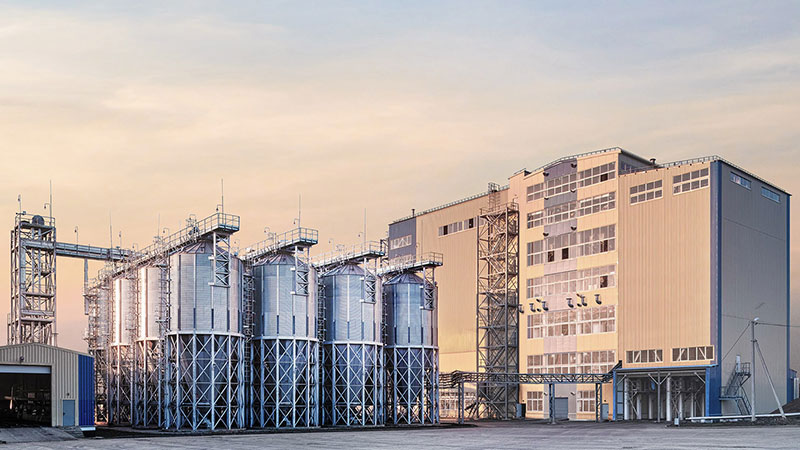
At RICHI, we go beyond project completion. With RICHI Servicee, we’re your dedicated partners in success. Count on us for expert guidance, minimal downtime, and optimized productivity. Choose RICHI for unmatched service and support.
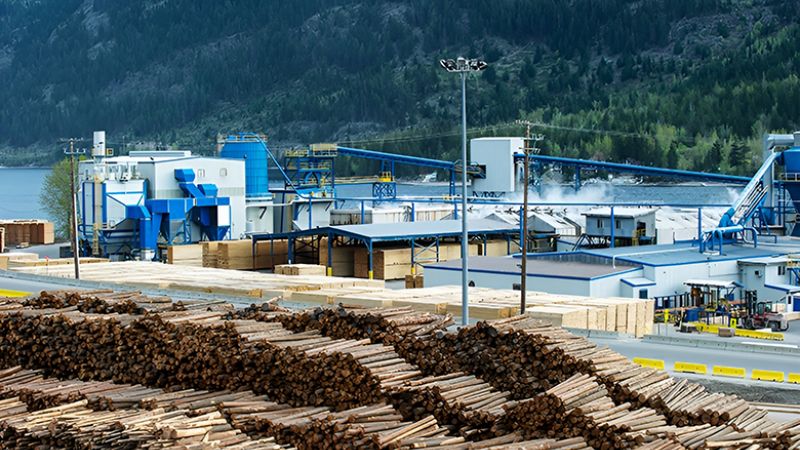


Meet global product demands and quality standards with industry-leading pellet plant design, engineering, equipment, and construction services for pellet processors.


Your Partner Beyond Project Completion
2000+ cases
RICHI is the leading designer, manufacturer and builder of pellet plants in the world, completing over 2000 projects in 140 countries across 6 continents.
Read More
Increase plant productivity, profitability, and safety by integrating high quality equipment into your pellet production line. Over the years, RICHI has become China's top pellet equipment manufacturer. At the same time, RICHI has established valuable partnerships with the world's leading component and raw material manufacturers to bring you the best there is in technology, automation, and efficiency in pelleting plant machinery.

For nearly 30 years, RICHI has been providing best-in-class pellet plant equipment and services to clients across a variety of industries, sizes, and needs. We pride ourselves on the knowledge and skill that each team member possesses – from our technical sales team to our process design engineers. You can count on RICHI Machinery to take your operation to the next level of innovation, quality, and success.
Need help with your pellet manufacturing plant project? Contact us today.
ANIMAL FEED
BIOMASS
WOOD
ORGANIC FERTILIZER
AQUA FEED
CAT LITTER
MUNICIPAL WASTE RECYCLING
SPECIAL PELLET PRODUCTION
RICHI Machinery continues to deliver world class pellet mill equipment, pellet plant engineering and project solutions that add value to our customers in the animal feed, wood waste, agriculture waste, organic fertilizer, cat litter and special pellet products industries. Throughout the years, we RICHI Machinery have built strong brand, becoming industry-leading pellet machine manufacturer. We value integrity, promise quality, and prioritize your success.
Learn MoreWith our expert team, we precisely implement your process engineering requirements in pellet mill and pelletizing plant systems. No matter which industry you’re in – we understand your needs and deliver solutions that meet the highest standards.
At RICHI, quality comes first. Our pellet making machine and related pellet line equipment undergo rigorous quality controls to ensure they meet the highest standards. Rely on products that are durable, safe, and efficient.
With decades of experience in pellet machine and pellet production line production, we have earned a reputation as a trusted partner in various industries. Our expertise allows us to cover a wide range of applications.
Not only do we offer premium pelleting equipment, but we are also experts at designing, building, installing, and maintaining facilities from the ground up. Our expertise is within pellt plant process design, discovering the most efficient, productive, and profitable way to handle your materials in an end-to-end cycle.
○ RICHI MACHINERY
Keeping in touch with us is an effective way to solve all your problems. If you have any needs or questions, please leave your contact information, then RICHI technical consultants will send design, quotation, videos to your mailbox. You can also contact us directly via WhatsApp: +86 13838389622
Copyright©2015-2026 by HENAN RICHI MACHINERY CO., LTD. All rights reserved.