
A wood recycling and biomass supply company near Lagos selected one RICHI RIBPC1250×400 pallet chipper in Nigeria to process used wooden pallets and other traceable solid-wood residues. The company already collected recovered timber from logistics companies, warehouses and selected commercial wood users, but irregular pallet dimensions and residual nails made the material difficult to prepare efficiently with its existing equipment.
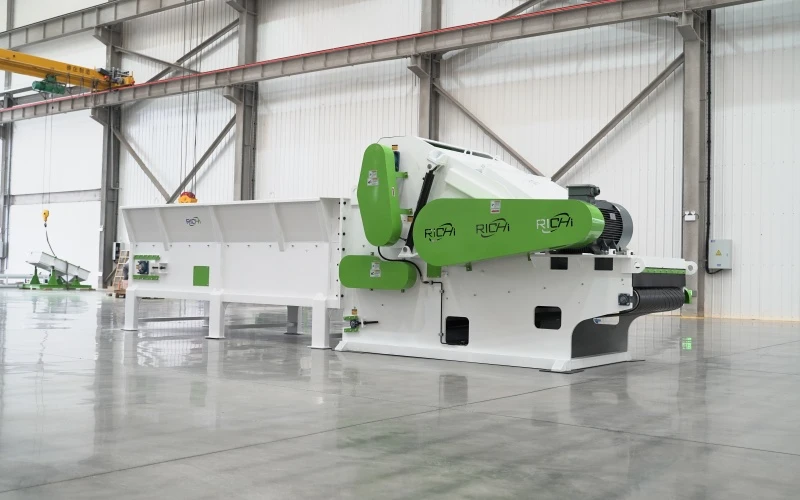
A wood recycling and biomass supply company near Lagos selected one RICHI RIBPC1250×400 pallet chipper in Nigeria to process used wooden pallets and other traceable solid-wood residues. The company already collected recovered timber from logistics companies, warehouses and selected commercial wood users, but irregular pallet dimensions and residual nails made the material difficult to prepare efficiently with its existing equipment.
Instead of purchasing a complete biomass production line, the customer added one heavy-duty pallet crushing machine as the primary size-reduction stage. With a 1250×400 mm feed opening, 110 kW main motor and reference capacity of approximately 5–9 T/H, the machine reduces bulky recovered wood into approximately 20–40 mm material for subsequent metal separation and further biomass processing.
Name:
Wood Pallet Chipper
Country:
Nigeria
Date:
2026
Capacity:
5–9 T/H
Model:
RIBPC1250×400
Main Motor Power:
110 kW
Main Raw Material:
Used solid-wood pallets
Primary Output Size:
20–40 mm
Used wooden pallets are very different from clean sawdust or uniformly sized wood chips.
A recycling company may receive complete pallets, broken pallet sections, deck boards, stringers and irregular pieces of solid timber in the same delivery. Some pallets still contain ordinary nails or staples, while others arrive partly damaged or repaired.
These characteristics make recovered pallet wood difficult to process with equipment designed primarily for clean, pre-sized wood.
The Nigerian customer wanted to increase the amount of recovered solid wood it could prepare for biomass fuel production without relying on excessive manual dismantling.
The company did not want operators removing every ordinary pallet nail one by one before size reduction. At the same time, it understood that a pallet chipper should not be treated as a machine capable of safely swallowing unlimited metal contamination.
The project therefore combines material inspection, controlled feeding, heavy-duty primary crushing and downstream magnetic separation.
This creates a more practical route for processing commercial pallet waste while protecting the downstream hammer mill and pelletizing equipment.
| Project Parameter | Configuration |
|---|---|
| Equipment | Heavy-duty pallet chipper / pallet shredder |
| Model | RIBPC1250×400 |
| Feed Opening | 1250×400 mm |
| Main Motor | 110 kW |
| Reference Capacity | Approximately 5–9 T/H |
| Primary Output Size | Approximately 20–40 mm |
| Main Raw Material | Used solid-wood pallets |
| Supplementary Material | Selected clean, untreated solid-timber residues |
| Main Application | Primary preparation for biomass fuel production |
| Project Type | Standalone machine added to an existing recycling operation |
The 1250 mm-wide receiving opening is useful for bulky pallet sections because the customer does not need to reduce every piece to small blocks before feeding.
The approximately 5–9 T/H reference capacity gives the recycler enough range to handle changing incoming material volumes.
Actual throughput is not fixed.
A stream of dry, broken softwood pallets can behave very differently from dense hardwood pallets or mixed solid timber. Pallet dimensions, moisture, wood species, contamination, feeding continuity and the amount of metal present all influence practical production.
For this reason, 5–9 T/H is treated as a machine reference range rather than a guaranteed output for every recovered-wood mixture.
Raw-material classification is one of the most important parts of this project.
The customer focuses on identifiable solid wood suitable for its downstream biomass fuel route.
Typical acceptable materials include damaged shipping pallets, broken pallet boards, solid-wood packaging components and selected untreated solid-timber offcuts.
Engineered and chemically treated materials are separated from this stream.
MDF, particleboard, laminated board, heavily coated furniture panels, plywood with uncertain adhesive systems, preservative-treated timber and painted demolition wood should not simply be mixed with clean pallet wood intended for biomass fuel production.
The reason is not whether the chipper can physically break the material.
A powerful crusher may mechanically reduce many wood-based products, but mechanical crushability does not determine whether the resulting material is appropriate for a particular fuel product.
The customer therefore controls incoming wood by source and material type before processing.
This is especially important when wood arrives from furniture workshops or construction activities, where solid timber can be mixed with engineered panels, coatings, plastics, insulation and other contaminants.
A major reason for selecting a heavy-duty pallet chipper is the presence of ordinary residual pallet fasteners.
Complete removal of every small nail or staple before primary crushing would make commercial pallet recycling unnecessarily labor-intensive.
However, this does not mean that all metal should enter the machine.
Large bolts, thick steel brackets, hinges, tools, wire bundles, chains and other substantial metal objects should be removed during receiving and inspection.
Stones, concrete fragments and other hard foreign objects also need to be kept out.
The customer therefore uses a practical contamination-control sequence:
This is a much safer operating principle than claiming that a pallet chipper makes metal separation unnecessary.
Ordinary nails that remain embedded in pallet boards may be liberated during crushing. Once exposed, they can be captured much more effectively by a downstream magnet before the wood reaches fine grinding equipment.
The RIBPC1250×400 crusher machine performs primary size reduction.
Its approximately 20–40 mm output is suitable for easier conveying, magnetic separation, storage or transfer to another processing stage, but it should not be described as finished pellet-mill feed.
Wood pellet production requires substantially finer and more controlled particles.
If the Nigerian customer uses the recovered wood for biomass pellets, the material continues through another preparation sequence after pallet crushing.
After magnetic separation, moisture is checked.
If the recovered pallet wood is too wet for the intended process, drying may be required. If the wood is already sufficiently dry, it can proceed toward fine grinding without unnecessary thermal processing.
A hammer mill then reduces the 20–40 mm primary chips into particles suitable for the biomass pellet mill.
This distinction between a pallet chipper and a fine hammer mill is important.
The pallet chipper solves the problem of bulky, irregular recovered wood. The hammer mill solves the problem of final particle-size preparation for pelletizing.
Trying to make one machine perform both jobs can reduce throughput and increase wear.
The primary commercial route for the processed material in this project is biomass fuel preparation.
The customer does not need to develop animal bedding, landscaping mulch, panel board feedstock and several other markets at the same time simply because wood chips can potentially be used in different industries.
Its business model is based on collecting suitable recovered solid wood, reducing it to a manageable intermediate size and supplying or further processing it for biomass energy use.
This gives the company a clear raw-material acceptance standard.
Traceable untreated solid wood is valuable. Unknown coated panels and contaminated demolition material are not automatically accepted just because they are wood-based.
Where the 20–40 mm material is subsequently pelletized, the complete route becomes pallet receiving, inspection, primary crushing, magnetic separation, moisture control, fine grinding, pelletizing, cooling and screening.
The finished fuel specification then depends on the requirements of the final industrial boiler or biomass customer.
This means the recycler has to think beyond chip size.
A clean-looking 30 mm wood chip is not automatically qualified fuel feedstock if its original material source is unknown.
Pallet recycling is an impact-intensive application.
Wear rate depends heavily on the actual feedstock.
Clean dry softwood pallets create a different wear condition from dense hardwood pallets containing sand, soil and repeated metal contamination.
Construction-derived timber can be particularly demanding if concrete residue, grit or other abrasive contamination has not been removed.
For this reason, RICHI does not assign one fixed hammer life or maintenance interval to every pallet chipper.
The operator instead inspects wear components according to operating hours and actual condition.
Feeding consistency also affects machine loading.
Dumping excessive quantities of irregular timber into the receiving area at once can create unstable motor load even when the average hourly throughput appears acceptable.
Controlled feeding gives the crusher time to process each incoming section and reduces unnecessary shock loading.
Dust and fire management also need attention in a commercial wood-recycling facility.
Dry recovered wood produces fines during crushing, and accumulated wood dust around motors, bearings, conveyors and electrical equipment should not be ignored.
Good housekeeping, appropriate dust management, inspection and separation of ignition hazards are therefore part of operating the machine safely.
The Nigerian customer did not need a complete new recycling plant.
The value of this project came from fitting one primary crusher into the material flow the company already had.
Before confirming the arrangement, the receiving area, feeding method, discharge direction, magnetic separator position, electrical supply and maintenance access all need to be considered.
The discharge system has to transfer the 20–40 mm material without creating unnecessary accumulation below the crusher.
The magnet should be positioned where liberated nails and ferrous fragments can be separated effectively before downstream equipment.
Enough space is also required around the machine for inspection and wear-part maintenance.
The 110 kW main motor makes electrical planning important.
The customer needs to confirm the actual three-phase plant supply, transformer capacity, cable sizing, motor-starting arrangement and protection system with the site electrical design.
RICHI does not assume that one breaker size or one electrical configuration will suit every Nigerian industrial site.
Where voltage stability or available transformer capacity is a concern, these conditions should be identified before installation rather than discovered during commissioning.
The RIBPC1250×400 was prepared for export from Qingdao for delivery to the customer’s operation near Lagos.
Lagos provides a practical maritime gateway for a recycling company located in southwestern Nigeria.
Final routing depends on the selected carrier, terminal, freight arrangement and inland delivery plan, so the project is not tied to a fixed ocean transit or customs-clearance period.
Before dispatch, RICHI checks the machine configuration against the order and prepares the technical documentation required for installation and operation.
The customer can prepare the receiving area, electrical interface and downstream conveying arrangement while the equipment is in transit.
Because this is a standalone-machine project, commissioning focuses strongly on interfaces.
RICHI needs to verify how pallets reach the machine, how the crushed material leaves it, where metal is separated and where the wood moves next.
A pallet chipper operating correctly in isolation can still create a bottleneck if the discharge conveyor, magnetic separator or downstream hammer mill is undersized.
This pallet chipper in Nigeria project gives the recycling company a dedicated primary size-reduction stage for used wooden pallets and selected clean solid-timber residues.
The RICHI RIBPC1250×400 uses a 110 kW main motor, provides a 1250×400 mm feed opening and has a reference processing range of approximately 5–9 T/H depending on material condition and feeding stability.
The approximately 20–40 mm discharge size makes bulky pallet wood easier to separate, convey and prepare for subsequent biomass processing.
The machine does not eliminate the need for raw-material control.
Ordinary residual pallet nails and staples are fundamentally different from large steel brackets, bolts, tools, concrete and other heavy foreign objects. The latter need to be removed before crushing, while a downstream magnet captures liberated ferrous material before fine grinding.
The same discipline applies to wood type.
Solid untreated pallet wood can enter the customer’s biomass route, while MDF, particleboard, laminated panels, coated wood and chemically treated timber are separated when their composition is unsuitable or uncertain.
For another recycling company searching for a pallet chipper in Nigeria, wood pallet crusher Nigeria, pallet crushing machine, waste pallet chipper, wood crusher for pallets with nails, 5–9 T/H pallet crusher or industrial wood recycling machine, the first selection question is not simply how many pallets arrive each day.
RICHI needs the typical pallet dimensions, maximum individual wood section, approximate tonnes per hour, wood species where known, moisture, percentage of complete versus broken pallets, type and amount of residual metal, downstream chip-size requirement and final biomass application.
The customer should also identify what equipment is already available.
A recycling company that already owns a magnet, hammer mill, dryer and biomass pelletizing system may need only the RIBPC1250×400 and suitable conveying interfaces.
A company receiving complete pallets but owning no downstream preparation equipment may require a much broader system.
This difference is important when comparing quotations.
The lowest-cost machine purchase is not necessarily the lowest-cost processing route if the output cannot connect correctly with the next production stage.
For a Nigerian pallet-recycling project, send RICHI representative pallet photos or dimensions, hourly input requirement, approximate moisture, details of nails and other metal contamination, required output size, available electrical supply and the equipment installed after primary crushing. RICHI Machinery can then determine whether one RIBPC1250×400 pallet chipper is sufficient or whether additional magnetic separation, conveying, drying or fine grinding should be included in the process.
Having the right mix of reliable, high-quality pellet machine and pelletizing systems and expert support is essential to your success. Watch how our end-to-end feed pellet plant solutions have helped our customers optimize their performance.
Our customized and future-proofed turnkey pellet plant solutions is designed with you at the core. From vision to reality and beyond, our team stays connected with yours. Giving you peace-of-mind with an expert at your side.
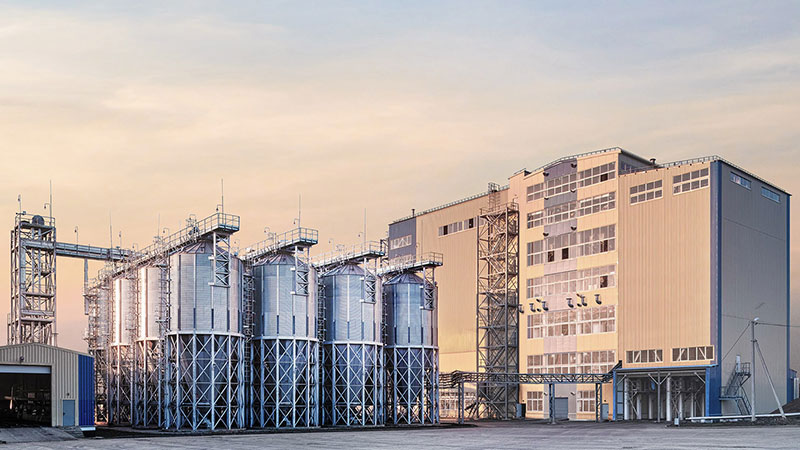
At RICHI, we go beyond project completion. With RICHI Servicee, we’re your dedicated partners in success. Count on us for expert guidance, minimal downtime, and optimized productivity. Choose RICHI for unmatched service and support.
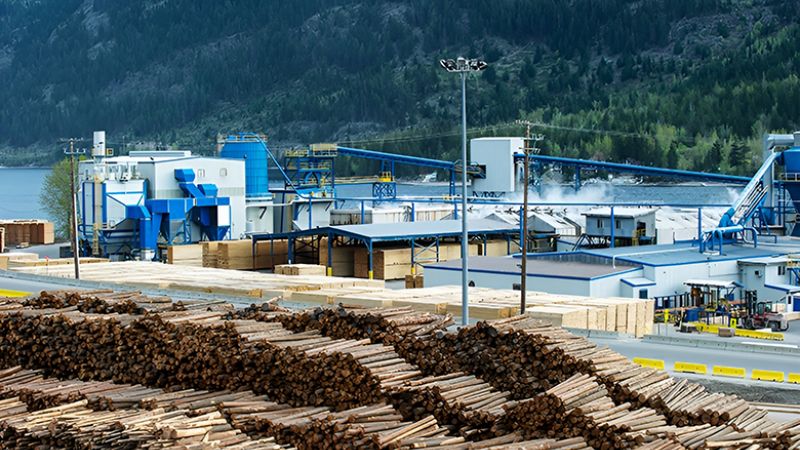


Meet global product demands and quality standards with industry-leading pellet plant design, engineering, equipment, and construction services for pellet processors.


Your Partner Beyond Project Completion
2000+ cases
RICHI is the leading designer, manufacturer and builder of pellet plants in the world, completing over 2000 projects in 140 countries across 6 continents.
Read More
Increase plant productivity, profitability, and safety by integrating high quality equipment into your pellet production line. Over the years, RICHI has become China's top pellet equipment manufacturer. At the same time, RICHI has established valuable partnerships with the world's leading component and raw material manufacturers to bring you the best there is in technology, automation, and efficiency in pelleting plant machinery.

For nearly 30 years, RICHI has been providing best-in-class pellet plant equipment and services to clients across a variety of industries, sizes, and needs. We pride ourselves on the knowledge and skill that each team member possesses – from our technical sales team to our process design engineers. You can count on RICHI Machinery to take your operation to the next level of innovation, quality, and success.
Need help with your pellet manufacturing plant project? Contact us today.
ANIMAL FEED
BIOMASS
WOOD
ORGANIC FERTILIZER
AQUA FEED
CAT LITTER
MUNICIPAL WASTE RECYCLING
SPECIAL PELLET PRODUCTION
RICHI Machinery continues to deliver world class pellet mill equipment, pellet plant engineering and project solutions that add value to our customers in the animal feed, wood waste, agriculture waste, organic fertilizer, cat litter and special pellet products industries. Throughout the years, we RICHI Machinery have built strong brand, becoming industry-leading pellet machine manufacturer. We value integrity, promise quality, and prioritize your success.
Learn MoreWith our expert team, we precisely implement your process engineering requirements in pellet mill and pelletizing plant systems. No matter which industry you’re in – we understand your needs and deliver solutions that meet the highest standards.
At RICHI, quality comes first. Our pellet making machine and related pellet line equipment undergo rigorous quality controls to ensure they meet the highest standards. Rely on products that are durable, safe, and efficient.
With decades of experience in pellet machine and pellet production line production, we have earned a reputation as a trusted partner in various industries. Our expertise allows us to cover a wide range of applications.
Not only do we offer premium pelleting equipment, but we are also experts at designing, building, installing, and maintaining facilities from the ground up. Our expertise is within pellt plant process design, discovering the most efficient, productive, and profitable way to handle your materials in an end-to-end cycle.
○ RICHI MACHINERY
Keeping in touch with us is an effective way to solve all your problems. If you have any needs or questions, please leave your contact information, then RICHI technical consultants will send design, quotation, videos to your mailbox. You can also contact us directly via WhatsApp: +86 13838389622
Copyright©2015-2026 by HENAN RICHI MACHINERY CO., LTD. All rights reserved.