
A Lower Saxony sawmill uses an SFSP66×120 wood crusher to grind prepared spruce, pine and clean hardwood chips into controlled sawdust for biomass pellet production.
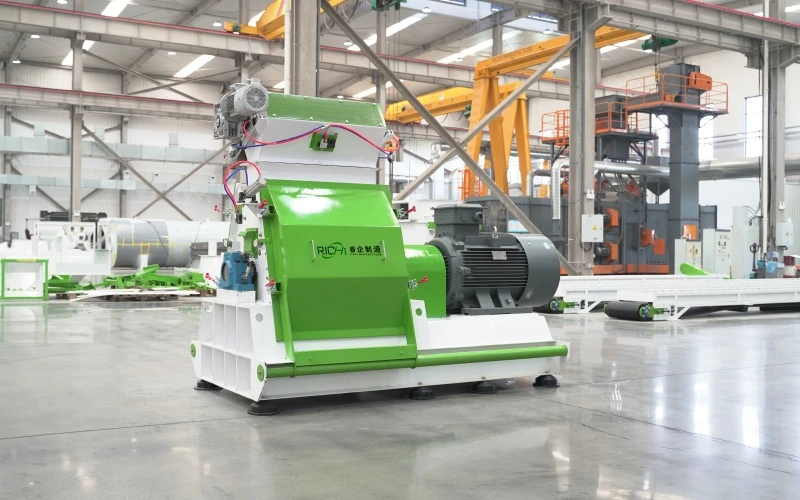
A commercial sawmill and biomass pellet producer in Lower Saxony selected one SFSP66×120 New Condition High Efficiency Wood Crusher for Sawdust in Germany to strengthen the fine-grinding stage of its existing wood-pellet operation. The plant handles clean spruce and pine residues from sawmilling together with selected untreated hardwood chips and shavings, and required a machine capable of preparing several tonnes of controlled fine wood material per hour for downstream pelletizing.
The customer retained its wood receiving, coarse size-reduction, drying, conveying, pelletizing, cooling and finished-product handling equipment. The SFSP66×120 was installed specifically between prepared wood-chip handling and the pellet-production buffer. With a 185 kW main motor, 660 mm rotor and 1200 mm grinding chamber, the machine is operated around a project basis of approximately 4–5 T/H on properly prepared wood residues rather than being treated as a universal crusher for logs, wet timber and every form of sawmill waste.
Name:
Wood-residue hammer mill
Country:
Germany
Date:
2026
Capacity:
4–5 T/H
Model:
SFSP66×120
Power:
185 kW
Raw materials:
Pre-chipped spruce, pine
Main Product:
Fine wood material
The sawmill generates several wood-residue streams during cutting, edging and planing.
Fine sawdust can sometimes enter pellet preparation with little additional size reduction, while coarse shavings, chips and short solid-wood pieces require further processing before they are suitable for a biomass pellet mill.
The customer therefore did not need another complete pellet production system. The requirement was a stronger secondary grinder capable of accepting properly prepared material at a rate consistent with the existing biomass section.
This keeps the investment focused on one processing stage instead of adding equipment that the facility already has.
| Project Parameter | Configuration |
|---|---|
| Equipment | Wood-residue hammer mill for sawdust preparation |
| Model | SFSP66×120 |
| Quantity | 1 unit |
| Main Motor Power | 185 kW |
| Rotor Diameter | 660 mm |
| Grinding Chamber Width | 1200 mm |
| Rotating Speed | Approximately 2980 rpm |
| Hammer Tip Speed | Approximately 103 m/s |
| Main Project Screen | Approximately 6 mm |
| Project Reference Capacity | Approximately 4–5 T/H on suitably prepared wood material |
| Main Materials | Pre-chipped spruce, pine and selected clean untreated hardwood residues |
| Main Product | Fine wood material for biomass pellet production |
| Installation Type | Standalone secondary grinding upgrade |
The 4–5 T/H value is treated as a project reference rather than an unconditional output. Wood species, moisture, chip dimensions, bulk density, screen opening, hammer condition and required final particle distribution all influence actual production.
The SFSP66×120 uses high-speed hammer impact and screening to produce fine material. That operating principle works best when the incoming wood has already been reduced to a manageable size.
Logs, slabs and large sawmill offcuts should not enter the grinding chamber directly.
The customer's coarse wood fraction first passes through suitable chipping or primary crushing equipment. This reduces larger solid pieces to chips that can be metered steadily into the hammer mill.
Keeping coarse reduction and fine grinding separate prevents sudden impact loading and gives the 185 kW machine a more consistent feed.
An offcut measuring several centimeters in thickness or width is very different from a loose planer shaving.
Even when the piece can physically enter a hopper, feeding large solid wood irregularly into a high-speed fine grinder is not an efficient process design.
The plant therefore routes larger solid residues through its coarse wood-processing section.
The objective is not to create perfectly identical chips. It is to eliminate oversized solid pieces that would otherwise cause unstable motor loading and excessive impact inside the hammer chamber.
The word sawdust covers a broad particle range.
Some material coming directly from saw cutting is already sufficiently fine for the customer's pelletizing specification. Sending this fraction through a 185 kW wood hammer mill again would add electricity consumption without creating useful additional value.
The plant therefore checks particle distribution before routing material.
Qualified fine sawdust can bypass the SFSP66×120 and move toward moisture control or the pelletizing buffer.
Coarse sawdust, chips and shavings that exceed the production requirement enter the grinder.
The German customer's primary materials are clean spruce and pine residues generated by timber processing.
These materials are well suited to fuel-pellet production when moisture, contamination and particle size are properly controlled.
Softwood residues can include:
The plant does not force all five material forms through exactly the same route. Processing is selected from the condition in which each residue enters the facility.
Selected clean beech and oak residues can also be processed, but hardwood should not be treated as mechanically identical to spruce or pine.
Density, hardness and fibre structure influence grinding resistance.
A hardwood campaign can therefore create a different motor load and hourly output from a softwood campaign even when the same screen is installed.
The customer monitors actual grinder load and particle distribution rather than requiring the SFSP66×120 to maintain exactly 5 T/H on every species.
Furniture and construction businesses can generate wood residues, but not all of those materials are appropriate for this biomass route.
The customer accepts clean untreated solid wood where its quality can be confirmed.
Painted timber, preservative-treated wood, laminated boards, MDF, particleboard and residues containing adhesives or surface coatings remain outside the normal clean fuel-pellet material stream.
This distinction is especially important when sawmill residues are supplemented with material obtained from external woodworking businesses.
A hammer mill can reduce contaminated wood physically, but grinding does not make that material suitable for a clean biomass product.
The New Condition High Efficiency Wood Crusher for Sawdust in Germany performs particle-size reduction, not moisture removal.
Dry or moderately moist wood fractures more readily under hammer impact. As moisture rises, fibres become more flexible, screen passage can become less efficient and usable grinding capacity may decline.
The customer therefore checks moisture before fine grinding.
Material that falls outside the practical operating range is managed through the plant's drying or storage system rather than being forced through the crusher at maximum feeder rate.
The project may receive wood residues across a broad moisture range, but the highest-moisture material should not be used to define normal hammer-mill performance.
A batch at approximately 20% moisture can behave very differently from dry planer shavings or well-conditioned chips.
Actual capacity can decline as moisture increases, particularly when a relatively fine screen is being used.
The plant therefore separates two questions:
The answer to the first question does not automatically guarantee the second.
The best position of the dryer depends on the incoming wood condition and the existing plant layout.
Where very wet chips arrive, reducing moisture before aggressive fine grinding can improve hammer-mill behavior. Where material is already close to the pelletizing moisture range, unnecessary thermal drying should be avoided.
The customer therefore uses moisture measurement to determine the route rather than imposing one fixed process on all residues.
This keeps thermal energy and grinding electricity focused on material that actually needs those processing steps.
The German plant uses an approximately 6 mm screen as the main working configuration for biomass pellet feedstock.
That number refers to screen opening rather than a guarantee that every discharged wood particle measures exactly 6 mm.
Hammer milling creates a distribution of fines, fibres and small particles. Wood species, moisture and hammer condition influence that distribution.
The customer checks the material entering the pellet mill and adjusts screen selection when required instead of defining finished sawdust quality from screen aperture alone.
A smaller screen can create finer material, but it also requires more hammer impacts before wood leaves the chamber.
This can reduce tonnes per hour and increase electrical energy per tonne.
Excessive fine grinding can also create more airborne dust.
The plant therefore grinds only as finely as required for reliable downstream processing.
If the biomass wood pellet mill can accept the material produced with a 6 mm screen and maintain stable pellet formation, there is little reason to pursue an unnecessarily fine sawdust specification.
The hammer-mill screen should not be confused with the diameter of the finished biomass pellet.
The grinder prepares wood particles. The pellet mill ring die forms the finished cylindrical pellet.
A 6 mm hammer-mill screen does not mean every wood particle is 6 mm or that the customer must manufacture only 6 mm pellets.
The two specifications are coordinated but perform different functions inside the production process.
Planer shavings occupy a large volume for relatively little mass.
This creates a different feeding condition from dense hardwood chips.
If lightweight shavings enter in large surges, the machine can alternate between periods of insufficient load and sudden chamber filling.
The upstream conveyor or feeder therefore delivers a controlled material layer.
Motor current provides useful operating feedback and helps the operator avoid feeding faster than the installed screen can discharge the ground material.
Sawmill material can pick up nails, screws, wire fragments and other ferrous objects during handling.
External material obtained from woodworking operations creates another possible contamination route.
A magnetic separation point ahead of the hammer mill reduces the risk of ferrous metal entering the 2980 rpm grinding chamber.
Magnetic protection does not remove stone, glass or non-ferrous metal, so receiving inspection and upstream cleaning remain necessary.
Clean sawmill residues generally create a different wear environment from recovered wood contaminated by soil and construction debris.
Sand and mineral particles are particularly undesirable because they can accelerate hammer and screen wear.
The customer therefore keeps outdoor residues away from muddy ground and evaluates externally supplied wood before it enters storage.
Good contamination control can provide greater maintenance benefit than simply specifying a harder hammer material.
Hammer wear is gradual.
Rounded striking edges can reduce impact efficiency before a hammer becomes visibly unusable.
The maintenance team therefore checks hammer condition together with screen integrity, rotor balance, bearing condition and machine vibration.
Declining capacity, higher motor load or a shift in particle distribution can all indicate that the grinding section requires inspection.
Wear intervals are based on actual tonnes and material condition rather than one universal number of operating hours.
A worn or damaged screen can allow oversized material to leave the chamber.
Blocked screen area creates the opposite problem by reducing effective discharge area and increasing residence time.
For this reason, hammer and screen inspection are treated as one maintenance routine.
The plant also monitors screen fastening and surrounding seals so that material cannot bypass the intended grinding surface.
An SFSP66×120 is not a small workshop sawdust machine.
A 185 kW main motor is justified only when the facility has enough prepared wood and downstream demand to use the available grinding capacity.
The Lower Saxony customer operates a commercial sawmill and biomass pellet business, so several tonnes per hour of fine-grinding demand can be integrated into an existing production schedule.
A small joinery shop producing a few tonnes of shavings each week would require a substantially smaller solution.
The approximately 4–5 T/H figure describes this project's working basis with suitably prepared wood material.
It is not transferred automatically to every SFSP66×120 application.
Throughput can move downward when:
Conversely, easier material and a less restrictive particle specification can create a different operating rate.
A 5 T/H grinding section does not mean the complete factory automatically produces 5 T/H of finished wood pellets.
Usable line output also depends on:
If the pelletizing section can accept only 3 T/H, increasing the wood grinder to 5 T/H merely creates more intermediate material unless enough buffer capacity is available.
The customer uses intermediate storage so the hammer mill and pellet mill do not have to operate at exactly the same instantaneous rate.
The grinder can run in scheduled campaigns and build a controlled inventory of fine wood material.
The pelletizing section then draws from that buffer according to its own operating rhythm.
This arrangement is useful when the raw-material mix varies because spruce shavings, pine chips and hardwood material do not necessarily produce the same grinding rate.
Fine dry wood creates substantial airborne dust during hammer milling.
The grinding installation therefore requires controlled airflow, enclosed material transfer and an appropriate dust-separation system.
Airflow helps carry sufficiently fine particles away from the screen after grinding, while the separation section recovers product from the conveying air.
Insufficient aspiration can reduce capacity and encourage material accumulation. Excessive uncontrolled airflow can increase dust loading elsewhere in the plant.
The fan, separator, filter and ducting therefore need to be considered together with the hammer mill.
Fine combustible wood dust requires specific safety assessment.
The German installation therefore cannot be designed only around production capacity and motor power.
The complete grinding and dust-handling arrangement is evaluated for ignition risk, electrical classification where applicable, grounding and bonding, dust accumulation, fire detection and the required explosion-protection measures.
Explosion venting, isolation or other protection measures are selected from the actual installation and dust-risk assessment rather than claimed as one identical configuration for every wood-processing plant.
A dust collector does not eliminate the need to clean the grinding area.
Fine wood material can settle on beams, cable trays, motors and other horizontal surfaces if leaks or transfer points are not maintained.
The plant therefore includes routine inspection of the machine housing, ducting, filter connections and surrounding processing area.
Reducing accumulated dust improves both maintenance conditions and fire-risk control.
The main purpose of the German SFSP66×120 is to prepare material for biomass fuel pellets.
Fine wood leaving the grinding section is buffered and conditioned to the moisture required by the pelletizing system before entering the ring-die machine.
Particle consistency helps the feeder and pellet mill operate more predictably, but the hammer mill itself does not determine pellet density, durability or final fuel certification.
Those properties depend on the complete raw-material and pellet-production process.
Where the customer has a briquetting route, suitably prepared sawdust can also serve as briquette feedstock.
The required moisture and particle distribution are checked against the briquette press rather than copied directly from pellet production.
This means one grinder can support more than one downstream product only when both forming processes accept the prepared material.
The plant does not assume one screen and one moisture setting are automatically optimal for every densified wood product.
Clean wood shavings and selected sawdust can be used in animal-bedding products, but extremely fine pellet-grade dust is not automatically the best bedding material.
Bedding buyers may require lower dust levels, suitable absorbency and strict control of chemical contamination.
If the facility develops a bedding product, it separates the relevant clean untreated wood fraction and controls particle size for that market.
Material intended for fuel production is therefore not automatically relabeled as livestock bedding after fine grinding.
Landscape mulch generally relies on a coarser wood structure than pellet-grade sawdust.
Producing very fine material with a 185 kW hammer mill only to use it as coarse landscape cover would add unnecessary processing cost.
If mulch becomes part of the customer's business, a coarser processing route can be evaluated separately.
The SFSP66×120 remains focused on applications that actually require fine size reduction.
The New Condition High Efficiency Wood Crusher for Sawdust in Germany works as one stage inside a controlled material route:
This arrangement makes the hammer mill responsible for fine size reduction rather than expecting it to perform every wood-processing function in the factory.
The main motor alone represents a significant industrial electrical load.
Site preparation therefore checks transformer capacity, motor-starting method, cable sizing, protection devices and voltage stability.
The complete grinding section also includes power demand from the controlled feeder, aspiration fan, separator, conveyors and dust-control equipment.
The electrical system is sized from the simultaneous operating load rather than the hammer-mill motor alone.
A high-speed rotor with a 1200 mm grinding-chamber width requires a stable support arrangement.
The machine is installed on a foundation or structural platform designed for its operating loads and maintenance requirements.
Alignment, fastening and rotor balance are checked before full-load operation.
The installation also leaves enough access for screen removal, hammer inspection, bearing service and cleaning.
A large hammer mill that physically fits into the available floor area can still be difficult to maintain if service clearance is overlooked.
If wetter wood becomes a larger part of the incoming material mix, the limitation may move away from grinding.
The hammer mill can prepare several tonnes per hour, but the pellet plant can use that output only if the drying section removes enough water to maintain the required downstream moisture.
The customer therefore monitors wood moisture and dryer evaporation load together with crusher capacity.
Adding more grinding power would provide little benefit if wet material continues accumulating ahead of an undersized dryer.
The same logic applies after fine grinding.
If the pellet mills can consume only part of the SFSP66×120 output, the customer either needs sufficient intermediate storage or a lower grinder operating schedule.
Machine utilization is therefore coordinated with the complete factory rather than measured only by whether the hammer mill can maintain 4–5 T/H.
This helps prevent unnecessary electricity consumption and excessive intermediate stock.
The SFSP66×120 wood crusher machine is prepared for sea transport from Qingdao to Hamburg before inland delivery to the Lower Saxony facility.
A machine with a 185 kW drive and associated grinding components requires suitable industrial transport planning rather than being treated like a small workshop crusher.
Before dispatch, the customer can prepare foundation, electrical connections, material inlet, discharge, aspiration interfaces and maintenance clearances from confirmed equipment drawings.
Ocean schedules, terminal handling and inland transport are coordinated from the actual shipment arrangement rather than one fixed transport duration.
If pellet demand increases, the customer should first determine which process is restricting usable output.
Potential limits include coarse chipping, drying, fine grinding, pelletizing, cooling and storage.
A second SFSP66×120 is justified only when enough prepared wood regularly accumulates ahead of the installed grinder and the downstream equipment can accept additional fine material.
If grinding has unused capacity but the dryer is fully loaded, investment belongs in moisture removal rather than another crusher.
Adding another 185 kW machine would create a large increase in connected load.
The plant would need to confirm transformer capacity, feeders, aspiration, dust collection, conveying and fine-material storage before considering parallel grinding.
Simply doubling the number of hammer mills does not automatically double finished pellet output.
The entire wood-preparation section has to support the additional mass flow.
A New Condition High Efficiency Wood Crusher for Sawdust in Germany should be selected from the material that genuinely requires fine grinding rather than total sawmill residue volume. Fine sawdust may bypass the crusher, while solid offcuts need coarse chipping before they can enter the hammer-milling stage.
For another German wood-processing project, RICHI Machinery would first review annual residue volume, spruce and hardwood proportions, incoming material form, largest chip dimensions, moisture range, percentage of already-fine sawdust, required particle distribution, screen size, target T/H, dryer capacity, pellet-mill capacity, dust-control arrangement, electrical supply and available maintenance space.
Those details determine whether an SFSP66×120 with a 185 kW drive provides the right balance or whether a smaller grinding machine would achieve better utilization with lower installed power.
Having the right mix of reliable, high-quality pellet machine and pelletizing systems and expert support is essential to your success. Watch how our end-to-end feed pellet plant solutions have helped our customers optimize their performance.
Our customized and future-proofed turnkey pellet plant solutions is designed with you at the core. From vision to reality and beyond, our team stays connected with yours. Giving you peace-of-mind with an expert at your side.
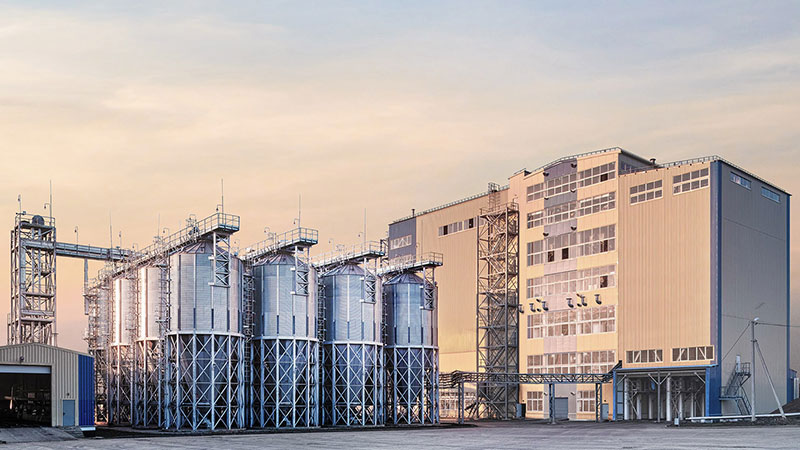
At RICHI, we go beyond project completion. With RICHI Servicee, we’re your dedicated partners in success. Count on us for expert guidance, minimal downtime, and optimized productivity. Choose RICHI for unmatched service and support.
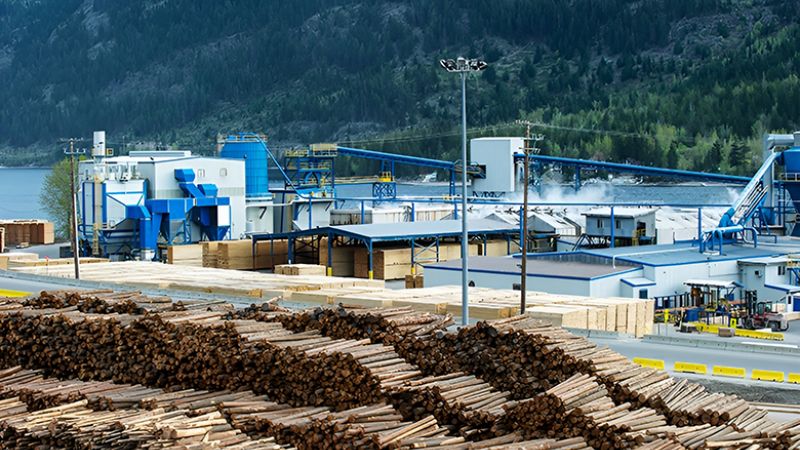


Meet global product demands and quality standards with industry-leading pellet plant design, engineering, equipment, and construction services for pellet processors.


Your Partner Beyond Project Completion
2000+ cases
RICHI is the leading designer, manufacturer and builder of pellet plants in the world, completing over 2000 projects in 140 countries across 6 continents.
Read More
Increase plant productivity, profitability, and safety by integrating high quality equipment into your pellet production line. Over the years, RICHI has become China's top pellet equipment manufacturer. At the same time, RICHI has established valuable partnerships with the world's leading component and raw material manufacturers to bring you the best there is in technology, automation, and efficiency in pelleting plant machinery.

For nearly 30 years, RICHI has been providing best-in-class pellet plant equipment and services to clients across a variety of industries, sizes, and needs. We pride ourselves on the knowledge and skill that each team member possesses – from our technical sales team to our process design engineers. You can count on RICHI Machinery to take your operation to the next level of innovation, quality, and success.
Need help with your pellet manufacturing plant project? Contact us today.
ANIMAL FEED
BIOMASS
WOOD
ORGANIC FERTILIZER
AQUA FEED
CAT LITTER
MUNICIPAL WASTE RECYCLING
SPECIAL PELLET PRODUCTION
RICHI Machinery continues to deliver world class pellet mill equipment, pellet plant engineering and project solutions that add value to our customers in the animal feed, wood waste, agriculture waste, organic fertilizer, cat litter and special pellet products industries. Throughout the years, we RICHI Machinery have built strong brand, becoming industry-leading pellet machine manufacturer. We value integrity, promise quality, and prioritize your success.
Learn MoreWith our expert team, we precisely implement your process engineering requirements in pellet mill and pelletizing plant systems. No matter which industry you’re in – we understand your needs and deliver solutions that meet the highest standards.
At RICHI, quality comes first. Our pellet making machine and related pellet line equipment undergo rigorous quality controls to ensure they meet the highest standards. Rely on products that are durable, safe, and efficient.
With decades of experience in pellet machine and pellet production line production, we have earned a reputation as a trusted partner in various industries. Our expertise allows us to cover a wide range of applications.
Not only do we offer premium pelleting equipment, but we are also experts at designing, building, installing, and maintaining facilities from the ground up. Our expertise is within pellt plant process design, discovering the most efficient, productive, and profitable way to handle your materials in an end-to-end cycle.
○ RICHI MACHINERY
Keeping in touch with us is an effective way to solve all your problems. If you have any needs or questions, please leave your contact information, then RICHI technical consultants will send design, quotation, videos to your mailbox. You can also contact us directly via WhatsApp: +86 13838389622
Copyright©2015-2026 by HENAN RICHI MACHINERY CO., LTD. All rights reserved.