
A Natural Grass Drying Machine in Laos was selected by a livestock cooperative in Xiangkhouang Province to preserve locally harvested forage during the long rainy season. The cooperative manages cattle and goats and has access to abundant natural grass, but high rainfall and humidity made outdoor drying too unpredictable for producing consistently storable forage.
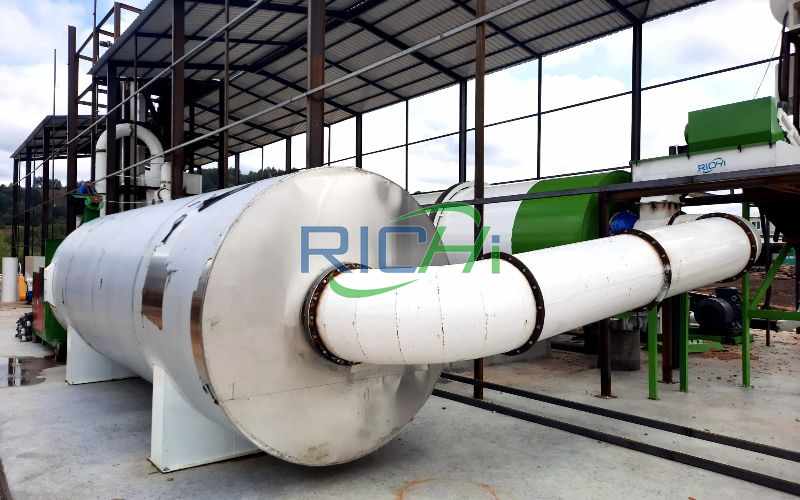
A Natural Grass Drying Machine in Laos was selected by a livestock cooperative in Xiangkhouang Province to preserve locally harvested forage during the long rainy season. The cooperative manages cattle and goats and has access to abundant natural grass, but high rainfall and humidity made outdoor drying too unpredictable for producing consistently storable forage.
The customer purchased two Φ1.8×12×3C three-cylinder rotary dryers as standalone machines. Existing forage harvesting, chopping, storage and feeding operations could continue to be used, so the investment focused specifically on the missing drying capacity: turning high-moisture grass into a stable feed material that could be stored and used when fresh forage quality or availability declined.
Name:
forage dryer
Country:
Laos
Date:
2025
Capacity:
Flexible
Model:
Φ1.8×12×3C
Quantity:
2 units
Raw Materials:
harvested forage
Drying Structure:
Three-cylinder rotary type
The reason for this project was closely connected with local climate rather than simply a plan to automate an existing process.
Laos has a pronounced wet season, generally extending from around May to October. Xiangkhouang has extensive grassland and livestock production potential, but rainfall during this period makes natural forage preservation difficult. Grass grows quickly when moisture is abundant, yet the same weather that produces the grass makes reliable sun drying difficult.
The cooperative had traditionally cut grass and used favorable weather windows for outdoor drying. This worked when several sufficiently dry days occurred together. During unstable weather, however, partially dried forage could be exposed to rain again before reaching a suitable condition for storage.
The result was inconsistent feed quality and considerable pressure on forage management.
The customer therefore began looking for a Natural Grass Drying Machine in Laos that would allow forage preservation to continue without depending entirely on several consecutive sunny days.
The customer is a livestock cooperative rather than a commercial grass pellet factory. Its members raise beef cattle and goats, and natural forage is an important part of their feeding system.
This distinction affected the equipment configuration.
The cooperative was not trying to manufacture a highly processed compound feed. Its immediate requirement was much simpler: harvest grass when it was available, reduce its moisture mechanically through thermal drying, and store the dried forage for later feeding.
Two dryers were selected because forage harvesting can be concentrated into relatively short periods. When suitable grass is cut, the customer needs enough drying capacity to process the material without creating a large backlog of wet forage waiting outside the dryer.
The two Natural Grass Drying Machine in Laos units can operate according to actual harvesting volume. This also gives the cooperative greater operating flexibility than depending on one oversized drying unit.
The main feedstock is freshly harvested natural grass from grazing and forage areas used by cooperative members. Depending on season and field conditions, the harvested forage may also contain locally grown forage legumes.
Fresh green grass is fundamentally different from rice straw or already field-dried hay. It contains considerably more water, has a soft fibrous structure and can form tangled masses if long material is fed directly into a rotary dryer.
For this reason, grass preparation is important.
The customer reduces long forage before drying so that material can move more evenly through the feeding and drying system. The objective is not to grind fresh grass into powder. It is simply to obtain a manageable length that promotes stable feeding and better contact with the drying medium.
Incoming moisture can vary substantially with harvest timing, rainfall and grass species. RICHI therefore does not treat one moisture value as the permanent design condition. Wet feed quantity and actual evaporation demand both have to be considered when determining dryer output.
After discussing the customer's forage condition, operating season and available installation area, RICHI recommended the Φ1.8×12×3C three-cylinder rotary dryer.
| Project Item | Configuration |
|---|---|
| Equipment | Three-cylinder natural grass dryer |
| Model | Φ1.8×12×3C |
| Quantity | 2 units |
| Outer Drum Diameter | 1.8 m |
| Drum Length | 12 m |
| Drying Structure | Three-cylinder rotary type |
| Main Raw Material | Fresh natural grass and forage material |
| Final Application | Dried forage for livestock feeding and storage |
The three-cylinder structure provides a relatively long material movement path within a more compact equipment footprint. For a customer processing wet forage, the objective is to obtain sufficient contact between the material and drying medium while keeping the installation practical for the available site.
RICHI matched the Natural Grass Drying Machine in Laos to the customer's evaporation requirement rather than simply giving a nominal ton-per-hour figure without reference to moisture.
This was an important part of the technical discussion with the customer.
When buyers ask for a grass dryer with a certain hourly capacity, RICHI also needs to know the incoming moisture and required final moisture. Five tons per hour of relatively dry forage and five tons per hour of freshly cut wet grass represent very different evaporation loads.
For example, grass harvested after rain requires substantially more water removal than partially field-wilted material. The dryer size, heat requirement and actual finished-product output will consequently differ.
For customers considering a natural grass dryer in Laos, providing four pieces of information makes equipment selection much more accurate: grass type, incoming moisture, wet material volume per hour, and required final moisture.
This approach prevents customers from buying a machine based only on a capacity number that may have been calculated under completely different raw-material conditions.
Prepared forage is fed continuously into the dryer rather than being placed inside in large batches. As the drum rotates, internal structures lift and redistribute the material, increasing contact between wet grass and the drying medium.
Moisture is progressively removed as the forage travels through the drying path.
The operator needs to coordinate feed rate and thermal conditions according to incoming grass moisture. If grass arrives wetter after rainfall, operating conditions may need to change. If the material has already lost part of its moisture before entering the machine, unnecessarily aggressive drying only wastes fuel and can reduce product quality.
This controllability is one reason the customer moved away from relying solely on sun drying. Mechanical drying does not eliminate the need for operators to understand the forage, but it gives them much greater control over the process.
This project did not require RICHI to replace the cooperative's complete forage handling system.
The customer already had tractors, harvesting equipment, forage handling facilities and covered storage. Basic size reduction could also be carried out before the material reached the dryer.
The bottleneck was moisture removal.
RICHI therefore concentrated on the drying section and the interfaces required to connect it with the customer's existing operation. This reduced unnecessary investment and allowed the cooperative to retain equipment that was still useful.
This same approach is relevant to other customers searching for a Natural Grass Drying Machine in Laos. A cattle farm that already has a forage chopper and conveyors may only require a dryer and associated thermal system. A new commercial forage processing project may require additional feeding, chopping, conveying, cooling or storage equipment.
The configuration should depend on what is already available at the site.
Thermal drying economics depend heavily on the heat source, especially when the raw material contains a large amount of water.
Laos has agricultural and forestry residues that can potentially be considered as biomass fuel where supply, quality and local requirements make their use suitable. Rice husk and wood residues are examples of materials that may be available in agricultural processing areas.
RICHI discussed fuel conditions with the cooperative before finalizing the drying arrangement. The important considerations included fuel moisture, calorific value, feeding stability, ash characteristics and continuous availability during the forage drying season.
This matters because purchasing a Natural Grass Drying Machine in Laos without considering thermal energy cost would provide an incomplete investment calculation.
The primary product is dried forage for the cooperative's own cattle and goats.
Instead of trying to turn this project into several unrelated businesses, the customer wanted to solve one fundamental livestock-management problem: preserving forage produced during periods of strong grass growth so that it remains available when feeding conditions change.
Once properly dried and stored under suitable conditions, the forage can be incorporated into the cooperative's feeding program. This reduces the urgency to use freshly harvested material immediately and creates a forage reserve that can be managed according to livestock requirements.
If production later exceeds internal consumption, dried forage can also provide a potential product for nearby livestock farms. However, the economics depend on local feed demand, forage quality, transportation distance and seasonal conditions rather than a guaranteed fixed selling price.
Because the customer was buying standalone equipment, RICHI first needed to understand what would be installed before and after the dryers.
The technical discussion covered forage condition, cutting length, wet feed volume, moisture variation, required storage moisture, operating hours, fuel availability, electrical conditions and available installation space.
RICHI also provided equipment drawings and connection information so that the cooperative could prepare foundations and surrounding facilities before delivery.
This type of pre-sale engineering is particularly important for an overseas standalone machine. A dryer may be well manufactured but still perform poorly if the feeding system is too small, wet grass arrives in tangled masses, the heat source is unstable or the downstream conveying equipment cannot remove dried material at the required rate.
The objective is therefore not just to sell two drums. It is to make sure the two Natural Grass Drying Machine in Laos units can actually work with the customer's forage operation.
Laos has no seaport, so the two dryers were arranged for ocean shipment from Qingdao Port in China to Laem Chabang Port in Thailand, an established regional gateway for cargo moving into mainland Southeast Asia.
RICHI prepared the dryer components for long-distance transportation and supplied the corresponding packing information, equipment drawings and technical documentation required for installation preparation.
For large rotary drying equipment, shipping preparation matters because drum sections, transmission components and auxiliary equipment need to arrive ready for correct assembly.
The most important improvement reported by the cooperative was greater control over forage preservation.
Previously, freshly cut grass had to be managed around the weather. When rain interrupted outdoor drying, the cooperative had limited options. With mechanical drying available, harvested forage can be directed into a controlled moisture-reduction process instead of waiting indefinitely for suitable sunshine.
Operators also learned that different batches of grass require adjustment. Material harvested after rainfall does not behave exactly like forage cut during a relatively dry period. Feed rate and drying conditions therefore need to follow the raw material rather than remain permanently fixed.
This operating experience has been valuable because the cooperative now evaluates the grass itself instead of treating the dryer as a machine that should produce identical results regardless of incoming moisture.
This Natural Grass Drying Machine in Laos project is particularly relevant to livestock farms, forage cooperatives and feed processors that already have access to grass but cannot preserve enough of it reliably during humid or rainy periods.
The first question is not simply which dryer model to buy. A more useful starting point is to determine what grass is available, how wet it is when it reaches the processing site, how many tons need to be handled each hour, what moisture is required after drying and what fuel can be supplied economically.
Customers who already own forage choppers, conveyors or storage facilities do not necessarily need to purchase a complete grass processing line. RICHI can evaluate the existing equipment and determine whether a standalone grass drying machine can be integrated into it. For a new project, the required supporting equipment can instead be configured around the dryer.
If a customer considering a Natural Grass Drying Machine in Laos can provide the grass species or a material photo, approximate incoming moisture, required wet-feed capacity, target moisture and available heat source, RICHI Machinery can use those conditions to calculate the evaporation requirement and recommend a more appropriate dryer configuration.
That is the value of this project beyond the two machines installed in Xiangkhouang. The customer did not invest in drying equipment simply because Laos has a rainy season. It invested because it had a stable source of natural grass, livestock that needed preserved forage, existing equipment that could continue to be used, and a specific moisture problem that mechanical drying could solve. Matching those conditions to the right equipment is what makes the investment practical.
Having the right mix of reliable, high-quality pellet machine and pelletizing systems and expert support is essential to your success. Watch how our end-to-end feed pellet plant solutions have helped our customers optimize their performance.
Our customized and future-proofed turnkey pellet plant solutions is designed with you at the core. From vision to reality and beyond, our team stays connected with yours. Giving you peace-of-mind with an expert at your side.
At RICHI, we go beyond project completion. With RICHI Servicee, we’re your dedicated partners in success. Count on us for expert guidance, minimal downtime, and optimized productivity. Choose RICHI for unmatched service and support.


Meet global product demands and quality standards with industry-leading pellet plant design, engineering, equipment, and construction services for pellet processors.


Your Partner Beyond Project Completion
2000+ cases
RICHI is the leading designer, manufacturer and builder of pellet plants in the world, completing over 2000 projects in 140 countries across 6 continents.
Read More
Increase plant productivity, profitability, and safety by integrating high quality equipment into your pellet production line. Over the years, RICHI has become China's top pellet equipment manufacturer. At the same time, RICHI has established valuable partnerships with the world's leading component and raw material manufacturers to bring you the best there is in technology, automation, and efficiency in pelleting plant machinery.

For nearly 30 years, RICHI has been providing best-in-class pellet plant equipment and services to clients across a variety of industries, sizes, and needs. We pride ourselves on the knowledge and skill that each team member possesses – from our technical sales team to our process design engineers. You can count on RICHI Machinery to take your operation to the next level of innovation, quality, and success.
Need help with your pellet manufacturing plant project? Contact us today.
ANIMAL FEED
BIOMASS
WOOD
ORGANIC FERTILIZER
AQUA FEED
CAT LITTER
MUNICIPAL WASTE RECYCLING
SPECIAL PELLET PRODUCTION
RICHI Machinery continues to deliver world class pellet mill equipment, pellet plant engineering and project solutions that add value to our customers in the animal feed, wood waste, agriculture waste, organic fertilizer, cat litter and special pellet products industries. Throughout the years, we RICHI Machinery have built strong brand, becoming industry-leading pellet machine manufacturer. We value integrity, promise quality, and prioritize your success.
Learn MoreWith our expert team, we precisely implement your process engineering requirements in pellet mill and pelletizing plant systems. No matter which industry you’re in – we understand your needs and deliver solutions that meet the highest standards.
At RICHI, quality comes first. Our pellet making machine and related pellet line equipment undergo rigorous quality controls to ensure they meet the highest standards. Rely on products that are durable, safe, and efficient.
With decades of experience in pellet machine and pellet production line production, we have earned a reputation as a trusted partner in various industries. Our expertise allows us to cover a wide range of applications.
Not only do we offer premium pelleting equipment, but we are also experts at designing, building, installing, and maintaining facilities from the ground up. Our expertise is within pellt plant process design, discovering the most efficient, productive, and profitable way to handle your materials in an end-to-end cycle.
○ RICHI MACHINERY
Keeping in touch with us is an effective way to solve all your problems. If you have any needs or questions, please leave your contact information, then RICHI technical consultants will send design, quotation, videos to your mailbox. You can also contact us directly via WhatsApp: +86 13838389622
Copyright©2015-2026 by HENAN RICHI MACHINERY CO., LTD. All rights reserved.