
A specialty mushroom processor in Fujian Province selected one RICHI DHG-500 mushroom continuous belt dryer in China to improve the consistency of its dried mushroom production.
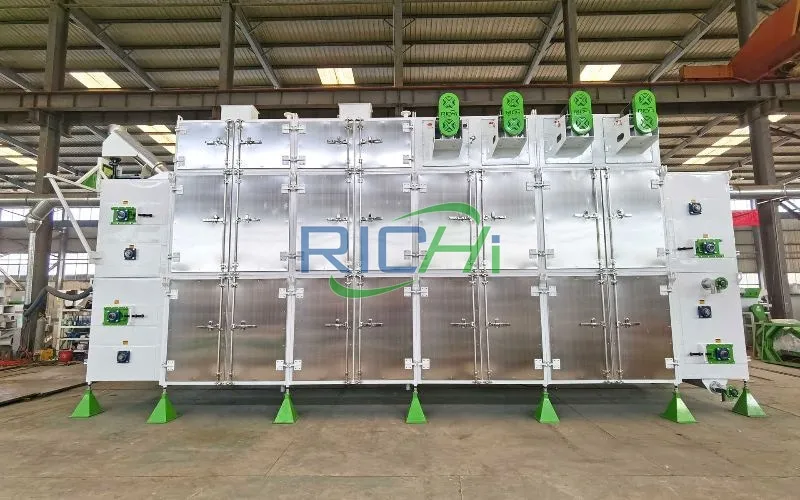
A specialty mushroom processor in Fujian Province selected one RICHI DHG-500 mushroom continuous belt dryer in China to improve the consistency of its dried mushroom production. The company processes shiitake, oyster and porcini mushrooms for domestic and export food markets and already had receiving, sorting, washing, cutting and packaging equipment, so the investment focused on adding a controlled continuous drying section rather than rebuilding the complete processing plant.
The DHG-500 uses electric heating and a five-layer mesh-belt structure with approximately 21 m² of drying area. The system allows the customer to adjust drying temperature, airflow, belt speed and product loading according to mushroom variety, product form, incoming moisture and final moisture specification instead of relying on sun drying or one fixed high-temperature recipe.
Name:
Mushroom Dryer
Country:
China
Date:
2026
Capacity:
8,000 T/Y
Model:
DHG-500
Drying Structure:
Five-layer mesh belt
Fresh Product Moisture:
85–90%
Finished Product Moisture:
10–12%
Fresh mushrooms contain a large amount of water and deteriorate quickly after harvest, making drying an important preservation step for processors selling products beyond the immediate fresh market.
The Fujian customer processes several mushroom categories, including whole or trimmed shiitake, oyster mushrooms and sliced porcini products.
These materials do not behave identically during drying.
A thick whole shiitake cap has a much longer internal moisture-migration path than a thin porcini slice. Oyster mushrooms have another shape, tissue structure and exposed surface area.
The processor therefore needed a dryer that could accommodate different product geometries without forcing all mushrooms through one fixed batch cycle.
A continuous multi-layer belt dryer provides that flexibility.
The customer can change belt loading, product preparation and operating parameters for different SKUs while maintaining controlled airflow and temperature inside an enclosed drying system.
This gives the plant more predictable production than outdoor sun drying, particularly during periods of unstable humidity or rainfall.
| Project Parameter | Configuration |
|---|---|
| Equipment | Mushroom continuous belt dryer |
| Model | DHG-500 |
| Heating Method | Electric heating |
| Drying Structure | Five-layer mesh belt |
| Reference Drying Area | Approximately 21 m² |
| Main Materials | Shiitake, oyster and porcini mushrooms |
| Fresh Product Moisture | Commonly high, often around 85–90% depending on species and condition |
| Finished Product Moisture | Typically around 10–12% for this customer’s dried mushroom products, subject to SKU specification |
| Main Process Variables | Temperature, airflow, belt speed, loading depth and product preparation |
| Project Type | Continuous drying-section upgrade |
The DHG-500 was selected because the customer needed a compact continuous dryer rather than another large batch drying room.
The five-layer arrangement increases effective drying area within a relatively limited footprint. As product moves through the dryer, it passes progressively through different sections of the machine while heated air removes moisture.
The useful capacity of the dryer cannot be expressed accurately from belt area alone.
Fresh feed rate depends on initial moisture, final moisture, product thickness, drying temperature, airflow, layer loading and the amount of water the heating system can actually evaporate per hour.
The customer’s annual fresh-mushroom volume is around 8,000 tonnes, while dried product is approximately 1,200 tonnes across the complete operation.
That relationship is plausible only when the large water loss during drying is considered.
For example, 1,000 kg of fresh mushrooms at 88% moisture contain approximately 120 kg of dry solids and 880 kg of water.
If those dry solids are processed to 11% final moisture, the theoretical finished product mass becomes approximately 135 kg.
About 865 kg of water therefore has to be removed from every 1,000 kg of fresh mushrooms under those conditions.
This mass balance explains why dryer sizing must distinguish three different quantities:
fresh mushroom input, water evaporation and final dried mushroom output.
A machine processing 500 kg/h of fresh mushrooms at high moisture is performing a very different thermal duty from a machine producing 500 kg/h of finished dried mushrooms.
The complete 8,000 T/Y fresh-mushroom operation also does not mean that one DHG-500 must process every tonne.
The dryer can serve one production section, selected mushroom SKUs or part of the factory’s seasonal volume. The annual plant total can include other dryers, batches, sun-drying routes or different product lines depending on the facility.
For a DHG-500 project, RICHI therefore calculates fresh feed and evaporation load for the specific section connected to this machine.
Mushroom quality is sensitive to drying conditions, and lower-temperature hot-air drying can be useful when the processor wants to limit excessive shrinkage, structural damage or surface hardening.
However, one fixed 50°C setting should not be described as the best temperature for every mushroom species and product form.
Research on shiitake drying shows that temperature affects rehydration, texture, shrinkage, browning and other quality attributes, but the relationship is not simply “higher temperature is always worse.”
For example, published studies have found that high-temperature pre-drying can improve some rehydration and aroma-related characteristics, while other work shows that lower-temperature hot-air drying can preserve certain structural properties better.
Relative humidity also matters.
Research on shiitake hot-air drying has shown that controlling humidity during early and later drying stages can influence case hardening, shrinkage and rehydration behavior.
This means case hardening is not controlled by temperature alone.
For the Fujian customer, a moderate-temperature range around approximately 45–55°C can provide a useful starting window for some products, but the final recipe is established through product trials.
Whole shiitake, oyster mushrooms and sliced porcini can require different settings.
The five-layer structure increases residence area and gives the dryer a longer material path, but it should not be interpreted as one hour per layer or exactly five hours total.
Residence time depends on belt speed and the effective travel path through the machine.
Operators can adjust belt speed according to the drying load.
Thicker mushrooms with higher initial moisture may require longer residence than thin slices. A thin porcini slice can dry much faster than a whole shiitake cap, even when both enter at similar moisture content.
Product loading also changes the result.
A heavily loaded belt can restrict airflow around the mushrooms and increase the amount of water that has to be removed from each square meter of belt area.
A thinner, more uniform layer improves air contact but reduces fresh-feed mass per square meter.
RICHI therefore evaluates belt speed, bed loading and airflow together.
The goal is not to force every product to remain inside for five hours. The goal is to provide enough time and drying potential to reach the finished specification without unnecessary heat exposure.
The customer processes multiple mushroom forms, so material preparation is one of the most important factors in dryer performance.
Shiitake can be dried whole, trimmed or sliced depending on the finished product.
Whole caps have a relatively long moisture path, especially around thick central tissue and stems.
Oyster mushrooms have thinner tissue but irregular shape and larger exposed surfaces, which changes belt loading and airflow around the product.
Porcini intended for premium dried products is often sliced, reducing the moisture-diffusion distance considerably.
This means it is not practical to define one universal spacing such as 10 mm for shiitake, 20 mm for oyster mushrooms and zero spacing for porcini.
The better objective is uniform loading with limited overlap and enough open area for drying air to contact the product.
The processor can also sort product by size before drying.
However, different sizes are not assigned permanently to specific belt layers. All material entering a continuous multi-layer dryer normally follows the designed belt path.
Size grading instead helps the customer run more uniform batches or feed streams, reducing the risk that very thick pieces remain wet while much smaller pieces are already overdried.
The customer targets approximately 10–12% final moisture for many dried mushroom products, but final acceptance depends on more than moisture percentage.
Product quality can also be evaluated through water activity, color, aroma, texture, shrinkage, piece integrity and rehydration characteristics depending on the market.
Rehydration is particularly important for dried shiitake and other culinary mushrooms.
Research shows that drying temperature and method can significantly alter pore structure, cell-wall behavior and rehydration characteristics.
However, a commercial belt dryer cannot guarantee that dried mushrooms will recover 95% of their original fresh size.
The result depends on mushroom species, maturity, pre-treatment, drying history and the test method used for rehydration.
The same caution applies to flavor.
Mushroom aroma and umami characteristics arise from multiple compounds and biochemical reactions. Temperature influences these compounds, but it is not technically defensible to state that guanosine monophosphate or other flavor substances retain exactly 85–90% at 50°C and only 50–60% at 75°C unless those values come from validated testing of the customer’s product.
The processor therefore uses sensory and laboratory evaluation where required instead of relying on one generic percentage.
Moving from sun drying to an enclosed continuous dryer gives the customer much more control over weather exposure, temperature, airflow and production scheduling.
This can reduce one source of variability, particularly during humid or rainy periods.
It does not guarantee zero microbial risk.
Fresh mushrooms still require hygienic receiving and preparation, while the dryer needs regular sanitation and residue control.
Finished dried mushrooms also need appropriate cooling, moisture verification and packaging before storage.
If dried product leaves the machine warm and is sealed immediately, moisture redistribution or condensation can still affect storage stability.
The customer therefore allows the dried product to cool or equilibrate before final packing.
Water activity and package moisture-barrier performance are especially relevant for long-distance export products.
Cleaning frequency is established according to the processor’s sanitation program, production schedule and actual residue accumulation.
Mushroom fragments can adhere to belts and transfer points, so these areas need access for inspection and cleaning.
The plant does not rely on a rigid rule such as “30 minutes of hot-water washing every evening” for all conditions.
The DHG-500 was delivered to the customer’s Fujian mushroom-processing facility as a domestic China project and integrated with the existing food-production workflow.
The customer retained receiving, grading, washing, cutting and packaging assets while adding the multi-layer dryer to create a more controlled continuous dehydration section.
This mushroom continuous belt dryer in China uses electric heating, a five-layer belt structure and approximately 21 m² of drying area.
Its practical throughput is determined from fresh feed, initial moisture, target final moisture, product geometry, airflow and evaporation duty rather than from one generic tonnes-per-hour number.
For shiitake, oyster and porcini products, different drying recipes can be established according to whole or sliced form, thickness, loading and final market requirement.
A moderate-temperature approach can be useful for quality-sensitive products, but the customer does not need to operate permanently at exactly 50°C.
The same flexibility applies to residence time.
The five-layer design provides drying path and area; belt speed determines how long the mushrooms remain inside the system.
For another processor searching for a mushroom continuous belt dryer in China, mushroom belt drying machine, shiitake mushroom dryer, multi-layer mushroom dryer, continuous food dryer or electric mushroom drying machine, the most useful project information is not simply annual mushroom tonnage.
RICHI first needs to know fresh mushroom input per hour, mushroom species, whole or sliced form, typical dimensions, incoming moisture, required final moisture, desired product quality, daily operating hours, available electrical capacity and the equipment already installed before and after drying.
Those values allow the drying load to be converted into kilograms of water evaporation per hour.
For example, 1,000 kg of fresh mushrooms at 88% moisture dried to 11% final moisture produces only about 135 kg of theoretical dried product and requires removal of roughly 865 kg of water.
This calculation is the basis for heating capacity, airflow and dryer sizing.
A processor with a large annual fresh-mushroom volume may require several dryers or a larger model if peak hourly intake exceeds the DHG-500 operating range.
A smaller specialty line processing selected premium products may use one DHG-500 while other factory production follows separate drying routes.
RICHI Machinery can therefore configure the dryer around one real production section rather than dividing annual tonnage by working days and assuming one machine automatically handles the entire factory.
For a China mushroom-drying project, send RICHI your fresh mushrooms per hour, moisture, species, whole or sliced form, slice thickness where applicable, final moisture target, preferred heat source, operating hours and available workshop dimensions. These parameters provide the basis for selecting the appropriate belt area, heating configuration, airflow and residence-time range for the finished mushroom product.
Having the right mix of reliable, high-quality pellet machine and pelletizing systems and expert support is essential to your success. Watch how our end-to-end feed pellet plant solutions have helped our customers optimize their performance.
Our customized and future-proofed turnkey pellet plant solutions is designed with you at the core. From vision to reality and beyond, our team stays connected with yours. Giving you peace-of-mind with an expert at your side.
At RICHI, we go beyond project completion. With RICHI Servicee, we’re your dedicated partners in success. Count on us for expert guidance, minimal downtime, and optimized productivity. Choose RICHI for unmatched service and support.


Meet global product demands and quality standards with industry-leading pellet plant design, engineering, equipment, and construction services for pellet processors.


Your Partner Beyond Project Completion
2000+ cases
RICHI is the leading designer, manufacturer and builder of pellet plants in the world, completing over 2000 projects in 140 countries across 6 continents.
Read More
Increase plant productivity, profitability, and safety by integrating high quality equipment into your pellet production line. Over the years, RICHI has become China's top pellet equipment manufacturer. At the same time, RICHI has established valuable partnerships with the world's leading component and raw material manufacturers to bring you the best there is in technology, automation, and efficiency in pelleting plant machinery.

For nearly 30 years, RICHI has been providing best-in-class pellet plant equipment and services to clients across a variety of industries, sizes, and needs. We pride ourselves on the knowledge and skill that each team member possesses – from our technical sales team to our process design engineers. You can count on RICHI Machinery to take your operation to the next level of innovation, quality, and success.
Need help with your pellet manufacturing plant project? Contact us today.
ANIMAL FEED
BIOMASS
WOOD
ORGANIC FERTILIZER
AQUA FEED
CAT LITTER
MUNICIPAL WASTE RECYCLING
SPECIAL PELLET PRODUCTION
RICHI Machinery continues to deliver world class pellet mill equipment, pellet plant engineering and project solutions that add value to our customers in the animal feed, wood waste, agriculture waste, organic fertilizer, cat litter and special pellet products industries. Throughout the years, we RICHI Machinery have built strong brand, becoming industry-leading pellet machine manufacturer. We value integrity, promise quality, and prioritize your success.
Learn MoreWith our expert team, we precisely implement your process engineering requirements in pellet mill and pelletizing plant systems. No matter which industry you’re in – we understand your needs and deliver solutions that meet the highest standards.
At RICHI, quality comes first. Our pellet making machine and related pellet line equipment undergo rigorous quality controls to ensure they meet the highest standards. Rely on products that are durable, safe, and efficient.
With decades of experience in pellet machine and pellet production line production, we have earned a reputation as a trusted partner in various industries. Our expertise allows us to cover a wide range of applications.
Not only do we offer premium pelleting equipment, but we are also experts at designing, building, installing, and maintaining facilities from the ground up. Our expertise is within pellt plant process design, discovering the most efficient, productive, and profitable way to handle your materials in an end-to-end cycle.
○ RICHI MACHINERY
Keeping in touch with us is an effective way to solve all your problems. If you have any needs or questions, please leave your contact information, then RICHI technical consultants will send design, quotation, videos to your mailbox. You can also contact us directly via WhatsApp: +86 13838389622
Copyright©2015-2026 by HENAN RICHI MACHINERY CO., LTD. All rights reserved.