
A 15,000 T/A Lithuanian feed mill uses one DCS-50P belt-fed packing scale for controlled filling of pig and poultry pellets plus dairy mash in 20–25 kg bags.
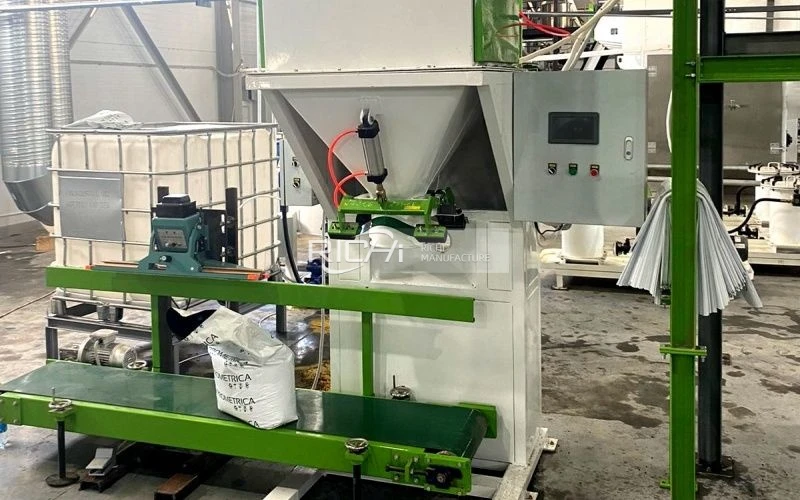
A new 15,000 T/A feed mill in Kaunas County selected one DCS-50P Mixed Feed Packing Scale in Lithuania because its finished products do not all behave the same way during filling. The plant supplies pig and poultry feeds as pellets or crumbles while also producing mash feed for dairy farms, so the packing section needed controlled feeding for both free-flowing pellets and less predictable meal-type products.
The customer chose a standalone belt-fed weighing machine rather than a complete automatic bagging line. Empty bags are still presented by operators, while the customer's sewing machine and bag conveyor remain part of the finishing section. With a reference filling speed of 6–8 bags per minute, the DCS-50P provides enough cycle capacity for the mill's production scale without adding automatic bag placing and palletizing equipment that the factory does not currently require.
Name:
animal feed weighing and packing scale
Country:
Lithuania
Date:
2026
Capacity:
6–8 bags/min
Model:
DCS-50P
Power:
1.5 + 0.55 + 0.37 kW
Feeding Method:
Belt feeding
Bag Sizes:
20 kg and 25 kg
The main equipment decision came from product behavior rather than annual tonnage.
Dry pig and poultry pellets normally move relatively freely from a finished-product bin. Mash feed contains a much wider particle distribution and can include fine meal, grain fragments and fibrous ingredients.
The two products therefore do not enter a weighing system in the same way.
A machine selected only for free-flowing pellets could become difficult to control when a less free-flowing mash product is introduced. At the same time, equipment designed only around fine powder would add unnecessary mechanical handling to finished pellets.
The Lithuanian project therefore required one filling principle that could bridge the gap between both duties.
| Project Parameter | Configuration |
|---|---|
| Equipment | Mixed animal feed weighing and packing scale |
| Model | DCS-50P |
| Quantity | 1 unit |
| Suitable Materials | Pellets, crumbles and qualified mash feeds |
| Feeding Method | Belt feeding |
| Packaging Speed | 6–8 bags/min under suitable conditions |
| Installed Power | 1.5 + 0.55 + 0.37 kW |
| Static Weighing Accuracy | ±0.1% |
| Dynamic Weighing Accuracy | ±0.2% |
| Compressed Air Requirement | 0.4–0.6 MPa, approximately 1.5 m³/h |
| Packaging Range | 10–50 kg/bag |
| Main Project Bag Sizes | 20 kg and 25 kg |
| Main Bag Closing Method | Sewing with the customer's existing closing equipment |
| Installation Type | Standalone weighing and filling unit in a new feed mill |
The machine specifications describe the weighing and filling unit. Complete packaging output also depends on operator bag placement, feed flow, bag removal, sewing speed, conveying and pallet handling.
The DCS-50P meters material onto a belt before the weighing cycle is completed.
For pellets, the belt provides relatively gentle transfer without forcing the finished product through a screw feeder. For mash, positive belt movement provides more control than depending entirely on gravity flow from the hopper.
This does not mean every mash formula is automatically easy to package.
Flowability still depends on moisture, fat content, particle distribution, bulk density and the proportion of fine material. A very dry cereal-rich mash can behave quite differently from a more fibrous dairy product.
The advantage of the belt-fed arrangement is that the customer has more room to adjust material delivery as those conditions change.
A gravity-fed packing scale can be an efficient solution when the entire product range consists of dry, free-flowing pellets or granular materials.
That is not the situation in this plant.
The dairy mash product can flow more slowly or irregularly through a hopper, particularly when its fine-particle fraction or moisture changes.
Depending only on gravity would therefore give the customer less control over the difficult half of its product portfolio.
The decision is not based on a claim that gravity feeding can never handle mash. Some free-flowing meals can be gravity filled successfully. The issue is that this mill wants one machine to cover a broader and more variable product range.
Auger feeders are particularly useful for many fine powders and premixes because the screw positively meters material.
The Lithuanian customer, however, also packages finished pig and poultry pellets.
Passing those pellets through an auger creates more mechanical contact than necessary and introduces another moving component into the pellet path.
The DCS-50P therefore provides a better compromise for this particular combination of pellet and mash products.
If the factory were packaging only fine premix powder, the equipment selection could be completely different.
The DCS-50P*2 Automatic Packing Machine provides a higher reference cycle rate of 10–12 bags per minute, but greater speed is useful only when the production section and downstream bag handling can use it.
This feed mill is designed around approximately 15,000 tonnes of annual production and still uses operator-assisted bag placement and sewing.
The single-belt DCS-50P already provides 6–8 filling cycles per minute.
With 25 kg bags, the theoretical steady filling rate is approximately 9–12 T/H. With 20 kg bags, it is approximately 7–10 T/H.
Those figures provide substantial packaging capacity relative to the average requirement of a 15,000 T/A mill. Installing the higher-speed twin-belt machine would therefore add capacity that may remain unused.
The plant's 15,000 T/A design figure should not be divided mechanically by operating hours to select the packing scale.
Not every feed formula is necessarily manufactured or packed at the same rate.
Production scheduling includes formula changes, mixer cycles, pelleting campaigns, cooler operation, finished-product storage and packaging periods.
The relevant number for the DCS-50P is the peak flow of qualified finished feed reaching the bagging section while bags are actually being filled.
This is why bags per minute is more useful than annual factory tonnage when checking packing-machine capacity.
The Mixed Feed Packing Scale in Lithuania does not treat pig pellets, poultry crumbles and dairy mash as one identical material.
Operators establish suitable feeding and weighing parameters for each main product family.
Dry pellets can normally move onto the belt relatively quickly. Mash may require a more controlled feed rate as the weighing target is approached.
If bulk density or moisture changes substantially between formulas, the relevant settings are verified again.
This is more reliable than operating every feed with one permanent belt speed simply because all products use the same nominal bag weight.
The mill packages grower and finisher pig feeds as dry pellets.
Once properly cooled and screened, these pellets normally have predictable bulk flow and create a relatively straightforward filling duty.
The packing machine still depends on pellet quality upstream.
If excessive fines arrive from the cooler or conveying section, the physical behavior of the product changes. Fine particles can accumulate differently inside the hopper and alter the material flow near the weighing cut-off point.
The DCS-50P measures the product presented to it; it cannot restore damaged pellets.
Poultry products can include both intact pellets and crumbled feed.
Crumbles contain a broader particle-size distribution and typically generate more fines than intact pellets.
This means a crumble campaign can create more dust around the filling position and can leave more fine material on contact surfaces.
The customer therefore checks belt cleanliness and filling-point housekeeping when moving between pellet and crumble production.
Small pellet diameter alone does not determine flowability. Pellet durability, fines, bulk density and surface condition also matter.
The customer has selected mash as one of its dairy-feed formats, but physical feed form should not be turned into a universal nutritional claim.
Dairy cattle diets depend on forage supply, concentrate formulation, particle characteristics, feeding system and ration management.
The bagging machine therefore only needs to accommodate the customer's chosen commercial mash product.
It does not determine whether mash, pellets or another concentrate form is nutritionally preferable for every dairy farm.
The dairy product contains both fines and coarser feed particles.
A very fine fraction can become dusty, while larger fibrous particles can reduce flow consistency.
Moisture also matters. Material with higher moisture can adhere more readily to belts and chutes than a dry cereal meal.
The operator therefore watches actual product behavior at the feeder rather than defining all mash by one nominal particle size.
Where residue begins to accumulate, cleaning frequency and feeding parameters are adjusted before weight variation becomes a packaging problem.
Moving from dairy mash to clean pellets requires more than changing the target weight on the controller.
Fine material can remain on the belt, around the weighing hopper, at the bagging spout and on nearby ledges.
The customer therefore includes those areas in the product-change procedure.
Cleaning requirements depend on the formulas being produced and the feed mill's contamination-control program.
One fixed changeover time should not be promised because a dry pellet-to-pellet switch is very different from cleaning after a dusty mash campaign.
Some mash materials leave little residue on a properly selected belt. Others contain enough fine or slightly cohesive material to remain on the return side.
If product testing shows persistent carryover, an appropriate belt-cleaning or scraper arrangement can be considered.
The cleaning component should be adjusted so that it removes retained material without creating unnecessary belt wear.
This is a better approach than declaring that every DCS-50P application always requires the same scraper configuration.
The DCS-50P is specified at ±0.1% static accuracy and ±0.2% dynamic accuracy.
Dynamic accuracy is particularly relevant during routine operation because the product is moving while the weighing cycle is being completed.
At a 25 kg target, ±0.2% corresponds mathematically to approximately ±50 g. At 20 kg, it corresponds to approximately ±40 g.
These values describe the reference accuracy specification rather than a promise that every individual bag will always remain at exactly that deviation.
Calibration, vibration, product flow, feeder cut-off and scale condition all influence real bag-to-bag performance.
An electronic packing scale does not eliminate production quality checks.
The customer periodically verifies filled bags using an appropriate independent check scale.
If average bag weight begins to move away from the intended target, operators can inspect scale calibration, feeder behavior and product condition before making unnecessary control adjustments.
Consistent verification is more useful than deliberately overfilling every bag to create a large safety margin.
Small excess weights become commercially important when thousands of bags are packed.
If a 25 kg product is routinely filled well above target, the additional feed is shipped without a corresponding increase in the number of bags sold.
Underfilling creates the opposite problem and can cause customer or compliance issues.
The purpose of controlled weighing is therefore to keep the filling process stable around the specified target rather than simply aiming high enough that underweight bags are unlikely.
Bag size has a direct effect on the required number of machine cycles.
One tonne requires 50 bags at 20 kg but only 40 bags at 25 kg.
A poultry-feed campaign using 20 kg packages therefore creates 25% more filling cycles per tonne than the same mass packed into 25 kg bags.
This is why bags per minute needs to be checked against the customer's real package mix instead of only asking for tonnes per hour.
The customer already has a usable bag-sewing machine and does not need to replace it merely because the weighing section is new.
Filled bags leave the DCS-50P and move toward the sewing position on the customer's conveyor.
The interface still needs to be checked carefully.
Discharge height, conveyor height, bag stability and sewing speed must work together so that bags do not accumulate directly beneath the filling position.
Reusing serviceable equipment keeps the investment focused on the stage that actually needs automation.
The main project uses sewn feed bags, but sewing should not be described as a Lithuanian requirement.
The correct closing method depends on the bag material and the storage or distribution requirement.
Suitable paper or woven feed bags can be sewn. Compatible thermoplastic structures can use heat sealing, while lined packaging may require a combined closing arrangement.
The DCS equipment family can be configured around these different requirements, but the customer does not need extra sealing equipment when its main bags are already compatible with the sewing machine in the plant.
Lithuania's climate makes warehouse moisture management relevant, but package selection should still be based on actual storage conditions.
Feed stored in a dry enclosed warehouse for a short commercial cycle has a different requirement from product exposed to prolonged humid storage or long-distance export.
The customer therefore selects bags from feed moisture, storage duration, warehouse protection and customer requirements rather than installing heat sealing simply because the plant is located in northern Europe.
Pellet filling creates relatively little airborne material when the product has been properly screened.
Mash feed produces a different condition because fine particles can be displaced as the bag fills.
The packaging area therefore needs suitable containment and aspiration where actual dust loading requires it.
Extraction should capture escaping feed dust without pulling excessive saleable product away from the weighing and filling position.
The customer also keeps nearby load-cell and mechanical areas free from accumulated feed.
Installation quality is part of weighing accuracy.
A packing scale mounted on a support structure that receives strong vibration from a hammer mill, large conveyor or other rotating equipment can experience less stable measurements.
The DCS-50P is therefore positioned on a suitable structure with mechanical connections arranged so that unwanted forces are not transferred directly into the weighing section.
This is especially important in a compact mill where several machines may share one processing area.
A small or medium feed mill does not always have room for separate pellet and mash bagging stations.
One DCS-50P reduces the number of weighing machines, product chutes and operator positions required in the finished-feed area.
That does not mean one machine is universally better than two.
A much larger mill running pellet and mash production simultaneously could justify dedicated packing positions.
For this 15,000 T/A operation, production is scheduled in batches, making one flexible scale more appropriate.
Floor space alone is not enough when planning a retrofit or compact feed mill.
The customer also checks the vertical distance between the finished-product bin and the DCS-50P inlet.
The weighing section, bag position and discharge conveyor each require usable height.
The installation review therefore covers available length, width and height together with the positions of structural columns, platforms and utility connections.
The DCS-50P can control material after it reaches the belt, but it cannot solve severe flow problems inside a poorly designed finished-product bin.
If mash forms a stable bridge above the outlet, the belt feeder may simply receive too little material.
Bin outlet dimensions, wall angle and the physical characteristics of the feed therefore remain part of the packaging system.
The customer's pellet and mash products are checked separately when the finished-bin arrangement is finalized.
The DCS-50P requires approximately 0.4–0.6 MPa compressed air with reference consumption around 1.5 m³/h.
The air supply is therefore included in site preparation.
Pressure has to remain stable during packing, and moisture should be controlled so that pneumatic components operate reliably.
Where the compressor serves other plant equipment as well, sizing is based on total simultaneous demand rather than the packing machine alone.
The DCS-50P uses a power configuration of 1.5 + 0.55 + 0.37 kW.
This is small compared with feed hammer mills, pellet mills and mixers, but the packaging section still requires correct electrical protection, grounding and control integration.
The conveyor and sewing equipment also contribute to the total connected load.
Electrical details are matched to the actual Lithuanian plant supply before commissioning rather than copied from another export project.
A weighing machine capable of six to eight cycles per minute provides little benefit if filled bags cannot leave the station quickly enough.
The customer therefore checks the existing conveyor and sewing position against the practical bag cycle.
Manual removal and stacking can also limit usable output even when the scale itself still has available speed.
Complete packaging capacity is determined by the slowest stage from bag presentation through final bag removal.
The Lithuanian mill deliberately keeps operators in the packaging process.
An operator positions the empty bag, the scale controls weighing and filling, and the filled bag moves toward sewing and pallet handling.
This arrangement reduces automation complexity while still removing manual judgment from the weighing step.
A fully automatic bag placer becomes more relevant when labor availability, continuous high output or very high bag-cycle demand justifies the additional equipment.
Lithuania has a substantial cereal sector, making a feed mill based around wheat, barley and other grain ingredients commercially realistic.
Protein meals, rapeseed-derived ingredients, peas and imported materials can be incorporated according to formulation and purchasing conditions.
The factory does not rely on one permanent percentage formula merely because certain crops are produced locally.
Feed ingredients change with price, quality and nutritional requirements, while the packing system only sees the physical form of the finished feed.
A dairy mash containing more fibrous ingredients can have lower bulk density than a cereal-rich product.
Additional oil or moisture can also alter belt behavior.
For that reason, a formula change can require a packing check even when the nominal bag weight remains 25 kg.
Operators pay attention to belt loading, weighing cut-off and the amount of residual material after each cycle.
The physical behavior of the finished feed is what determines the filling adjustment.
Two feeds weighing 25 kg can occupy noticeably different volumes.
Dense pellets may sit comfortably in a relatively compact bag, while coarse dairy mash can require more internal volume for the same weight.
The customer therefore verifies bag dimensions with the actual product rather than selecting one package solely from its nominal kilogram rating.
Bag volume also affects stability on the conveyor and during pallet stacking.
Final commissioning uses the materials that the customer actually plans to package.
Pellets provide one calibration condition, while mash gives the operator a second material with different flow behavior.
Representative filled bags are checked independently while the machine settings are established.
If future formulas fall substantially outside those physical characteristics, the packing parameters can be verified again before a long production campaign begins.
The time needed to switch products depends on what is being changed.
Moving from one dry pellet formula to another can be relatively simple.
Changing from dusty dairy mash to a pellet product can require additional cleaning around the belt, hopper and bagging spout.
Bag size and sewing setup can also influence the changeover.
The plant therefore schedules enough time to meet its feed-hygiene requirements instead of treating one short changeover figure as a guaranteed machine feature.
The DCS-50P is installed after grinding, batching, mixing and any required pelletizing or crumbling.
It does not control protein, energy, fibre, minerals or formulation accuracy.
Its role is to receive qualified finished feed and divide that product into controlled commercial bag weights.
This keeps the packaging equipment responsibility separate from nutritional and upstream manufacturing control.
The DCS-50P is prepared for sea transport from Qingdao to Klaipėda before inland delivery toward Kaunas County.
For equipment entering Lithuania, Klaipėda provides the country's principal maritime cargo gateway and handles substantial container and agricultural cargo volumes.
Before shipment, the customer can prepare the packing position using confirmed dimensions, inlet and outlet elevations, electrical requirements, compressed-air information and maintenance clearances.
Ocean schedules, terminal handling and inland transport are coordinated according to the actual shipment rather than one fixed transit period.
If feed sales increase, the customer first needs to identify the packaging stage that has reached its limit.
The DCS-50P may still have enough weighing capacity while manual bag placement, sewing, pallet stacking or finished-product storage becomes restrictive.
In that situation, the next investment could be a faster downstream conveyor, another sewing position or a higher level of bag-handling automation.
A second packing scale becomes useful only when enough feed is arriving and the surrounding equipment can clear the additional bags.
If the factory later operates at substantially higher output or produces a larger share of feed in 20 kg bags, the number of required cycles can increase enough to justify the DCS-50P*2.
The higher-speed model provides a reference range of 10–12 bags per minute.
Before making that change, the customer would need to check finished-product supply, available floor space, bag placement, sewing, conveying and pallet handling.
Higher filler speed only creates usable capacity when the complete packing section can follow it.
A Mixed Feed Packing Scale in Lithuania should be selected from the finished-feed forms that actually enter bags, not simply from the mill's annual tonnage. A plant producing only dry pellets can use a different feeding system from a factory that switches regularly between pig pellets, poultry crumbles and dairy mash.
For another Lithuanian feed project, RICHI Machinery would first review product forms, bulk density, moisture, fines level, target bag sizes, required bags per minute, peak feed output, finished-bin design, available L × W × H, sewing or sealing method, conveyor capacity, operator involvement, compressed-air supply and electrical conditions.
Those details determine whether the single-belt DCS-50P provides the right balance or whether a gravity-fed, auger-fed or higher-speed packing configuration would better match the customer's production plan.
Having the right mix of reliable, high-quality pellet machine and pelletizing systems and expert support is essential to your success. Watch how our end-to-end feed pellet plant solutions have helped our customers optimize their performance.
Our customized and future-proofed turnkey pellet plant solutions is designed with you at the core. From vision to reality and beyond, our team stays connected with yours. Giving you peace-of-mind with an expert at your side.
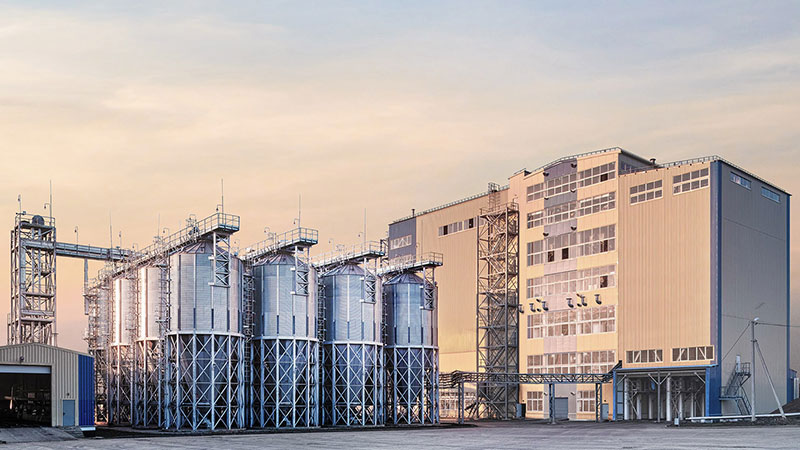
At RICHI, we go beyond project completion. With RICHI Servicee, we’re your dedicated partners in success. Count on us for expert guidance, minimal downtime, and optimized productivity. Choose RICHI for unmatched service and support.
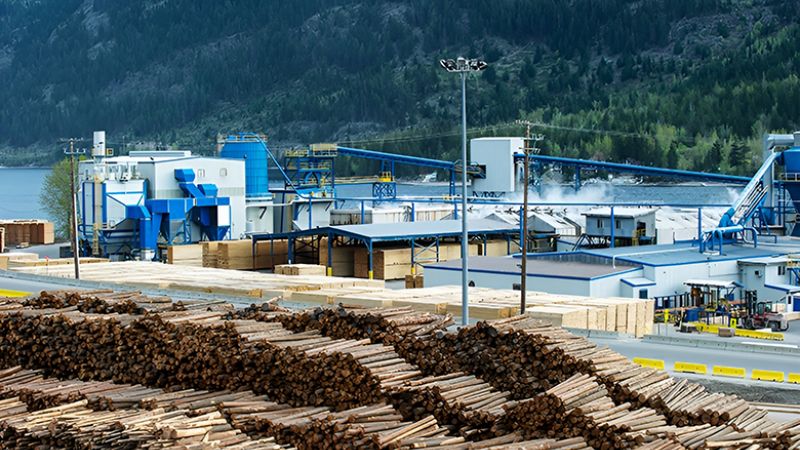


Meet global product demands and quality standards with industry-leading pellet plant design, engineering, equipment, and construction services for pellet processors.


Your Partner Beyond Project Completion
2000+ cases
RICHI is the leading designer, manufacturer and builder of pellet plants in the world, completing over 2000 projects in 140 countries across 6 continents.
Read More
Increase plant productivity, profitability, and safety by integrating high quality equipment into your pellet production line. Over the years, RICHI has become China's top pellet equipment manufacturer. At the same time, RICHI has established valuable partnerships with the world's leading component and raw material manufacturers to bring you the best there is in technology, automation, and efficiency in pelleting plant machinery.

For nearly 30 years, RICHI has been providing best-in-class pellet plant equipment and services to clients across a variety of industries, sizes, and needs. We pride ourselves on the knowledge and skill that each team member possesses – from our technical sales team to our process design engineers. You can count on RICHI Machinery to take your operation to the next level of innovation, quality, and success.
Need help with your pellet manufacturing plant project? Contact us today.
ANIMAL FEED
BIOMASS
WOOD
ORGANIC FERTILIZER
AQUA FEED
CAT LITTER
MUNICIPAL WASTE RECYCLING
SPECIAL PELLET PRODUCTION
RICHI Machinery continues to deliver world class pellet mill equipment, pellet plant engineering and project solutions that add value to our customers in the animal feed, wood waste, agriculture waste, organic fertilizer, cat litter and special pellet products industries. Throughout the years, we RICHI Machinery have built strong brand, becoming industry-leading pellet machine manufacturer. We value integrity, promise quality, and prioritize your success.
Learn MoreWith our expert team, we precisely implement your process engineering requirements in pellet mill and pelletizing plant systems. No matter which industry you’re in – we understand your needs and deliver solutions that meet the highest standards.
At RICHI, quality comes first. Our pellet making machine and related pellet line equipment undergo rigorous quality controls to ensure they meet the highest standards. Rely on products that are durable, safe, and efficient.
With decades of experience in pellet machine and pellet production line production, we have earned a reputation as a trusted partner in various industries. Our expertise allows us to cover a wide range of applications.
Not only do we offer premium pelleting equipment, but we are also experts at designing, building, installing, and maintaining facilities from the ground up. Our expertise is within pellt plant process design, discovering the most efficient, productive, and profitable way to handle your materials in an end-to-end cycle.
○ RICHI MACHINERY
Keeping in touch with us is an effective way to solve all your problems. If you have any needs or questions, please leave your contact information, then RICHI technical consultants will send design, quotation, videos to your mailbox. You can also contact us directly via WhatsApp: +86 13838389622
Copyright©2015-2026 by HENAN RICHI MACHINERY CO., LTD. All rights reserved.